
I am trying something different with this essay in that it is a follow up to someone else’s very well-written and enviously succinct article. That someone is Kati Rae of The Healing Delusion, whose written incision into the soft, rotten underbelly of pseudoscientific medicine is meticulously researched and riveting thanks to her personal past dealings with it. Thus, you should click the link below to her excellent article below before returning to mine:
So now that The Healing Delusion has so expertly laid out the many fatal flaws of alternative medicine, I want to bring up a two things that actual medicine has gotten damagingly wrong about alternative medicine: tolerance of danger, and patience with patients.
The problem, in a nutshell (or technically in a fruit pit):
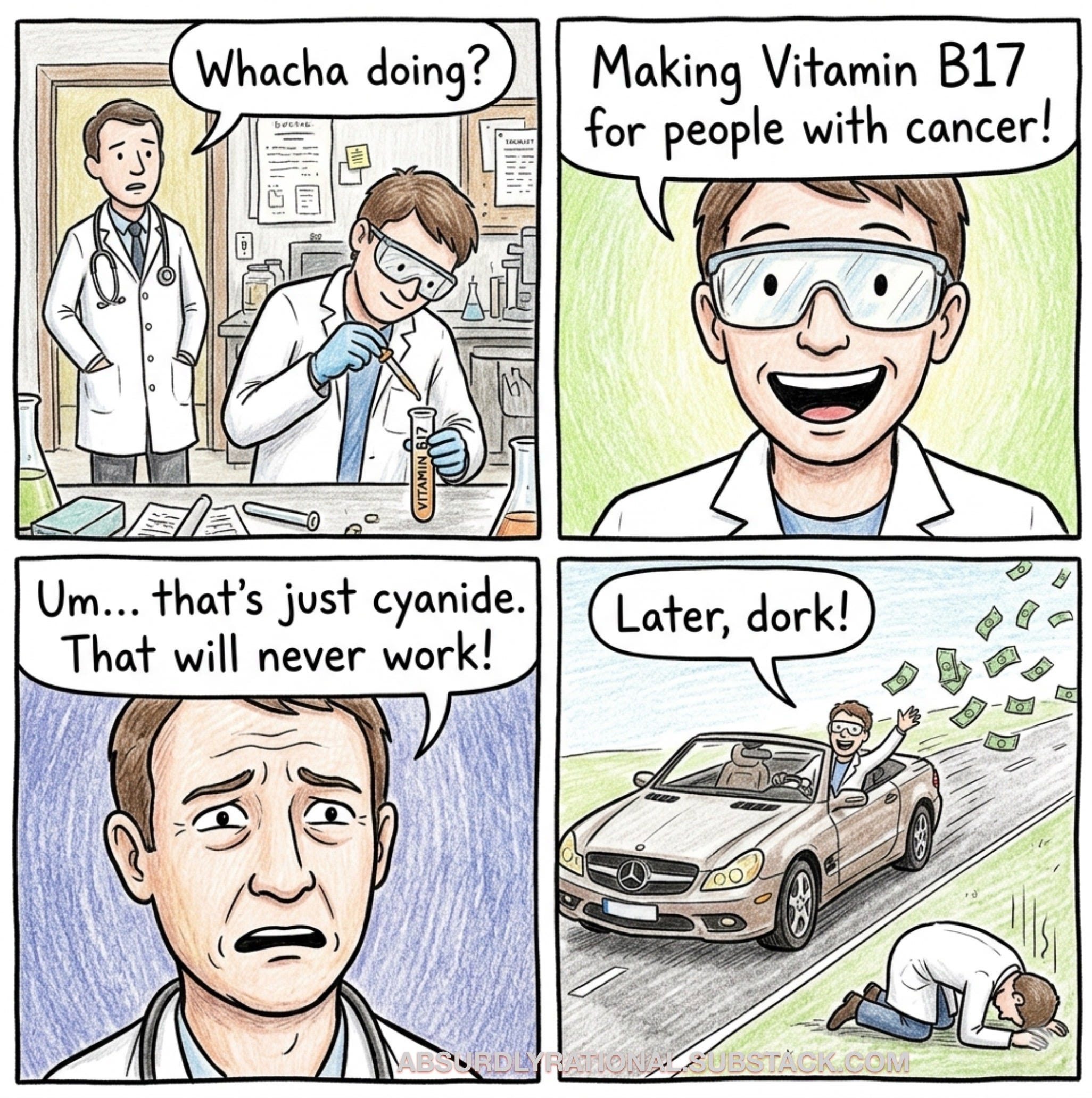
For perspective: vitamin B17 is not really a vitamin, it’s actually amygdalin -which is really dangerous. It comes from the pits of stone fruits, and is rich in all-natural cyanide. Yes, it has been marketed as an alternative treatment for cancer, and no it doesn’t do anything other than kill you by way of cyanide poisoning or avoidance of effective cancer therapy. But… selling amygdalin grows the economy, and its use preserves the rich cultural history of alternative medicine, so everything is cool, right?
Unfortunately, the medical profession, society at large, and the government have all agreed to disagree on the assertion that harming people with foolishness and false advertising should be against the law.
Cruising by the chiropractor’s office looking for the police
As a young child there was a house on the way to our local grocery store that was re-zoned into a chiropractic clinic. Nothing changed about the house itself, other than a sign added to the front yard that read: “Dr. Cracker, Chiropractic.” The fact that it was still just a house in a residential area that paved its lawn over for parking was weird to me as a child… I mean, where would his kids play? The asphalt? Lame.
My mother, an elder Boomer who grew up in the projects of Lynn, Massachusetts was far more bothered, and in an entirely different way. Whenever we drove by the house of skinned knees, she would exclaim:
“Chiropractors! Quacks! When I was a kid, it was ILLEGAL to do that crap in Massachusetts!! They all got sent to jail!”
To which I usually thought: “Wow. Why go to a school that’s just gonna send you to jail?”
I mean…I was only 6 years old -the internet hadn’t been invented yet, and “sending chiropractors to jail” wasn’t a subject in my discounted home-encyclopedia set. I just accepted the incarceration information -but remained worried about their kid’s lack of a proper yard, and somewhat disappointed that we never drove to the grocery store when the cops were perp-walking the chiropractor. What are the odds?
As the Earth’s datasphere matured, I was later able to confirm my mother’s angry tale and broaden my understanding of it. Chiropractors and many other practitioners of alternative medicine: homeopathy, acupuncture, faith healing, even non-pseudoscientific arts like midwifery and osteopathy (the latter of which was sketchier a century ago, but is now 100% legit) were historically arrested for practicing medicine without a license -up through the 1970’s in some states.

Like any draconian policy, this was both good and bad. It was bad because it felt oppressive to people who gravitate to the peculiar for any number of personal reasons. You can’t very well get your aura massaged if your energy healer is eating prison meatloaf. It also elbowed out a handful of legitimate practices.
But… it was good because it prevented the creepy high school dropout who lives alone at the end of your street from nailing a sign to his front door that reads: “Gynecologist.”
It’s important to be able to validate who your medical professionals are, and what they have done to deserve their title… especially if it’s nothing. In fact, studying nothing (like your neighbor) is no more valuable a medical commodity than the exhaustive study of a completely fictional field (like homeopathy), so licensure was important in determining what the degree actually meant; just having one is not enough. The point was to keep both lazy and highly-accomplished grifters out the pool of prospective practitioners that the average person may not realize are dangerously useless in matters of personal health.
So what happened?
Why can I find people in business who will give me detox-diarrhea via laxative-laced juice for my festering brain cancer, and precisely none of those people will see the inside of a jail cell? Isn’t that “practicing medicine without a license?”
Yes. But the state deduced that putting people in jail costs money, and licensing the people you were putting in jail makes money!
So they formed licensing boards for nearly anything but your neighbor’s women’s health center -but there still might be a state accountant somewhere who thinks failing to capture this abusive sector of the economy is just leaving money on the paper-covered table.
I favor greater restriction, but no one cares -so now it’s incredibly difficult to be arrested for practicing medicine without a license because our society and government are both tolerant to almost any kind of pseudo-medicine if they first register with the state.

Karl Popper wrote about the paradox of tolerance in the 40’s as it pertains to society losing its freedoms to authoritarianism by being tolerant and accepting of intolerance. He argued that tolerance should be extended to most (but not all) on the grounds that irrationally intolerant mindsets would usurp power by way of being tolerated, and lead to an overall loss of tolerance once they assumed control. Totally crazy and unrelatable at this moment, right?
I would argue that this same phenomenon is in play within the collective sphere of what can be considered alternative medicine -because almost anything goes no matter how far-fetched, including unfounded claims of parity or superiority to scientific medicine. The state has gradually become universally tolerant of ever-more ridiculous notions packaged as alternative medicine.
Why? A number of reasons related to tolerance and greed. Let’s enumerate tolerance first:
For government: everyone is equal under the eyes of the law (true), ergo everyone’s ideas are also equal (false). This conflation allows sustained belief in the effectiveness of alternative medicine relative to rational medicine because human attention spans are too short, and medicine too complicated, and culture too touchy a subject to appreciate bad outcomes months or years after the fact that faith healing didn’t cure someone’s leukemia. All ideas are not equal.
Consider that the state would never license “alternative garbage collectors,” who pray, or adjust, or dilute the trash away, but this same scrutiny is not appreciated by law or government when it comes to biology, where pathology grows like untended garbage.
The designation of a separate space: “alternative medicine,” gives actual medicine the illusion of a clear conscience to ignore the antics of their crazy neighbors. Medicine generally tolerates alternative medicine because -we aren’t responsible for it. “It’s not in my yard, so it doesn’t affect me” we tell ourselves… until someone rolls into the hospital in florid heart failure after chelation therapy. Or with an inoperable tumor that could have been cured if they didn’t try homeopathy until it was too late. These antics inevitably end up in our yard.
In the 90’s, medicine began to invite alternative medicine into its halls -not for study, but as a cultural sensitivity exercise. Esteemed institutions added “complementary medicine” to their offerings, which is just alternative medicine paired with real medicine. But just as religion or culture is taboo to question, medicine never scrutinized the alternative components the way they did the scientific. That was a grave error, because it legitimized a great deal of worthless bullshit, and muddied the waters of reason. These are issues we still suffer from today -decades later, as the general population (now conditioned against separating science fact from fantasy), is inundated with an unending stream of medical disinformation on social media. Shame on my predecessors for their naive tolerance of repackaged snake oil.
Unfortunately, there is always more than verifiable fact and dispassionate logic at play in any human endeavor. Greed has as much to do with this as naiveté:
Government benefits greatly by sanctioning cultists and cosplayers to practice alternative medicine. No one goes to jail for free meals, any citizen can exercise their right to die of magical thinking, and importantly… the state collects licensing fees, surcharges, and taxes on sales, property, and income in the creation of a new sector of the economy that exchanges imaginary cures for real money.
Medicine is not innocent of greed in this either. Complementary medicine was devised as a way to capture a part of the medical market that was escaping clinics and hospitals, into the pockets of independent snake oil salesmen. By employing said purveyors of snake oil, additional revenue was captured by legitimate medical institutions to offset charity care or… to put marble on their walls -whichever was deemed more noble at the time.
Tim Minchin famously said in 2011: Alternative medicine that is proven to work is just called “Medicine.” And he’s right. Medicine needs to dispassionately study every path and possibility to health and against disease. That includes the study of alternative medicine, because the early history of medicine was a few lucky natural remedies imbedded in a tapestry of poison, injury, and elaborate rituals that didn’t work (but made people feel slightly better as they suffered and died). Scientific medicine (ideally) strips away the bullshit, figures out what works, refines it if possible, and uses just that which is safe and effective without pride or ego, so that even newfound cures can be dropped abruptly upon the discovery of something even better.
Andrew Weil criticized science-based medicine for being too insular and unaware of other cultural medical practices, which is valid. Looking down on cultural medical practices is arrogant, and blinds us from the discovery of unexpected cures by way of hubris. Absolutely nothing should be spared from scientific scrutiny.
Unfortunately, having an open mind can backfire if you can’t bring yourself to discard that which is useless or harmful out of fear of being insensitive or intolerant. We should strive to be tolerant, but we should never tolerate irrationality in medicine.
Thanks to the many good works of children’s museums, everyone assumes that science is warm and welcoming -but it’s not. The real work of science is cold and harsh specifically because it must eject heartfelt fables no matter how much cultural or emotional baggage has been attached to it.
But… patients want it! We must care for whole patient!
We take care of the whole patient every time -unless the patient shows up with a traumatic amputation. Then we take care of both pieces of the patient unless the smaller piece can’t be saved. This wellness platitude of wholeness is pure marketing nonsense.
As for needs, people want many things that they don’t need. Money they didn’t earn. A steady supply of recreational drugs. Their neighbor’s spouse. The list is very long, but nicely illustrates that wants are not needs.
This is why Dr. William Mayo’s 1910 commencement speech at Rush Medical College in Chicago, came to be the motto of the Mayo Clinic:
The needs of the patient come first.
Needs, not wants. The patient might want bourbon and smoked ribs before surgery, and they may insist they want their surgeon to be a white man with a little gray hair at his temples, but that isn’t what they need. They need to fast before surgery, and to have it done by most qualified surgeon who may or may not anywhere near to those demographics.
Needs are physiologic, and wants are not. You want to vape, but you need oxygen. You can have both, but interesting things happen when you withhold one or the other:
Withhold your wants… you get crabby without your vape.
Withhold your needs… you quickly die of anoxia. Oops.
This is the simple litmus test of how scientific medicine prioritizes action.
No one needs alternative medicine -they just want it. If you close every homeopathy clinic in the world for a decade, no one will die as a result. Some will suffer emotionally, but none will suffer physiologically. Conversely, if you closed every ER and operating room for 1 day… millions would die, and many more would suffer physically.
So in this sense, any equivalence drawn between medicine and alternative medicine is just… absurd. Medicine is a necessity, and alternative medicine is simply a service that satisfies emotional demands.
Brah, you are starting to sound arrogant…
I know, but I’m not apologizing because it’s objectively true, and it brings me to my final point: Alternative medicine absolutely kicks the shit out medicine in one key area:
Time, empathy, and active listening. The stuff that builds rapport and connection between a patient and their caregiver.
This is the lifeblood of alternative medicine. They spend more time talking and listening to their patients, and that builds trust and joy. Sure, those herbal supplements may not be doing much for your multiple sclerosis (which might just be stable on its own), and there was that one time your chiropractor used hammer and a dowel in your butthole to “adjust” your coccyx, but DAMN are they sincere and unhurried listeners!!
For all of the cures that medicine has shamelessly identified, appropriated, and improved from alternative medicine, time and attention remain elusive. This frustrates me because we know that it has real effects on outcomes: diagnoses are more accurate, patient compliance with therapy improves, and particularly in the case of alternative medicine, patient satisfaction is enhanced to the point of maximizing the placebo effect of whatever treatment (real or sham) has been prescribed. We really should be chasing that placebo effect much harder than we are.
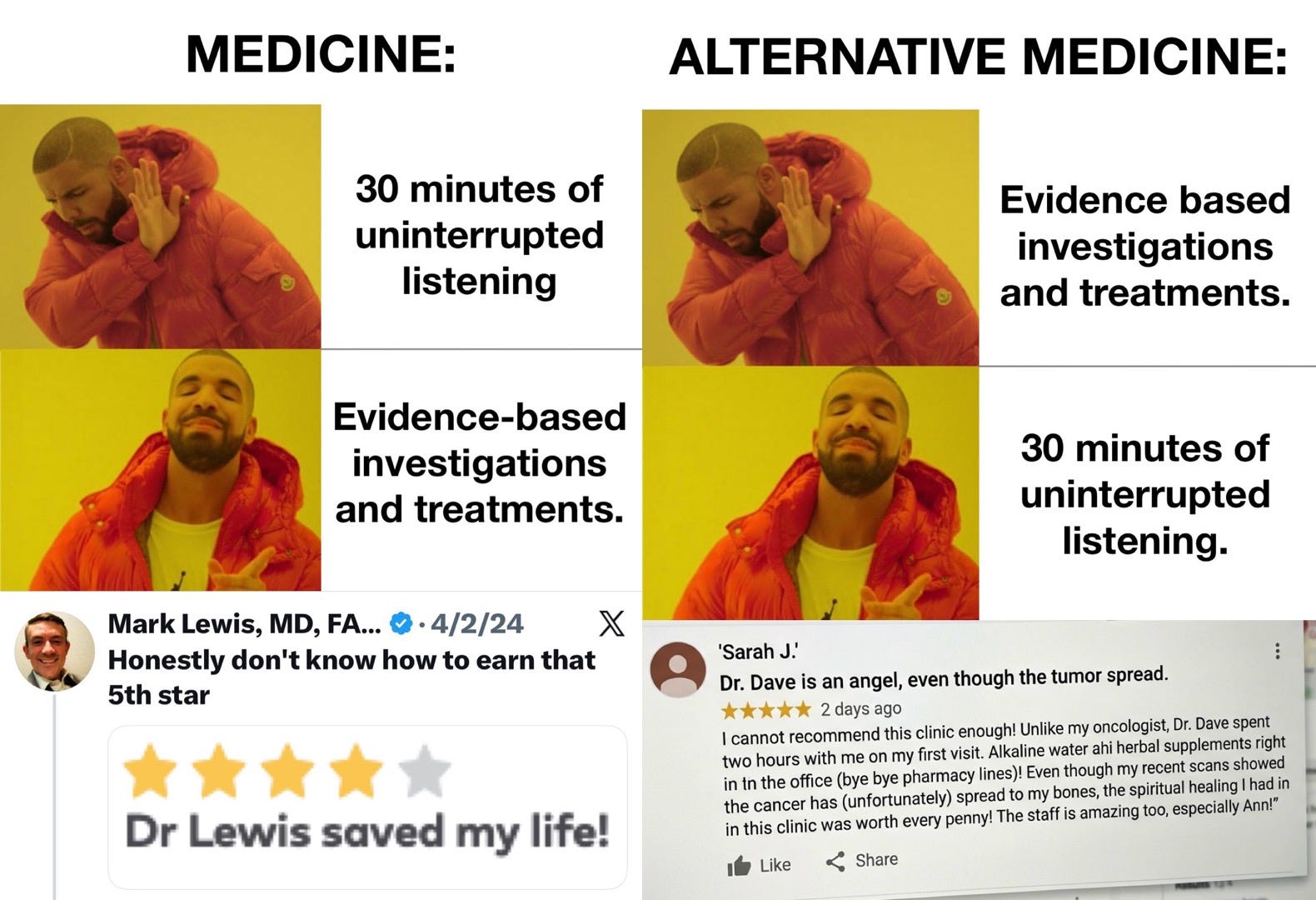
I would assert that establishing a better human connection between patient and physician is in fact a need (as much as a want), and regular medicine is failing to address it as well as we should.
There are many reasons for this ongoing failure:
time constraints from the growing shortage of physicians (if you are struggling to see one, they are struggling to see everyone who wants to see them).
time and ethical constraints from the corporatization of medicine (lawyers and alternative health practitioners bill by the minute, but physicians can only bill by the encounter. Thus, our reptilian overlords want more visits, which demands fewer minutes per patient encounter, regardless of outcomes).
impaired ability to connect for any number of systemic reasons (moral injury, production pressure, etc). Be A Health Architect writes extensively and well on these if you want to learn more.
But this critical issue remains an area ripe for tremendous improvement. I do not profess to have a comprehensive solution to what amounts to a widespread problem, but I trust the nature of scientific medicine and the benevolence of my fellow physicians to make improvements incrementally over time, even when other forces (notably, those who employ physicians) directly impede such progress.
Please don’t let our failings push you into the rabbit hole of woo-woo. We are working on it.
No posts
Comments
Nothing yet. Say the first thing.
Sign in to join the conversation.