
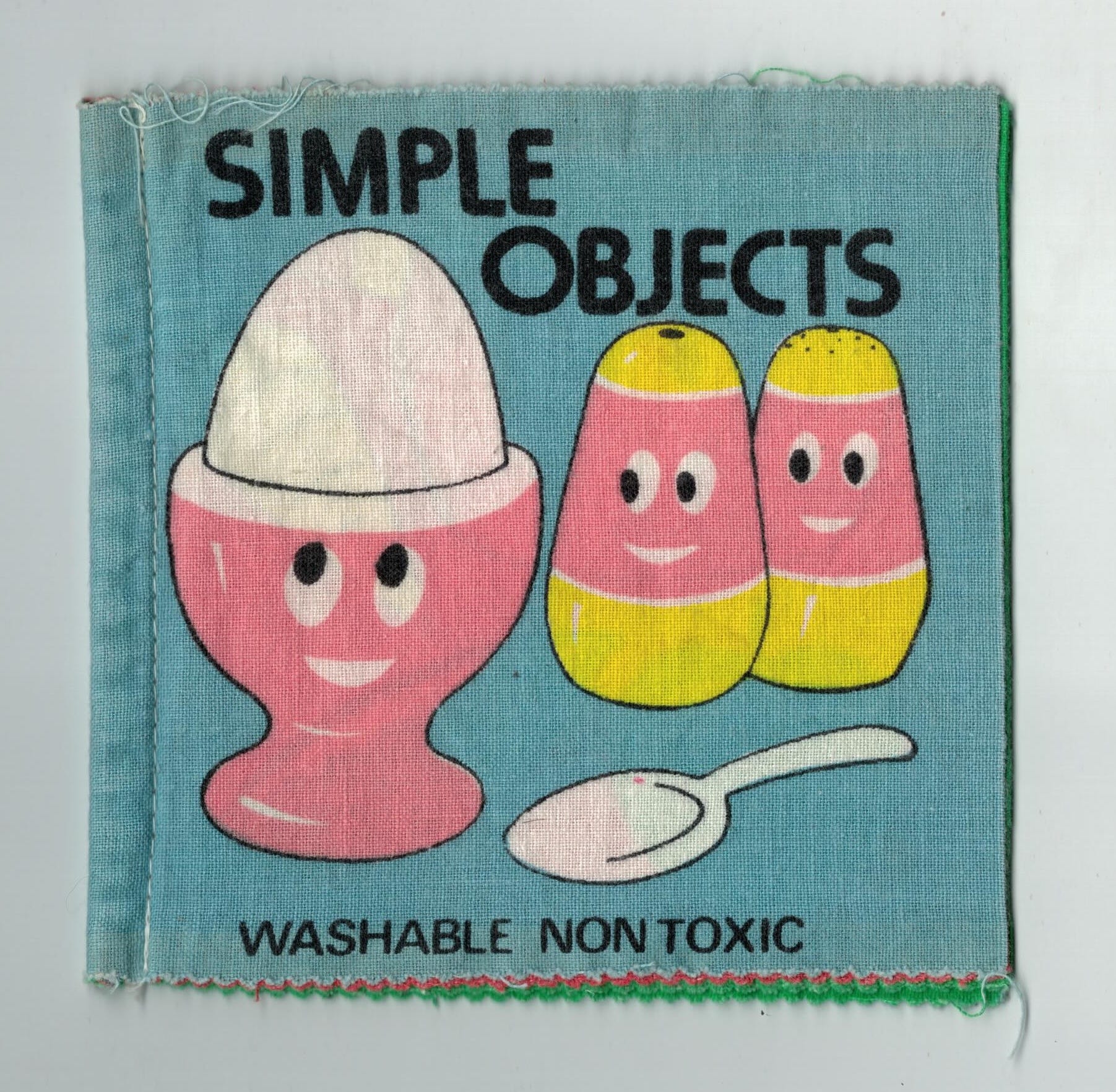
Cloth books were first mass produced in the UK at the turn of the 20th century. They were conceived as books for babies — washable, indestructible and hygienic — designed to survive a baby’s love and aggression and pose no risk of harm in return. Of the cloth books I have bought over the years, the ones I like most are soft and thinning with use, their zig-zagged edges fraying — loved, perhaps, as a baby might love a blanket, or any other object discovered and held for comfort.
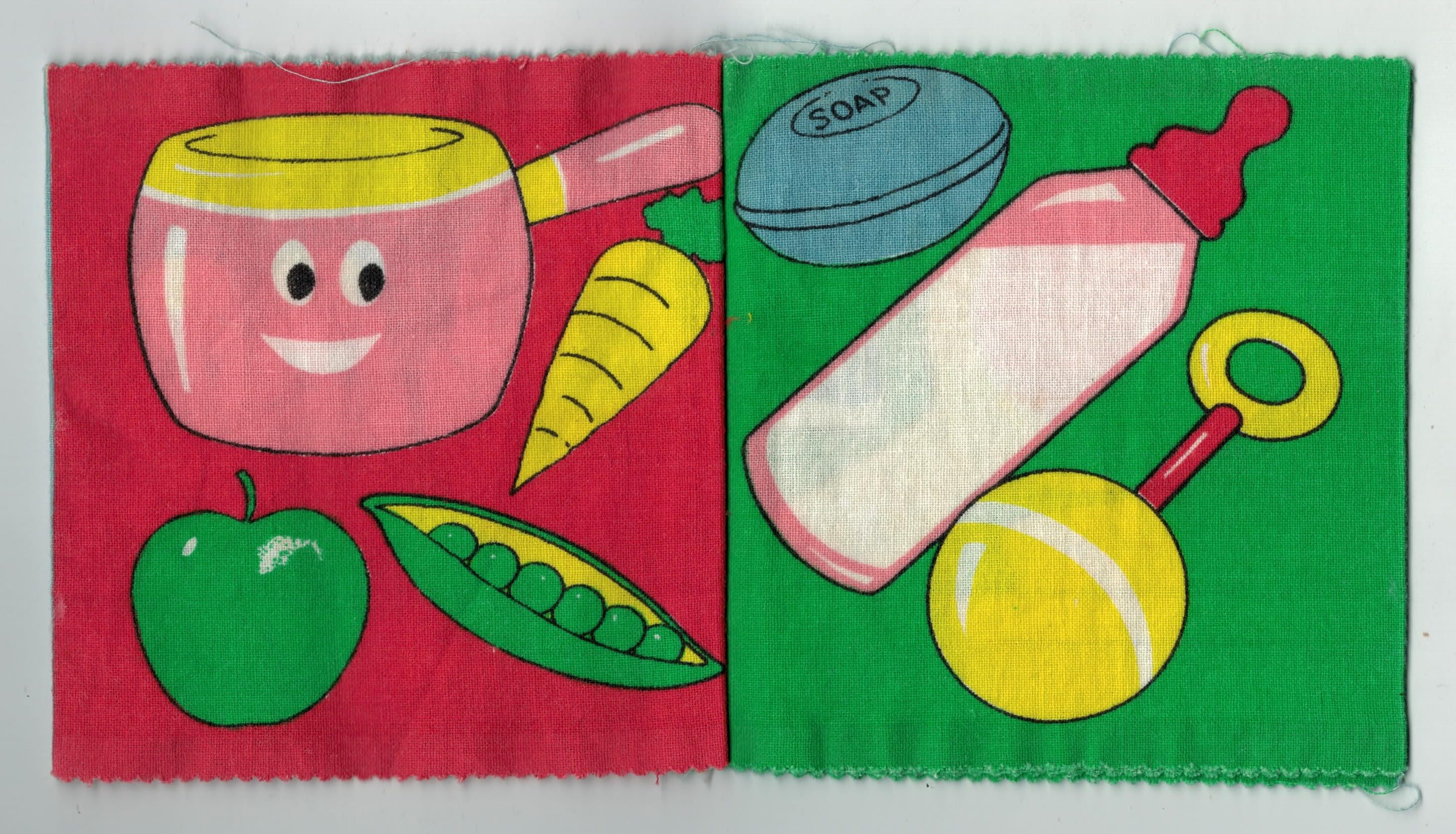
For this book, Simple Objects, there is no publication date and I can’t find anything concrete about the publisher, ‘SP Toys’, with their vulture logo, but it is ‘made in England’, probably in the late 1970s. It’s about the size of a CD case with between two and five objects per page, grouped roughly according to domestic use. They include an eggcup, an egg, a mirror, a slipper, a turnip, a saucepan, a pod of peas and a toy. There is no foot to fit the slipper, and we do not know what will go inside the cup and bowl, what combination of peas, turnip or apple might fill the saucepan.
Walter Benjamin talks in ‘A Glimpse into the World of Children’s Books’ of ABC books showing a ‘higgledy-piggledy still-life that seems very mysterious until you realise what is happening and what…Anchor, Ark, Arm, Armadillo…are all doing in the same place.’ Simple Objects is not an ABC book; the choice of its objects is not alphabetical. There is no obvious logic beyond their relating to activities presumably familiar to a baby; they are chosen because they are ‘simple’ according to an unknown metric of simplicity.
Of all the items, only the eggcup, salt and pepper shakers, saucepan, bowl and cup are personified. It is unclear what causes these objects to smile whilst the others remain the thing itself. Why do some things read as surface patterns and others as a sign of something going on inside — a consciousness that can be recognised? Perhaps the book is about how we understand the difference between a person and an object and how we learn to see ourselves and, crucially, outside ourselves. (Cloth or ‘sensory’ books made nowadays often include an actual mirror for a baby to see themselves — there is no face in the mirror from Simple Objects.)
My reading of Simple Objects is one of displaced intimacy. It makes me wonder at the connection between a baby chewing on a rag and an adult finding pleasure in a text. Benjamin describes how children know the pictures in ABC books ‘like their own pockets; they have searched through them in the same way and turned them inside out.’ He is also famous for the aphorism that books (‘and harlots’) can be taken to bed. He draws attention to the ways in which a book can be experienced as closely as a hand knows its pocket, or as we might come to know the body of a person in bed beside us. Simple Objects might have been known this way too: mouthed, searched; frayed.
**
Esther Sorooshian and Florie Harding run Token Books around their work across archives and libraries, collecting printed material that interests and moves them. They source and curate libraries for projects and exhibitions, including collaborations with Reference Point, The Face, and Emalin Gallery. Simple Objects, a cloth book, is available from Token Books.
No posts
Comments
Nothing yet. Say the first thing.
Sign in to join the conversation.