
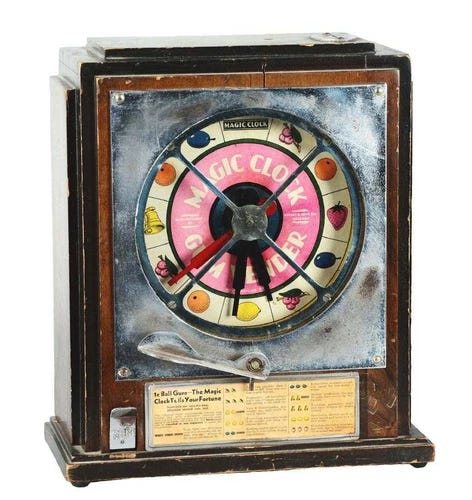
The Magic Clock Tells Your Fortune is the promise of this chipper, desk-scale 1930s gumball wishmaker. The seller’s description clarifies that ‘the mechanism loks [sic] to be clean however it is not working.’ Perhaps its fortune-fulfilling days are over – and perhaps that’s a good thing.
The clock brings to mind Curry Barker’s viral new horror Obsession (2026), in which a thwarted young man called Bear wishes, using a ‘One Wish Willow’, that his co-worker Nikki would ‘love him more than any more than anyone else in the world’.
When Bear’s wish comes true, the pleasure of realising a fantasy of possession is slowly replaced by all kinds of pain – mostly induced by a rabidly love-stricken Nikki, whose soul has been kidnapped by numinal forces behind the ‘Willow’.
We suspect that what Bear wanted from Nikki as he made his wish was not something he had chosen freely: wishing on the basis of a want that wasn’t quite his own. This sense is enforced when Bear shares an intimate moment in a car with Sarah, another co-worker who loves him and whom he seems to love – in a truer but remoter part of him.
When Sarah’s head is summarily clarted against the steering wheel by a maniacal Nikki, we – adrenal glands pumping – regret Bear’s earlier failure to elect higher, wish-worthy suggestions from his chaotic wants.
Barker’s story reveals how poorly we understand the things we think we want; we are – tragically, truthfully – mostly unfit candidates to be granted wishes. Maybe, part of the danger lies in our ability to distinguish wishes from wants; or to formulate wishes properly out of our wants.
What is the difference between a wish and a want? The word wish can be traced all the way back to the Proto-Indo-European wenh, which also, interestingly, meant ‘to love’. Want, until very recently, exclusively meant ‘to lack’ or ‘to be deficient in something’. We are found ‘wanting’. Of course we are.
We want all kinds of things, in ways we can and can’t control. Who knows where some of these wants come from? A wish, contrastingly, is something more developed. To wish contains a sense of striving, longevity; something cherished, something compacted by experience.
Why is it that people have always created playful wishmaking apparatus like this gumball-wishmaker from the 1930s? Is it that we need opportunities to practice our wishing – blowing out candles, 11:11? Yearly and daily rituals like these suggest so.
Obviously, we want this all-powerful gum dispenser. To acquire the beautiful magic clock and fix its faulty mechanism – easily done by ‘someone who knows’, the seller tells us – would present a nice opportunity for some wishing practice. Though if we do get it humming, it might be our turn to formulate our best effort – or make our mistake.
We have agreed between us to wish for a billion pounds: sixty-six percent for charity, the other thirty-three for the Knightsbridge Abscondita Megaplatz.
**
This Keeney and Sons Fortune Teller Magic Clock Gumball Machine is available from eBay.
No posts
Comments
Nothing yet. Say the first thing.
Sign in to join the conversation.