
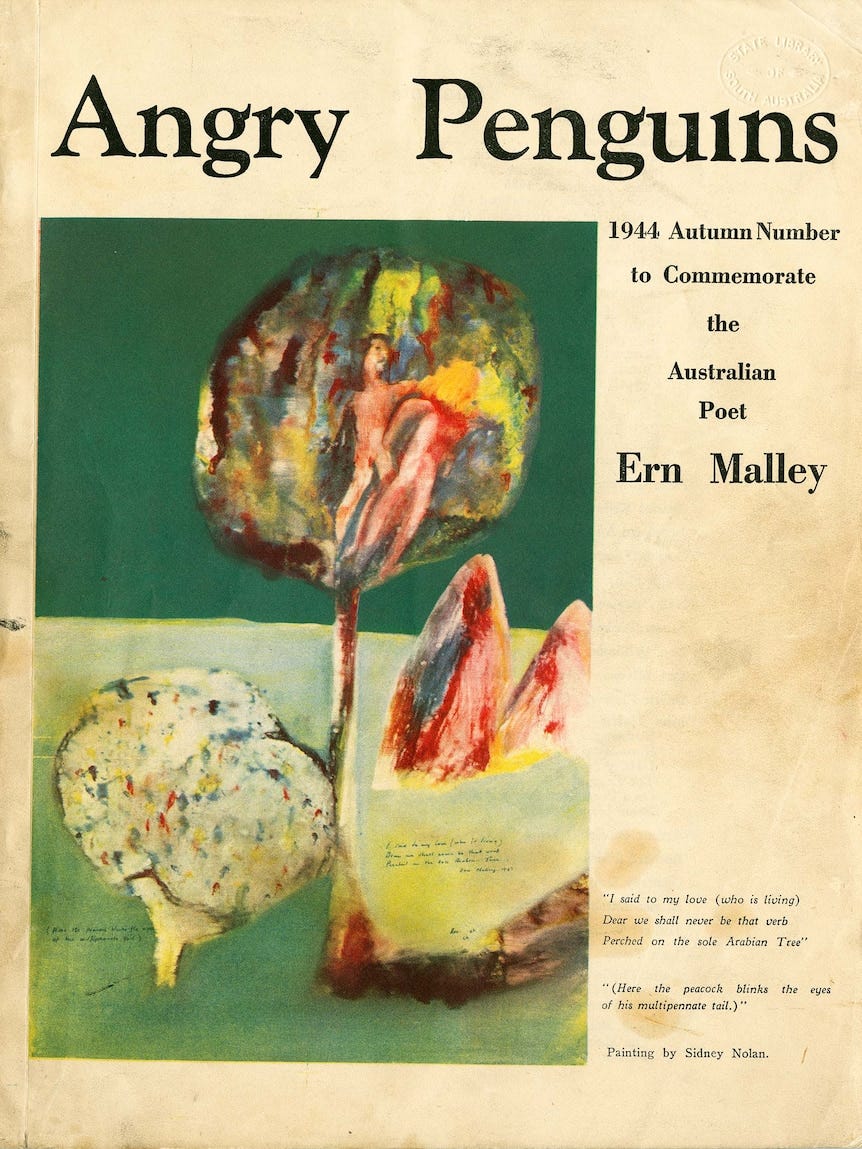
This 1944 edition of the Australian literary journal Angry Penguins – produced to commemorate the mysterious late poet Ern Malley – opens with his poem “Boult to Marina” and its oracular but equivocal first line: ‘Only a part of me shall triumph in this.’
The deceased Malley went on to gain minor cult status, and his poems were reprinted multiple times. His work anticipated a set of questions that dominate literary discourse today. If Malley himself was never aware of his own significance, that’s because he wasn’t a real person.
Malley was a hoax. He was invented by James McAuley and Howard Stewart, two writers who sought to undermine the sloppy and listless tendency they thought ran rampant in modernist journals like Angry Penguins. It is said that Malley’s oeuvre was written in a single afternoon by the pair. They sent Angry Penguins’ editors a stack of his poems alongside a note from Ethel, his fictional sister. ‘It would be a kindness,’ they wrote in an affected, spindly hand, ‘if you could let me know whether you think there is anything in them.’
Last week, Jamir Nazir’s short story “The Serpent in the Grove” won a Commonwealth Prize and was published online by Granta. It contains many hallmarks of AI-generated writing, and some of its passages are borderline incoherent: ‘She had the kind of walking that made benches become men’. Even Jabir’s headshot looks a little too symmetrical and smooth to be completely real. Some have speculated that, like Malley, he doesn’t exist at all.
Online, writers’ reactions to Nazir have been indignant and disbelieving, but rarely anxious. Its accolade notwithstanding, it is cathartic to read a piece of AI-generated literature that is clearly worse than one’s own writing. The overtures for this author/non-author have mainly been contempt. Contrastingly, Malley’s work retained a not entirely insincere level of respect even after ‘he’ was revealed to be an elaborate prank on the Antipodean literati. The critic Robert Hughes wrote that in Malley’s poems, McAuley and Stewart, ‘had reached inspiration by the side-door of parody’.
Nazir is unlikely to be remembered as fondly. A comparison between his work and Malley’s raises questions about what kinds of literary authorship should be rewarded. There are many ways to lie to your reader – equally, there are athletes and couch potatoes of literary bullshit. What’s objectionable to many of us is the craven deference involved in his AI-assisted authorship.
Ultimately, this prescient edition of Angry Penguins points to a question about which types of literary authorship should be lauded. In the Malley case, there was a clear athleticism at play – even if a conniving one. If you’re going to play pranks, at least make them good ones.
**
This edition of Angry Penguins is available from The Little Shop of Books, Cootamundra, NSW, Australia, via AbeBooks.
No posts
Comments
Nothing yet. Say the first thing.
Sign in to join the conversation.