
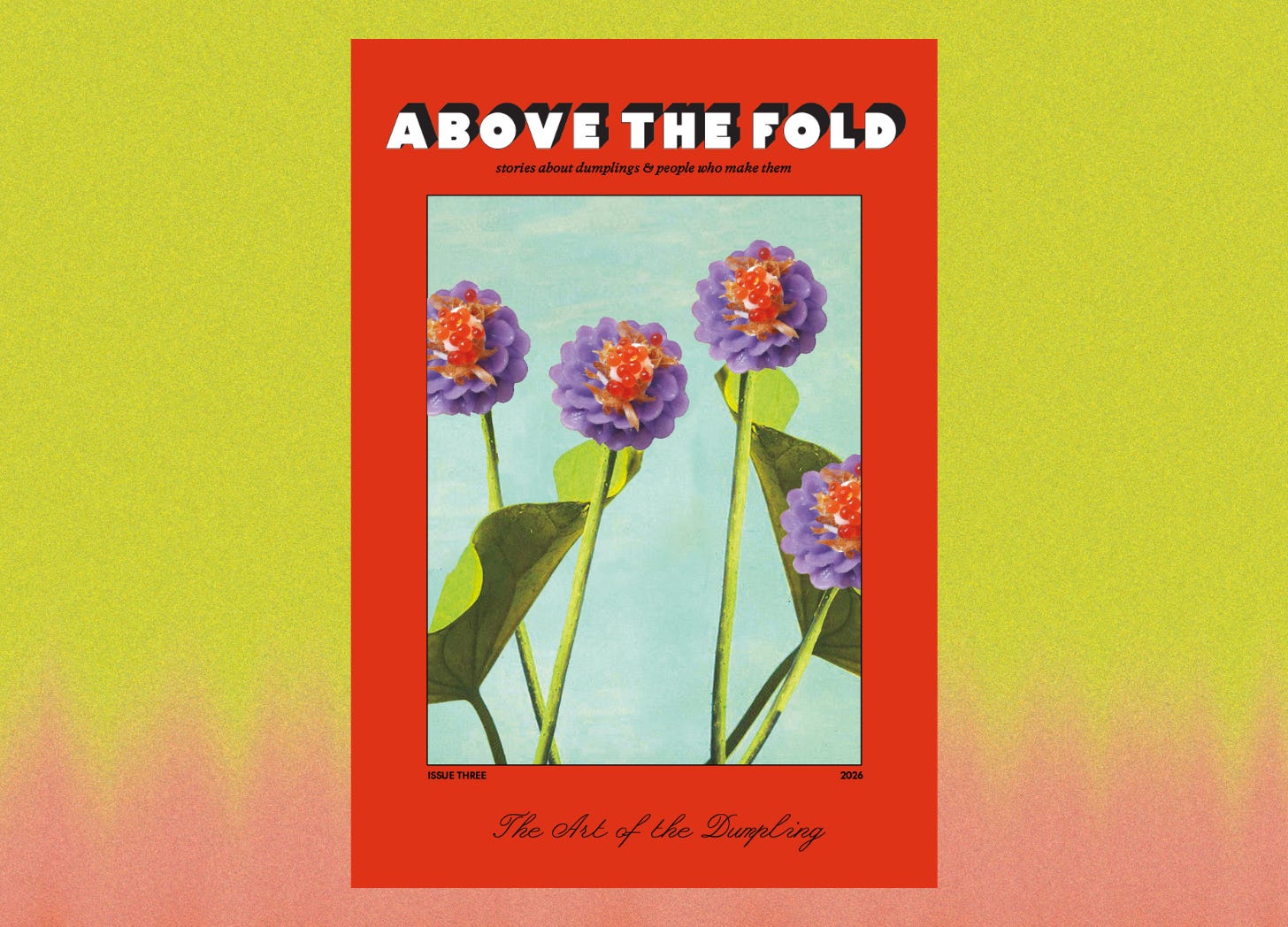
At long last, it’s here! (Or, to be a little more precise, it is almost here, but so close that you can actually order it!).
Introducing Above the Fold Issue 3: The Art of the Dumpling. The biggest issue yet, weighing in at 72 full-color pages. Pre-orders are now live—and newsletter readers are getting a 24-hour heads-up (as well as a 15% discount, with the code THEARTOFTHEDUMPLING). Orders will start shipping in early to mid-July.
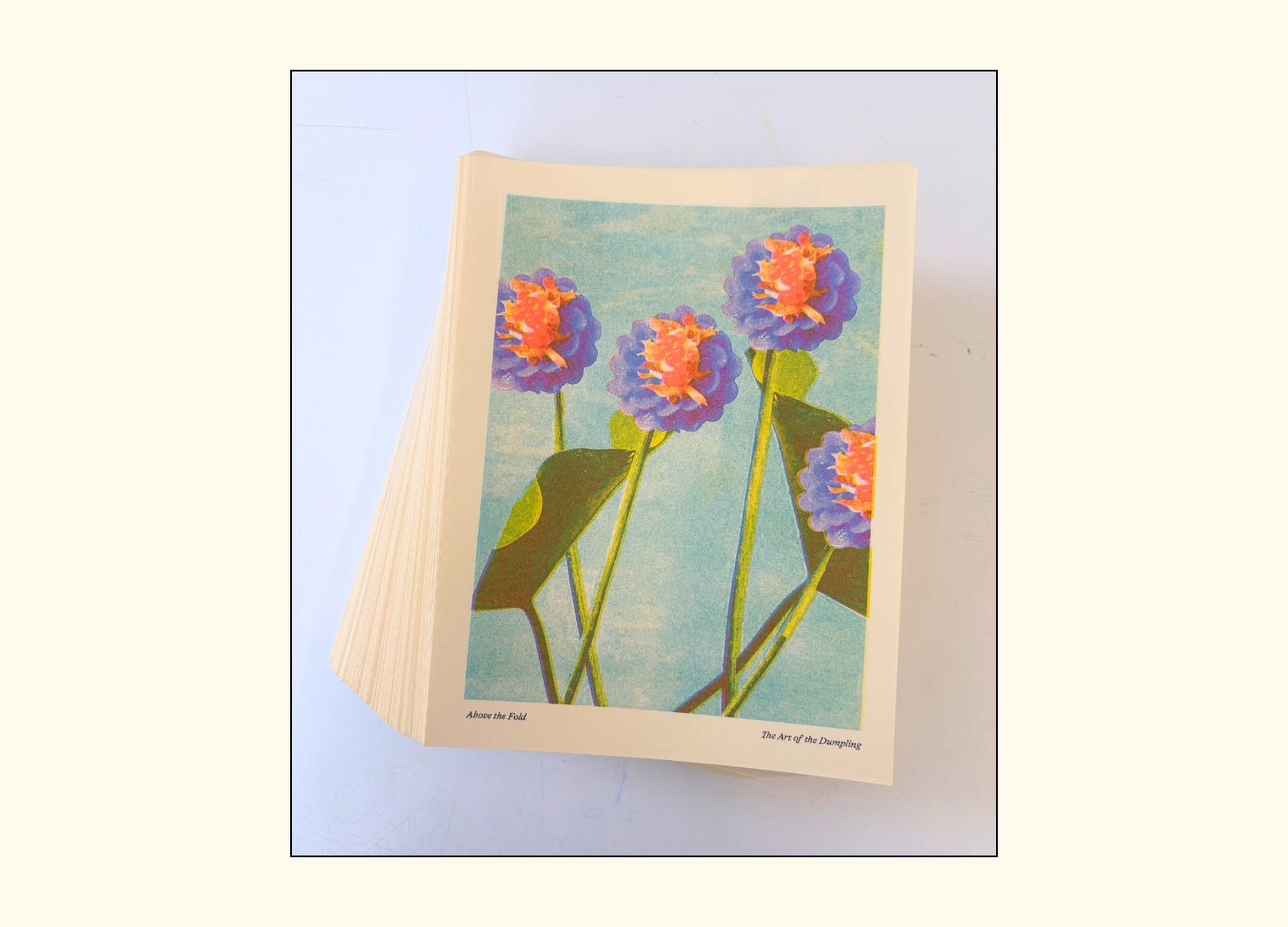
Pre-orders come with another fun bonus: A four-color, 6x8-inch riso print of the issue’s cover collage, designed and printed by yours truly (look closely at those flowers—they’re actually dumplings).
I’ve also made a (very limited) quantity bundle of all three issues of Above the Fold, knocking $10 off the list price for the set, and newsletter readers get first crack at that, too:
There is SO much more to say about what this issue is all about, and what went into making it. So for that, please read the issue’s welcome note, shared below in full.
This issue began with a question—can the dumpling be considered a work of art? Which of course, led to countless more: If so, what part makes it art? The finished product, in and of itself? The greater message conveyed by its creator, or how said message is received by others? The lifetime of discipline and repetition that made it all possible in the first place? If the finished product also serves a practical function, is it no longer art, and instead should be considered craft, or design? Is a quilt that actively warms a body a craft, and one that hangs in a museum art? A hand-thrown ceramic teapot that sits on a mantle as opposed to one that pours tea?
In hindsight, the idea that I could provide a definitive delineation between art and craft and design—and that it was ever necessary for me to do so—is laughable, if not delusional. Even more so was thinking that failing to do so would represent a failure in execution of the entire issue. Through the process of trying to seek answers to these questions, I learned that these were not the right questions to ask at all.
Ultimately, I wanted to understand the “everything but the eating” part of dumplings, underpinned by a belief that the expertise, intention, and careful attention to detail from the person who sculpted and folded them into existence before handing them to you is part of what makes them so special.
Because if dumplings existed only for the absorption of nutrients and calories,
numerous cultural practitioners wouldn’t have honed their skills over centuries to hand-tweeze them into flowers and birds or press them into hand-carved wooden molds, transmuting them into glistening tortoise shells. They wouldn’t carefully pleat them into plump, braided teardrops, stain them deliberately with saffron and beet juice and butterfly pea flower, or insist that they must be made so tiny as to fit 40 on a single spoon.
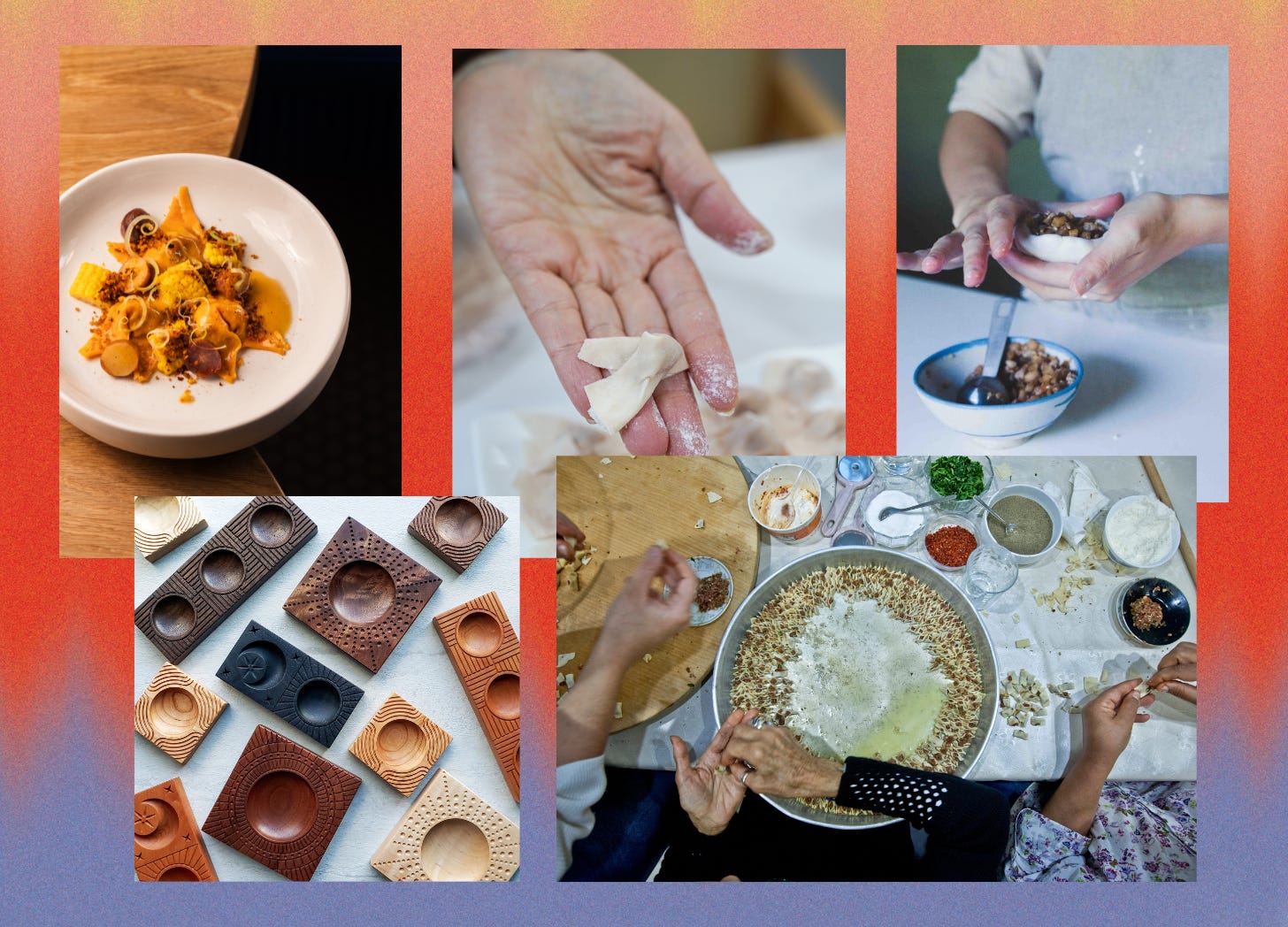
Can dumplings warrant contemplation solely as works of art, particularly if you never get to eat them? “Pleats Please,” the exhibition-in-print you’ll find on page 29, imagines what would happen if dumplings were shown in a gallery setting, instead of consumed. I asked many of the makers of the dumplings shown both here and throughout the rest of the issue if they considered their works to be art, and the answers were wildly inconsistent, ranging from “absolutely” to “sure, why not?” to “that wasn’t really the point” to “fine, but only if all dumplings, regardless of how aesthetically intricate, are also considered art”—implying that labels shouldn’t be used to separate creations into classed categories.
What binds all of these makers is not that they set out to create something that could be labeled art, but that they wanted to make something with passion and a point of view, and worked tirelessly to realize their vision and to share their labor (and its yield) with other people. Self-expression in defiance of classification is best articulated by the work of artist aisha tida, interviewed on page 54, whose social practice project Diaspora Dumplings exists in part to interrogate and celebrate multihyphenate identity and ways of being. While the classification of dumpling can unify a multitude of perspectives within one genre of food, it also can become a misleading, flattening catch-all, which Kiki Aranita examines in the essay on page 45.
Aranita’s essay also explores what happens when you’re making dumplings to be consumed in the afterlife, for a loved one who has passed away. In this scenario, as in many others, the gathering that precedes the ingestion is a critical part of the process. On page 13, you’ll meet two artists in different parts of the world who both rely on dumplings as an integral part of performance art, situating the act of making and sharing them as a form of communal theater. And on page 60, learn how a nonprofit in Istanbul united a disparate group of people for the cause of fighting censorship by making a whole lot of manti together and then publishing a newspaper about it.
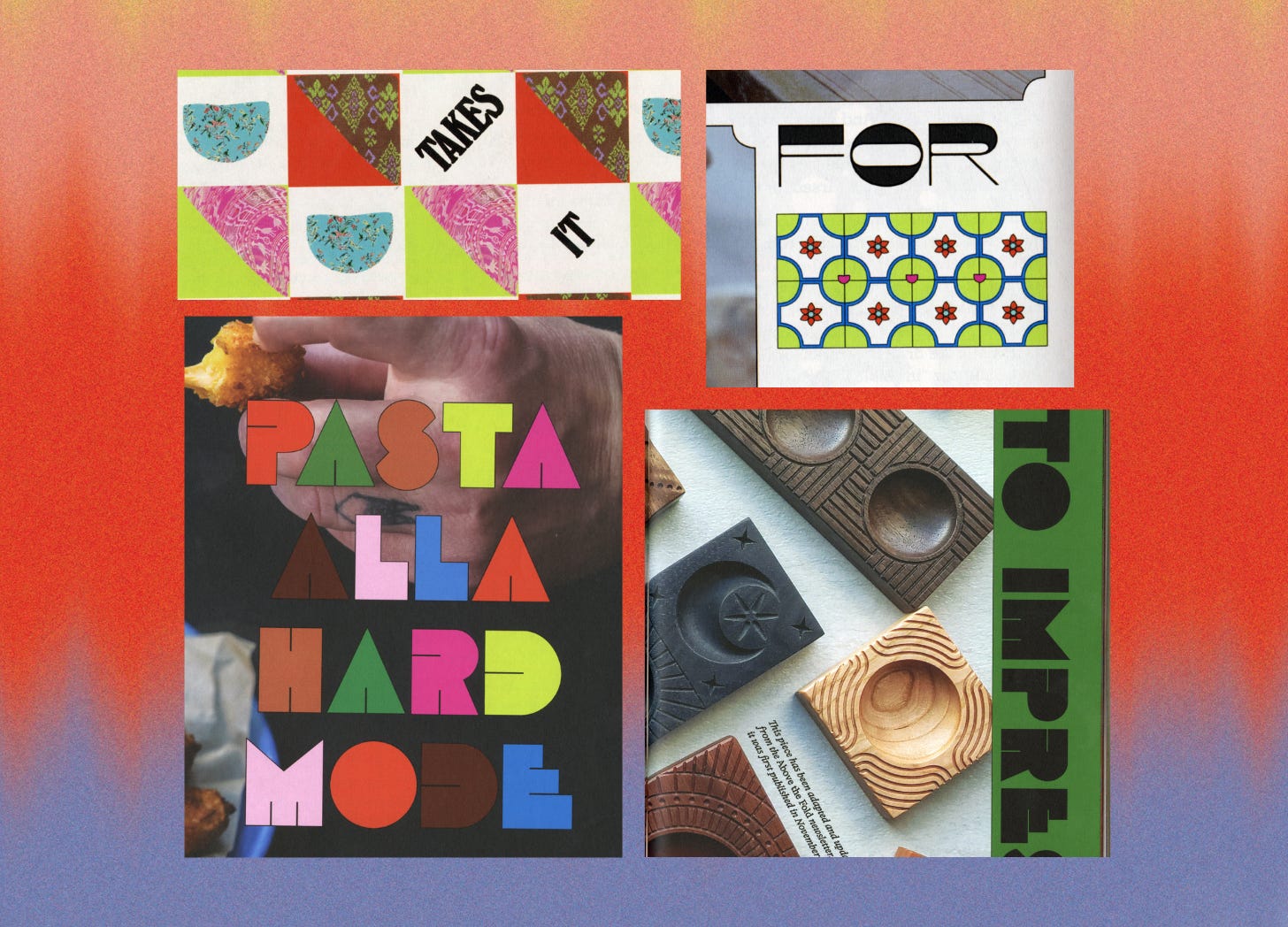
I’ve worked as a writer and an editor for long enough to know that the process is messy, fraught, and mentally laborious. Pieces require honing and shaping, bringing in fresh perspectives and new eyes to contribute critical new directions and poke holes that need poking. And yet, when I read a beautifully written and designed feature in another publication, where the prose is tight, the thesis is tighter, and the visual expression is perfectly calibrated to the message, I still can’t help but think that the author knew exactly what they were going to do, sat down, and wrote the piece top to bottom in its finished form, while the visual layout sprung fully realized from the designer’s mind at once. For this issue, that couldn’t be further from the truth.
There’s been a whole lot of thinking, and mulling over, and effort. Pieces have been written and rewritten. Layouts have been designed and redesigned. Conversations have spanned many months. Holes have been poked, and then refilled, yet I’m sure there’s more to investigate. What you’re holding reflects the moment where I had to stop the process and send the issue to the printer, but the work could truly last in perpetuity. The questions from where this issue began will remain unanswered, but I’m learning to find satisfaction in the knowledge that the process of exploring them was far more important than ever reaching a conclusion. —Leah Mennies, Editor
Above the Fold was created by Leah Mennies.
Comments
Nothing yet. Say the first thing.
Sign in to join the conversation.