
Welcome to Above the Fold, home to stories about dumplings and people who make them! Issue 3 print zine orders are now live for pre-order. Learn more here.
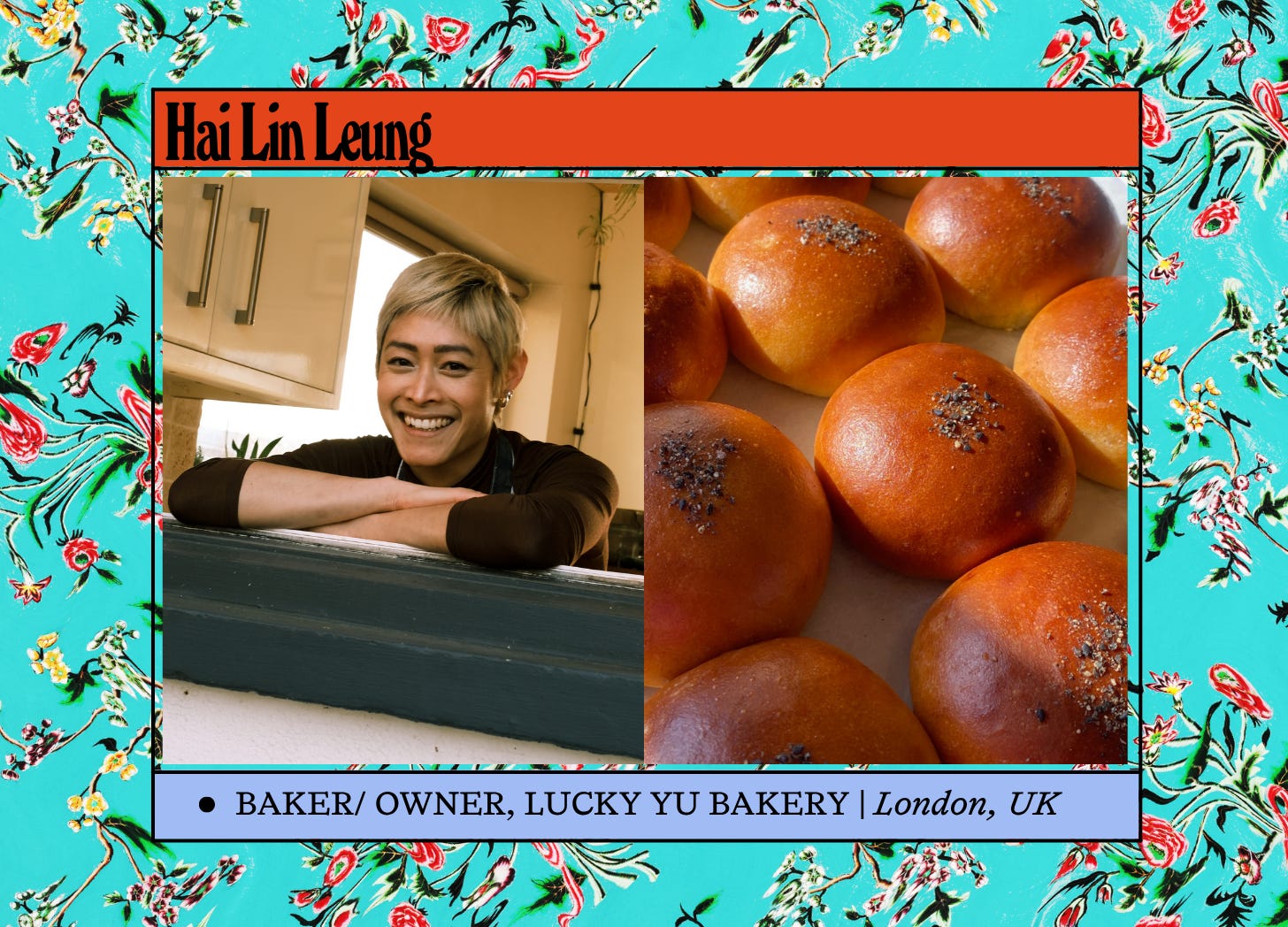
It’s common knowledge that baking is a science. Which might explain why bread-baking, specifically, became Hai Lin Leung’s preferred way to unwind while also studying for her medicine and surgery degrees. “It's kind of a slower cycle than making cakes or pastry, which is what's so tantalizing,” Leung tells me now, over a decade since baking her first loaf, and three years into running her own Cantonese/British microbakery, Lucky Yu, from her home in London. “You've got this degree of suspense. In theory, it's a very simple thing, but there are so many different ways to flex the variables to get different results, and I think that's when I got hooked.”
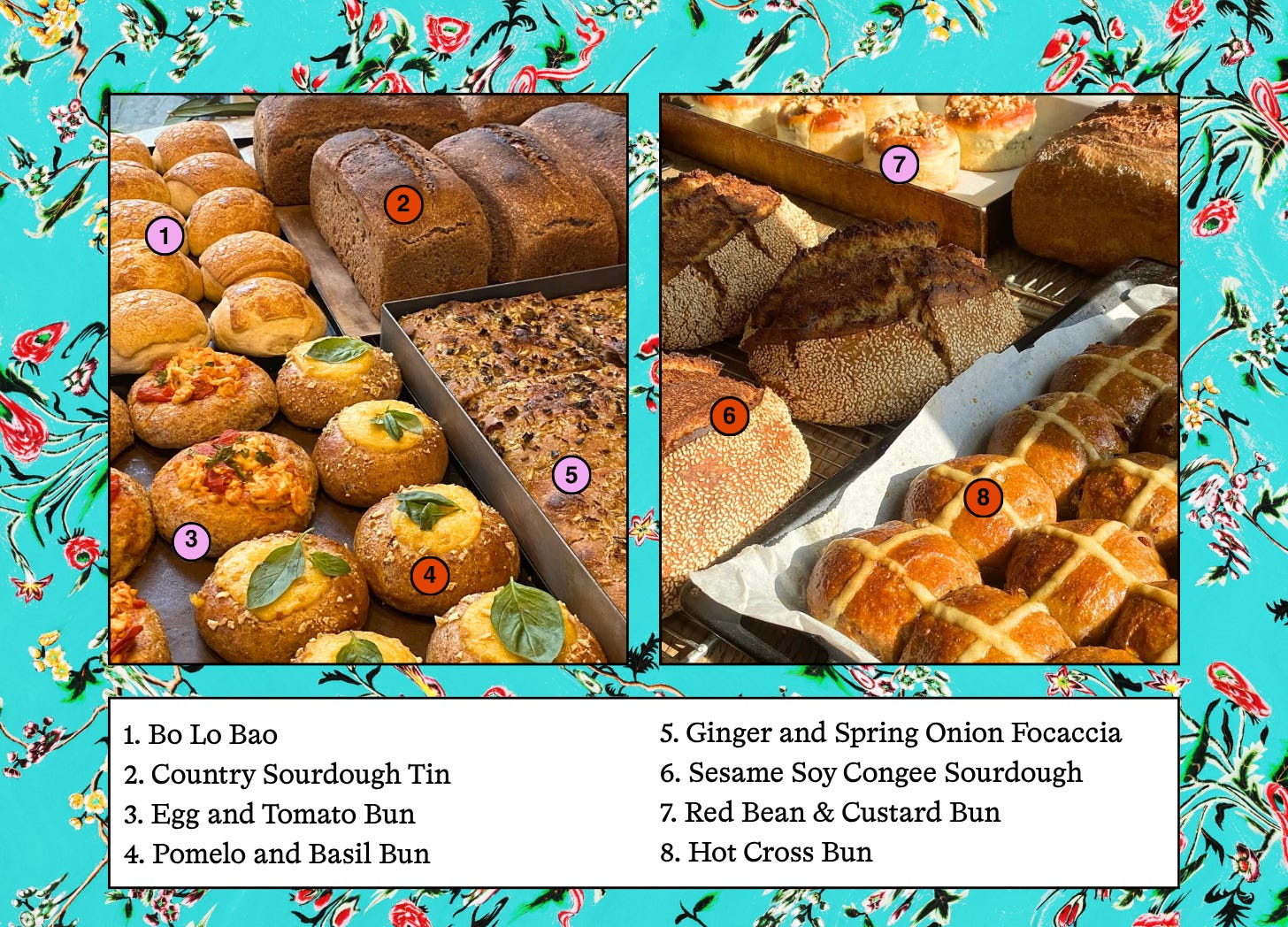
Lucky Yu’s roster of unique creations, which Leung switches up for her fortnightly drops, include sourdough made with wheat, congee, and soy sauce rolled in sesame seeds, rough puff pastry turnovers filled with daikon braised in a Hong Kong-style curry sauce, and miniature almond cakes with browned butter and candied ginger. But among her most popular bakes are her golden brown, plump, and fluffy filled buns.
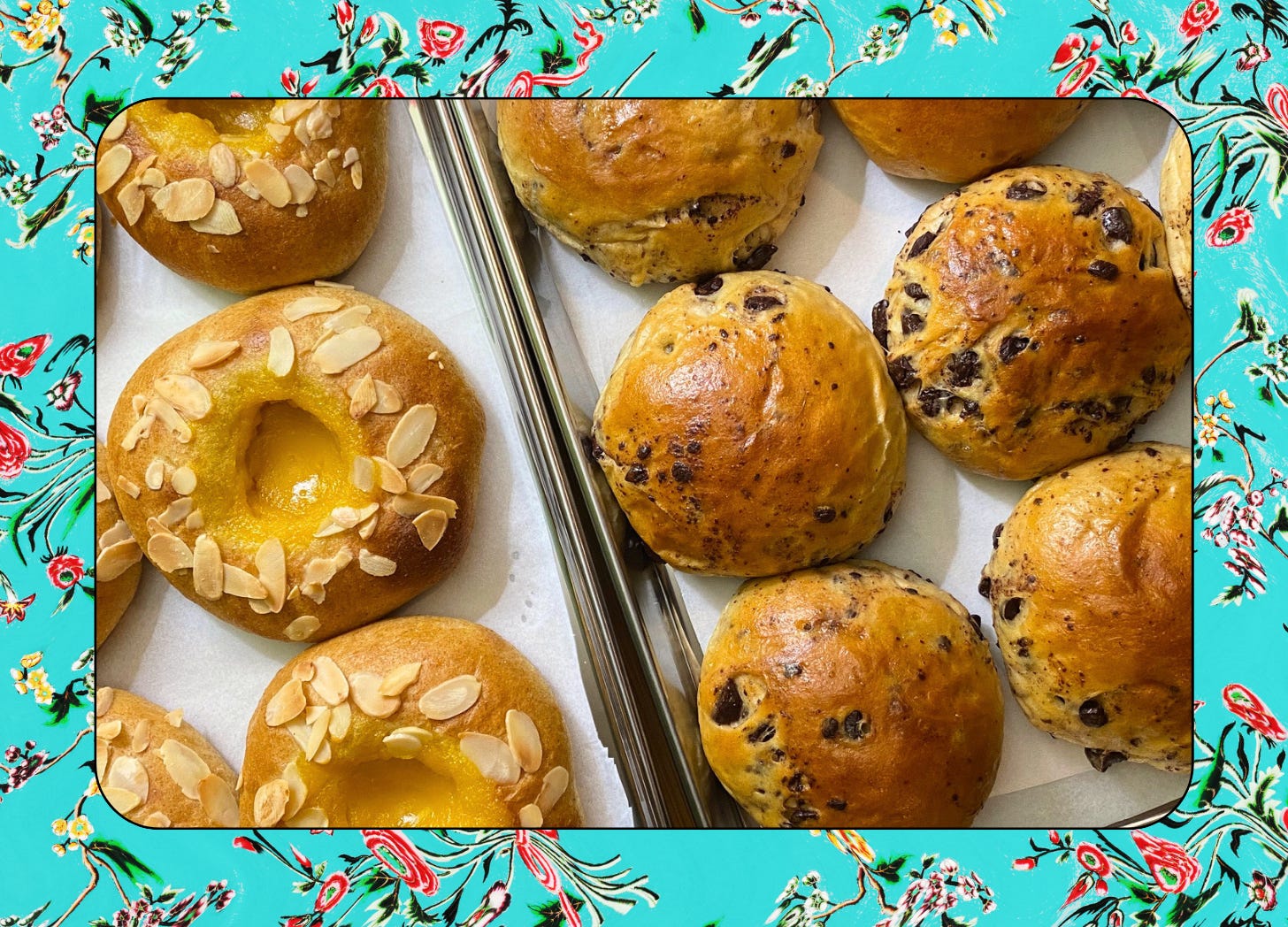
At the Food in Print Magazine Fair (organized by Vittles, Pit Magazine, and FatBoy Zine, and featuring Above the Fold as well as many other food zine friends) in London, Lucky Yu’s display put their panko-encrusted rolls—stuffed with a roasted squash, garlic, and fermented black bean filling—front and center. Alongside them were “tuna chinois” buns, dotted with sesame seeds and filled with Leung’s Cantonese take on a tuna niçoise, a mixture of tuna, pickled mustard leaf and chinese olive, kewpie mayonnaise, red and spring onions. Among the sweet treats on the table were Lucky Yu’s signature red bean and chocolate chip milk buns, packed with Leung’s homemade red bean paste.
Everything sold out so fast that Above the Fold’s editor Leah Mennies was, regrettably, unable to grab a bite of it for herself. Luckily, we were able to get some time to catch-up with Hai Lin and learn about her busy life as a doctor/baker/pastry chef, the inspiration and influences that have shaped her bakes, and what (to her) makes the perfect bun. Read the full interview below.
Jasmine Ting: You mentioned that baking became a hobby in university. But was this something that began while you were growing up?
Hai Lin Leung: My mum would make chiffon cakes, so on Sunday mornings I would hear the beaters of those handheld mixers against this plastic bowl that she’s had literally for 30 years, because she would bake a cake for her Cantonese opera group and then take it in. But that was the pretty much the extent of the baking—we never bake bread at home, so baking bread was completely new to me.
Can you talk about those early days of dipping your toes into the world of professional baking?
I’d done my first two years of training as a doctor, which are mandatory in the UK. I then took a year where I was basically able to freelance on my own terms for a year, because I wasn’t sure which specialty training program I wanted to go into. My housemates at the time had realized that I really liked baking bread and noticed that there was a volunteering opportunity at this social enterprise bakery, and because I had some flexibility I was able to start volunteering with them one day a week.
At that point, having only been baking one or two loaves a week, going into a bakery where I was able to bake 60 to 100 loaves a day was a game changer. I thought, Why am I doing this? Why am I only baking two loaves when I could be baking 60? That’s the point where I really saw the value in how much more practice you get if you’re in a commercial environment, so I would try in-between jobs to find internships or stages in various bakeries.
But you eventually found yourself actually baking while also practicing medicine at the same time. On your profile, you describe yourself as “a 3-in-1 identity crisis.” How did you get here?
Just after COVID, I was in a job which I was not enjoying. It wasn’t medical, but still healthcare-adjacent. So I thought, well, the only way for me to build a career that might be sustainable for me is if I build baking into my life. I decided to take a six-month, full-time baking course.
When I started working in a hospital as part of my general practitioner training, I applied part-time knowing that I wanted to do baking alongside. I also took a job part time as a pastry chef at St. John Restaurant at Smithfield. I later overheard someone else talking about selling their bakery equipment, and then I was like, Okay, well, now maybe I’ll also start a bakery. And that’s when it became this like three-in-one life that I maintained, actually, for about a year. After that, I thought three jobs was too many jobs, and so I cut out the pastry chef job at St. John.
How do you think the experience at St. John has helped or influenced your work at Lucky Yu?
St. John is really seasonal, and they had such incredible produce. I would taste new fruits on a monthly basis, or see something that I’ve never seen in a different color. Because the menu changes, if not daily, sometimes twice a day, there’s so many different elements coming in all the time. There’s experimentation, whoever it is that’s on the section that day will have their own ideas about what they want to do, so it opened up my eyes. It was a good foundation, and just made me more aware of seasonality as well as different ways of using fruit custards. They were obsessed with custard, so I don’t feel scared of making custard anymore.
Obviously, baking at St. John was more of a British baking experience. With Lucky Yu being a Cantonese-British microbakery, how does each of the two cultures influence what you make and coalesce into a finished product?
I’m very much influenced by the sustainable-slash-regenerative approach to baking, the use of single varietals and seasonal ingredients that is of a particular type of artisan baking, and is really surging all across the world. That, I would say, is probably where the Western/ British style influence comes from. The Cantonese side is sort of what textures that I might be aiming for, like the kind of flavors or the ingredients that I might use. Fusing those things together, I think, can work really well sometimes. It takes a bit of tweaking.
For example, stone-ground flours often contain a lot more of the bran or the wheat, so it doesn’t give you the same really light texture that you would expect from a milk bread that you’d get in a Chinese bakery. I think that’s where you get a bit of an intersection and you have to figure out what works.
How do you go about figuring that out? What, to you, is the platonic ideal of a filled bun? What’s the dough style and texture you aim for as opposed to the filling?
One other place that I think about a lot in my baking is a Japanese bakery called Tetote in Ealing, where I spent some time as an intern. It was open for over 10 years, but it’s recently closed. They always considered the eating experience. They were creating loads of filled buns, some that were open with toppings, some that were completely closed, some that were part-open and filled after they’re baked.
There’s a balance of what textures and qualities of the filling you want the person to experience as they see it, as they bite into it. If it’s really soft, are there other elements of texture that you want to incorporate? Some things explode a bit, so sometimes you don’t want to keep them enclosed, or if you are enclosing them, you want to give them some space to explode out of and become all steamy when you bake them. Are there things on the outside that actually would be quite good if they charred a bit as it was baking?
It’s thinking about how it might behave when it’s in the oven, what is the eating experience as someone gets from the beginning to the middle to the end.
What are some flavor combinations that you’re particularly proud of, and that you think really embody your ethos as a baker?
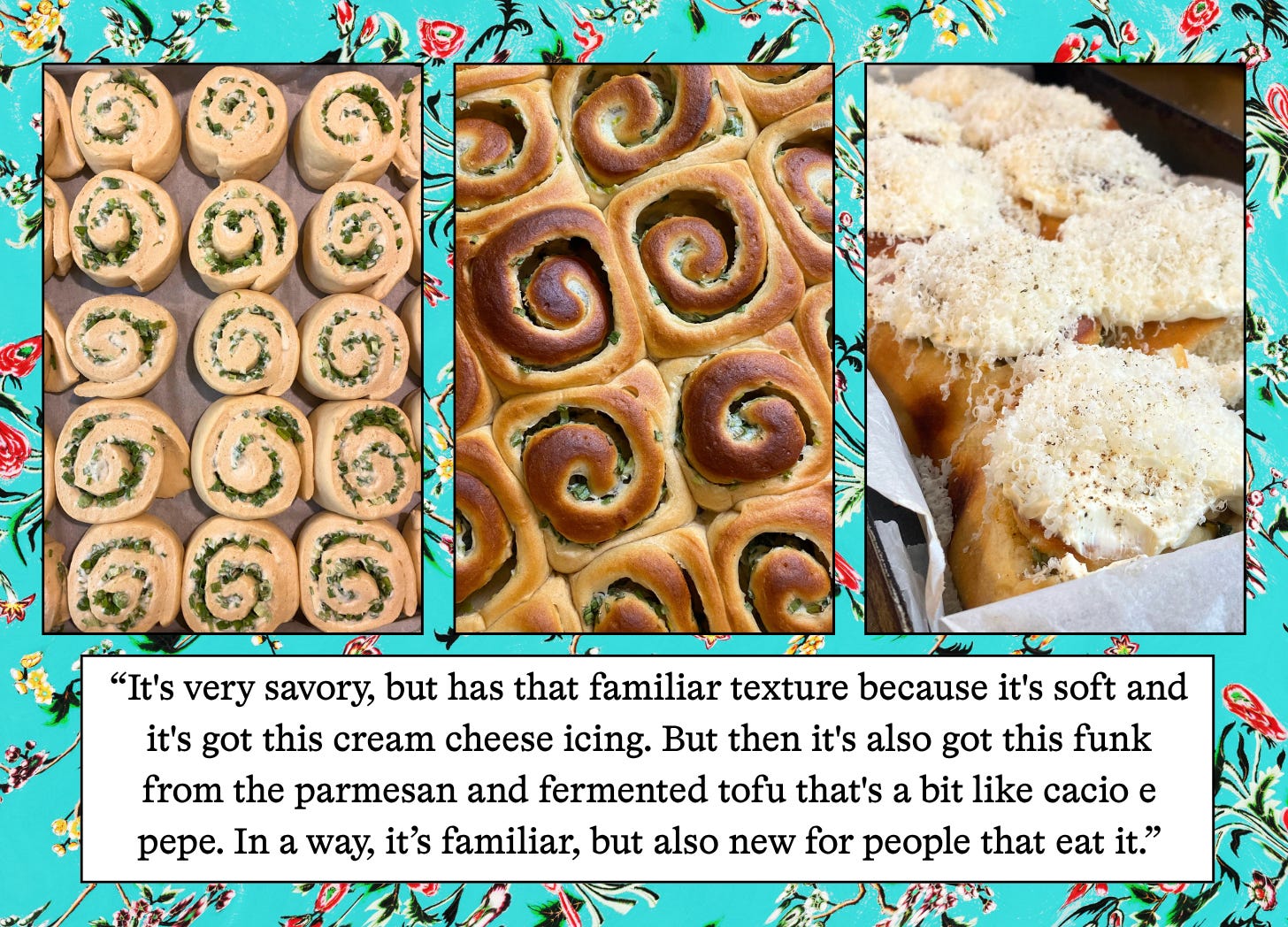
I think probably the spring onion, fermented tofu, cream cheese, parmesan, black pepper bun. It’s one that I thought about a really, really long time ago, quite early on in starting the bakery. I have never taken it off the menu since.
Cinnamon buns are really delicious, but there was a part of me that was like, I’m never going to make a cinnamon bun. It just doesn’t fit. It would be a great seller, I’m sure, but other people are selling really great cinnamon buns. So I thought, How can I sell something that looks a bit like a cinnamon bun, but is not? This bun is a swirled bun. It’s very savory, but has that familiar texture because it’s soft and it’s got this cream cheese icing. But then it’s also got this funk from the parmesan and fermented tofu that’s a bit like cacio e pepe. In a way, it’s familiar, but also new for people that eat it. For me, I find it funny because you think this is the sweet thing that you know, but surprise! It’s not.
Is there an underrated Cantonese dish or bake that you’d like to bring to life for Lucky Yu at some point?
I love braised mushrooms. I love braised shiitakes. I have been thinking about a kind of filled braised mushroom bun. A lot of my buns or bakes, I try to keep vegetarian, so mushroom is like a great ingredient to use to kind of bring that savoriness. It can be so simple to just have something braising really slowly, have some lovely savory flavors in there. It just reminds me a lot of my mom’s cooking.
What challenges do you still face, even when you’re down from three to two jobs? Running a microbakery while also doing your general practitioner training can’t be easy.
I don’t always have someone to bounce ideas off of. And because I’m only doing it on a fortnightly basis, it really feels like every week is the week. There’s no time or space to fail. As it’s gotten a bit busier, it’s been much harder to squeeze in R&D. And when things do go wrong or things don’t come out as I expected, I don’t necessarily always have the time to investigate that either.
They are very physically demanding jobs. What do you do on your day off?
This morning, I was actually just saying to my partner, George—who also has so kindly stepped in as basically the front-of-house man—I actually think I have a problem relaxing now. I don’t think I know how to relax.
Weirdly, the other night, I came home from work and my head was really busy and full. And, actually, the thing that I thought would make me feel more relaxed is if I did some baking—which is also perverse and makes me feel a bit psychopathic. But I think there is also something about doing something that’s quite mindless in the sense that you’re just following some instructions that makes you feel sort of productive and stops me just like vegetating on the sofa, doom scrolling, or staring at my laptop when I can’t actually use my brain.
This interview has been condensed and edited.
No posts
Comments
Nothing yet. Say the first thing.
Sign in to join the conversation.