
“All small beasts should wear bows in their tails” – Snufkin

In the summer of 1945, to distract herself from life after five years of the war, Tove Janssen took another look at her vicious little satirical drawing of the philosopher Immanuel Kant. She rounded the monster philosopher’s snout into a friendlier shape, and renamed him as Moomin. She drew him a house like a pepperpot in the middle of the woods; a small friend called Sniff; a loving but absent minded pair of parents, Moominmamma and Moominpappa.
And a storyline involving an immanent comet impact and the end of the World…
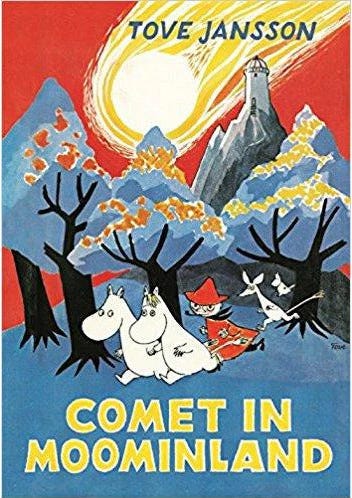
Finland, not unlike Ukraine today, suffered invasion by the Soviet Union in the Winter War of 1939-40. Through the woods on skis with out-of-date equipment and no air force at all, the Finns surprised everybody by fighting the Russians to a standstill.
The losses were enormous – 5% of their entire male population killed and about 9% of their territory. And, of course, Russia was still there, with its army that outnumbered the entire Finnish population.1
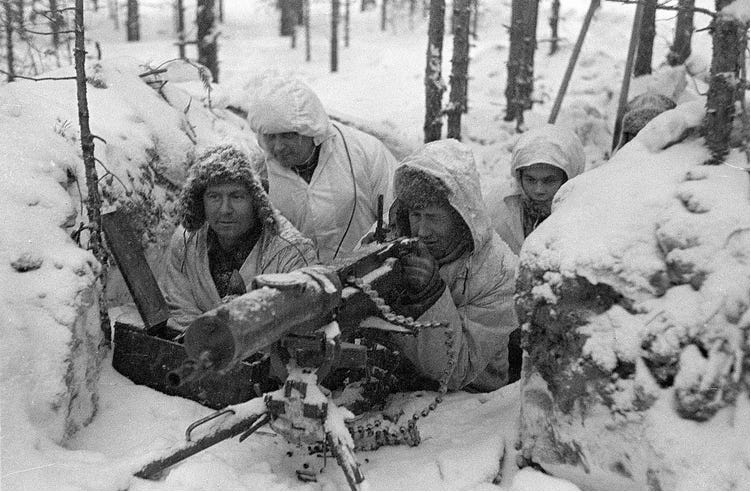
Finnish machine gun crew during the Winter War 1939-49 (Military Museum of Finland via Wikimedia Commons)
Finland sent the children to Sweden, and absorbed 10% of its own population out of the Karelia province (and the country’s second city Viipuri) which had been seized by the Soviet Union. “His house has fallen apart, so now he’s living with us.” Oh, that’s actually Moominpappa referring to the Muskrat in Chapter 1.2
By 1945, after three wars with Russia and one against the Germans, the threat of invasion and occupation was very much still there. Meanwhile, in Moominland, the sky turns a nasty reddish colour, the streams and waterways are draining dry, and the comet impact is less than a week away…
Comet in Moominland starts with the discovery of
an entirely new path. “That’s the curious thing about paths and rivers,” mused Sniff. “You see them going by and feel a terrible longing to be somewhere else.”
translated by Sarah Death, Sort Of Books (2025)
With the end of the World confidently forecast by the Muskrat, and confirmed by a strange rain of phosphorus-smelling dust, Moomintroll and Sniff set off to the Lonely Mountains. They mean to gather information from the Observatory there.
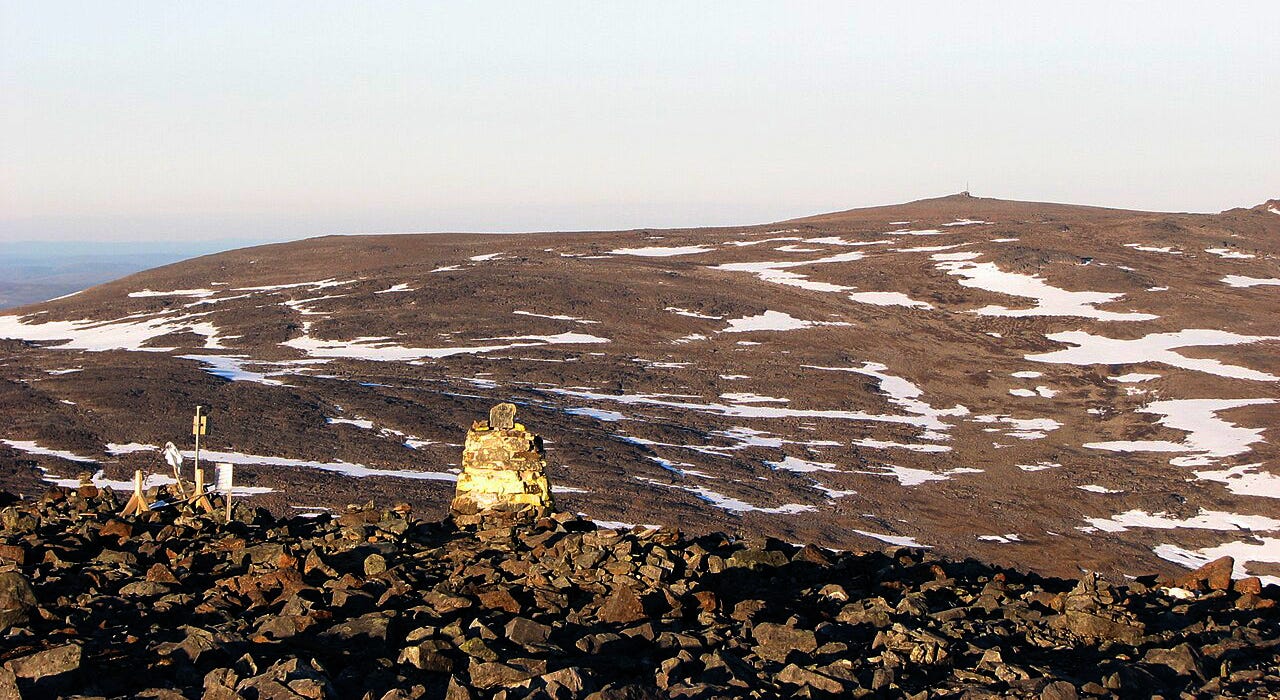
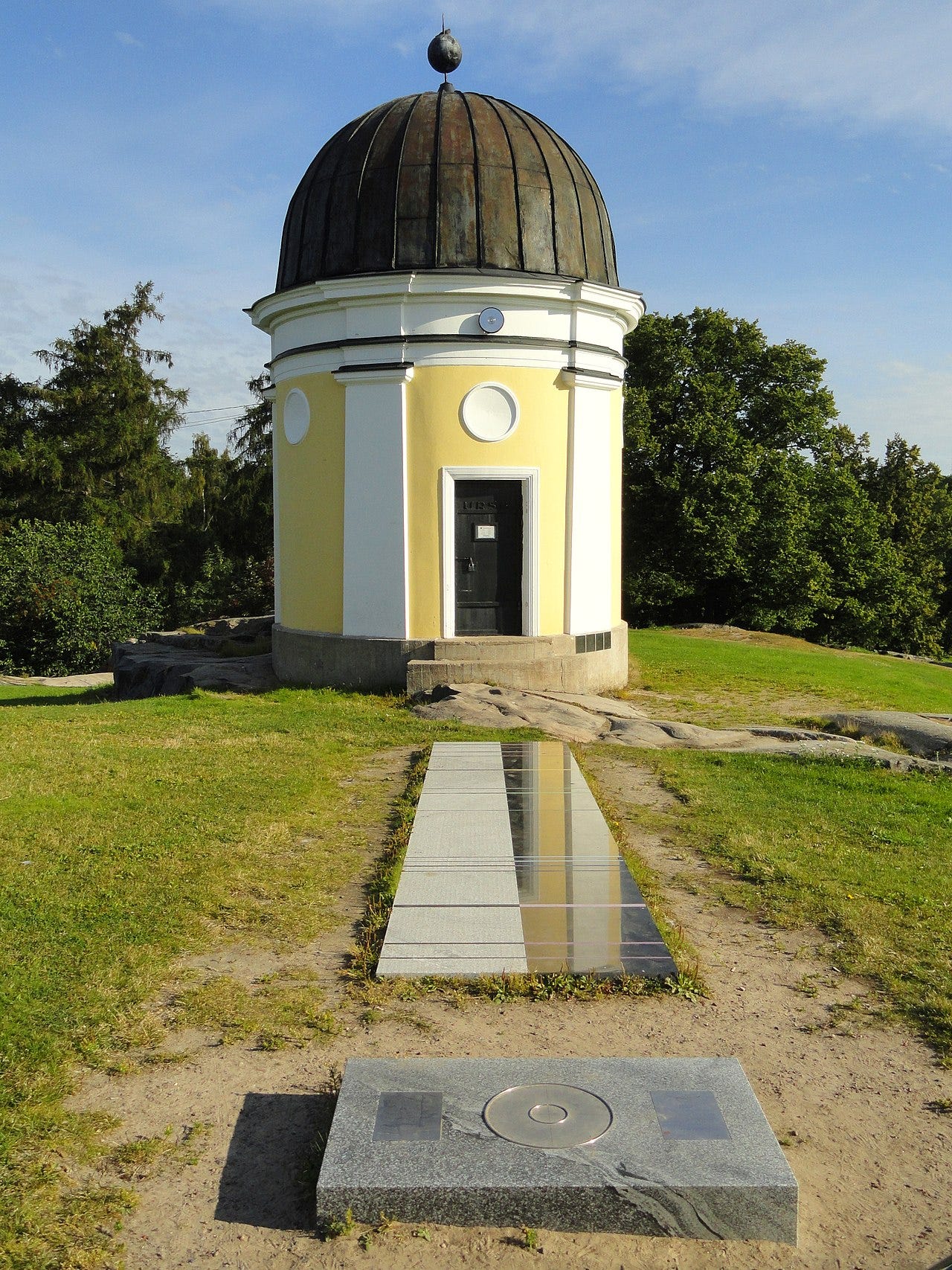
At this point I insert a photo from Wikimedia Commons of the Finnish mountains that inspired Tove Janssen. Except, there are no Finnish mountains. (Well there are some way up beyond the Arctic Circle.) Instead we have Helsinki’s municipal park, with small but rugged seacliffs around it – plus the live imagination of Tove Janssen.
Which, in the event, is even better.
For after an exciting river trip and down an underground hole: “all around them, vast mountain ranges towered up, immensely desolate and grey. It was very quiet and there was a chill in the air…”
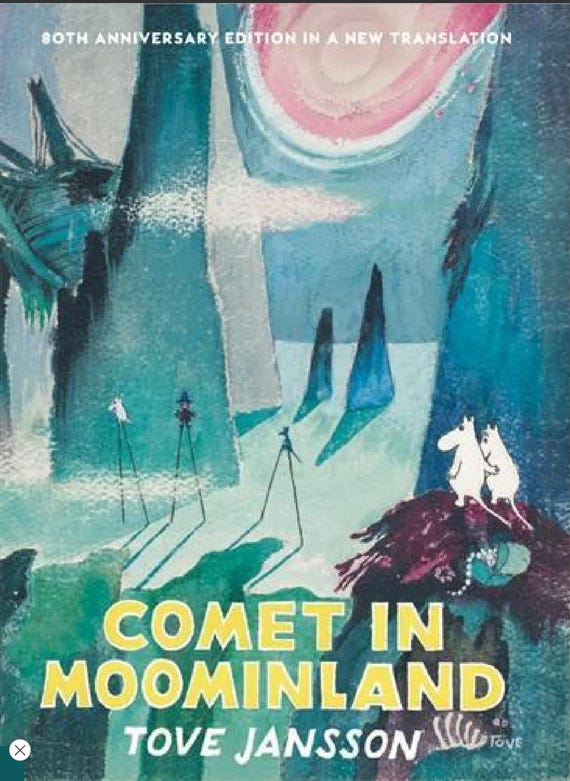
It was late evening. The ancient mountains stood there solemnly, deep in dreams. The peaks looked out at one another across the chasm where the mists were rising, greyish white and bitterly cold. Now and then a hazy little wisp floated free from the heavy banks of cloud and glided leisurely across the mountainside where the eagles and condors had their nests.
They identify the correct peak by the cigarette ends thrown down by the astronomers. And make their way up it by a “twisty little mountain path, with the three of them roped together by a lifeline that they had knotted round their middles to be on the safe side”.
It grew steeper and steeper as they went higher and higher. Everything around them seemed age-old, gigantic and lonesome, dreadfully lonesome.
So up they go, surviving attack by a condor, through the cloud and out again at the top of it, to where
Perched right at the top of the mountain range was the Observatory where the professors made thousands of remarkable observations and smoked thousands of cigarettes and lived in isolation with the stars.
The Observatory which, in real life, stands a few metres above sea level in the town park of Helsinki.
Janssen was a gay woman, living with her partner on an isolated island in the Baltic sea. She was also excluded as a member of Finland’s Swedish-speaking minority. ‘Comet in Moominland’ was translated into English four years before its first Finnish-language version. Today, of course, she’s celebrated as the third most famous Finn—behind Linus Thorvalds of the linux operating system and some random racing driver3, but one place ahead of the composer Jean Sibelius. She was an artist of astonishing range and variety, as well as a writer. But above all, the creator of the Moomins.
The whimsical but at the same time hard-edged illustrations. The whimsical but hard-edged storylines. The general lack of a moral message – unless it’s the specifically 1945 Finnish moral of courage, self-reliance, and welcome offered to the stranger. The celebration of eccentrics and outcasts, from the casual wanderer Snufkin and the grumpy Muskrat, to the opinionated Little My.
Plus, in ‘Comet in Moominland’, a bit of serious mountaineering.
It’s cold in the Lonely Mountains,” said Moominmamma, slipping two sweaters and a pancake pan in with everything else. “Have you got the compass?”
more posts MOUNTAIN LITERATURE
Finland total population 3.7 million. Russian army over 5 million at the end of 1939
Jared Diamond ‘Upheaval’ 2019 has its opening chapter about Finland during and after World War Two.
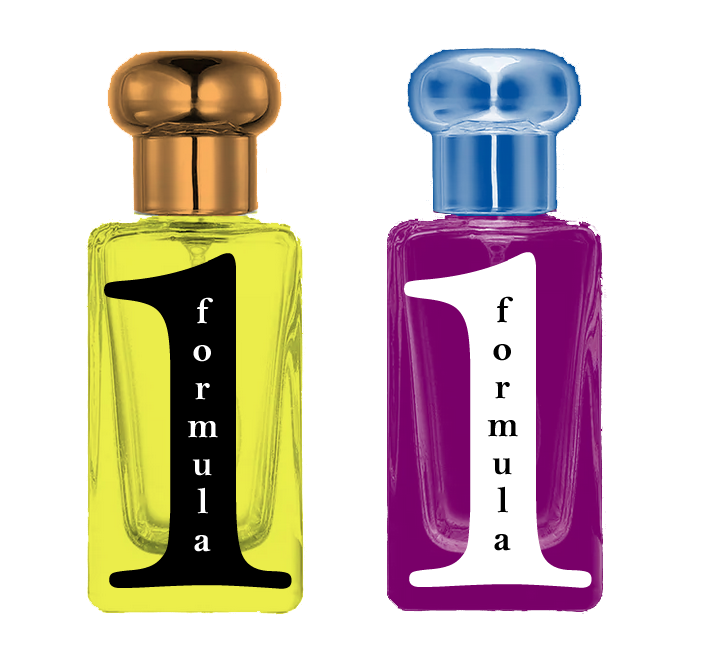
I know, i know, Kimi Räikkönen matters a lot. It’s just I have trouble following a sport that sounds so much like an up-market brand of scent.
Comments
Nothing yet. Say the first thing.
Sign in to join the conversation.