
Life is made of dreams
Julie Tullis
In 1985, filming with an Italian expedition on K2, mountaineer and film maker Julie Tullis reached the 8000m contour for just the second time in her life.1
I had reached the magic 8000 meters on the mountain of my dreams, the first woman in the world to do so … I knew I would have to go back to K2. Of all the mountains, this one was the most special to me.
Last week’s post was about her climbing and film-making partnership with veteran climber Kurt Diemberger, and how they climbed Broad Peak in lightweight ‘Alpine’ style. The pair also climbed and filmed on Nanga Parbat and Everest. And in 1986, they returned to K2 as film crew for an Italian expedition.
Nine expeditions were on the mountain: four of them aiming at the unclimbed Southwest Pillar or ‘Magic Line’. The various groups included Liliane and Maurice Barrard with Wanda Rutkiewicz, and a Polish team with three other women in it. At last, the gender ratio was starting to shift a little!
On 7th June 1986, Julie and Kurt reached Base Camp on the Baltoro Glacier, near the memorial to K2’s previous dead climbers.
It was a thought that occurred to most of us… There were sixty-odd climbers there and we would be remarkably lucky if there wasn’t a death. It was as if we were waiting for the first one to happen.
Jim Curran, cameraman with the British expedition attempting the unclimbed Southwest Pillar.
Jim Curran’s film, ‘K2’s Deadliest Year’, includes some footage by Diemberger and Tullis. At 4min in this low-res video, Julie herself is in conversation about the mountain.
The doubts expressed by Jim Curran were very reasonable. Statistically, K2 is either the most dangerous or the second most dangerous mountain in the world. Out of 60 climbers, one would expect about 30 to reach the summit, and six or seven to die.
1986, however, would be the year that bucked the trend. By the end of the climbing season there would be 13 more names added to the Gilkey Memorial.
For three weeks up to the end of June, Kurt and Julie were filming low down on the Abruzzi Ridge, the standard route up the mountain. Even this ‘easiest’ route on K2 is long, technical and dangerous: much more so than the South Col route on Everest. It normally involves a sequence of four camps on the way up, a summit day from Camp Four, and one or two days for the descent.
Apart from the climbing difficulties, the main danger of K2 is the weather. In 1986 there was no such thing as a six-day weather forecast, and storms on K2 can make all movement impossible, at the same time laying down feet of fresh snow to make all further movement extremely strenuous and threatening even a stationary camp with avalanches.
June 21st saw the first deaths: two of the American group were swept away by an avalanche on the Southwest Pillar.
On June 23rd, the first two teams reached the summit by the Abruzzi Ridge: they included Wanda Rutkiewicz and Liliane Barrard, the first two women ever to climb this mountain. Liliane’s long held ambition to be the first woman was frustrated by just 60 minutes: Wanda got up ahead of her.
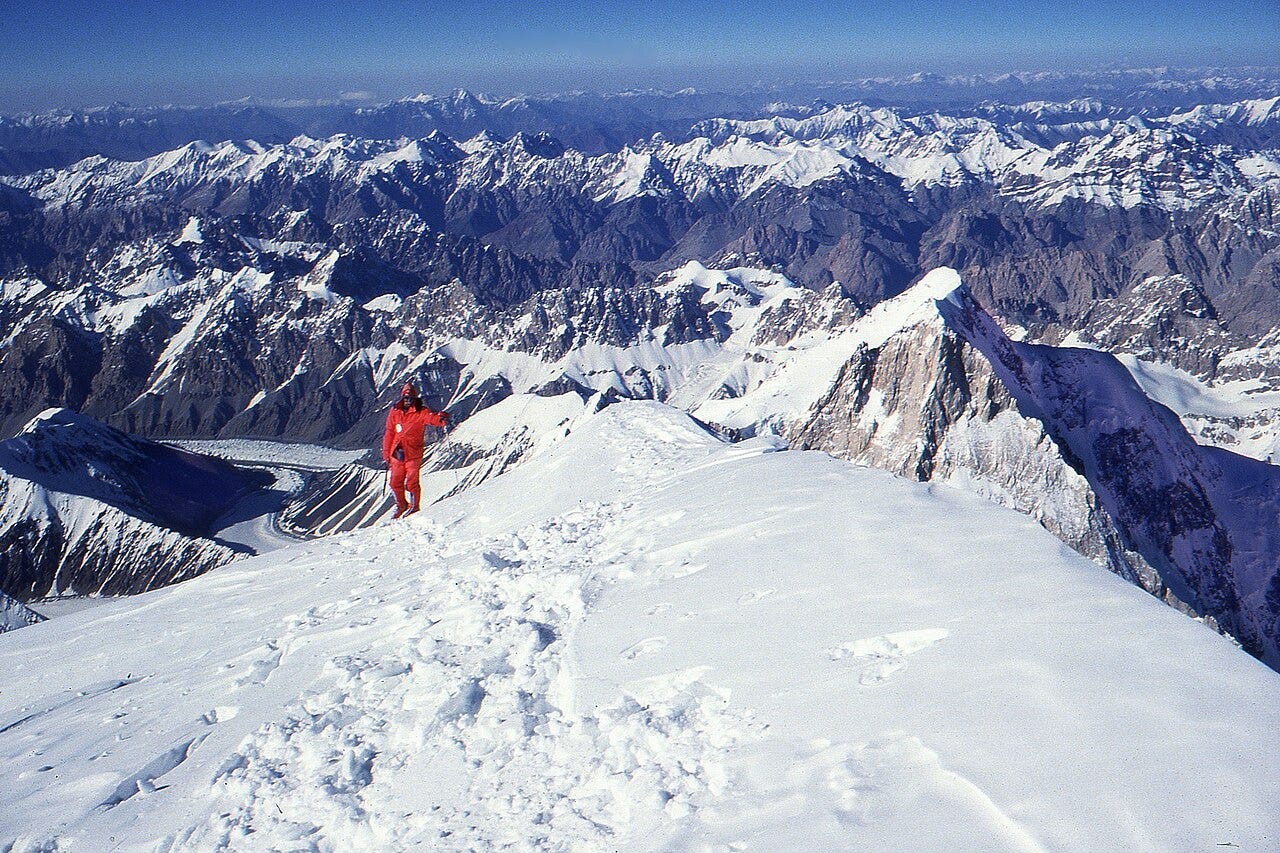
Their descent was hit by storms. The French couple fell behind and was lost. Liliane’s body was recovered several weeks later: Maurice has not been found.
On 3rd July, the Italian team gave up their ambitions on the Magic Line and set off up the crowded but less technical Abruzzi Ridge. Julie and Kurt filmed them as they climbed to Camp Four, the highest camp, which is on a snow slope called The Shoulder at 7700m.
On July 5th and 6th, six members of two separate expeditions reached the summit at 8611m and returned safely to Camp 4 (see photo above). The following day, Julie and Kurt made their own summit bid. But they strayed off the correct line and lost too much time; by 4pm they’d only reached 8300m. They decided to turn back to Camp 4 at the Shoulder.
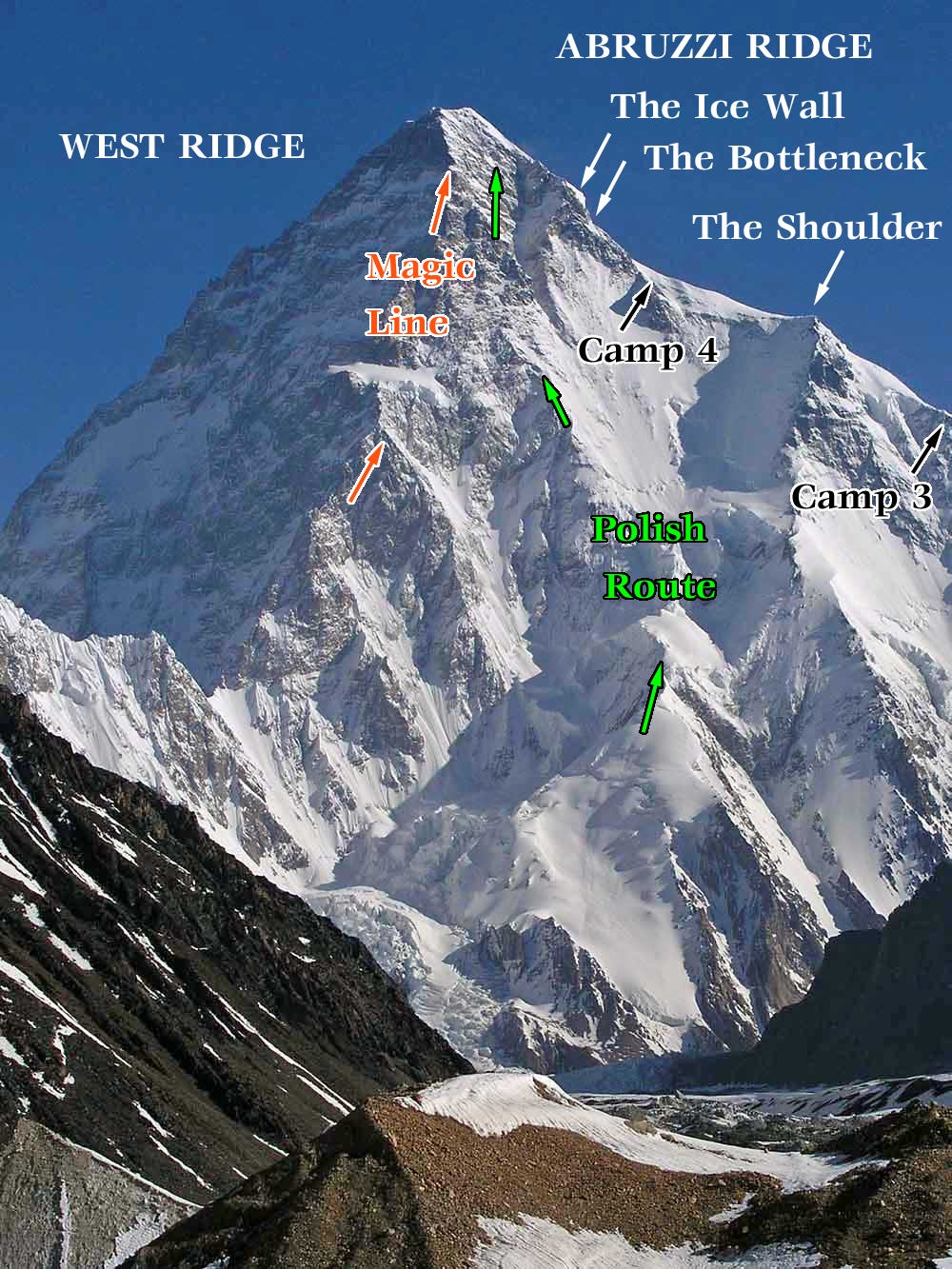
They’d enjoyed six days without serious storms, and hoped for a couple more to make another try for the summit. But that wasn’t going to happen. On July 8th they turned downhill in storm and whiteout, getting as far as Camp 3 at 7350m. Next day, with the storm continuing and the fixed ropes on the mountain tangled and iced up, they descended the two stages to Camp 1.
There were moments when I convinced myself that that was it. I was not going all that way back up again. Who really cared if I climbed 300 metres higher on K2 or not? – Julie’s diary
In the same storm, two Poles reached the summit, by the previously unclimbed ‘Polish Route’. But on the descent Tadeusz Piotrowsky had his crampons come loose: he fell to his death down an ice slope.
Meanwhile, over several weeks, the Italian Renato Casarotto had been working his way up the Magic Line on what he’d promised to his wife Goretta at Base Camp would be his final attempt. It was. In the storm, 400m below the top, he turned back. On July 12th he was within sight of Base Camp when he fell into a crevasse. He radio-ed for help and was rescued within an hour, but died of his injuries.
Having comforted Casarotto’s wife Goretta through the night, Julie wrote home that she wouldn’t be making any further attempt on K2. “To get home safely means more than standing on the summit. I have no more pleasure to climb my mountain of mountains.”
Kurt doesn’t quite see the logic. “I was thinking a lot about it, but saw no direct connection between Renato’s accident and an ascent by us of the Abruzzi Ridge.”2
But Julie’s made her mind up, and they arrange homeward porters for August 4th.
On July 28th the weather cleared. They had unused film stock, so they moved up to Advanced Base Camp for some higher views. And on July 29th, Julie wrote in her diary: “I know I did not want to go up again, but I have changed my mind.”
They carried a tiny bivvy-tent. But there were enough camps established on the mountain that they could sleep in more comfort: a Swiss Tent at Camp 1, a Basque one at Camp 2, then an abandoned French one which they’d been gifted by its owner: they took that one with them up to Camp 4 on the Shoulder. Here the supplies they’d left exactly a month before were unfindable: carried away by an avalanche, buried under fresh snow, or even stolen by other climbers. But they’d anticipated that, and brought up everything they’d need for the summit push.
This was just as well. Up here, at the final camp below the summit, there were four separate expeditions, and no spare tents. In fact, it was worse than that. The three Austrians had negotiated by radio to use a pre-existing Korean tent. The Koreans were a day behind: by the time they arrived, the Austrians would have claimed the summit and descended to one of the lower camps.3
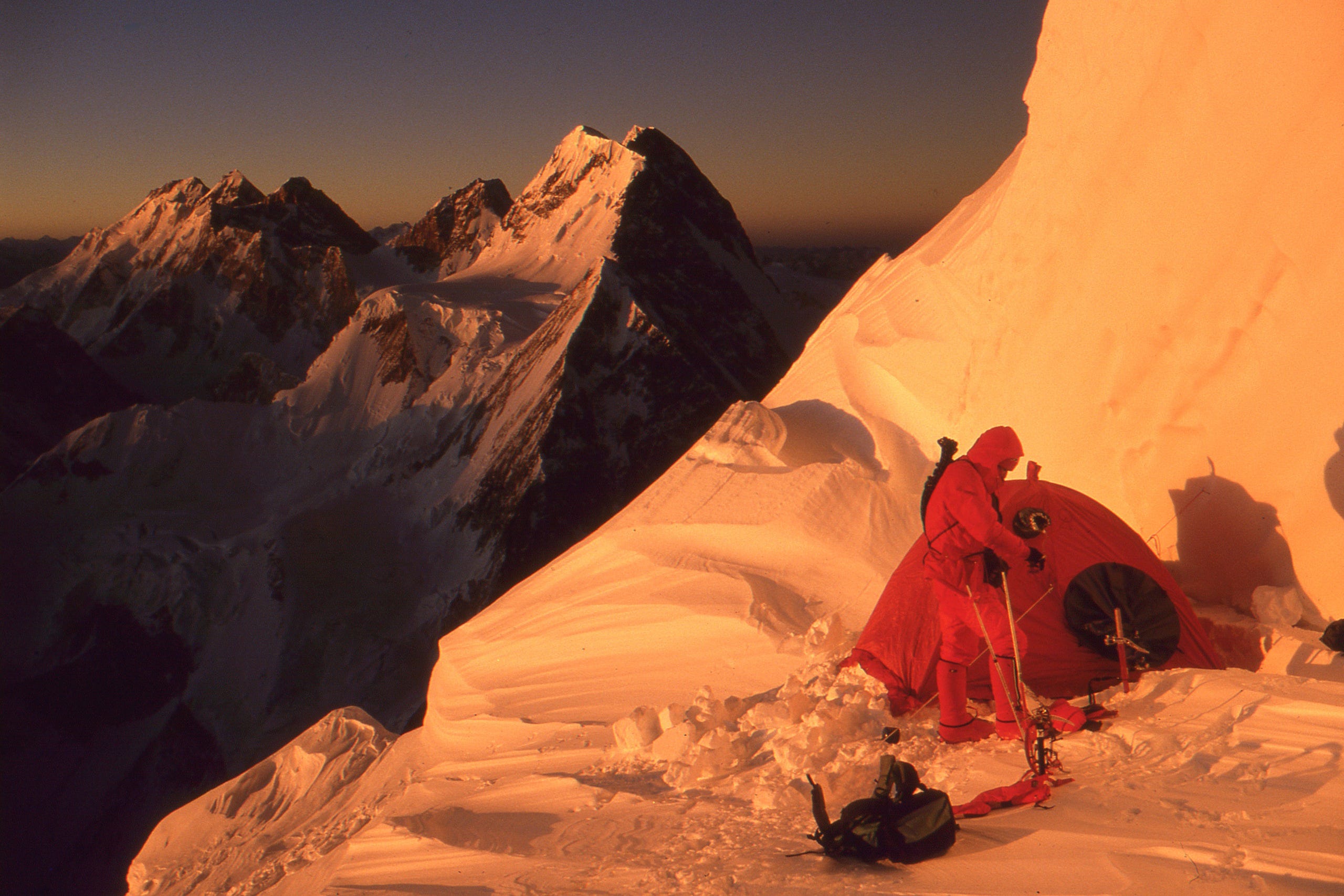
However, the Austrians lost time fixing ropes across the ice slope, and didn’t make it to the summit. They were back at Camp 4, where the Koreans had now arrived to reclaim their tent. Meaning there were three more climbers than tent-spaces.
Two of the Austrians squeezed in alongside the Koreans in their three-man tent. Kurt and Julie didn’t have space for the third one, who headed on down to the small tent of English climber Alan Rouse and Polish climber Dobrosława Miodowicz-Wolf – known as Mrufka, the Ant, for her small size and fierce determination.
This put Rouse into a horrible dilemma. Their tent was small even for the two of them. But if he refused to let the Austrian in, then that man was out in the open, at 7700m altitude, and was likely to die.
Rouse let him into the tent.4
The next day the weather remained clear, and the three Koreans headed up to the summit. Kurt and Julie had planned to follow in their tracks. But the Koreans in their overcrowded tent took several hours getting away, and Alan Rouse, after a sleepless night, was unfit to climb. With Plan A (climbing with their friend Alan Rouse) ruled out, and Plan B (climbing behind the strong Korean party) grossly delayed, they suffered an attack of indecision. Legs, lungs – but brains, too, need blood supply, operate weakly at 8000m: and doing nothing is always an option.
So the two of them stayed in their tents, hoping for a more favourable day to follow. The Austrians, too, were resting ready for a second try for the top.
At the same time, three Poles were completing the first-ever ascent of the Southwest Pillar or ‘Magic Line’. They crossed the summit, and descended towards Camp 4. They had lightened their rucksacks, expecting, or at least hoping, to find empty tents on the busy Abruzzi Ridge. They carried no tent of their own.
One of the three fell to his death on the way down from the summit; one of the Koreans was benighted, and bivvied in the open above Camp 4. That still left one extra body to accommodate. Alan Rouse moved out into an improvised snowhole, leaving Mrufka with the two Poles in their two-person tent for the night.
On August 4th – the day when they should have been leaving Base Camp a for home – Julie and Kurt with Alan Rouse, Mrufa the Ant, and the three Austrians, go for the summit.
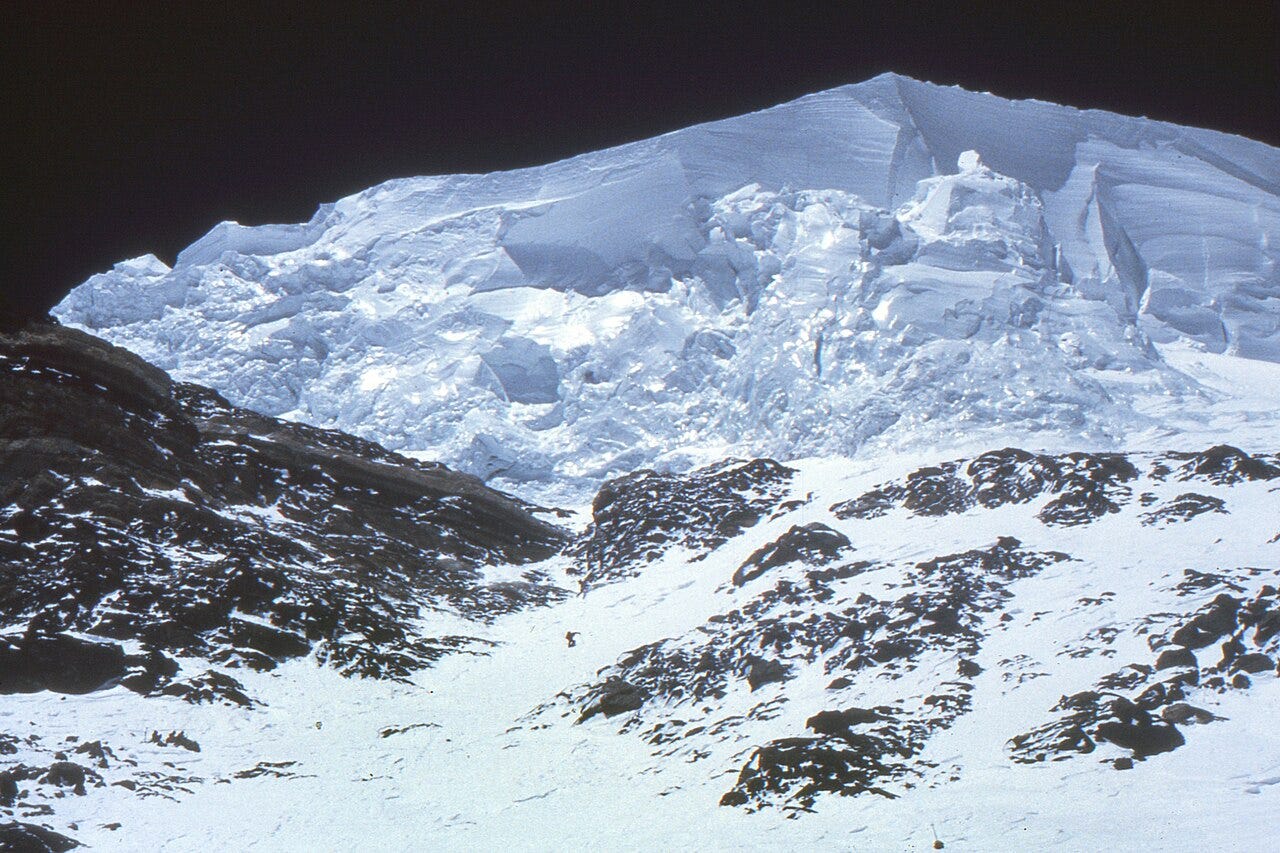
Climbing carefully and roped together, Kurt and Julie are soon at the back.
A strange, filmy mist has settled over everything … The weather is slowly worsening.
All the same, we keep climbing. It can’t be much further now. If we’re caught in a storm up here, up at almost 8600 metres, we haven’t a hope of surviving whatever we do. Whether we turn back or not. This way, at least, we shall have stood on the summit – ‘our’ summit – first.
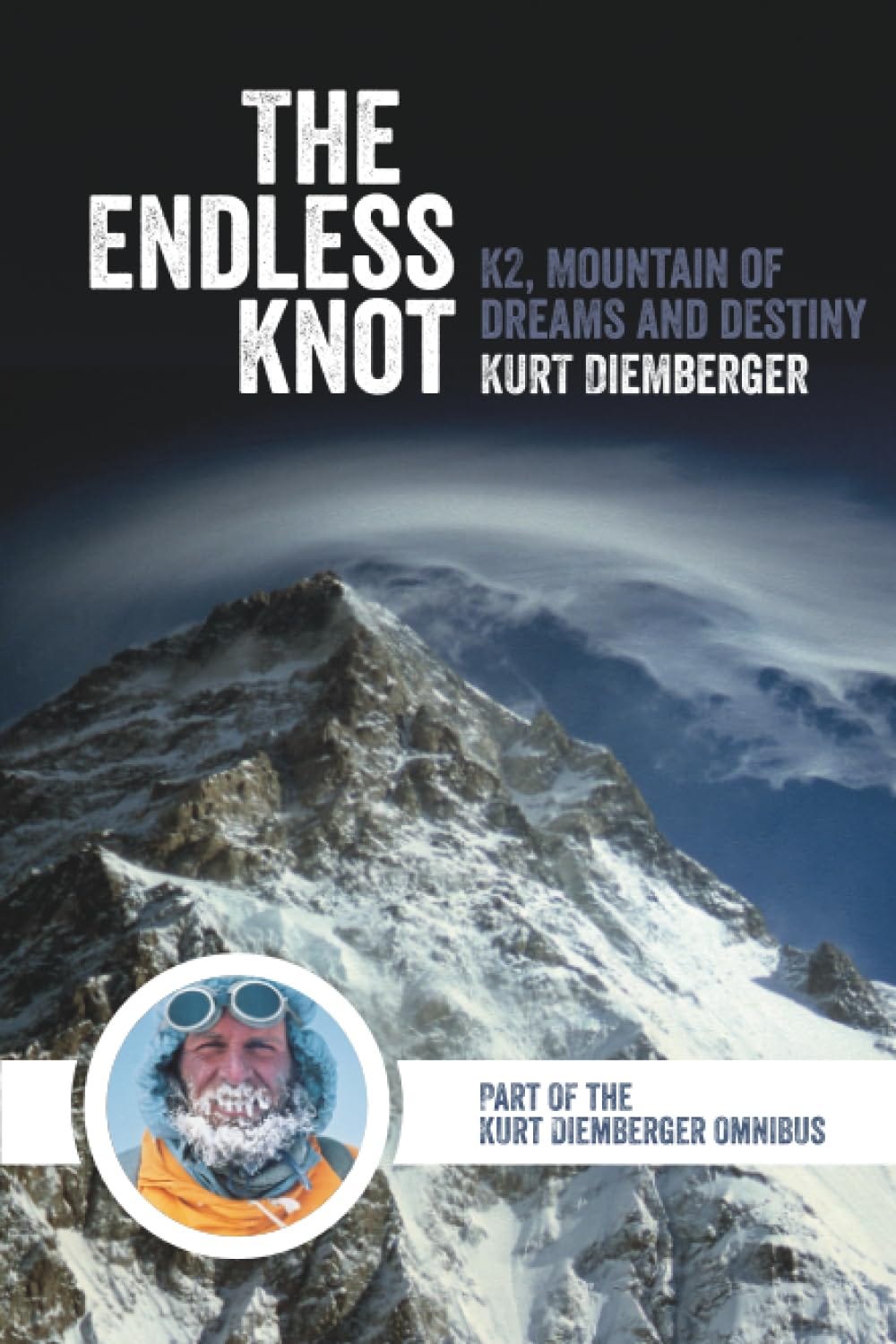
Kurt Diemberger Traum und Schicksal (Dream and Fate) 1989 translated by Audrey Salkeld as ‘The Endless Knott’ 1991.
By the time they reach the summit it’s 5.30pm, almost dusk. it’s clouding over, with a rising wind. They embrace, take summit photos, and turn downhill again. After 200m of descent, in fading light, Julie slips and falls, pulling Kurt with her.
Their downhill slide is stopped before going over the 3000m drop.
They’ve survived the fall: but the cloud has come down and they’re now in a white-out. They left the rucksack with the space blankets at the top of the ice wall and it’s too late to make it down even as that far. They scoop out a shallow snow hole to spend the night in.
The seven continuous days of clear weather have come to an end. What now hits the mountain has been described as the ‘killer storm’. Storms are common on K2; from 40 years later it’s hard to say if this one was especially worse than others. And there are evident reasons why, of the seven now trapped at Camp 4, only two were going to survive.
Firstly, those overcrowded tents, where nobody got a proper night’s sleep.
Next: dehydration. It’s awkward or impossible, in an overcrowded tent, to fire up the stove and melt snow.
Third: altitude. Dehydration thickens the blood and makes acute mountain sickness even more likely. Julie’s vision problems may have been caused by the fall high on the mountain, but are at least as likely to be indicating HACE, high-altitude cerebral oedema.
And fourthly: K2 is, quite simply, a very dangerous mountain.
The storm ties all the climbers down for four days. During the first day Julie and Kurt’s elegantly designed but flimsy French tent collapses under the weight of snow, so that the remaining tents are again overcrowded. Julie dies that night or early the next morning (August 7th or 8th). On August 10th, when the weather clears although the wind is still very strong, Alan Rouse is too weak to be moved. The remaining five set off down without him, but very soon the two Austrians collapse into the snow and cannot continue. Mrufka makes it down as far as Camp 3, but falls behind and never arrives at Camp 2. The last of the Austrians, Willi Bauer, makes it to Base Camp: a rescue party retrieves Kurt Diemberger from a short way up the mountain.
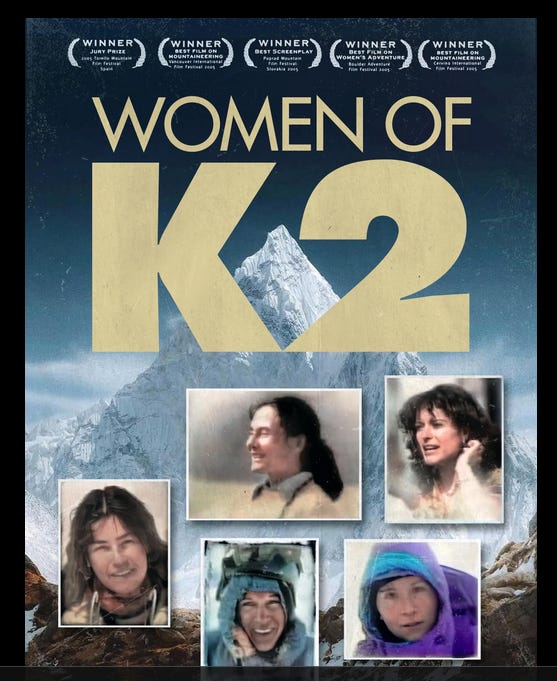
Of the first six women to climb K2, four died on the mountain and the other two on different 8000m peaks soon afterwards. Wanda Rutkiewicz, 1986 – died Kanchenjumga 1992; Liliane Barrade, Julie Tullis, 1986; Chantal Maudit 1992 – died Dhaulagiri 1998; Alison Hargreaves 1994. The film illustrates the supposed ‘Curse of K2 for women’.5
But K2 is extremely dangerous for everyone.
It’s standard literary practice to attach every death with the adjective ‘tragic’. (See also my 2020 piece about Alison Hargreaves on the UKclimbing site.) Was Julie Tullis’s death a tragedy? She went up K2 aware of the risks, and for her it was worth it anyway. Was she driven to it by some larger-than-life character flaw? Only if mountaineering itself is a tragic character flaw.
Even though I know that the odds of injury and survival must be shortening, I have to go back [to K2]. One in twelve Himalayan mountaineers die for their ruling passion. But life is short and there has to be a reason to live beyond purely surviving, an extension of that force of nature of which my body and spirit are a part, just as a river has to flow and broaden or it will stagnate.
Today K2 has become a tourist mountain like Everest, even if quite a bit more challenging. It has also become rather less dangerous, with the death rate dropping to one for every ten successful climbers. 2025 saw 41 successful ascents and just two deaths.
This is down to better weather forecasts, but also because the guiding companies combine to make sure there are never going to be more people than tents up there at Camp 4. As I write this in July 2026, ten climbers have just lost their lives on the one where Julie and Kurt survived their three avalanches, Broad Peak.
The first time being on Broad Peak, two years before – see last week’s post
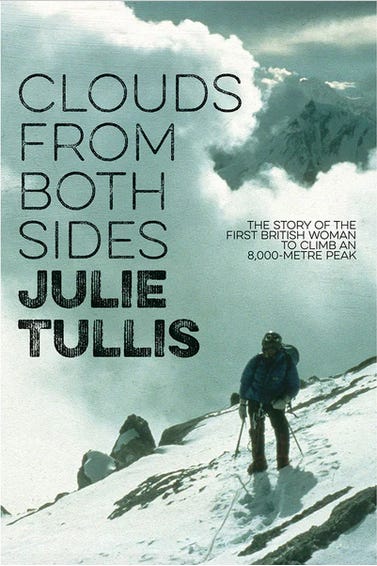
Quotes from Kurt Diemberger are from Traum und Schicksal (Dream and Fate) 1989 translated by Audrey Salkeld as ‘The Endless Knot’ 1991. Julie’s letters and diaries were shared with Peter Gillman for his final chapter added to Julie’s autobiography ‘Clouds from Both Sides’.
This appears to have been the Austrians’ intention, rather than deliberately to occupy tents belong to other groups and needed by those groups for their survival.
There are conflicting accounts of the tent agreements and allocations, and most of those involved would shortly be dead. I’ve relied on the careful analysis by Peter Gillman as the most authoritative account.
Mrufka isn’t included as, although she climbed to around 8500m, she didn’t reach the summit itself.
Comments
Nothing yet. Say the first thing.
Sign in to join the conversation.