

(1000 words)
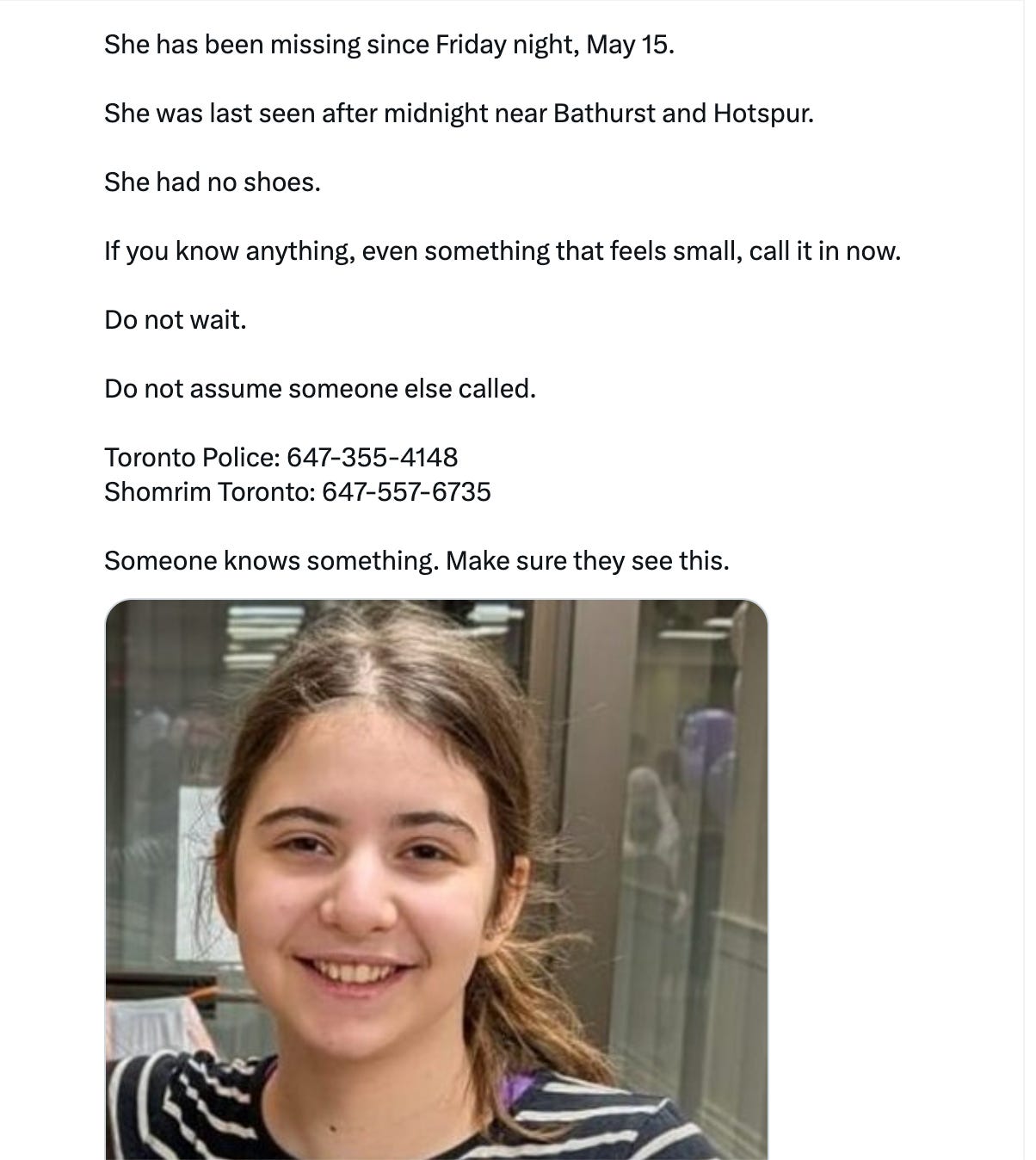
The search parties meet at a storefront in North York, organized by a local Jewish group, Shomrim. We are given a region to cover along with posters, tape and a phone number to share with shop owners and passers-by. We are hoping to find Esti and to let everyone know to look for her.
Esti is 14 and autistic; she ran off 10 days ago. We need to find her, fast. There have been some hopeful (potential) sitings recently. Today there is a localized search, and generalized prayers.
Those of us putting up Missing posters have noticed that people are tearing them down. It’s not shop owners, or utility workers, or the wind. The posters are being torn down mostly by lone white women, aged 20-40—the same demographic that tore down posters that raised awareness of the October 7th hostages.
These same women would never take down a missing dog poster. They are tearing them down because Esti is Jewish.
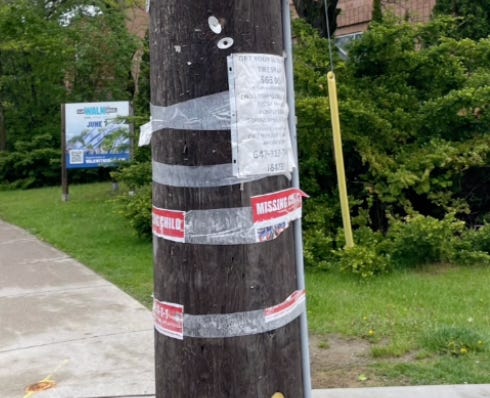
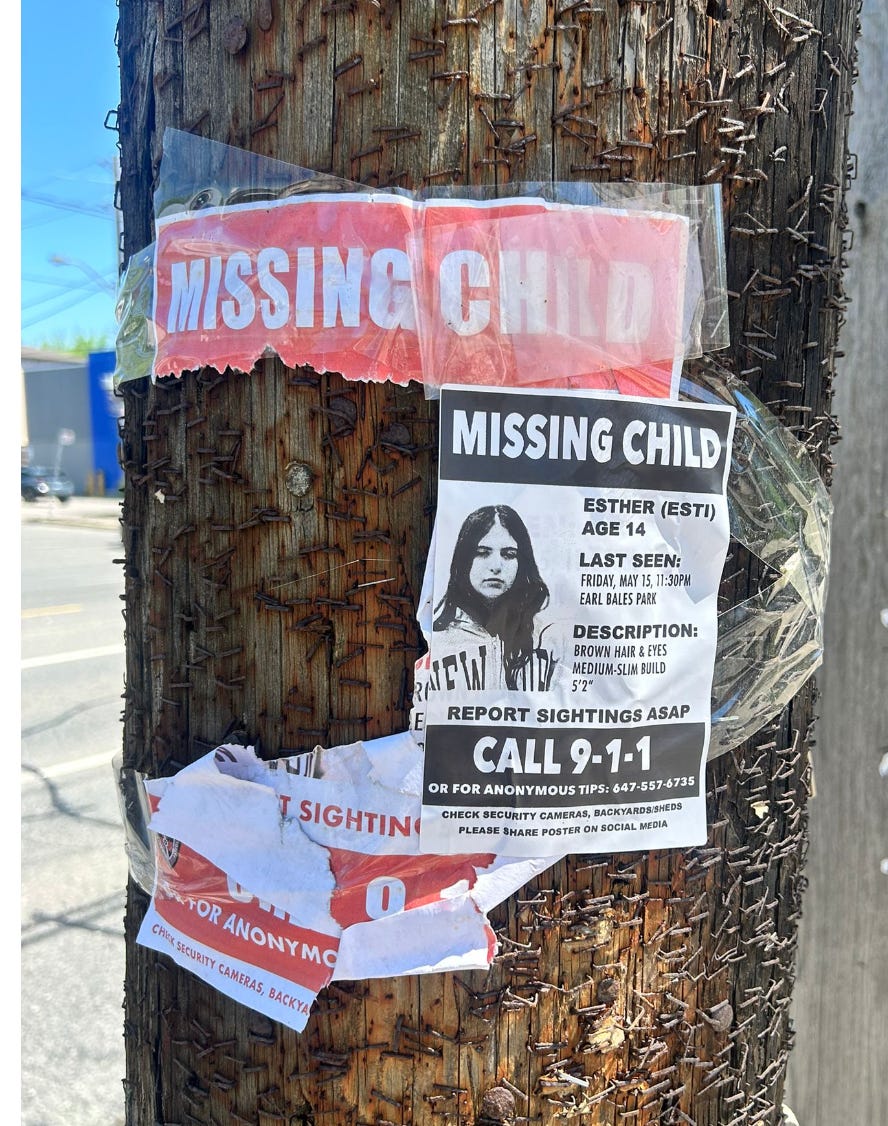
Friends of mine have been berated by these women, and videos shot around the city show them marching down streets, ripping off posters one by one, each with a similar, strangely possessed quality to their gait. It’s part of a broader wave of antisemitism, a toxic social contagion in Toronto that feeds a complex array of agendas. But that’s a topic for another time. Today I want to write about life in Toronto, for autistic people and Jewish people.
When an autistic person runs off suddenly, therapists tend to label it as “elopement”. Elopement can happen randomly, but more often it’s triggered by an upsetting moment, an instinctive flight response.
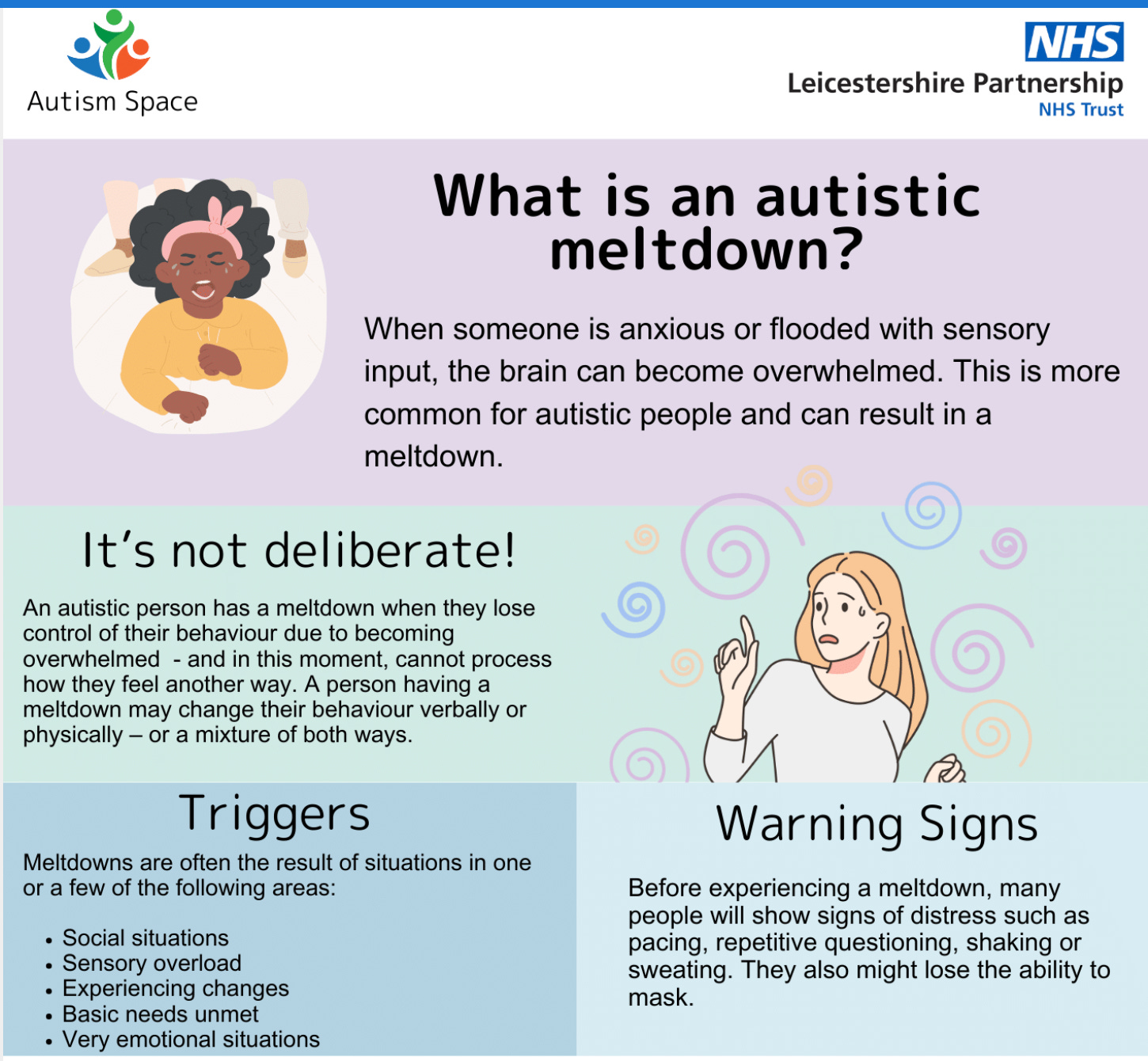
As co-founder of Canada’s autistic self-advocacy organization, I’ve spoken with many other autistic people since Esti went missing, and everyone can relate to the idea of running away from something painful, without putting on shoes (as was the case with Esti), not knowing which way to run to—barely seeing, caught up in thoughts, feeling misunderstood and all alone. It’s often called a meltdown.
Meltdowns can be dangerous to the person because there is this feeling that the meltdown will never end. It is a kind of inner noise that seems ceaseless in the moment. Like any trauma, after a meltdown we have to process a lot of complex emotion in order to mend bonds, to move forward.
Unfortunately, state-run social services mostly fail autistic people and their families. Much support for autistics comes from finding each other, usually as adults, and working through trauma together, usually in a low-key way. There is no psychiatric drug that provides that kind of experience, and no therapist that can approximate it. it is community—and as such, we come to rely on each other with a trust that doesn’t extend to institutional supports.
That same kind of unity and connection is happening in the Jewish community now. Haskala instructed Jews to integrate, but in times of pressure Jews still need to insulate—to make a living, to be safe, to stay sane, to be connected to the divine and transcend a troubled world. That’s the zeitgeist in today’s diaspora, in many ways.
Since October 8th, antisemitic hate crimes have skyrocketed. The City government of Toronto turned its back on the Jewish population, enabling harassment and terrorism to flourish. The police response to the nearly-daily hate rallies and crimes has been astonishingly inadequate, and our Liberal federal leadership appears disinterested, with Canada’s Foreign Affairs Minister receiving praise from Hamas for defending its actions. In addition, labour unions, universities, public schools and even hospitals have become hotbeds of antisemitic radicalism, blackballing Jews and parroting terrorist talking points verbatim.
The fight, flight or freeze instinct kicked in. Many of us first froze, as our colleagues and “friends” betrayed us in favour of the blood- libel mob. Then we flew—to new communities, and back to familiar places: shul, the JCC, ethnic associations, and good ol’ God. Astonishingly, many traditional Jewish charities simply froze—collecting data and issuing statements/donor appeals, but not helping the community in any tangible way.
Luckily, amazing new groups like Tafsik are taking charge (And they have been an absolute powerhouse, locally and globally!) Then there are new sector-specific efforts, such as union members and doctors are also fighting back to protect Jews at work, creating their own professional groups. (I’ve covered this in my podcast).
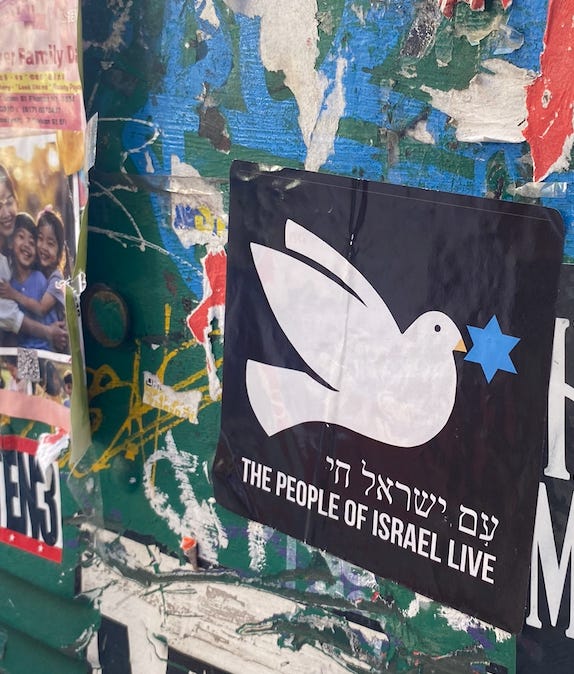
History is repeating itself. Our local Jewish hospital, which serves all patients, was established in 1923 as a space that would hire Jewish doctors and treat Jewish patients fairly, in a deeply antisemitic era. That used to feel like that was history, but not anymore. Some even wonder if our insulated spaces here in the city are enough. Many Jews are emigrating out of Canada entirely. Fight, flight or freeze--again.
It is difficult to be an autistic teenager. It is also difficult to be the parent of an autistic teenager. And as long as we’re being honest here: It’s difficult sometimes to even be in a family. There are certain agonies that come with trying to live together, including as a community, especially when life is made more difficult by a culture of hate that pokes, insults and threatens from the edges.
In these times, staying connected is not just about being together, it’s also about looking inward. The arc of Jewish history shows us that our perseverance has always been predicated on a certain amount of reflection, whether through prayer, philosophy or simply allowing for quiet moments to download our experiences, as it were.
As we continue the search for Esti, I hope each of us can cut away the harmful noise and remain focused on the task with renewed energy each day. If you pray (whatever religion you are) please pray for Esti.
No posts
Comments
Nothing yet. Say the first thing.
Sign in to join the conversation.