
Matthew’s Gospel, like any story worth telling, has a structure. There are discoveries, developments and crises, and then outcomes or resolutions. Few Gospel passages are timeless pictures of unchanging truth (despite the proverbial suggestions otherwise); they have a context that needs to be understood. Reading a particular Gospel through the liturgical year can help, although the interruptions of the Lent/Easter cycle mean that we are now picking Matthew’s narrative up after a long break, and some effort is required to re-establish just where we are, and where Jesus is, in the story. In this passage we find Jesus’ work at a key turning point.
The first verse of the Gospel as read (9:35) is an almost explosively dense summary of Jesus’ healing and preaching in the previous few chapters. It is close to identical to 4:23, just before the Sermon on the Mount: “And he went throughout all Galilee, teaching in their synagogues and proclaiming the gospel of the kingdom and healing every disease and every affliction among the people.” So this is a summary or bookend, and in between the two statements these things have been taking place.
These were all a fulfillment of Messianic expectation. As Ulrich Luz puts it, “The OT coloring is now in full relief”;1 that is to say, Jesus has embodied the picture of the new Davidic king who would restore Israel’s fortunes.2 His ministry is not so much a “religious” program in our terms; even if its “political” aspect also defies usual categories. He has healed and liberated those whom he encountered, proclaiming and enacting his new regime, the reign of heaven (4:17). Now comes the hinge between Jesus’ activity and the call of others to expand it:
When he saw the crowds, he had compassion for them, because they were harassed and helpless, like sheep without a shepherd. Then he said to his disciples, “The harvest is plentiful, but the laborers are few; therefore ask the Lord of the harvest to send out laborers into his harvest” (9:35-38).
We have seen before that this sheep language is a political metaphor, well-established in the experience of Israel (cf. Ps 23, Ezek 34, etc.), a reminder that the project of Jesus is related to that history. Under foreign occupation and with local cronies collaborating, Judea and Galilee again have no just and effective leadership. Jesus has come to announce and establish it, yet invokes the need for a wider campaign and additional “laborers.”
So Jesus calls the twelve. They come into focus gradually across this passage, as a group and then individually. First, Jesus just addresses an unspecified number of “disciples” (9:37) when lamenting Israel’s oppression and discerning the need for others to join the work. Then he focuses on “twelve disciples” (10:1) but, after the idea of a mission appears, they become “twelve apostles.” “Apostles” is a more specific, and more exclusive, term in early Christian writings; everyone on Jesus’ side is a disciple, but not everyone is an apostle. Apostles are literally “sent ones,” so when they are mentioned for the last time in this passage (10:5) they are just “the twelve,” but he “sent them,” using the same language as a verb instead.3
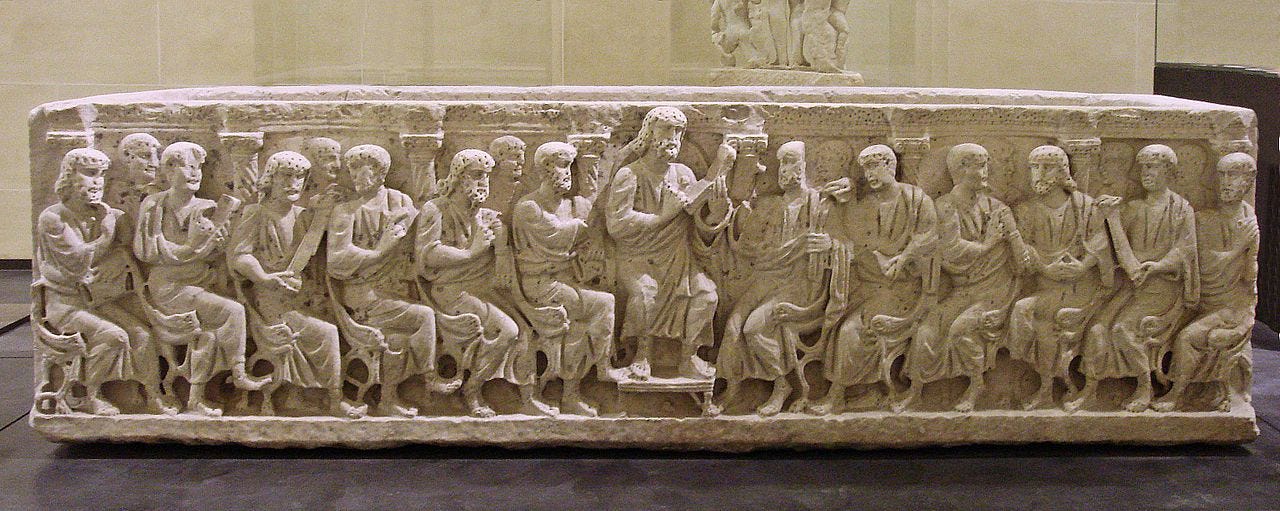
Last in this process of focussing in and defining them, a set of final close-ups as it were, the twelve are named one by one. So this story is not being told, at least initially, as a general paradigm of ministry, but for remembrance of their unique place. Just as much as telling of Moses striking the rock to look after the thirsty wanderers, or Elijah contesting with false prophets, recounting the place of the twelve—their number an echo of the twelve patriarchs, the sons of the original Israel (=Jacob; cf. Gen 49 etc.)—is remembering their unique part in this great epic.
If we do not understand their place in the story, the exclusivity of the mission for which they are empowered is jarring: “Go nowhere among the Gentiles, and enter no town of the Samaritans, but go rather to the lost sheep of the house of Israel.” These instructions are the marching orders for a particular campaign, that work to which the twelve have been called during Jesus’ ministry, which he has emphasized elsewhere is for Israel. These wandering radicals were being remembered by Matthew and the first readers as part of a remarkable period of the history, or even pre-history, of their movement. This is establishing the new regime for the “harassed sheep,” not yet a universal mission at all.
Yet there are also hints that this picture is meant to inspire some kind of imitation in the reader and not just nostalgia for that greatest generation. This will be easier to see if the longer version of the reading is offered, because in the later verses there are hints of a situation more like that of the early believers reading the Gospel than of the twelve at that time. The punishments in synagogues, the trials before governors, and even (or especially) executions, were features of the following decades, not of the actual time being narrated. These warnings may hint at the later lives and fates of the apostles in particular, but the time frame seems to have slipped into the future regardless.
This slippage is even more curious when Jesus promises the work would not be complete “before the Son of Man comes” (v. 23). That last verse is somewhat cryptic, but it seems to suggests the mission of the twelve—and so that of Jesus himself—was not just in the past. While that promise of the coming of the Son refers to “all the towns of Israel” we know that at the end of the story there will actually be a different mission that extends beyond Israel. A universal proclamation of the Gospel would only become possible after the campaign of the twelve, and most of all after Jesus’ own great struggle with the forces of evil. The cross itself is the standard raised by the regime he has proclaimed, stated ironically on the label the cross bears.
The epilogue to this account of the campaign, and a clue to its meaning, is not found in this reading but is the last story in the Gospel, where Jesus once again instructs and sends the twelve (Matt 28:19-20). Then and only then, after the true shepherd-king of Israel has given his life for the “harassed and helpless” people, these same apostles are sent to extend the mission to all nations. Jesus had come as Israel’s Messiah, and called a new set of leaders—symbolically, twelve new patriarchs—to represent a renewed Israel through whom all the nations would be blessed.
Their renewed commission at the end of the whole story is to teach and baptize new “disciples” (28:19), bringing us back full circle. The reader should understand themselves as referred to now; we did not get here just because this was written however, but because particular ancient disciples had responded to Jesus. The call to participate in Jesus’ mission is for all who now hear this Gospel read, but it was not always about us. Yet we, “all nations,” do have a place in the reign of God once proclaimed to Israel, and the practice to which we are called may be as revolutionary as described in this Gospel, because the story did not end.
Luz, Matthew v.2, p. 51.
Contemporary realities may require me to note that the modern state of that name is not directly relevant to the biblical idea of “Israel,” although the Jewish people in whatever time and place certainly are.
So in v. 2 their title is “apostolos” and in v.5 he uses the verb “apostellō” instead.
Comments
Nothing yet. Say the first thing.
Sign in to join the conversation.