
Last week Jesus sent the twelve out, or seemed to; in fact his commission of these new apostles goes on for a whole chapter, of which this Gospel reading is a section. The lengthy instruction is thus a second Matthean “discourse,” or extended speech by Jesus, after the Sermon on the Mount (and three more to come).1 This one is sometimes referred to as a “missionary discourse” for obvious reasons, but also as a “disciples discourse” by Ulrich Luz.2 Both designations have their strengths.
While the “missionary” aspect seems obvious from the content of the instruction, the connection with the Gospel narrative is curious. The apostles had indeed been “sent” (10:5), yet they are obviously still with Jesus as he speaks. When Jesus finishes these instructions (11:1) “he went on from there to teach and preach,” but the twelve are not mentioned, at least explicitly. We do not hear mention of their departure, nor of any return (unlike in Mark 6:30). The implication is that the rest of the Gospel story constitutes the mission, and that they share it with Jesus.
Their solidarity with his own work helps explain these urgings and warnings in the missionary discourse, a collection sometimes viewed as “without much purpose.”3 The group of sayings seems to have been gathered here to illustrate the theme of solidarity with Jesus and his own story (in Luke and presumably in any shared source the parallel material is dispersed).4 The last (optional) part of the previous week’s Gospel had already introduced the risks of discipleship, warning of punishment, exclusion, and even death. Now as Davies and Allison put it, “the imitatio Christi runs like a bright thread throughout” these verses.5
As we pick up the discourse with the saying about disciples and slaves not being “above” their teachers and masters, we may be distracted by democratic objections to hierarchy (or just wonder how “missional” this could really be).6 Power notwithstanding, the point is affinity more than hierarchy. Ancient ethics often emphasized the exemplary nature of roles we would call leadership. The responsibility of a teacher (etc.) was to act wisely and in a way fit for imitation; the role of student (etc.) was correspondingly to be as much like the teacher as they could. The critique offered by Jesus to those placing themselves “above” here is not so much, or not just, about inversion of power relations, but about a lack of affinity or solidarity that this would imply. This of course corresponds neatly with the kind of “sending” here that actually meant staying with Jesus. The disciples are being urged to imitation, not autonomy.
This basic point of solidarity with Jesus not only provides coherence to these sayings but links the missionary discourse to what preceded it, and what will follow. Jesus had taught (the Sermon on the Mount) and performed his great works (4:23, 9:35), and this extended call to apostolic mission now joins the twelve to him and extends his practice through them; but the significance of all this depends on what follows, and in particular on Jesus’ death.
Three times in this part of the discourse the question of death arises as a possible (likely?) consequence of discipleship:
Do not fear those who kill the body but cannot kill the soul; rather fear him who can destroy both soul and body in hell (10:28).
then, after the saying about loving family more than him:
…and whoever does not take up the cross and follow me is not worthy of me (v. 38).
Last comes the saying (v.39), which unusually is also shared with John’s Gospel (12:25), about wanting to save one’s live and losing it (and, more importantly, the reverse). These are of course accompanied by words of profound reassurance, in the repeated “do not fear” etc. (vv. 26, 28, 31); the assurance however isn’t the optimistic “don’t worry, it’ll never happen” but rather the hope-filled “yes, it may happen but it in the end it won’t matter.”
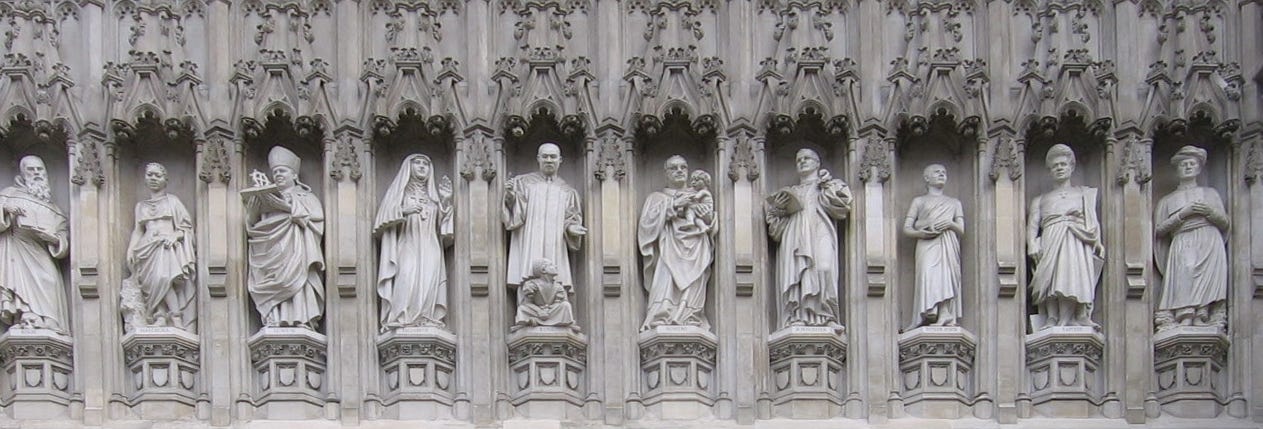
Following Jesus will, it seems, lead to conflict and suffering. We can see, by the way, that the horizon has drifted a bit, so that just as Jesus’ future is being alluded to with the reference to the cross, so also the experience promised to the disciples is more clearly related to their work after his ministry than to anything Matthew will go on to narrate directly. It is also intended as a message for the reader then, and a reminder that as Vicki Balabanski puts it,
…the disciples are not the only ones who have been ‘sent’: there have been prophets in the past (11.13; 21.34–36) culminating in the work of John the Baptist (11.10), and there are ‘prophets, sages and scribes’ still to come (23.34).7
Conflict in any case is not an abstraction, nor are these forms of struggle being presented as inherently good. The prospect of rejection and alienation by family and community are not subtle assessments of those allegiances in themselves, but of the disciples’ new allegiance, of solidarity with Jesus. This is also how we should understand the language of being “worthy” of him or not (vv. 37-8); this again is a way of naming which form of community one has really chosen.
Just as alienation from family and other community is not an end in itself, suffering and death are not abstractions here either. The particular death that hovers over this discourse and interprets it is named at 10:38: “whoever does not take up the cross and follow me is not worthy of me.” The cross is not (despite the traditional misuse of this saying) a way of talking about chronic hardship or other burdens, but about the shame and suffering that might be consequences of discipleship. The plank or patibulum that the condemned carried, before both it and they were affixed to the scaffold—so not a “cross” in the sense most traditional art depicts—was the mark of the condemned, and under Roman rule its imposition was the sign of the rebel and upstart, the person who had refused to accept the mastery or teaching of the Empire. To accept the cross is symbol of solidarity with Jesus and his new regime. Hence the story that will unfold as we read from here on, of Jesus and his cross, is also key to the meaning of discipleship.
This theme of solidarity with the crucified is what has drawn the missionary discourse together. The call of the disciple is not to “spiritual growth” in some purely inward sense, nor for that matter to see external measures of family and material success as signs of religious achievement. So this is not a Gospel remotely like that of prosperity theology, yet it also poses significant challenges to liberal or progressive assumptions too.
Although I just noted that this is not about mortality as an abstraction, we could qualify this. Jesus’ struggle is with the forces of death throughout this Gospel; the fact of death is ultimately a sign of that disorder. These forces are embodied in Roman imperialism, as well as in demonic possession, but they are all of a piece. The test of any spiritual or religious practice, if this Gospel is our guide, may then be how well or poorly those equip us to consider how suffering and death are manifest as the product of evil. In some more progressive piety, what passes for God’s action is merely the cheery, and God is only visible or named when things have gone right. If divine solidarity with us were only in joy and peace however, those whose faith has endured to death without obvious signs of redemption—the martyrs— are only worthy moral examples, whose lives were tragically cut short. They did not gain anything, but lost all.
This discourse suggests however that what seems to be true about our lives and those of others must bow to a perspective that is eschatological; that is, that God’s ultimate resolution of our lives, including the ways suffering and injustice are resolved, is not the obvious or material present. The Gospel dares us to consider the possibility that every disciple’s life lived fully, long or short, and especially those lived without regard to the apparent cost of living that way, are triumphs, not tragedies. And so in both the call to radical discipleship and in the possibility of knowing God’s presence even in death, there is an implicit challenge to consider the very nature and person of God: more than an abstract force for good, but the one who raised Jesus the crucified from death.
The other three are the parabolic sermon or discourse (Matt 13), the “ecclesial” discourse (18) and apocalyptic or eschatological discourse (24-25).
A judgment reported but not supported by Harrington, Matthew (Sacra Pagina), 152.
Hence for most commentators the material comes from the source Matthew and Luke share, “Q.” Harrington’s analysis: Matt 10:26-33=Luke 12:2-9; Matt 10:34-36=Luke 12:51-53; Matt 10:37-39=Luke 14:26-27, 17:33; Matt 10:40-42=Luke 10:16/Mark 9:41 (Matthew [Sacra Pagina], loc. cit.). It is easier to see Matthew editing these together from different parts of a source to create the discourse (and the overall structure of five discourses) than to imagine Luke “unpicking” (as it has been described) and dispersing the discourse into these different passages.
The issue of slavery is not readily dispensed with, but the use of familiar images including power structures in sayings and stories of Jesus does not imply anything about their inherent value. It is clear enough that this author does not envisage the permanence of any such institutions.
“Mission in Matthew against the Horizon of Matthew 24.” New Testament Studies 54 (April 2008), p. 162.
No posts
Comments
Nothing yet. Say the first thing.
Sign in to join the conversation.