
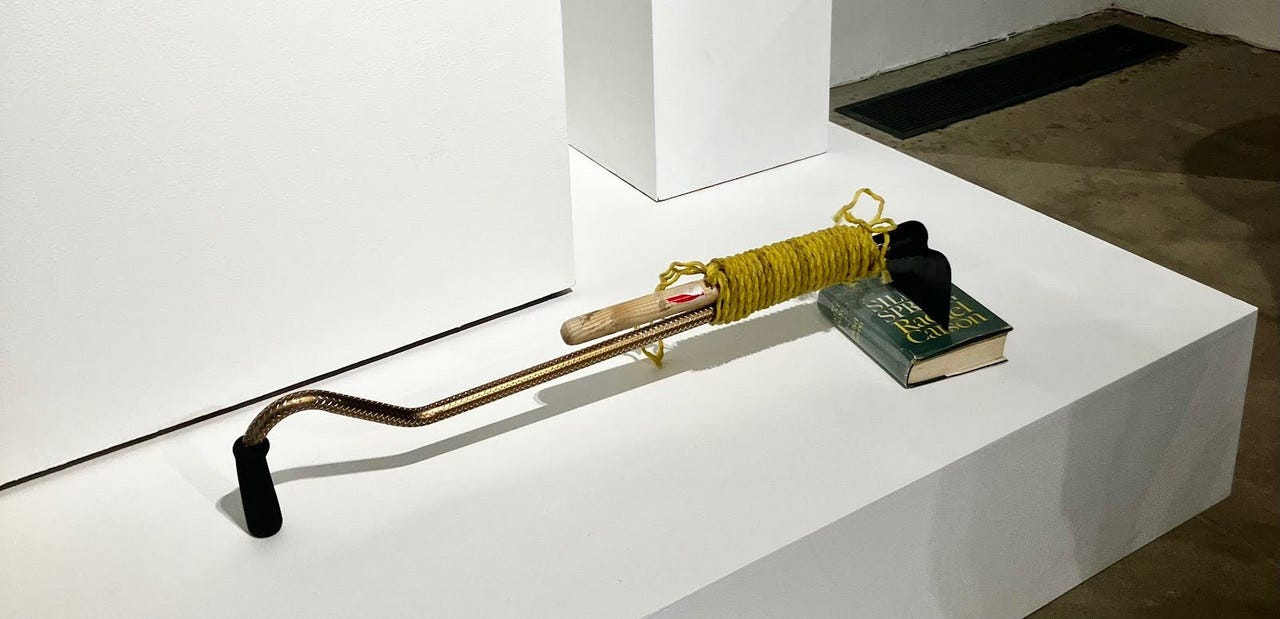
Cielo Saucedo is a disabled, interdisciplinary artist and access worker from a family of migrant farm workers, based in Los Angeles, California. Their work focuses on the dispersal of ableism through cultural economies. Their multidisciplinary approach encompasses writing, computer-generated imagery, sculpture and machine vision. They received their BFA from the School of the Art Institute of Chicago in 2020 and their MFA from the University of California, Los Angeles, in 2024. They were also an Eyebeam Democracy Fellow in 2024.
Claudia: ¡Hola, Cielo! Thanks for agreeing to talk with Able Zine about your work. Some pieces I’ve seen have really resonated with me as a disabled person and as someone of Mexican diaspora with many ties to the US. Let’s start the interview.
Cielo: To me, Los Angeles is the centre of the world. Living here, being gay here, leaving and always coming back. LA is so much about movement, maybe it’s because of the freeways and cars. When speaking about being from LA, it’s about arrival. How did you get here? When?
I arrived at art because I became ill. Disability is often framed in arrival, too. How did it happen? When? There are markers, but there is also the act of disclosure. It’s a moment shared among other sick or disabled folks that is this contact point. Or something unsaid, obvious, and none of our business. How close are we together? How far apart are our experiences? There is disclosure to health care providers and social services that are more harsh.
I was in and out of the hospital in my 20’s and decided to change something because I wanted to mark my life, and I just liked art. I really think narrative-free desire is important. It felt like it was slipping away within the walls of the psych wards, mostly. I was really caught up. Art felt like a marker of thought. It allowed me the opportunity to leave LA to pursue an art education in Chicago, and it brought me back to LA because I was ill again and wanted to be close to family. Again and again, markers of arrival.
Cielo: I think my purpose as an artist is to be near people. My people are disabled, workers, musicians, stylists, artists, and caregivers. That dynamic oscillates between satisfaction and hard feelings. Questions around authorship and labor come up all the time. And we laugh and are critical of choices. There is this kind of rebounding mirror, like extreme recognition, embarrassment and growth. Like you’re coming to terms with how ideas land in a faster way.
I have political purpose that is abolitionism. In light of terror, that purpose sharpened. I have an aesthetic purpose to be in conversation with the work that is meaningful to me. I love being in study. To be in constant study is an act of closeness. But like I said, it’s a means to work with the people I love.
Within my last two presentations, this idea came up as anti-surveillance. Sense 001: Data Haunt (2024) was made in collaboration with researchers/artists D.A Gonzalez and Christal Perez, with the score composed by Jazmin Romero. Rotten Sun felt like cracking as many jokes as possible during rehearsal to keep each other laughing and keep the chorus going as one voice. In all those works, I hoped that if I brought together as many people as felt sustainable, I could de-centre myself and the fantasy of a singular artist alone in their studio. It’s like the idea of a mob or a riot, that’s where fear and power lie. In the unmarkability of the collective. I want to make work like that. The art market is dependent on the circulation of a single person as much as the state is reliant on the identification of single citizens as a mode of management.
Sense 001: Data Haunt (2024) Video Description: Autonomous machines surveilling the southern borderlands are characters in Sense 001 where the player hacks into border patrol software accessible by a VR headset. This game mimics the genre of horror games and uses the mechanics of accumulation in the form of clues and documents to reveal the gore of ultra violent necropower present at the US Mexico border.
Cielo: I think about it in terms of virtuality. To be virtual is a simultaneity, multiple states acting all at once, becoming amplified. The digital body in my work is as actual as my blood body turned around and around by augmentation. The extremity comes from the realization that the digital and the natural are dependent on one another, and the border that separates them is in service of their own construction. They generate each other. And I generate myself through that too. I think about the audience a lot, too. How the work is networked through them, extended through the other.
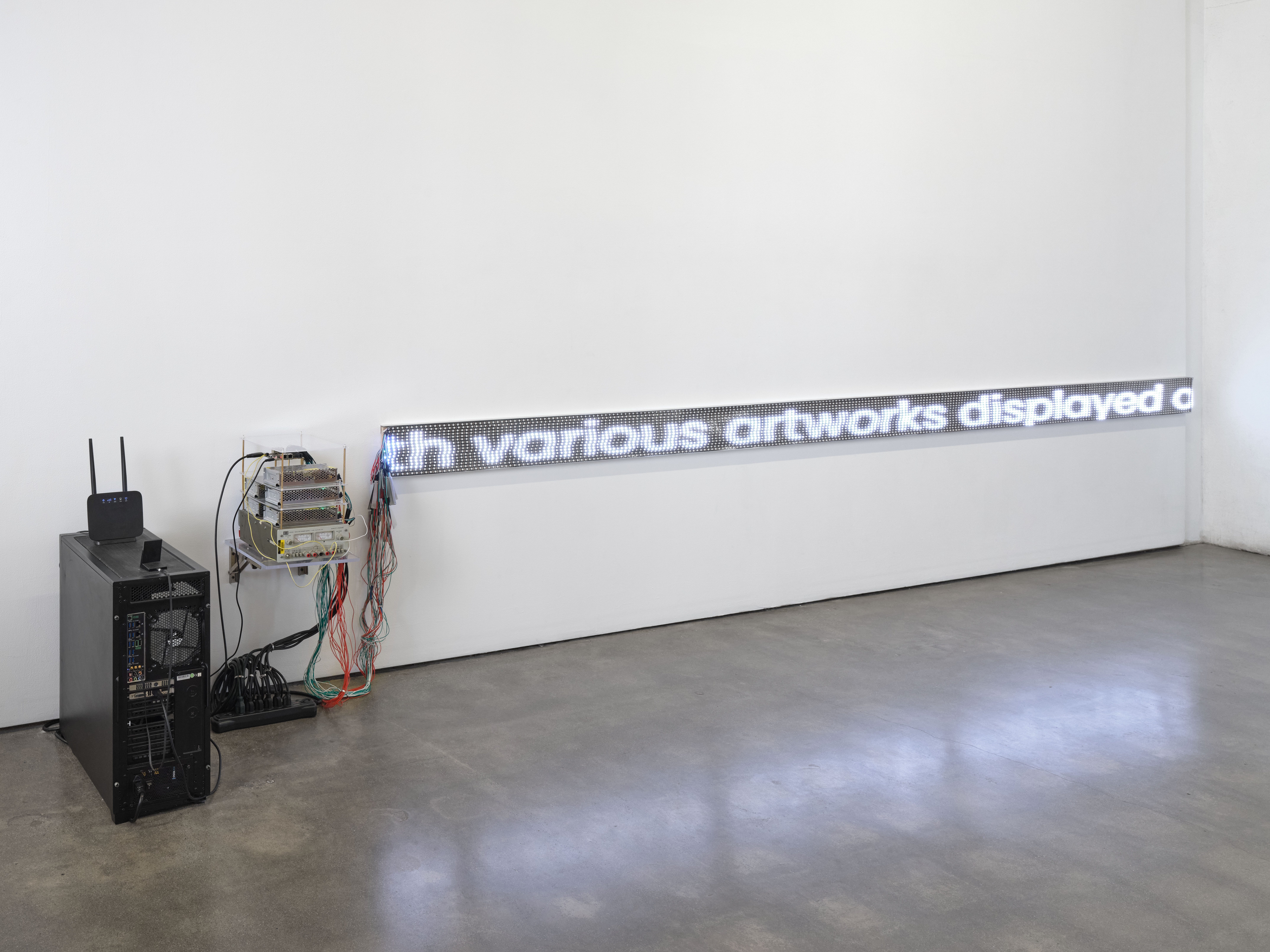
That’s where the logic of disability comes in a little bit. In my work, Captioning System (2024), real-time photographs of the gallery (and the artworks and people in it) are fed into an ML model I built with developers, and the resulting image descriptions scroll on an LED screen outside of the gallery.
I was trying to disturb the supremacy of sight and physical experience because I spent a lot of time online, not being able to be in places.
Susan Sontag said something like photography not having much to do with seeing, Harun Faroki too. The work is made in that chorus. The relationship between the machine, the audience and me makes the image. Image IDs are such beautiful poetry (shout out to Alt Text as poetry!!!!) developed by disabled people. This study into images and automation has fallen into a larger project about border technology that uses similar softwares for surveillance.
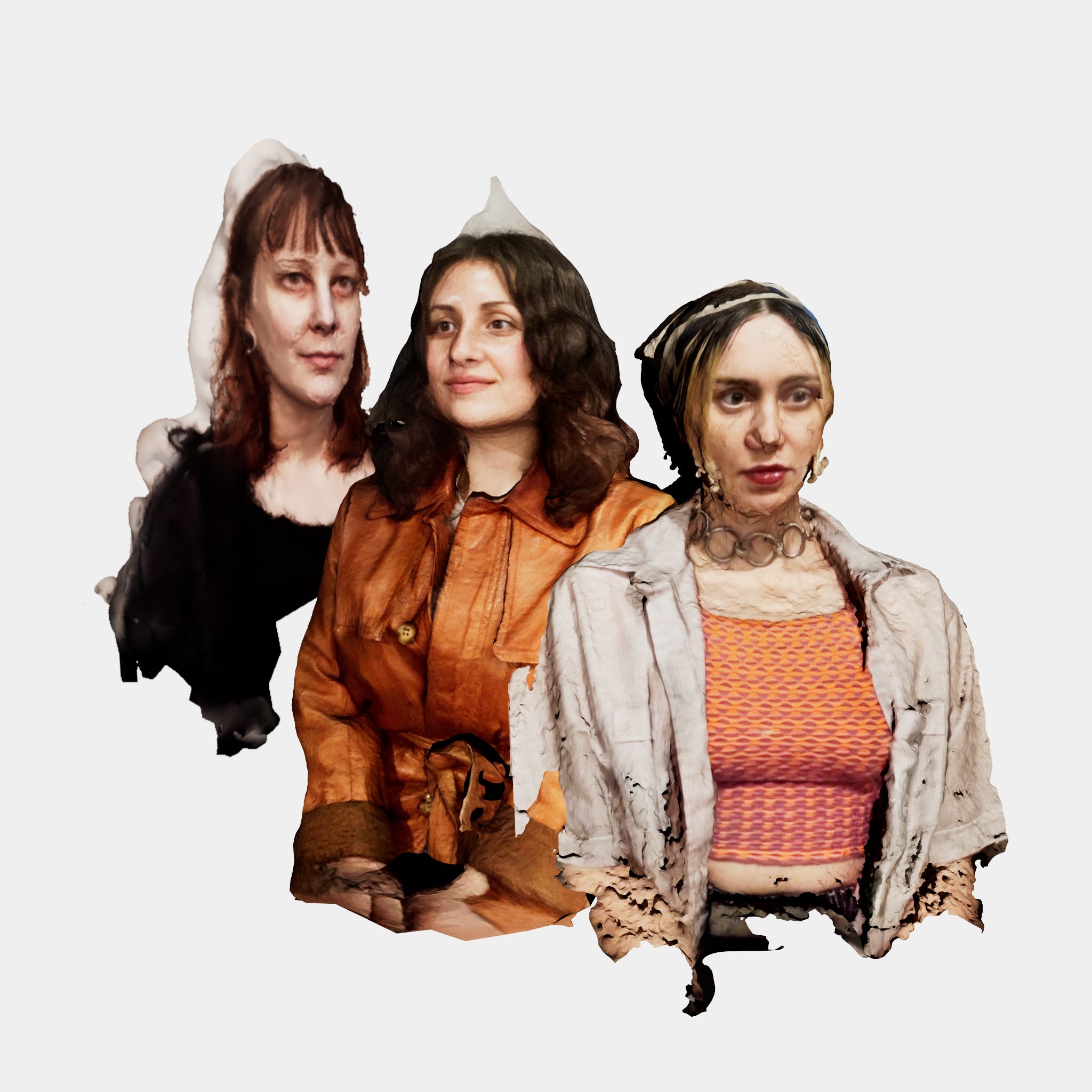
Cripping_CG comes out of our relationship to our disabled bodies and the interfaces (both soft/hardware) that translate them into the digital. We all met online. Nat and I both had been working in 3D animation and found that the infrastructural barriers within the softwares that we used to make our work interfered with our ability to show our bodies as we felt them. Olivia had been using biased character generators to create narratives about disability. Our project is an archive of motion capture made with people in our communities and a resource for other artists to use the data we collect in their own projects. We embrace the inability for software to capture the intricacies of disabled movement.
It’s been a joy and it operates in a very crip way. We pick it up and put it down, we write and worry together on the phone. It’s a wonderful thing to work on over a long period of time. Olivia is a mother, and her daughter is almost as old as the project! The realities of responsibility, love, and children change the way we approach this work. Our capacity is flux, the softwares are flux, the people we work with are flux, the representative data flux. The project is built on that at its core.
I think about it in terms of labor and as a narrative device. It shaped the content of my work. My family’s migratory history, their lives as migrant farm workers are the context in which I make my work and that has so much to do with the US. All of that comes into contact with my own labor as a disabled person, who, because of my disability is often prevented from being seen as a worker at all. I have made work about welfare systems that I’ve been part of. I want to misuse the systems.
As a disabled person, augmentation is unavoidable. Assistive technologies are scalar and shape how we move through the world and I am dependent as a rule. The first cyborg was disabled but of course they say it’s a man called Steve Mann who is cool but naming him that is missing the point. The central body of tech is an imagination. It’s a worker that needs to be optimized for maximum output or a criminal that needs to be documented and apprehended. Disabled folk are leveraged for university funding for access tools that eventually funnel into weapons. It’s a moving target in need to be captured.
Glitch is especially important in the Cripping_CG work, where we basically say that the glitch is disabled. The cyborg definitely haunts that project. It makes obvious the networked self.
I’ve been feeling called to intensity. I feel really intense. I like the register of Tania Bruguera and Teresa Margolles. They warp control and make work that’s environmental and pulls.
Arilia Azulay and Oraib Toukan, Susan Sontag, Gonzalo Reyes Rodriguez, Harun Faroki and Hito Sterly teach me about images. Dan Graham is a favorite to study, his work is so much about disability and fracture. Constantina Zavisantos too. Mel Y. Chen and Zakiyyah Iman Jackson. Kelly Lytle Hernandez is an incredible historian that I’ve been spending a lot of time with learning about the border and policing. I’m working my way through all her books.
Lately, I’ve been into the idea of getting dressed. I make work that feels like documentary sometimes, so how self refracts and multiplies through images and history. I love clothes as a way to do that. One of my biggest projects is the way I dress myself and make myself that way. And intuition. That’s new for me. I pull a lot of tarot cards in my studio. It doesn’t make its way in the work explicitly, but i’m trying to be less pulled by content and more pulled by symbol butting up against what’s going on. I’m trying to make more emo work.
Thats so nice! I sometimes feel like I spend large stretches of my life just trying to survive and I’m feeling like that is ok. I navigate it by not abandoning myself.
I have ongoing work that acts in the form of an Access Rider (2021-ongoing). An access rider is a document that advocates for accessible working conditions. Joanna Hedva’s blog post about her own document was instrumental to this work. She goes into detail about what she needs, down to the time flights should be booked to coincide with medication schedules.
I have everyone who comes to my studio for a visit sign a document where we both negotiate our needs. We both talk about what we need to be together for that set amount of time and then go from there. maybe it needs to be online while I’m in bed and not at my actual studio? I’ve had people ask me for honesty. It functions too as a log of who has come by, a long memory of conversations. The document has had its own life cycle, first taking into account the university accessibility protocols of the institutions it was first introduced in, then as recognition of studio visits as sites of unpaid labor. The current document is a recognition of mutual need. Need to me is more important than care, or maybe it comes first before we can approach care.
I invited three performers, Jester, Jazzy and Jesus, to work with me to process the ICE raids that summer and the imaging architecture that was popping up around downtown LA. It was a tough summer in terms of regular military deployment in the US as anti-immigration action. It’s continuing still with the escalation in cities like Minneapolis. Like the work Captioning System I mentioned before, systems of capture are the norm. We approached this in terms of self imagining. The images circulating post-ICE raids are utilized both as evidence of the criminality of the State but also as a warning of the real bodily harm that happens after witnessing subjugation. To witness now assumes culpability. Oraib Toukan speaks about it in terms of Cruel images. In the recordings and circulation of ICE facilitated kidnapping and murder, to witness is to understand that you too are a target. So we met to kind of perform cycles of self imaging. This performance is really different from how I usually work, it was like a desire path.
We walked around the fashion district together. That was a big part of rehearsals. It was slowly repopulating after becoming a ghost town after the raids. I love it there, the AI slop printed on pro clubs. I love the way the vendors style themselves and how fugitive the economy is. We collected pieces of our costumes and talked about our lovers. The look of the place was really evident in the performance, all dusty light and a billboard size projection scene. As was the cadence of our movement which was probably synced from all our walking and talking.
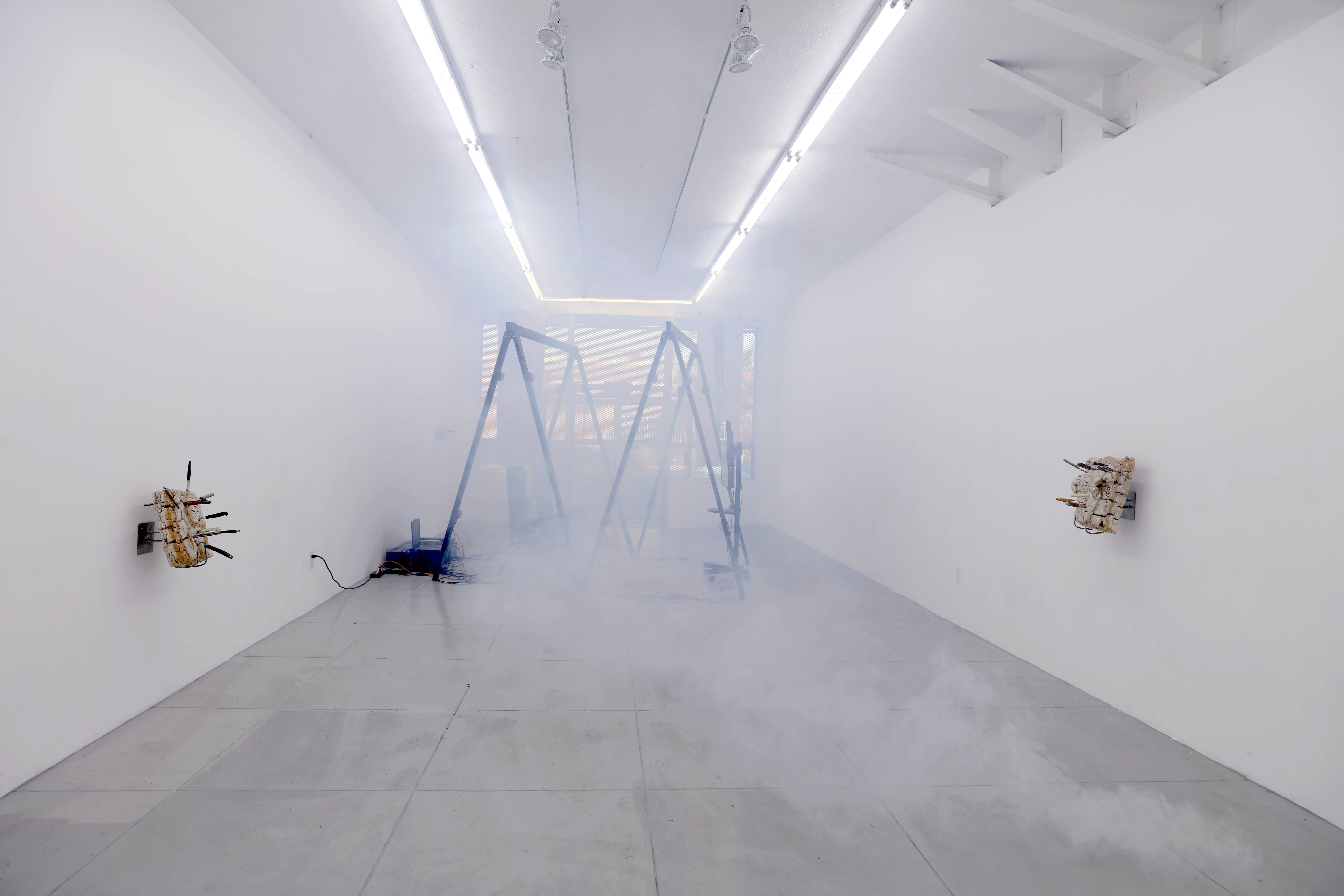
I turned the architecture of Coaxial into a huge imaging device, kind of like the Wooster group with images of the performers rebounding and warping through multiple cameras placed on the ceiling and on c stands. The performance wasn’t recorded. The cameras used a ML algorithm to blur the performers faces. It was staged at an experimental sound venue and the installation was the closest I get to playing music. The stage had 300 pounds of powdered masa, a floating signifier for post-NAFTA afterlives. The smell was volumetric.
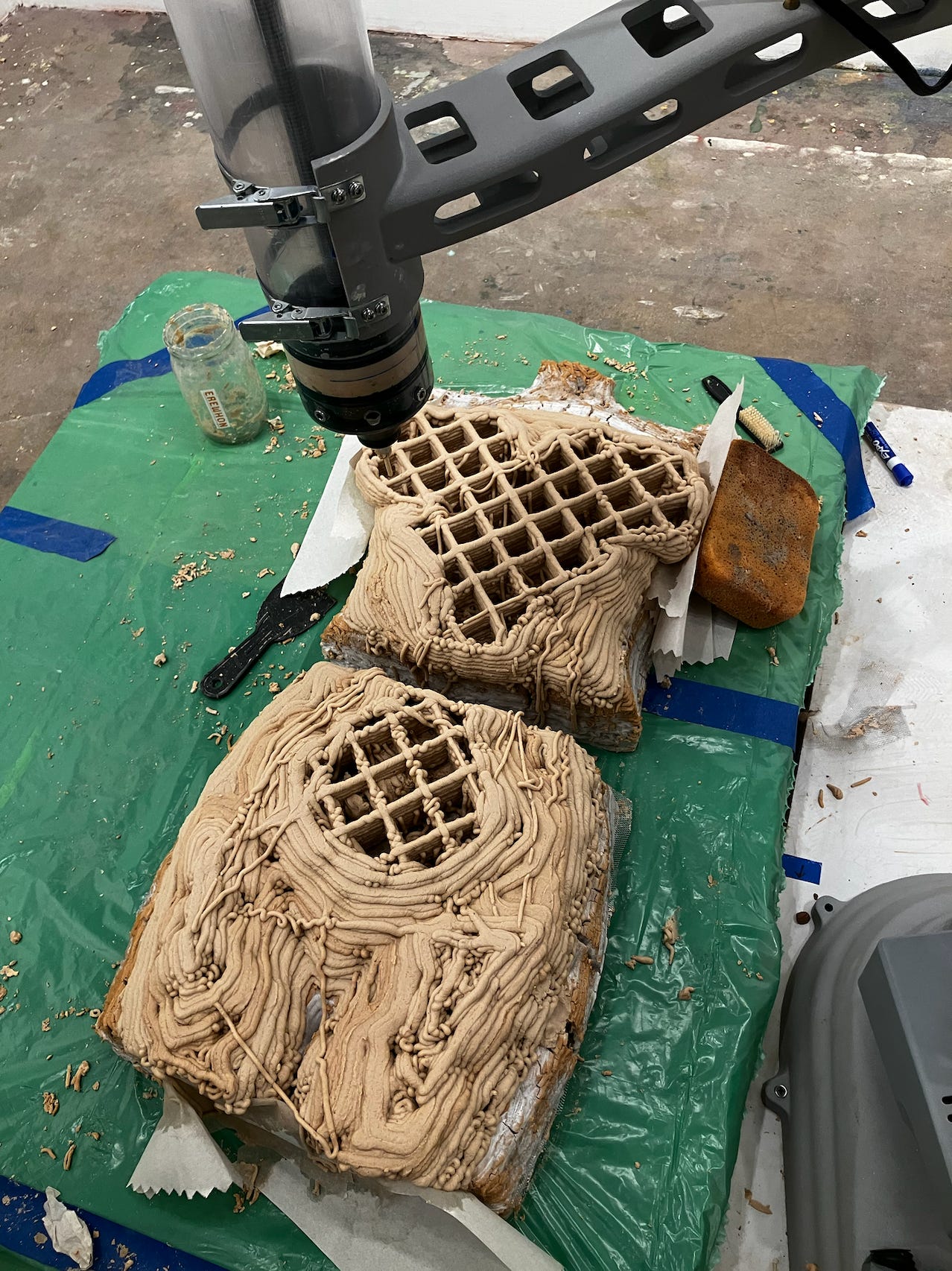
Thank you! They are prints of myself, scanned and processed through a machine I built. Both of those works come from a series titled Masticado (2021-2024). The two works you mentioned were the most body of the suite. For the work I hacked 3D printers to use a mixture of masa, self tanner and lamictal (a mood and seizure medication I’ve been on and off of for many years) as printing medium to make fucked up prints. I’ve been using Maseca brand powdered masa in my work for a few years. It’s this warped material, indigenous and wholly commercial.
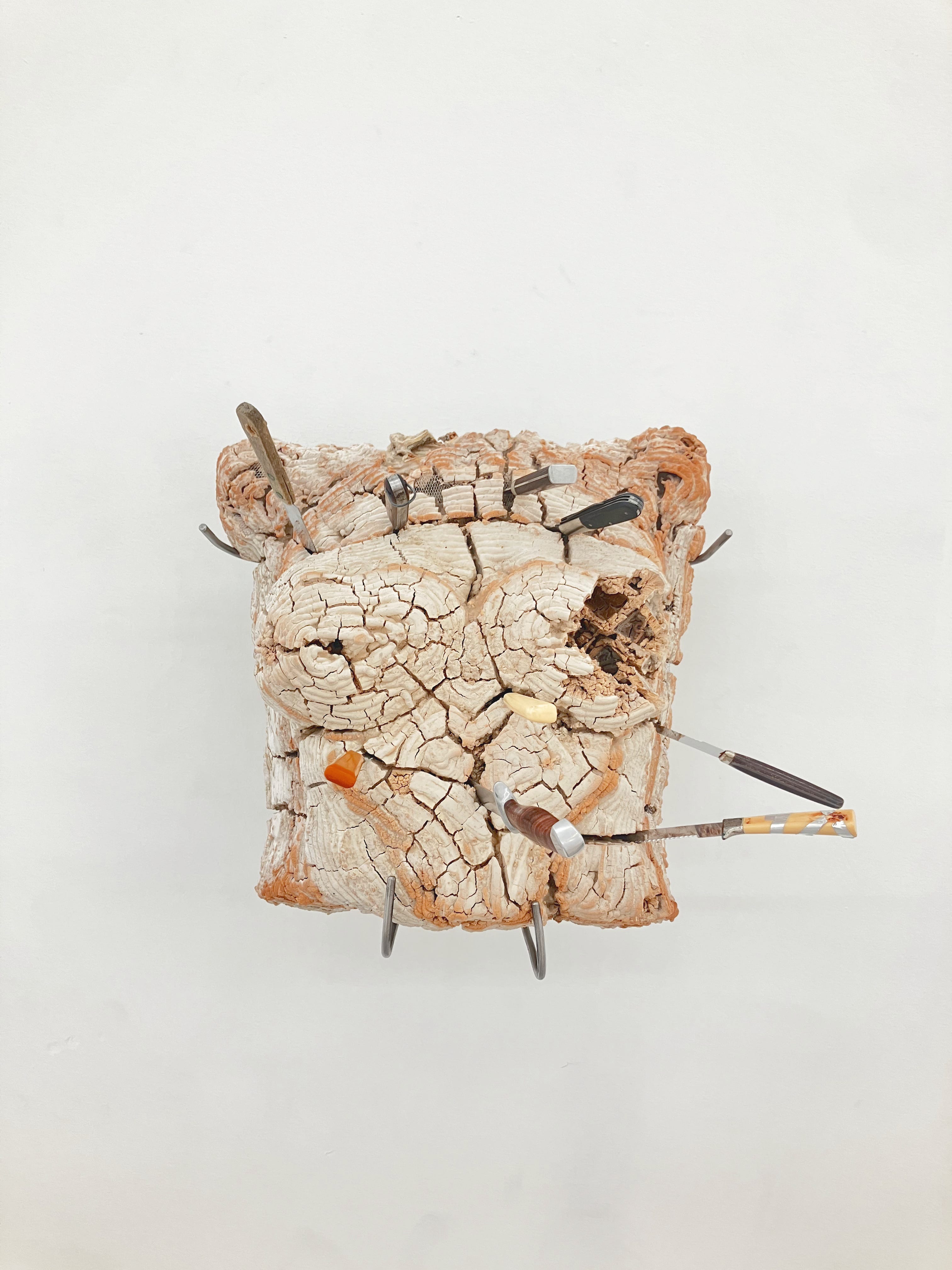
I am not interested in 3D printing because of the capacity for fidelity, a slick surface is not that sexy to me. The title Sublux is in reference to the slight dislocations I experience with my illness, Hypermobile EDS. It’s dissettlement, feeling out joint. The material performs the virtual form. It rots and clogs the machine. Brian Massumi talks about the blood body as an interrupter of systems. I was thinking about Jaspir Puar’s book The Right to Maim and her definition of debility a lot when making this. Impairment or the manufacturing of disability as something that is doled out by the state.
The knives in Sword of Damocles were bought in lots from TSA. They were taken from travelers in airports in a gesture of disarmament. Now they are mine.
I envision the future as multiple. I do think about violence a lot and its plainness. I can be literal. I’ve always been. Networking myself through others and the expansion of self in that regard is my vision of crip world building. DEPENDENCY!
No posts
Comments
Nothing yet. Say the first thing.
Sign in to join the conversation.