
The V&A Museum’s Friday Late ‘Radical Kinship’ celebrated the limitlessness of what creativity can be for disabled practitioners, performers and patrons alike. Whether it was a non-visual artist producing an immersive experience, films depicting chronic illness, or d/Deaf dancers and neurodivergent performers stimming, the spectrum of disabled communities lit up the palatial rooms and halls of the V&A.
The event was listed as celebrating “disabled ingenuity, resilience and ways of life”, inherent qualities disabled people exhibit every day. The curation drew inspiration from the current ‘Design and Disability’ exhibition on display until February 15th 2026, which highlights the radical contributions of disabled people to design from the 1920’s onwards, as well as the ways we subvert expectations, norms, and design codes to represent our culture and community, advocate for our rights and improve access.
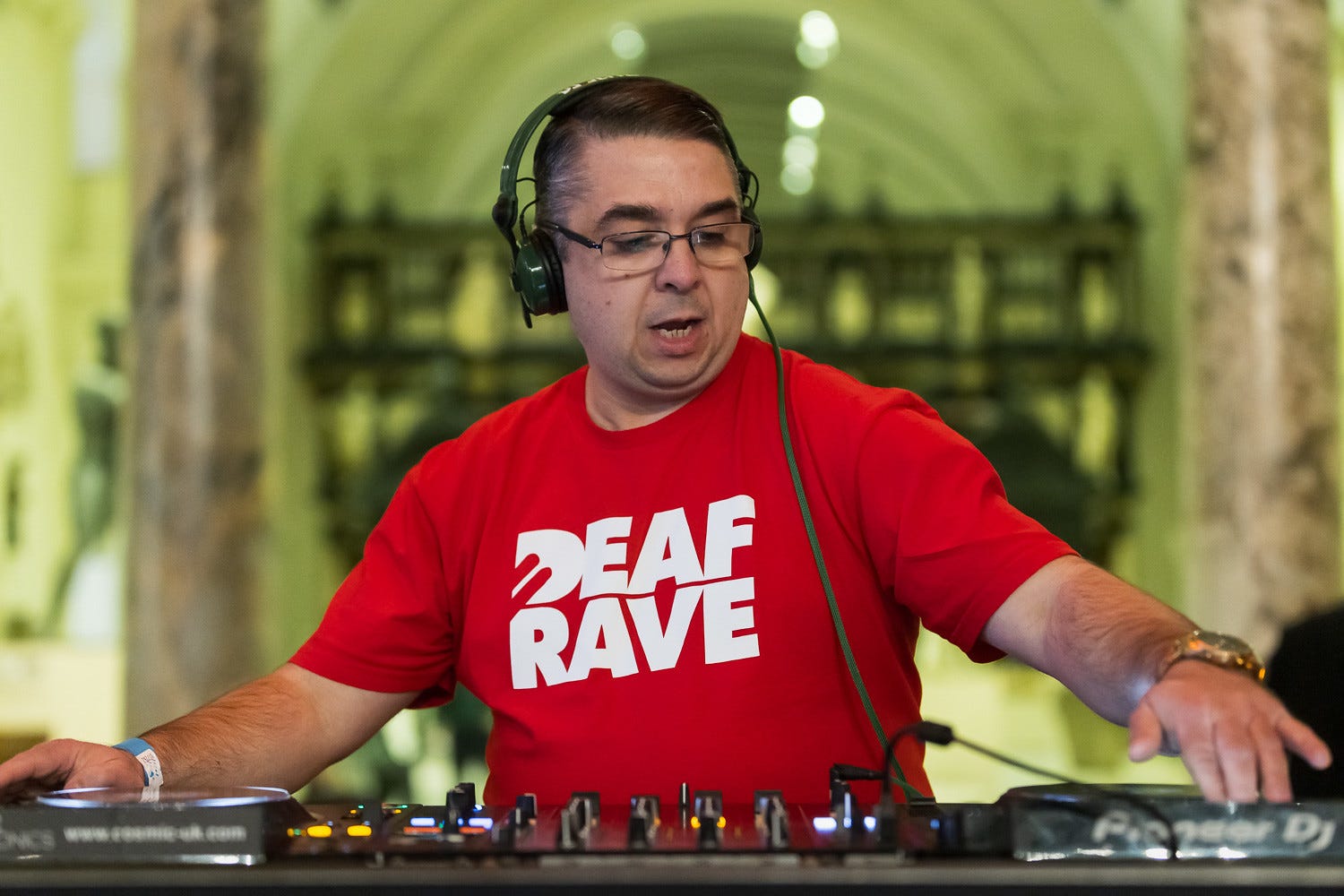
The museum’s Grand Entrance hosted Deaf Rave, which exemplifies this approach to community building by platforming Deaf, hearing and disabled artists. Founder Troi Lee recently wrote in The Guardian about his own clubbing experiences leading to the creation of Deaf Rave, which now hosts an annual festival. It also focuses on expanding access, as haptic vests allow users to feel sound as vibrations running through the body. And with his DJ set booming down the corridors away from the atrium, the Friday Late was the time for other disabled creativity to shine in a live setting.
Considering access was a concept that came up across the 10 activities, it was ironic that it was impossible to see everything in one evening, but this reflects the proliferation of disabled creativity permeating into the cultural mainstream. The range of activities also captured the importance of creativity, not as a performance but as a practice for anyone.
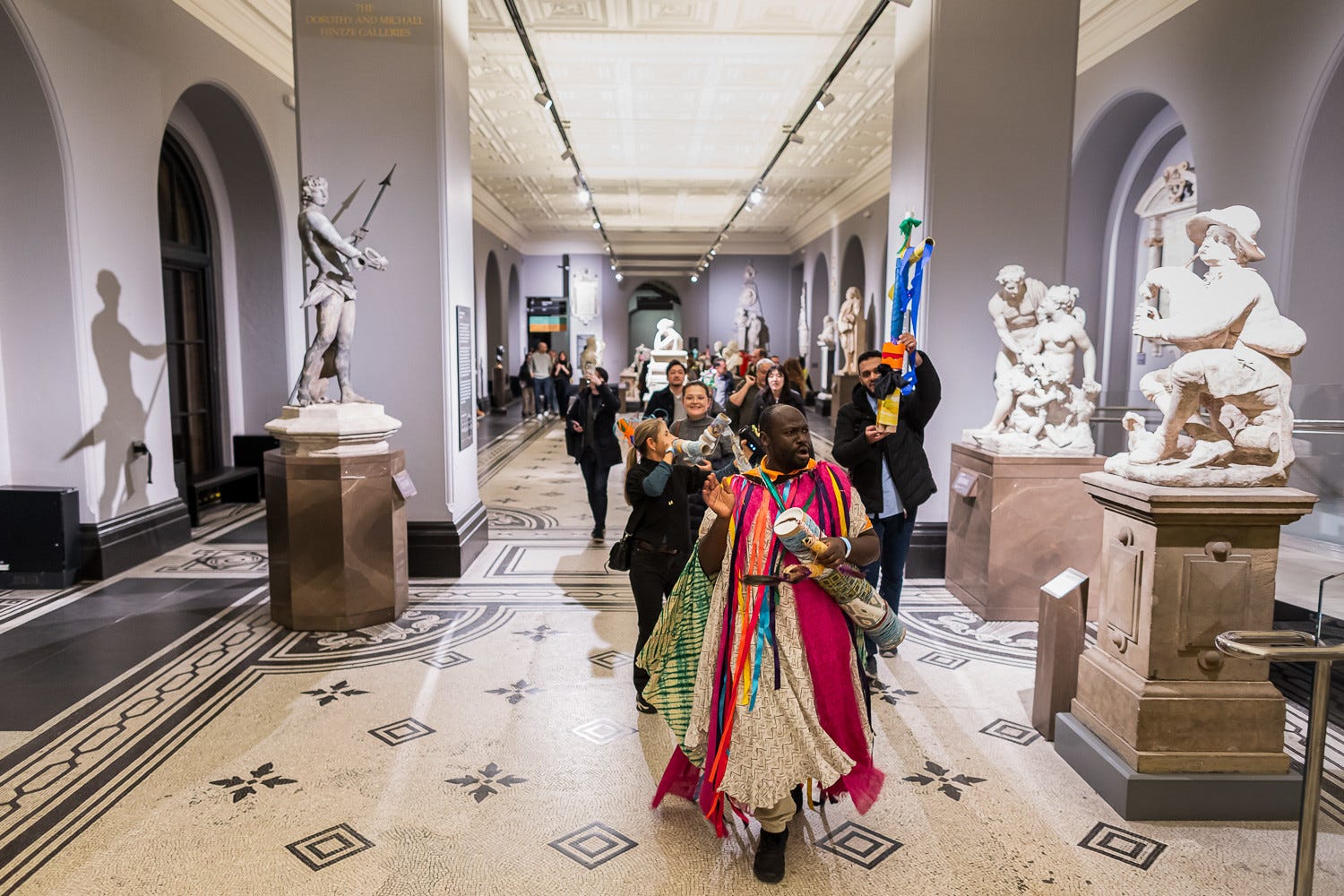
This participatory aspect extended to the workshops run by artist Andrew Omoding, where you could create drums, costumes and assemblages for a joyful parade, and the ‘Puffing and Wooling’ drop-in ran by Tilley & Del as a relaxing space to do arts, crafts, poetry and den building.
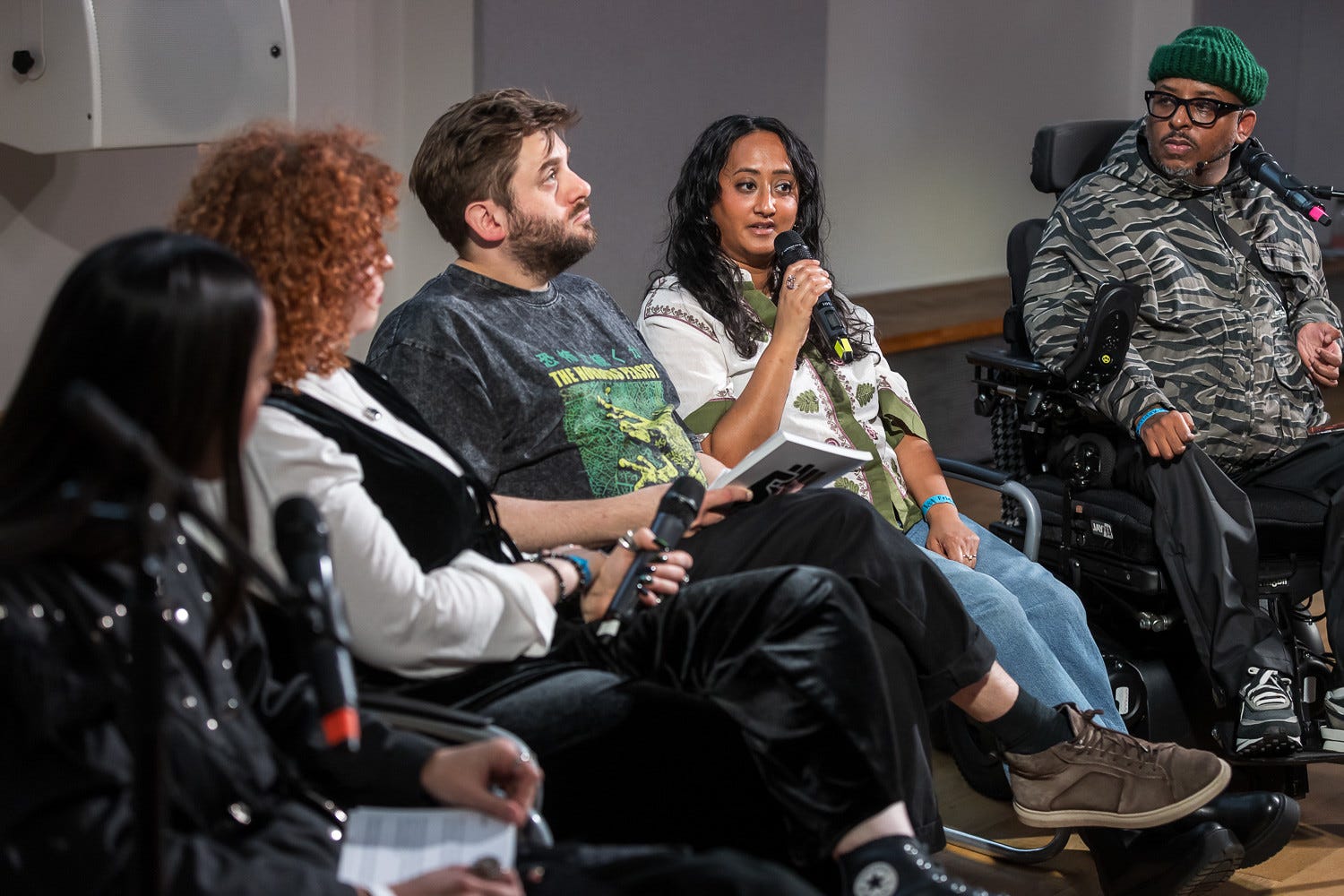
One of the important activities of the evening was the ‘Disabled in Practice, Not Theory’ panel discussion, which contextualised the working reality of disabled artists, centring around barriers to access and employment. As much as the breadth of disabled excellence was on show, there is still so much to be done for disabled equity in the arts and culture. The panel was chaired by Able Zine’s founder Claudia, and featured deaf visual artist Sabrina Tirvengadum, multi-disciplinary artist Christopher Samuel and artist-writer-educator Zuleika Lebow.
Tirvengadum’s work investigates untold histories through the lens of identity, memory, and family, and she runs the collective We’re All Human, which advocates for digital accessibility. She also uses AI in her work and does workshops on the process and its ethics. Exploring the concept of how identity is marketed through the arts, Tirvengadum expressed how she can “tick a lot of boxes” in certain spaces that are eager to reflect diversity, but also how, as a disabled artist, there is “that pressure to create a piece of work that’s about your trauma”.
It raises the question of whether disabled creativity is commodified and whether enough is being done to make it a sustainable creative endeavour. Claudia responded to how it feels, “there’s a relationship between fetishising your work and your identity in public”.
Artist Christopher Samuel added, “Maybe I am a fetish to some, but that’s okay with me. What’s important to me is the institution I’m working with: are they learning what’s wrong? And what are the red flags that I see within the organisation? And I’ll pull you up [on that]. They seem to be receptive at the moment.”
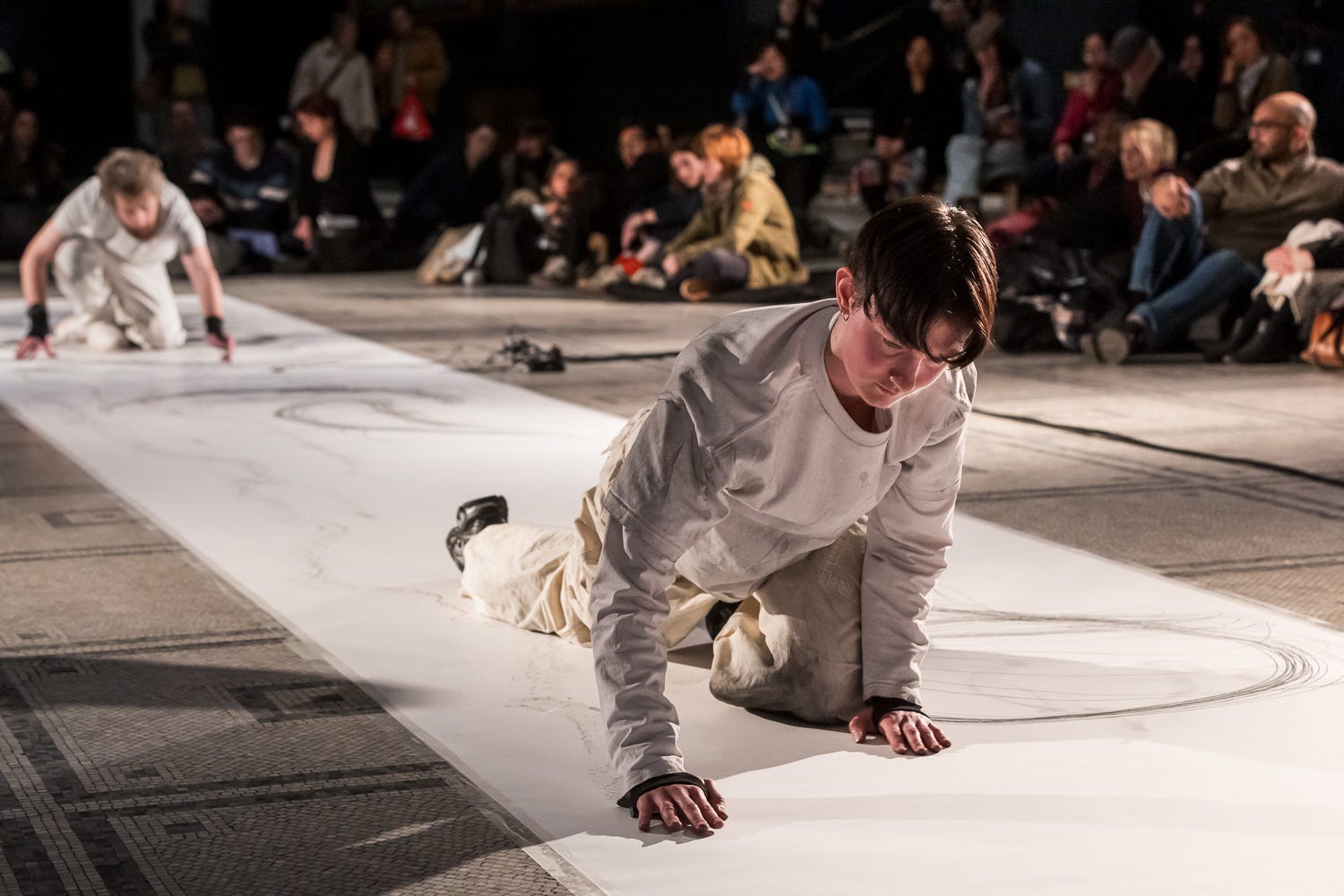
On the night, the receptiveness to new ideas felt strongest with Xan Dye and Gerald Curtis’ ‘Practising in Parallel’ performance. The pair use sticks of graphite to draw and create sound across a 10m length of white paper taped to the floor. Using stimming as a neurodivergent expression in their performance, they allow their own improvisation within repetitive movements to demonstrate what feels free and comfortable to themselves. Audience members could join in with paper available around the room.
The pair interplayed with celloist Zoe Gilmour, who switches between long foreboding notes, finger-picking delicacy and bouncing the bow. This emphasised the echo of the harsh, eerie, reverbed sounds picked up by the contact mic on the white paper Dye and Curtis moved across, clipping the mosaic tiles beneath that fill the enormous Raphael Cartoons room. It felt appropriate that the performance took place here, considering the word “cartoon” comes from the Italian cartone, meaning “big paper”.
Another performance also featured a creative experimentation with sound’s relationship to disability. Non-visual social practice artist Carmen Papalia performed ‘Loud Cane 1.0’ which translates the objects that his cane interacts with into an eclectic range of sounds. He has since developed a second version during a Tokyo residency, but ‘1.0’ has a contact mic in the cane’s “feeler” and whatever it touches is fed into either headphones, a speaker, or a modulation unit in the cane made from Fender electric guitar effects pedals.
Another concept that came up a lot was crip time, and the Crip Cinema Archive screening, run by curator Emily Simmons, featured two of its three shorts centred on it. Sara Wylie’s ‘Resistance Meditation’ offered a more experimental approach to the concept, shot in Super 8mm, pushing it toward a home-movie style. It traverses a dream-like setting, helped by landscape shots and a guiding voiceover. The blunt message that sickness is the “result of capitalism” is effectively captured with the person lying under the bed covers resting, just as they drift off and “time travel” into crip time as the clocks bend to disabled bodies and minds.
Carolyn Lazard’s ‘Crip Time’ is done in a deliberately uneventful single shot. It sees only Lazard’s hands methodically slip a kaleidoscopic range of pills into her weekly dosette boxes separated into morning, noon, evening and bedtime. The slow pace is only pushed along by the irregular metronome of a pill rattling inside one of the boxes as it captures the chronic illness experience. The third screening was Jameisha Prescod’s ‘On Black Pain’ that discusses chronic pain through the stories of three Black people.
During the panel talk, Lebow jokingly asked if Beyoncé ever had to factor in time to take medication. But crip time is an area she discusses with the students she teaches on Central Saint Martins’ MA Applied Imagination course. Lebow explained how the course is about “applied idealism and how to gather the tools to create change in the world”, and it is taught using the “nothing about us without us” principle.
Elsewhere in the panel talk, Samuel’s convictions on access were refreshing. Introducing himself as a “bit of a troublemaker”, his experience of becoming homeless led him to make art about “shit that pisses me off” and find allies who wanted to show his work. His ‘Welcome Inn’ installation of a hotel room designed to be inaccessible for non-disabled people highlights this.
“I deliberately seek opportunities not geared towards disabled practitioners, and I want to go into places I’m not welcome,” he said. Whilst he’s had success and is an “idealist”, he believes there’s still “a lot more work to do”. Claudia also pointed out that this can bring on additional responsibilities to “educate everyone you work with,” adding an emotional disability tax on any work you are paid, or not paid to do.
But it raises one of the salient points of Samuel’s approach, which follows the “nothing about us without us” principle. Co-design and inclusivity are essential for disabled creatives to prosper in the arts and continue producing work to be seen in revered institutions like the V&A.
The ‘Conversations with Visions’ performance perfectly captured how this can embrace new technologies too. It featured live dance and recorded motion capture as the dancers – Anhelo Collective’s Annie Edwards and Deaf dancer Anna Seymour who runs her own Deaf club event ‘SPIN’ – wore accessible motion capture technology, something that can often exclude disabled creatives.
The performance comes from a project involving the University of the West of England, motion-sensor company x-io Technologies, dance company Candoco, and musician Kris Halpin, to produce the wearable system called EqualMotion. The product allows for personalisation, inclusive visual language and integrates mobility aids. A paper that includes co-contributor Clarice Hilton – a creative technologist who was part of the V&A performance – provides more detail on the success of this specific disability-centred co-design approach.
This is a great snapshot of what made the Friday Late a success: there was true representation across so many disciplines, showing how inclusivity within artistic practices can strengthen the disabled community and inform non-disabled audiences. It’s why institutions like the V&A should continue platforming disabled creativity, access, and enterprise as a permanent fixture across all arts and cultural programming.
Written by Ben Lee
No posts
Comments
Nothing yet. Say the first thing.
Sign in to join the conversation.