
Hello Readers,
I recently (and fortuitously) was invited to interview Aksana Berdnikova for With Not For, a disabled-owned talent and production agency that exclusively represents disabled creatives. Shout out to the founders Kelly and Emma!
When I met Aksana, I was enamoured by her warm, relaxed energy. We shared common values, creative aspirations for the disabled community, and a design sensibility. As well as a fondness for tea and Mexican food, and the list went on.
So, naturally, a partnership has ensued, and I look forward to introducing her to you in this interview.
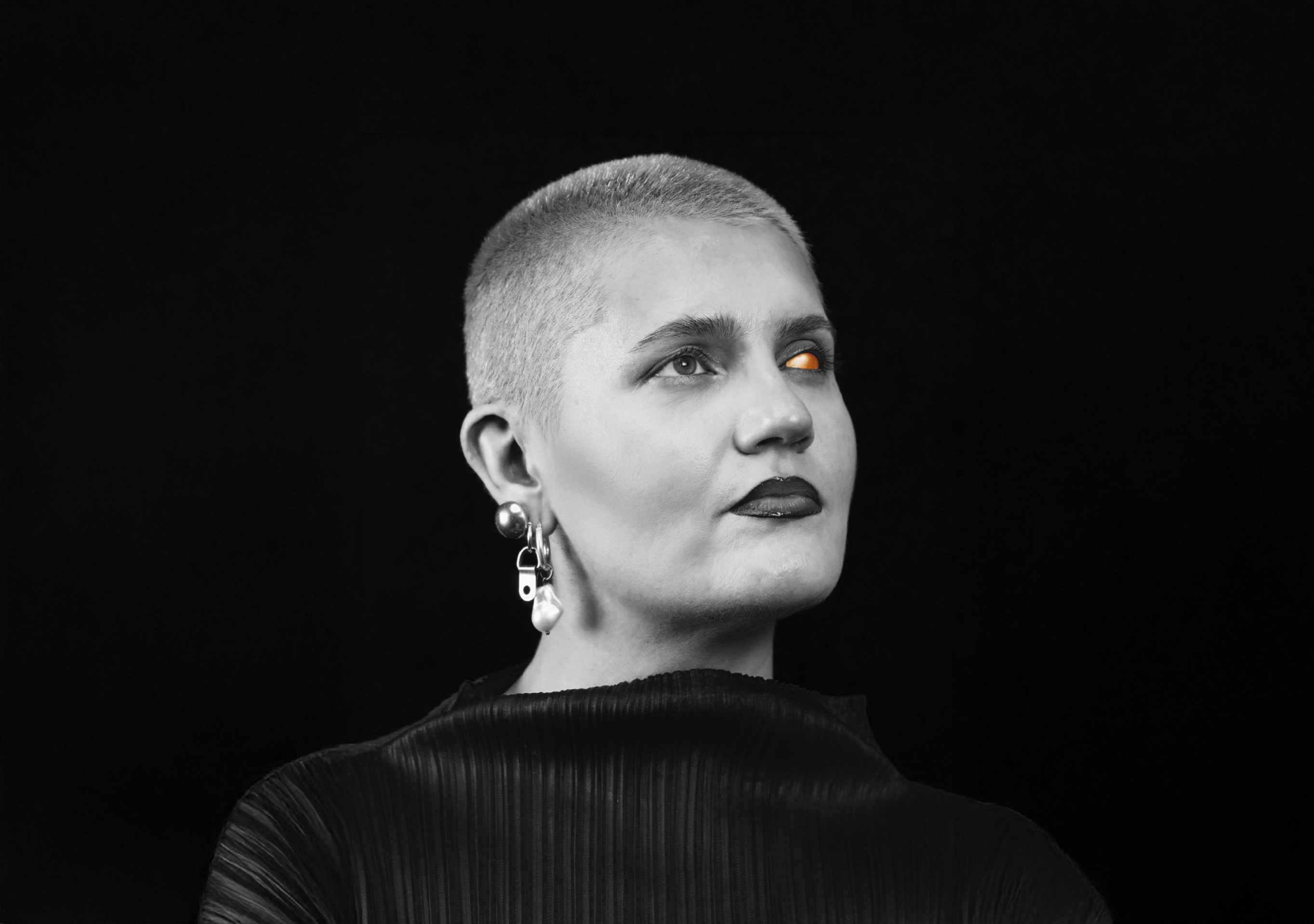
Aksana is a creative polymath whose work champions disability-centred design and the power of art to shift narratives. Recently graduated with an MSc in Disability, Design and Innovation, Aksana’s journey has taken her from an art student in New York City to a creative director and marketing leader with over 13 years of experience. After experiencing sudden vision loss from retinal detachment during art school, Aksana’s mission is to facilitate opportunities for the disabled creative community through design solutions and community collaboration, branching across industries and creative practices.
Claudia: Hi Aksana, it’s a pleasure to meet you. I start every interview with this icebreaker. Describe yourself in 3 words.
Aksana: I’d say I’m creative, confident and chill.
I would love to hear about your upbringing. Where are you from?
Aksana: When somebody asks me where I’m from, I usually ask, “How much time do you have?” I’m from Belarus, but I was born in Mongolia. I haven’t spent any time in Mongolia; I was born premature, and my parents happened to be there. I spent my childhood in Belarus, and when I was 15, my mom and I moved to the United States. I didn’t speak any English. My mom didn’t speak any English. We just moved to the US, and figured it all out.
If you’re comfortable talking about it, how did your disability manifest?
Aksana: I lost my left eye when I was 19, due to severe retinal detachment. It didn’t affect me much at the time. I was a delusionally confident teenager, so although physically, it was difficult, once the painful process was over and I had my prosthetic eye, I just moved on with my life. I had just graduated from high school and enrolled into a small, underfunded community college called Mercer County Community College. I had an incredible time there, and that’s when I really felt the power of art. On my first day back at school after the surgery, I was wearing an eye patch because I needed to wait 6 months before I could wear a prosthetic eye. I had a painting class, and the assignment was a self-portrait. I asked my teacher, Kyle, “What do I do? Do I paint myself the way I was most of my life? Or do I paint myself with this eye patch?” And he said, “This is your space. This is a safe space. You do whatever makes you feel comfortable, but it is an opportunity to capture this moment.” He put it in such a wonderful, inclusive way. I felt completely safe there. So I took off my eye patch and painted myself post-surgery. That moment was very healing. Thank you, Kyle! In art school, nobody gives a shit. You can be whoever you want, and so because of that environment, I really didn’t feel that different from anybody else.
What did you do after you graduated?
Aksana: I attended the School of Visual Arts in New York City, and after graduating, I stayed in New York. I worked in the advertising industry for 13 years, moving up the corporate ladder from graphic designer to art director, and so on. I worked for some big and small ad agencies.
My last job was at a non-profit organisation, where I did creative direction. I really loved it. During that time, I was having some health issues, and the non-profit I was working at had to do with disability, and it all sort of came together for me. I thought I must pursue that field, and that’s what led me to London. I discovered a really incredible Master of Science programme at UCL. It’s called Disability, Design and Innovation. Nothing like it exists anywhere else in the world.
Did your vision change over time or impact the work you were doing?
Aksana: It was fine for 10 years. You can do pretty much anything you want with one eye, if it’s a good eye. I never associated myself as disabled just because I had a prosthetic eye. As a matter of fact, many people didn’t know. My prosthetic was beautifully made by a wonderful woman, Susan. She’s also an artist, a painter, and we connected on that level. For somebody to know that I had a prosthetic eye, I had to tell them.
When I started losing sight in my right eye, it became difficult. I began to understand that I am part of the disabled community. In 2017, severe retinal detachment started happening to my right eye, but now we knew the history. My eye doctor knew exactly what to do, so we were able to save some of my vision, but not all of it. It was a long medical process, so I had four years to figure it all out. What did it mean for me as a visual person? I have a career in a really visual world. I was an art director at an ad agency. And nobody even knew I had a prosthetic eye; it’s not something you share in corporate America. So that was quite intense, but in a way, I think I’m really lucky that it happened to me at a point in my career when I wasn’t searching for who I am and what I can and cannot do. Eventually, I arrived at a point where I’m no longer “making” work; I’ve moved into a creative direction role, helping others create. So I’m more focused on giving feedback than on designing myself. That process was easier on my eyes.
I’m curious to hear more about the course, Disability, Design and Innovation. How do those three aspects unfold?
Aksana: It’s an interdisciplinary computer science programme that invites candidates from diverse backgrounds. Throughout my projects, my focus was always more on design and how to solve problems through creative thinking. If a project were about creating technology for the disabled community, for me, the aesthetics would always be really important, because I think that assistive tech too often leans towards the medical model of disability. However, during my dissertation, my main focus ended up being something entirely different. When I’m really curious about something, I trust my intuition and follow it. And that always leads me to different places. When I was struggling with my vision loss, I started thinking, what does it mean for me if I go completely blind? What am I afraid of? And I think what I was most afraid of was losing my ability to move around freely. I travel quite a bit, I’m independent, and I like exploring.
And so I decided that it’s really important for me to think about urban development and how disabled people can shape the spaces and communities they live in. For me, true accessibility isn’t just about ramps and physical infrastructure; it’s about belonging. I want society to accept disability as part of human experience, not as a problem to be solved. So, whether a person with a disability physically or metaphorically falls, I want the community to be willing to support them. That kind of interdependence feels more important to me than any technological fix.
What was your dissertation on?
My dissertation was about participatory, speculative design and creating methodologies for envisioning futures with the disabled creative community. I conducted a study on post-Olympic urban development in East London. This whole area was regenerated for the 2012 Olympics and specifically the Paralympics. Now, we’re 13 years post-event. So I found myself asking, what’s in it for the disabled creative community? Historically, this area of London, Hackney Wick and Fish Island, has been an incredibly creative area. Then the Paralympics happened, and a narrative around disability emerged. So, to investigate the outcomes for the disabled creative community, I ran a survey and facilitated a participatory, speculative co-design session with disabled creative individuals to imagine the creative future of East London.
Your own creative practice is so varied. It gives a flailing art lover and hobbyist like me motivation. Can you tell me more about your current practices?
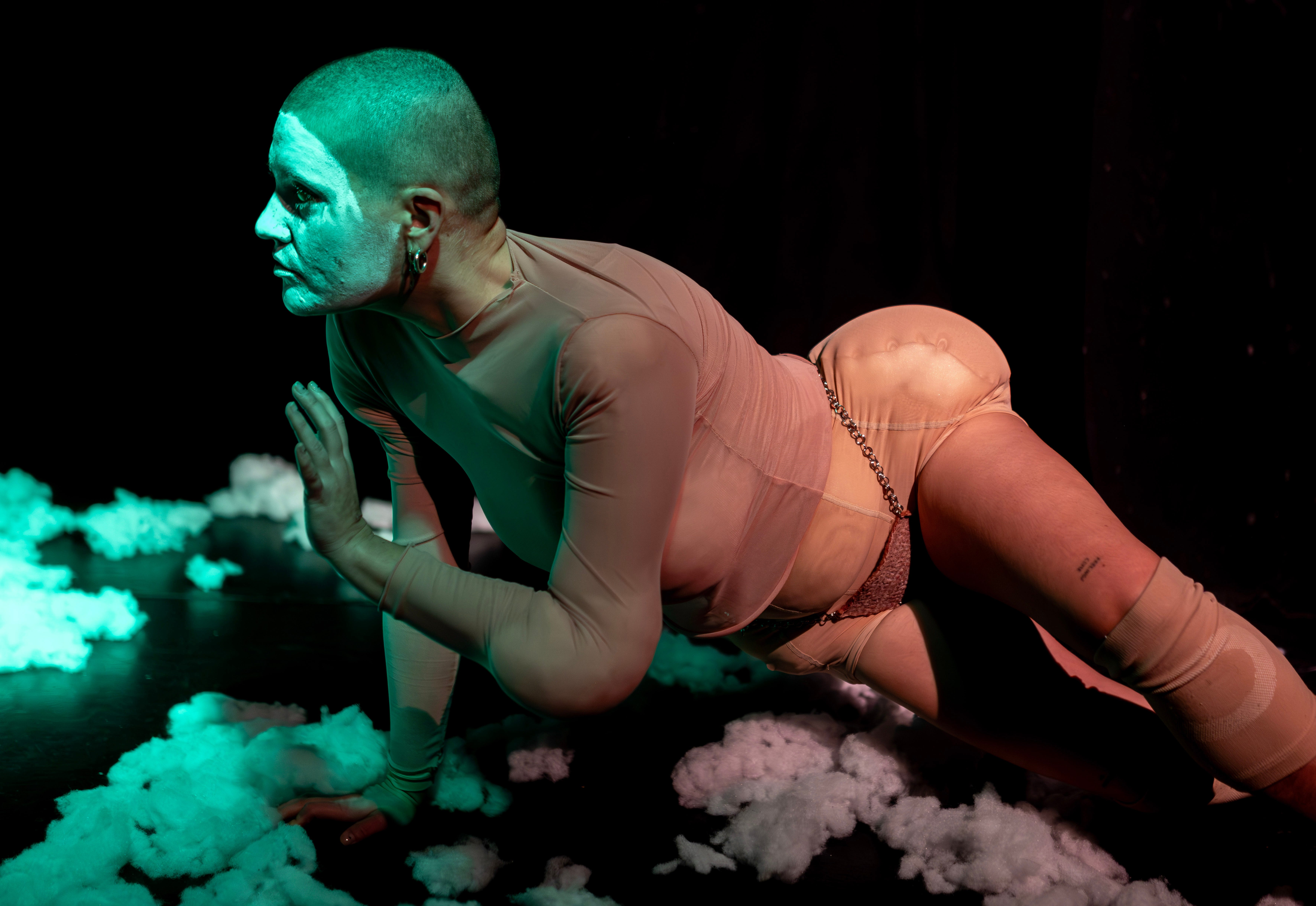
Aksana: Creative expression has always been a big part of my life. I was a trained dancer as a child, but when I moved to the US, I couldn’t continue training because it is very expensive. So I picked up art. For the past 10 years, I have been painting, but when I moved to London, I didn’t have access to a studio. So my body kept asking for another avenue. One evening, I went online, searched for Butoh classes, and discovered London Butoh Company. I am now part of the dance troupe. I love this group of people. They are an incredibly creative, talented and caring bunch from different parts of the world. Together, we explore themes of what it means to be in a human body, and what it means to discard it, abandon it, leave it behind. Themes of technology, artificial intelligence, and its effects on humanity. Themes of post-humanism. Themes of darkness and light, attachment and suffering. Themes of the unseen forces. The list can go on.
To be honest, I don’t exactly remember the moment I discovered Butoh. For about a decade now, I have spent countless hours watching Butoh videos online. I’m fascinated by it. Butoh, also known as “dance of darkness”, is an avant-garde dance form created in post-war Japan by Tatsumi Hijikata and Kazuo Ohno, in direct response to the trauma and despair. It was a difficult time for Japan, and contemporary performers needed a new creative language to depict what was happening. Butoh offers a space to explore alternative aesthetics, unconventional ways of moving, and bodily weakness, with a focus on internal sensations. It has its roots in disability and is a uniquely accessible form of movement that can be really healing.
My body movement often comes from my desire to close my eyes and give in to the complete absence of sight. Butoh allows me to leave “me” behind and be something else, be in touch with my inner “it” and let it explore and engage with the outside world.
Your golden eye is so beautiful, by the way. What led you to wear it as your primary prosthetic?
Aksana: I had an art show in London two years ago, and it was the first time I wore my gold prosthetic. At first, I thought it could be my fun party eye. So, of course, I had to wear it for my art show. During the show, this man came up to me to talk. He’s also partially blind; he doesn’t have a prosthetic, but one of his eyes is visibly different. And he told me that when he walked into the room and saw me, proud with my gold eye, it made him so happy, but also made him sad for himself. He’s a 60-year-old man, and he’s never been able to accept how he looks because he doesn’t look like everyone else. So I think it’s important for me to be visible, because I have the responsibility to share that people like me exist. We just don’t always know; some people’s prosthetics are not immediately visible, but mine is. It invites a conversation: What does it mean when people look different?
It’s been so nice getting to know you and your incredible story, Aksana. I can’t wait to see what you do next. Where can people follow and support your work?
Aksana: You can find me on Instagram, my commercial work here aksana.work, and my artwork here AksanaBerdnikova.com.
You can find Aksana and me next week at Libros Mutantes, April 24th-26th in Madrid. We’re running a workshop about accessibility in publishing. You can sign up here (please note that the webpage is in Spanish). We also plan to host the workshop virtually in the near future for those unable to attend in person, so stay tuned for that.
We’ll also be exploring ways to make Able Zine's future more visually accessible.
Until next time,
Claudia
BUY A PRINT COPY!
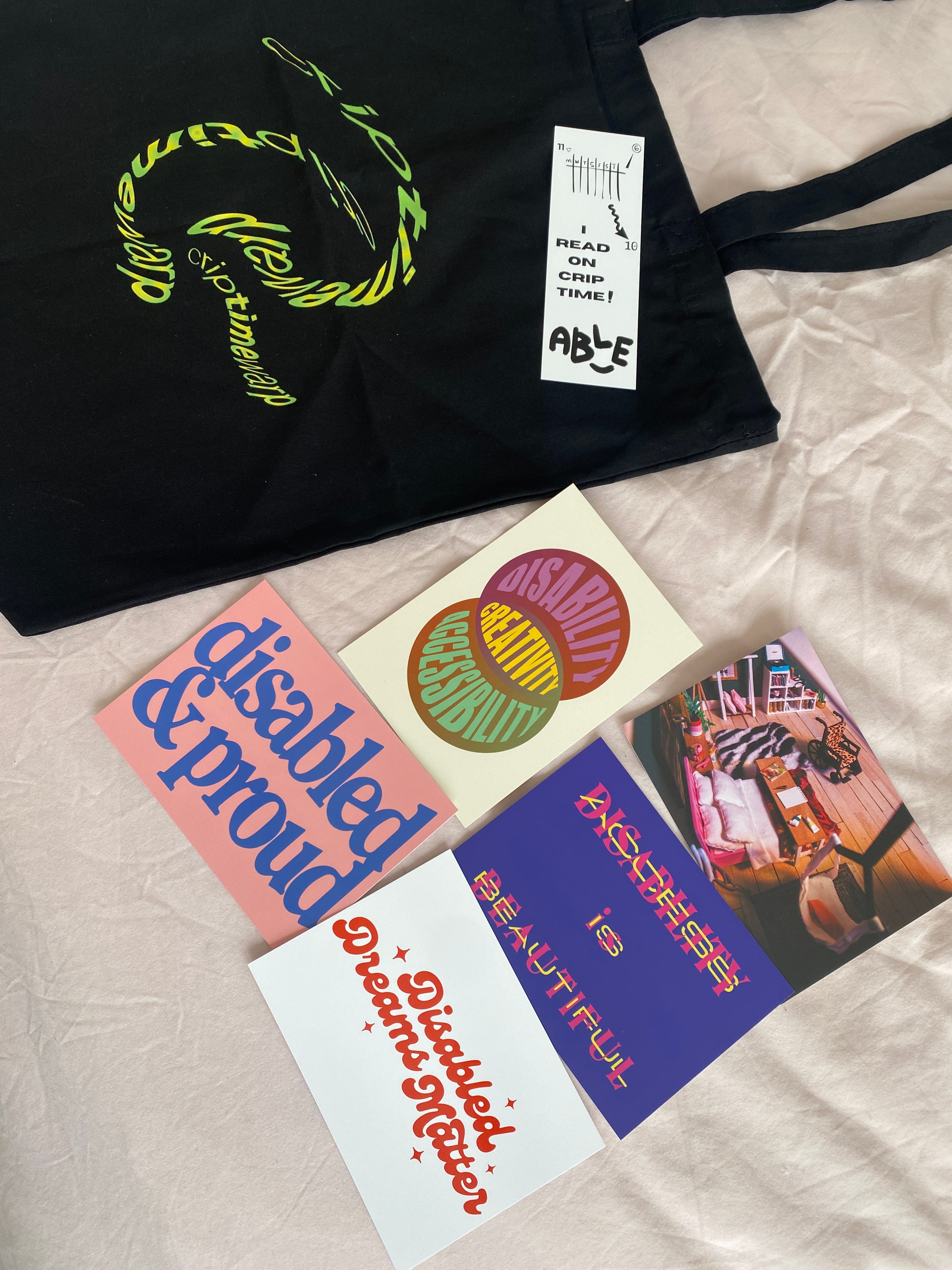
We still have copies of our recently reprinted Issue 2 available. You can buy a copy here. And we’ll also be uploading some other printed merch very soon. Here’s a sneak preview!
Able’s Substack is a reader-supported publication. To receive new posts and support our work, please consider becoming a free or paid subscriber.
Comments
Nothing yet. Say the first thing.
Sign in to join the conversation.