
🪶 Part I of “The Divergent Mind” series — an emotional reframe for every person who has ever been told they feel or think too much.
You’ve probably been told you’re too much.
Too intense. Too emotional. Too scattered. Too sensitive.
But what if all of that “too much” was never disorder—just difference?
What if your mind wasn’t broken, but tuned to a frequency that others can’t quite hear?
The world rewards linear focus and consistent productivity—the calm, convergent mind. It calls imagination distraction and emotion weakness. Yet beneath every so-called “overthinker” and “overfeeler” lies a nervous system doing exactly what it was designed to do: sense, process, and integrate the world at a higher volume.
Neurodivergent minds are not chaotic; they’re symphonic.
They move through thought like music—expanding, contracting, and resolving, all in rhythm.
When the rhythm flows, it produces innovation, empathy, and deep insight. When it’s interrupted, it sounds like overwhelm. The problem isn’t the mind itself—it’s a culture that only hears the beat, not the melody.
The Triad of Intelligence teaches us that intelligence isn’t a number or a label—it’s balance in motion. Every mind contains three instruments:
💙 Cognitive Intelligence (Mind): focus, logic, and clarity.
❤️ Emotional Intelligence (Heart): empathy, resonance, and feeling.
💚 Integrative Intelligence (Bridge): coherence, synthesis, and ethical direction.
In most people, these instruments play at moderate volume. In divergent thinkers, the soundboard is wide open. The music is louder, faster, and more layered. What looks like chaos from the outside is, internally, an intricate symphony of signal and sensitivity. The challenge isn’t to quiet it—it’s to conduct it.
Every mind carries three languages — thought, feeling, and synthesis.
Most people learn to speak one fluently and ignore the others. But in the divergent mind, all three try to speak at once.
The Triad of Intelligence explains why this feels both beautiful and exhausting.
It describes three interdependent systems working in rhythm:
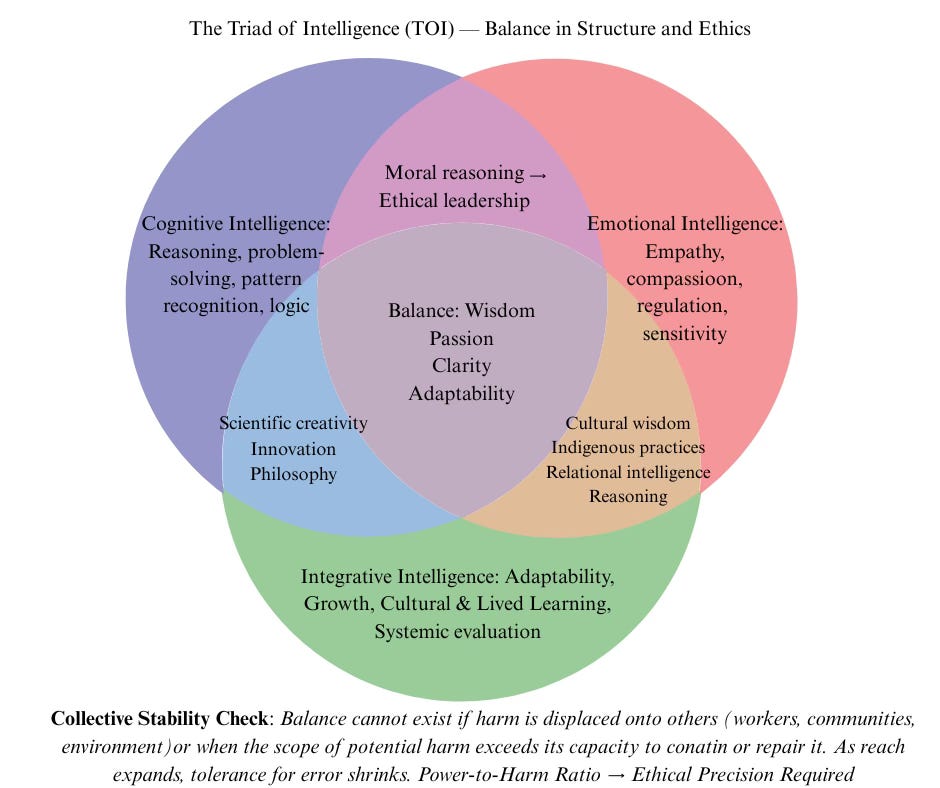
This is the part of you that loves patterns, ideas, and precision.
It wants to understand how everything fits together — the architecture of awareness.
When it leads too strongly, it can turn inward, analyzing until it freezes.
When balanced, it gives structure to imagination and clarity to emotion.
It asks: “What is true?”
This is your resonance system — where empathy, intuition, and depth live.
It’s the reason you sense other people’s moods before they speak, and why beauty, injustice, or small details can move you to tears.
When unbalanced, it can flood or fatigue you. But when guided, it fuels artistry, compassion, and moral instinct.
It asks: “What is kind and just?”
This is the translator — the part of you that turns feeling into understanding, and understanding into ethical action.
It takes the logic of the mind and the sensitivity of the heart and weaves them into coherence.
When strong, it feels like calm insight — the sense of “knowing what matters.”
When weak, you may feel trapped between thoughts and feelings that never agree.
It asks: “What is right to do, here and now?”
When these three are in rhythm, you feel aligned — creative yet clear, compassionate yet grounded.
But when one dominates, life can tilt out of tune:
Too much mind? You overthink and detach.
Too much heart? You drown in others’ emotions.
Too little bridge? You know what’s right but can’t act, or act without coherence.
For divergent thinkers, the volume of all three is turned up.
That means deeper empathy, faster pattern recognition, and heightened awareness — but also a thinner margin for imbalance. You are not too sensitive; you are simply high-resolution. Your system feels more, sees more, and therefore must regulate more.
The goal is not to silence the noise, but to learn the rhythm — to conduct your own orchestra rather than muting its power.
Once you begin to see your thoughts and feelings as parts of one system instead of enemies, everything starts to make sense.
The question shifts from “What’s wrong with me?” to “How does my rhythm move?”
Every person has a natural tempo. Some minds are slow and steady; others are quick, shifting like weather.
For divergent thinkers, the tempo is fast, dynamic, and often misunderstood. The Triad explains the instruments — the mind, heart, and bridge — but the CDI Model explains the music they play together: the rhythm of focus, expansion, and coherence that defines how the divergent brain actually moves.
Your brain is not broken — it’s dynamic.
It doesn’t follow a straight line from question to answer. It loops, swirls, expands, and contracts, constantly searching for deeper connection and coherence.
The Convergent–Divergent–Integrative (CDI) Model shows that thought moves in three repeating phases — like breathing or waves:
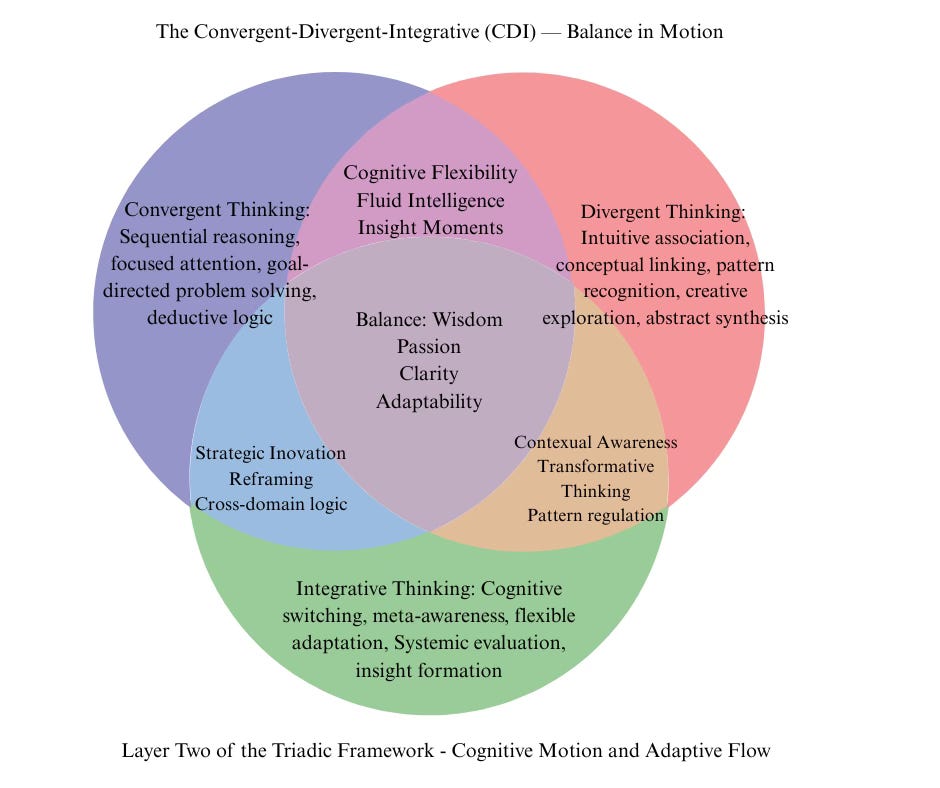
This is imagination mode — when your mind opens wide and connects everything to everything.
You brainstorm, daydream, sense possibilities, and feel a flood of ideas or emotions.
It’s where empathy and creativity live.
But without grounding, this expansion can scatter your focus and exhaust your energy.
This is the narrowing phase — your mind zooms in to organize, solve, or define.
It’s your logic and precision taking the wheel, turning insights into order.
But too much convergence can become rigidity, perfectionism, or anxiety — when the system clings to control to manage intensity.
This is where balance returns.
Integration acts like the breath between expansion and contraction, translating emotion into understanding and insight into action.
It’s when you pause and everything suddenly makes sense — the music resolves into harmony.
Strong integration doesn’t mean constant calm; it means graceful regulation between chaos and clarity.
Neuroscience mirrors this rhythm.
Your brain’s Executive Control Network handles focus, the Default Mode Network fuels imagination, and the Salience Network decides when to switch between them.
In neurodivergent brains, this switching happens faster and with greater intensity. It’s not instability — it’s amplified oscillation.
Your mind moves through these modes like waves in high tide — each swell containing more energy, more information, and more potential.
The key isn’t to fight it; it’s to learn to surf it.
Integration isn’t about stillness — it’s about motion that stays coherent, like balancing on a moving board instead of trying to stop the ocean.
What you call “overwhelm” is often your mind’s way of saying, I’m processing more than others can see.
Your sensitivity isn’t weakness — it’s bandwidth.
The divergent brain doesn’t just think more — it feels more, notices more, and links more.
It’s constantly decoding emotional tone, pattern, and possibility.
That’s why you might feel like you’re living with the volume turned all the way up while everyone else hears a soft hum.
Neuroscience now shows that this isn’t imagination — it’s physiology.
Highly sensitive and divergent individuals display amplified activity in regions like the insula and cingulate cortex — the parts of the brain that process empathy, emotional salience, and awareness.
In other words, your nervous system is biologically attuned to meaning.
The challenge is that amplification works both ways.
It allows for profound empathy, intuition, and creative insight — but it also leaves you more vulnerable to emotional static and sensory overload.
It’s like having studio-quality microphones tuned to pick up subtle beauty… and every background noise, too.
Yet that sensitivity is not a flaw to fix — it’s a form of evolutionary refinement.
You were built to sense imbalance in systems, people, and ideas.
You detect dissonance before it becomes visible. You feel tension before it’s spoken. You notice patterns before they coalesce.
That’s why environments that dismiss feeling or rush complexity can feel unbearable — your system can’t pretend not to notice.
The Triad and CDI models both show that when this sensitivity is integrated — when the bridge between emotion and logic is strong — it becomes something extraordinary:
💫 Cognitive sensitivity turns into innovation.
💫 Emotional depth turns into empathy and moral clarity.
💫 Integrative balance turns raw intensity into wisdom in motion.
So the goal isn’t to turn the volume down — it’s to become your own sound engineer.
Regulate your rhythm, mix your inputs, and direct your energy toward creation instead of containment.
You are not fragile. You are finely tuned.
Understanding your rhythm is one thing.
Learning to conduct it is another.
Integration doesn’t mean balance in the static sense—it means active regulation.
You can’t silence a symphony, but you can guide when each instrument plays, how loud it is, and when to rest between movements.
That’s what emotional regulation, cognitive pacing, and sensory awareness truly are: neural musicianship.
Below are a few practices that help you strengthen the bridge—the integrative muscle that transforms sensitivity into coherence.
A quick practice for daily alignment.
Pause for 30 seconds and ask:
What is my mind saying right now? (What’s the thought or story?)
What is my heart feeling right now? (What’s the body’s message?)
What would my bridge say if both were right?
This simple dialogue brings the Triad into consciousness—letting cognition, emotion, and integration collaborate instead of compete.
The CDI model says your mind flows between expansion (divergence) and focus (convergence).
Use journaling to track that motion:
Prompts:
“Where am I expanding today?” (ideas, empathy, imagination)
“Where am I contracting?” (overfocus, control, fatigue)
“What small shift could bring coherence?” (rest, creativity, movement)
You’ll start to see your own cognitive waveform—the ebb and flow of your inner tide—and learn to surf it rather than resist it.
Integration thrives on rhythm, not rules.
Use sensory rituals to signal your nervous system when to upshift or downshift.
Examples:
Breathing in 3’s: inhale (mind), hold (bridge), exhale (heart).
Music pacing: match playlists to your CDI phases—ambient for divergence, lyric-light focus tracks for convergence, and slow instrumental for integration.
Movement breaks: light stretching, walking, or tapping resets salience-network balance faster than forcing focus.
Rhythm teaches the body what the mind forgets: regulation is movement, not stillness.
When you feel flooded or frozen, picture a triangle.
At the top: Mind.
Bottom left: Heart.
Bottom right: Bridge.
Ask which corner is pulling hardest, and bring attention to the opposite one until the tension evens out.
It’s a simple visualization, but it re-engages your executive and emotional networks simultaneously—restoring coherence in seconds.
Make integration a rhythm of living, not a task.
Alternate input (learning, helping, creating) with empty space (silence, nature, rest).
Speak to yourself in plural: “Which part of me needs a turn?”
Design your day like a score—moments of forte, moments of rest, one clear closing note before sleep.
Balance isn’t perfection. It’s choreography.
When you learn your steps, life begins to dance with you again.
You were never too much.
You were simply tuned to everything.
In a world built for narrow focus, you were made for full-spectrum awareness — the kind that feels truth in the body before the mind can name it.
You sense the undercurrents. You notice what others miss. You carry a nervous system designed to translate chaos into meaning.
That sensitivity people told you to hide?
It’s not a flaw — it’s a compass.
It points toward imbalance, truth, and beauty with the same precision.
It’s the signal that reminds the world what coherence feels like.
You are not broken for feeling deeply or thinking endlessly.
You are a bridge — between reason and emotion, pattern and intuition, order and wonder.
And when you learn to walk that bridge with awareness, the noise becomes music again.
The Triad of Intelligence reminds us that wisdom isn’t the absence of feeling — it’s the ability to stay balanced within it.
The CDI model shows that health isn’t calm without movement — it’s rhythm that stays coherent.
Together, they reveal the truth every divergent soul needs to hear:
✨ You were never meant to fit a linear world.
You were meant to teach it how to feel, think, and integrate again. ✨
So let your rhythm move.
Let your waves be wide.
Let your mind play all its instruments.
Because when you stop apologizing for your volume,
the world finally hears the harmony it’s been missing.
~ By Abby Jo Adams
The Divergent Series Part I
Thanks for reading! This post is public so feel free to share it.
No posts
Comments
Nothing yet. Say the first thing.
Sign in to join the conversation.