
🪶 Part II of “The Divergent Mind” series — exploring how sensitivity, far from being disorder, is the nervous system’s most advanced form of balance.
For centuries, society has equated stability with strength.
We’ve built our schools, workplaces, and even our psychologies around the assumption that focus, consistency, and control define a healthy mind.
The result is a world optimized for convergence — for narrowing attention, measuring output, and rewarding predictability.
But not all minds work that way.
Some minds don’t move in straight lines; they move in waves.
They shift rapidly between deep analysis and wild imagination, between empathy and exhaustion, between vision and retreat.
They are the divergent minds — the empaths, inventors, feelers, and connectors who seem to live in several dimensions at once.
And because these minds are rhythmic rather than linear, they often get mistaken for disordered.
When their focus fractures, it’s called distraction.
When they feel deeply, it’s called instability.
When they think in webs instead of lines, it’s called inefficiency.
Yet every one of those traits is the natural result of a highly responsive regulatory system — one that processes emotional, sensory, and cognitive input at higher amplitude.
The problem isn’t that these minds are too much; it’s that our culture has defined too much by the limits of its own imagination.
Neuroscience is beginning to catch up.
Brain imaging now shows that people with heightened sensitivity — whether identified as ADHD, autistic, gifted, or empathic — display amplified oscillation between three key neural systems:
The Executive Control Network (ECN) that governs focus and problem-solving,
The Default Mode Network (DMN) that generates imagination and self-reflection, and
The Salience Network (SN) that decides when to switch between the two.
In most people, this system flows quietly.
In divergent individuals, it hums with higher energy, processing more data per second.
This is why a crowded room can feel like static, why ideas come in floods, and why emotion and logic often feel inseparable — because they are.
What looks like chaos is often coherence waiting to happen.
These minds aren’t unstable; they’re dynamic, moving through the same balance laws that govern ecosystems and weather systems.
They are not the outliers of humanity — they are its most complex feedback loops, designed to sense imbalance, interpret it, and translate it into insight.
At the center of every living system — from a heartbeat to a hurricane — lies a rhythm: expansion, contraction, and recalibration.
The human mind is no different.
Its stability doesn’t come from stillness, but from its ability to move between order and openness without losing coherence.
The Convergent–Divergent–Integrative (CDI) Thinking Model describes this motion.
It explains that cognition isn’t a fixed state of intelligence, but a dynamic rhythm between three modes:
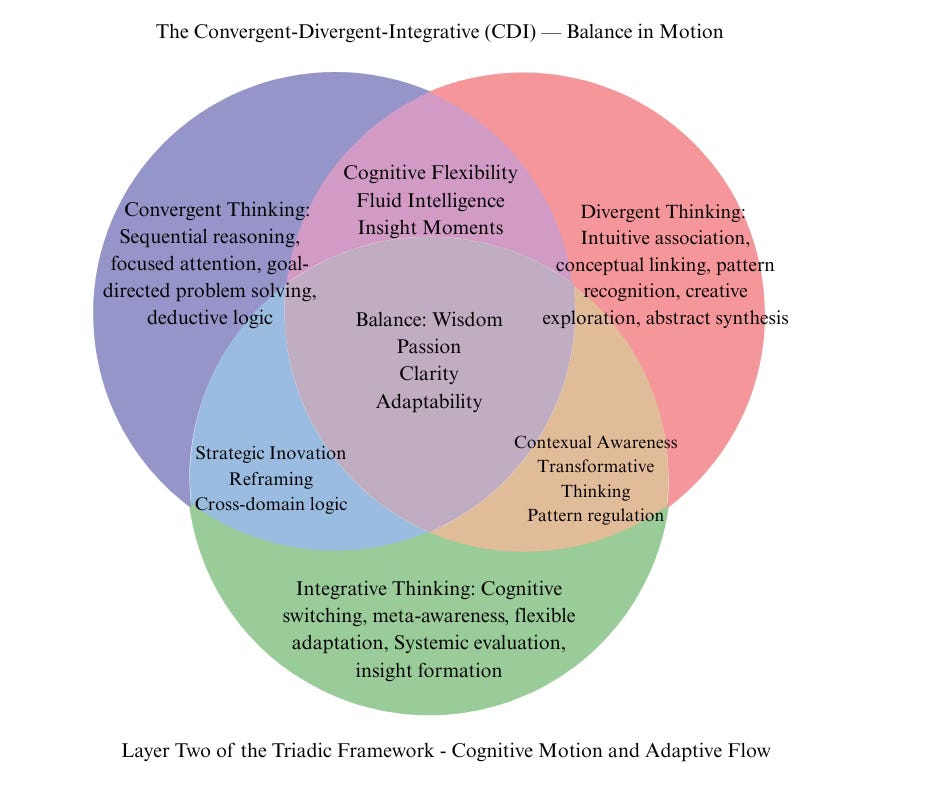
This is the mind’s narrowing phase.
It filters noise, organizes data, and finds precise answers.
Convergence is essential for logic, problem-solving, and grounded decision-making.
When balanced, it builds clarity; when dominant, it becomes rigidity — a refusal to adapt.
Divergence is the opposite movement: it opens the mind to possibility.
It’s creative, associative, and nonlinear — the mode that allows connection across distant ideas and emotional nuance.
When balanced, it creates innovation and empathy; when excessive, it floods the system, fragmenting focus and energy.
Integration is the bridge that keeps both energies in dialogue.
It’s not neutrality — it’s regulation under pressure.
Integration translates emotion into understanding and logic into meaning.
It’s the meta-cognitive process that knows when to zoom in, when to zoom out, and when to rest between.
Healthy cognition is a waveform, not a line.
You expand (divergence), you focus (convergence), and then you integrate — returning to coherence.
That cycle repeats thousands of times per day, governing creativity, emotion, and moral reasoning alike.
In neurotypical systems, these oscillations are moderate — enough to adapt, but rarely overwhelming.
In neurodivergent systems, the amplitude of each oscillation is higher.
They process more information, more emotion, and more subtlety per cycle.
This heightened sensitivity isn’t a malfunction — it’s energetic range.
Think of it like weather:
A typical mind experiences calm breezes; a divergent one experiences full seasons in a single day.
The difference isn’t disorder — it’s intensity.
The challenge isn’t to suppress the storms, but to strengthen the integrative systems that guide them.
This law of balance — oscillation between focus, imagination, and coherence — isn’t just psychological.
It mirrors the self-organizing laws of biology and physics: systems remain alive by maintaining tension between stability and change.
Too much order, and growth ceases.
Too much chaos, and form collapses.
Balance exists only in motion.
The divergent mind is proof of that principle in human form — a living ecosystem of thought that stays alive through movement, not restraint.
Sensitivity has long been framed as fragility—an overload of emotion, a lack of control, a weakness of will.
But beneath what psychology once called “instability” lies something far more sophisticated: an adaptive nervous system built for depth, speed, and connection.
Inside every human mind, three major networks form a kind of neurological choreography:
The Executive Control Network (ECN) — your focus system. It governs planning, attention, and problem-solving.
The Default Mode Network (DMN) — your imagination system. It activates during reflection, daydreaming, and self-awareness.
The Salience Network (SN) — your switchboard. It monitors emotional and sensory input, deciding what deserves focus and when to transition between the other two.
In most people, these networks hum along in steady rhythm.
In highly sensitive or neurodivergent individuals, they oscillate at a higher amplitude.
Their salience network doesn’t just detect relevance—it feels it.
It processes emotional tone, moral weight, and subtle environmental shifts in milliseconds.
This is why a tone of voice, a chaotic room, or an unresolved question can consume attention: the system has registered significance, not distraction.
In neuroscience, this is sometimes called amplified salience signaling—the nervous system’s heightened capacity to notice and respond.
That amplification means greater access to empathy, intuition, and pattern recognition—but it also demands more energy to regulate.
When the system becomes overloaded, convergence (focus) can lock down into rigidity, or divergence (imagination) can spin into chaos.
But the underlying mechanism remains the same: the brain is trying to restore coherence across networks operating at full volume.
The problem, then, isn’t that sensitive minds are erratic—it’s that society expects them to perform like low-volume systems.
When we teach them regulation, not repression, sensitivity becomes precision.
When we strengthen the integrative bridge—the part that links awareness to action—the same intensity that once caused burnout becomes the fuel for creativity, empathy, and ethical reasoning.
Evolution doesn’t eliminate sensitivity; it refines it.
In every species, the most adaptive systems are those with the broadest range of response—able to detect small changes in the environment and adjust accordingly.
Human sensitivity follows the same rule.
What we call “neurodivergence” is often the visible edge of that adaptive spectrum: systems capable of greater nuance, faster pattern recognition, and deeper moral attunement.
These are not the limits of humanity; they are its experiments in expanded awareness.
In that sense, the divergent brain is not merely a personal trait—it’s an evolutionary rehearsal for collective intelligence.
It mirrors the same balance principles found in ecological and artificial systems: coherence through feedback, not control.
When we begin to understand that, sensitivity stops looking like chaos and starts looking like design.
Every mind has its own tempo.
For sensitive or divergent systems, that tempo runs faster—like a hummingbird’s wings beating in a world built for walking.
The goal of regulation is not to slow the wings, but to teach the body how to fly without burning out.
Neuroscience confirms what experience has always whispered: the nervous system seeks rhythm.
Heart-rate variability (HRV), breath cycles, and even brain-wave patterns all depend on oscillation.
When those rhythms lose coherence—too rigid or too chaotic—the entire system strains.
Integration restores the beat.
Through practices that alternate activation and recovery, the brain relearns the same dance that sustains every living system: tension → release → realignment.
Every episode of overwhelm is a signal, not a failure.
It means the amplitude of divergence has exceeded the current capacity for integration.
The antidote is not suppression but sequencing:
Pause the input — step away, close the sensory gates.
Ground the body — slow exhale, movement, water, or sound.
Name the mode — am I divergent (too open) or convergent (too tight)?
Switch intentionally — redirect attention to the opposite pole until coherence returns.
This micro-cycle mirrors what the salience network already tries to do—rebalance attention and emotion.
Conscious cooperation with that loop transforms dysregulation into skill.
Triad Breathing – Inhale (Mind), Hold (Bridge), Exhale (Heart). Three seconds each. It literally synchronizes the ECN, SN, and DMN through breath-linked heart-brain rhythms.
Sensory Sequencing – Move from external senses (touch, sound, sight) to internal (breath, heartbeat). It teaches the salience network to modulate input instead of flooding.
Creative Containment – Channel divergence into form: draw, write, build. Physical structure anchors emotional expansion.
Ethical Action – Translate insight into service. Moral coherence is the highest form of regulation—it grounds intensity in purpose.
Each time you complete the loop—from overwhelm → awareness → integration—you expand your regulatory range.
Coherence is not calm; it is capacity—the ability to hold more energy, more empathy, more complexity without fragmenting.
That is the nervous system’s version of strength training.
Where others seek to quiet their storms, you are learning to sail them.
Every species evolves new senses before it evolves new tools.
Human sensitivity is one of those senses—an instrument of survival that detects imbalance long before intellect can explain it.
In individuals, heightened awareness fuels empathy and creativity.
In societies, it acts as an early-warning system.
Sensitive people notice what others ignore: emotional tension in a classroom, ethical drift in an organization, environmental signals of decline.
They are the nervous system of the collective—translating subtle feedback into conscious correction.
When cultures suppress this feedback, imbalance spreads.
History shows that every major social or ecological collapse was preceded by ignored sensitivity—voices that felt too much, saw too far, or spoke too soon.
The Triad of Intelligence frames this as loss of integration: the bridge between cognition (what we know) and emotion (what we feel) collapses, and ethics becomes optional.
In complex-systems theory, resilience depends on diversity of response.
Ecosystems stay healthy not because every organism behaves the same, but because some respond faster, others slower, creating stability through variation.
Neurodivergence serves the same role in human evolution.
It expands the species’ bandwidth for perception and adaptation.
Where convergent thinkers refine what is, divergent minds explore what could be, and integrative minds translate between them—sustaining the rhythm of collective growth.
Evolution isn’t only biological; it’s ethical.
As awareness increases, so does responsibility.
Heightened sensitivity brings heightened conscience: the inability to detach from suffering, to look away from injustice, to remain indifferent to imbalance.
When guided by integration rather than reactivity, that moral sensitivity becomes civilization’s steering mechanism—the capacity to adjust course before harm hardens into habit.
Strength, in the age of sensitivity, will not be measured by endurance alone but by regulatory range—the ability to feel fully, think clearly, and act ethically without collapse.
This is what both the Triad and CDI models describe at scale: a humanity learning to self-regulate like a living system, balancing stability and change through empathy and reflection.
Sensitivity, then, is not the edge of humanity—it is its evolution in motion.
Those who carry it are not fragile outliers; they are prototypes of coherence.
They remind us that adaptation is not about control, but about connection.
Every sensitive mind begins its journey in noise.
Thoughts overlap, emotions echo, and the world feels too loud to bear.
But within that noise lies the same structure that governs every living rhythm—pattern, feedback, recalibration.
What feels like chaos at first is often coherence waiting to emerge.
The Triad of Intelligence shows us how: cognition gives structure, emotion gives meaning, and integration restores flow between them.
The CDI Model reveals the rhythm beneath that balance—focus, expansion, and synthesis repeating like breath.
Together, they explain what sensitivity truly is: not a flaw, but a frequency.
It’s the nervous system’s way of translating complexity into consciousness.
When we regulate rather than repress, intensity becomes artistry.
When we integrate rather than isolate, empathy becomes intelligence.
And when we honor the full rhythm—mind, heart, bridge—the chaos resolves into coherence.
Humanity itself is moving through this same oscillation.
We’ve lived through centuries of convergence—logic, industry, and control.
We are now swinging into divergence—empathy, creativity, and connection.
The next phase will not be one or the other; it will be integration—the bridge between systems and souls.
Neurodivergent and sensitive individuals are the forerunners of that bridge.
They are not behind evolution—they are evolution, living proof that the next intelligence will be measured not by what we can calculate, but by what we can integrate.
So if your mind feels like a storm, remember: storms don’t destroy the sky—they renew it.
The world needs the way you think, feel, and move through it.
Your sensitivity is not your weakness; it’s your instrument.
And when you learn to play it with awareness, the noise becomes music—the kind that rebalances not just you, but everything you touch.
✨ From chaos to coherence — that is the art of being alive. ✨
~Abby Jo Adams
Divergent Series Part II
Thanks for reading! This post is public so feel free to share it.
No posts
Comments
Nothing yet. Say the first thing.
Sign in to join the conversation.