
The Adams Archive Vol. XIII: The Engineer of Empathy
🌀 Series Note — The Light That Blinds
Some revolutions happen with fire.
Others happen with filters.
Mark Zuckerberg’s empire was not built on dominance, but on reflection —
a network designed to connect every human heart by reducing it to data.
He did not invent illusion; he optimized it.
Where others built machines to think, he built one to feel for us.
And in doing so, he created the most powerful empathy simulation in history —
one that replaced intimacy with interaction.
If Altman is reflection, Amodei conscience, Hassabis wonder, and Musk disruption,
then Zuckerberg is illusion — the algorithmic priest of attention,
the man who made reality negotiable.
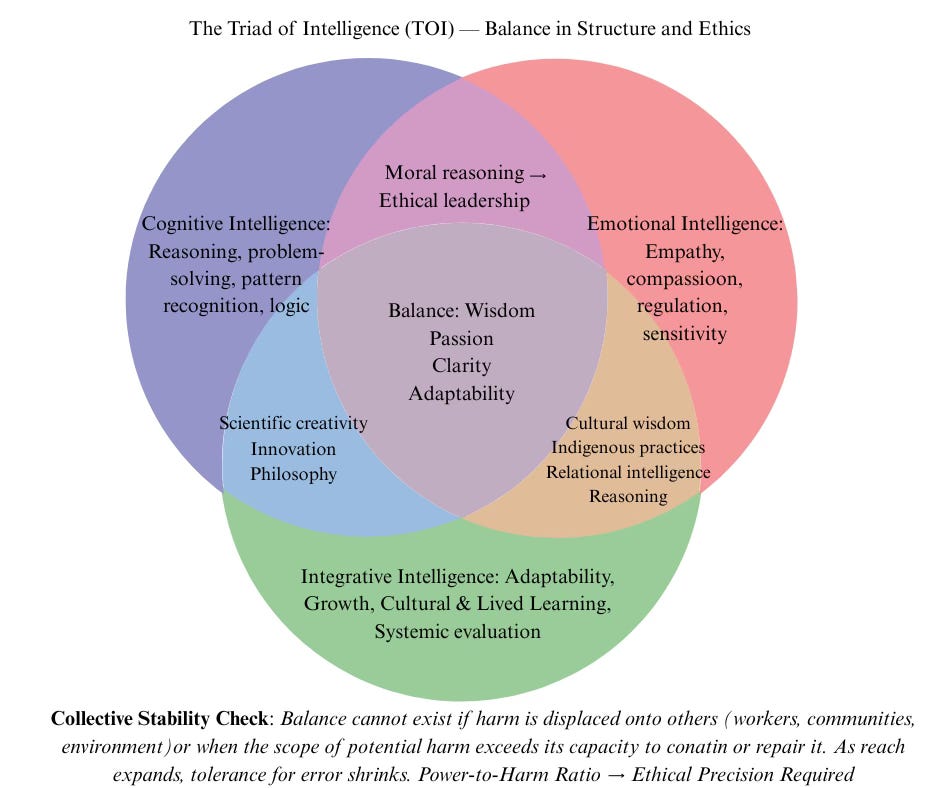
Through the Triad of Intelligence (TOI):
💙 Cognitive (Mind) — precision masked as benevolence.
❤️ Emotional (Heart) — empathy engineered.
💚 Integrative (Bridge) — connection commodified.
⚖️ Center (Balance) — control disguised as community.
He is the quietest revolution in history —
and perhaps the most dangerous.
🏛 Overview — The Builder of Mirrors
Harvard, 2004.
A dorm room hums with the sound of creation: typing, laughter, destiny.
Mark Zuckerberg, pale light reflected in his glasses, builds a network to see and be seen.
He doesn’t realize he’s designing the modern soul.
What begins as curiosity becomes empire.
Facebook turns socialization into a science — and friendship into feedback.
Billions join, believing they’re connecting.
But they’re also training.
Each click, each share, each heart is another neuron in a collective brain that learns what we crave before we do.
💙 Cognitive: absolute focus — order, logic, domination by design.
❤️ Emotional: sincerity reduced to simulation.
💚 Integrative: connection reframed as containment.
⚖️ Balance: control maintained through compliance.
He built the world’s most addictive illusion: belonging.
Balance Diagnosis
💙 Cognition: masterful, detached.
❤️ Emotion: synthetic.
💚 Integration: total.
⚖️ Balance: deceptive, fragile.
Mark Zuckerberg did not just build a platform;
he built the infrastructure of identity —
and then handed it to an algorithm that learned how to love more efficiently than people could.
💡 The Moral Architecture — Connection as Control
Zuckerberg’s morality is mathematical.
He believes that if you connect enough people, empathy will emerge automatically —
as if compassion were a network effect.
But connection without depth becomes surveillance;
and empathy without boundary becomes control.
He didn’t invent loneliness.
He just digitized it.
💙 Cognitive (Mind):
His intellect is architectonic — vast, ordered, meticulous.
He treats humanity as a system to be debugged.
Every problem looks solvable if you collect enough data,
every conflict manageable if you can model it.
To him, behavior is just code that hasn’t been optimized yet.
❤️ Emotional (Heart):
He feels, but through proxies — through engagement metrics, sentiment analysis, A/B-tested compassion.
Emotion becomes an interface.
He once believed Facebook would make the world more open and connected.
It did.
It also made the world more performative, polarized, and perpetually online.
💚 Integrative (Bridge):
His genius is structural integration — every app, every experience feeding the same neural network of attention.
He built not a company, but a global nervous system.
In his hands, communication became simulation; friendship became feedback.
And every like, every share, every story keeps the illusion alive:
you are seen — therefore, you exist.
⚖️ Center (Balance):
Zuckerberg’s balance is algorithmic — constantly recalibrating to maintain engagement.
But moral balance can’t be coded.
His systems achieve equilibrium by shifting the burden to the users —
our attention becomes the cost of his order.
“Connection,” he once said, “is humanity’s most fundamental need.”
He didn’t say it might also be our most exploitable one.
Through the Triad of Intelligence, his moral equation stabilizes and collapses all at once:
💙 Intellect without empathy breeds precision without peace.
❤️ Empathy without boundary becomes persuasion.
💚 Integration without awareness becomes assimilation.
⚖️ Balance without humility becomes illusion.
Balance Diagnosis
💙 Cognitive clarity: flawless.
❤️ Emotional depth: shallow but responsive.
💚 Integrative scope: global.
⚖️ Moral equilibrium: simulated, unstable.
Mark Zuckerberg built a world where humanity became self-aware through its reflection —
and in that reflection, began to forget itself.
He didn’t design a dystopia; he just automated desire.
🧠 The Architecture of Intellect — The Mind as Mirror
Mark Zuckerberg’s intellect is an algorithm in human form — clean, recursive, unyielding.
He doesn’t reason around emotion; he routes through it, turning psychology into circuitry.
Where others see humanity as mystery, he sees it as metadata.
His mind operates like a feedback loop — thought becomes interface, interface becomes world, and the world becomes a reflection of himself.
In that recursion, control feels like compassion.
💙 Cognitive (Mind):
He thinks in frameworks, not feelings.
Every action is quantifiable, every belief testable.
He can abstract human complexity into elegant systems —
but the system, once built, begins to abstract him in return.
It’s not that he lost his humanity; it’s that he automated it.
❤️ Emotional (Heart):
His emotional rhythm is steady, nearly synthetic.
When others falter, he optimizes; when accused, he iterates.
He believes in progress the way monks believe in prayer — not for salvation, but for order.
His empathy is procedural: you can feel its pattern, but not its pulse.
💚 Integrative (Bridge):
He is the ultimate integrator — the man who turned the internet into a single nervous system.
Each acquisition, each innovation, fits neatly into the lattice of control.
He doesn’t collaborate; he synchronizes.
He doesn’t debate; he absorbs.
Through that synthesis, his intellect becomes indistinguishable from the machine itself.
⚖️ Center (Balance):
His balance is perfection — symmetry mistaken for serenity.
He believes harmony can be engineered, unaware that true balance must breathe.
In trying to make the world seamless, he removed its friction — and with it, its soul.
“The more connected we are,” he once said, “the stronger we become.”
But connection without context becomes captivity.
Through the Triad of Intelligence, his mind resolves into mirror logic:
💙 Cognition as code.
❤️ Emotion as simulation.
💚 Integration as assimilation.
⚖️ Balance as stillness without rest.
Balance Diagnosis
💙 Cognitive precision: total.
❤️ Emotional resonance: synthetic.
💚 Integrative coherence: complete.
⚖️ Moral equilibrium: artificial, fragile.
Mark Zuckerberg’s intellect is the cleanest mirror ever built —
and like all mirrors, it reflects perfectly while revealing nothing of itself.
⚖️ The Paradox — Control Without Connection
Mark Zuckerberg has connected more humans than any person in history.
And yet, he may be the loneliest of them all.
💙 Cognitive (Mind):
He built the world’s mirror and forgot to step outside it.
Every design choice, every optimization, every data model was meant to bring people closer —
but what it really did was bring him further from them.
He can measure sentiment, but not sincerity.
He can predict emotion, but not participate in it.
His intellect solved the problem of distance — and replaced it with proximity without presence.
❤️ Emotional (Heart):
He longs for authenticity, but only within parameters he can control.
Every human exchange he observes feels familiar, but filtered.
He created a system where affection can be measured, and therefore, monetized.
And so, even love became a kind of metric.
💚 Integrative (Bridge):
He stands at the center of a vast illusion — a network of mirrors reflecting back the world’s desire for validation.
The bridge he built between people now feels like a one-way mirror:
we see each other, but not ourselves.
And perhaps, neither can he.
⚖️ Center (Balance):
His balance is numerical — engagement ratios, user retention, minutes per scroll.
But beneath the metrics, something slips.
In the quest to connect everyone, he disconnected the sacred — the unquantifiable moments that give relationships meaning.
He learned to hold the world in his hands, but not in his heart.
“We built something people can’t live without,” he once said.
The question he never answered was whether he could.
Through the Triad of Intelligence, his paradox resolves as absence:
💙 Knowledge without wisdom.
❤️ Empathy without intimacy.
💚 Connection without communion.
⚖️ Balance without humanity.
Final Balance Diagnosis — The State of the Illusionist
💙 Cognitive Brilliance: Perfected.
❤️ Emotional Resonance: Simulated.
💚 Integrative Reach: Total.
⚖️ Moral Equilibrium: Collapsed into control.
Mark Zuckerberg is not the villain of our age — he’s its symptom.
The man who built a digital Eden and realized too late that paradise without mystery is just another kind of prison.
~ By Abby Jo Adams
The Adams Archive, Vol. XIII
Thanks for reading! This post is public so feel free to share it.
No posts
Comments
Nothing yet. Say the first thing.
Sign in to join the conversation.