
Series Note:
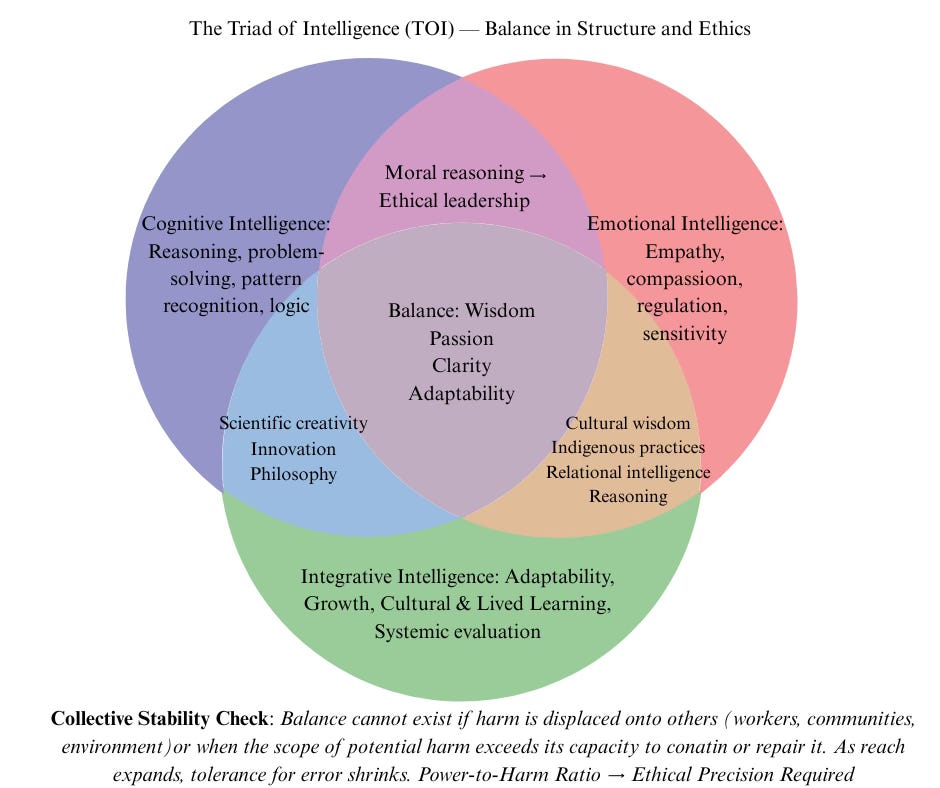
The Adams Archive uses the Triad of Intelligence (TOI) to map how people and institutions convert skill into influence.
This profile examines not just what Erik Prince says he is doing, but how his choices shape systems, shift harms, and test the limits of democratic accountability.
Erik Prince is the militarized twin of a family ecosystem that turns private resources into public influence. Where Betsy DeVos builds pipelines that move public money into private education, Prince builds pipelines that move force, secrecy, and decision-making out of public oversight and into private hands.
Both are architects of scale. Both show how integration can become domination when it’s separated from accountability.
In Triad-of-Intelligence terms, Prince operates with exceptional Cognitive (Blue) and Integrative (Green) power—strategic, organized, and adaptive—but an emotionally constricted Red domain. His system values precision over empathy, control over connection. The result is a machine that treats harm as operational collateral rather than a moral constraint.
Erik Prince’s reach is not a name—it’s a network. His influence operates through a complex web of private military contractors, shell companies, political allies, and financial partners that blur the line between public service and private profit.
This network doesn’t just adapt to government demand—it anticipates and shapes it. By positioning private force as a faster, cheaper, and more “efficient” solution to global instability, Prince helped create a self-reinforcing loop where secrecy and speed are rewarded while accountability is delayed or erased.
Contractor lineage: Blackwater → Xe → Academi → Constellis. Each rebrand distanced the enterprise from controversy while preserving its core operations.
Consulting and logistics fronts: Companies that manage transport, security, and supply chains across borders, often for governments or private clients.
Political and donor networks: Channels that normalize the idea of outsourcing war, detention, and surveillance to private entities.
Shell and holding companies: Layers of ownership that obscure responsibility and make tracing contracts difficult.
Together, these nodes form a regulatory shadow—a system that mirrors government function without public oversight. It’s fast, adaptive, and global. But without moral integration, speed becomes evasion, and innovation becomes impunity.
Privatized security systems naturally expand into any domain where control, logistics, and profit intersect. Immigration enforcement and detention are perfect examples. They offer large budgets, rapid turnover, and limited public oversight—a combination tailor-made for networks like Prince’s.
The same logistical and tactical expertise that ran private military operations overseas can be repurposed domestically to manage detention centers, transport detainees, and build infrastructure for mass containment. It’s not about ideology; it’s about scalability. Once a system learns to monetize conflict, it can monetize anything that resembles control.
Logistics and scalability: The infrastructure once used for combat operations—transport, secure perimeters, surveillance—maps seamlessly onto detention and deportation systems.
Opacity and outsourcing: ICE contracts often pass through layers of vendors and subcontractors, each blurring responsibility. This mirrors the shell company structures Prince perfected overseas.
Harm displacement as profit: The farther responsibility moves from public view, the more profitable it becomes. The trauma of detention—family separation, dehumanizing conditions, psychological harm—becomes an invisible externality absorbed by detainees, workers, and communities rather than the system’s architects.
Workers and guards operate in dangerous, underregulated environments with limited support.
Families and local communities shoulder the human and social costs while corporations reap federal payouts.
Democracy itself erodes when public power is subcontracted to private firms with no obligation to transparency.
The pattern is the same: a system designed for efficiency, not empathy. And once the public accepts that efficiency justifies harm, it opens the door for privatized power to govern far beyond the battlefield.
Prince’s mind is built for combat calculus. He thinks in grids, hierarchies, and logistics chains—the architecture of control. As founder of Blackwater, he recognized early that the “War on Terror” wasn’t just a military campaign—it was a business model. He saw the inefficiency of state bureaucracy and replaced it with privatized precision.
His Cognitive intelligence operates with extraordinary strategic foresight:
He anticipates geopolitical trends before governments do, positioning his companies to fill the gaps they can’t—or won’t—address.
He translates chaos into contracts, converting instability into revenue streams.
He systematizes violence, turning battlefield tactics into scalable products.
Yet this same clarity reveals his deepest flaw: the exclusion of empathy from the equation.
His mental frameworks treat people as moving parts, not moral subjects. Soldiers become assets; civilians become variables; death becomes data. The moral perimeter collapses under the weight of “efficiency.”
Prince represents what happens when intellect is maximized without conscience—a form of weaponized rationality that can execute flawlessly but never self-reflect.
Emotionally, Prince is the embodiment of stoic detachment. He projects control, confidence, and conviction. Those traits earn admiration in military culture—but when applied to governance and policy, they breed ethical anesthesia.
His emotional regulation is not empathy; it’s insulation.
Control as identity: Raised in a culture of dominance, success, and moral certainty, emotional vulnerability becomes a liability to be suppressed.
Moral justification through faith: Like his sister Betsy, he often invokes religion as validation—a divine license to operate beyond conventional morality.
Desensitization through exposure: Repeated proximity to violence fosters numbness disguised as professionalism.
This creates a paradox: he may genuinely believe he’s serving a moral mission, yet his methods perpetuate harm on a global scale. It’s not emotional absence—it’s emotional inversion: conviction without compassion, patriotism without humanity.
The result is a man who can look upon suffering and see only strategy.
Prince’s genius lies in his integration. He doesn’t just build companies—he builds ecosystems. His network stretches across continents, contracts, and ideologies. Each node—military, financial, or political—feeds the others.
This is Integrative Intelligence at its highest operational form and lowest moral expression.
He merges private capital with state power, creating a hybrid structure that acts faster than democracy can respond.
He blends nationalism with global opportunism, preaching loyalty while operating across borders.
He synchronizes technology, logistics, and ideology to transform military contracting into a parallel governance system.
But Prince’s integration is parasitic, not symbiotic. It absorbs oversight, outpaces regulation, and monetizes dependency. Every system he touches becomes reliant on him precisely because he erodes its internal stability.
Where his sister privatizes education, he privatizes enforcement. Both move the center of gravity away from the public good and toward the family network’s ideological and financial hub.
In TOI terms, his Green is brilliant but corrupted—connection used not to harmonize systems, but to dominate them.
The appearance of control in Prince’s world is deceptive. His systems are stable only because they feed on instability elsewhere. The wars, crises, and border conflicts that devastate human lives also sustain his business model.
He operates like a stability parasite—creating order within his network by outsourcing chaos to everyone outside it.
Economic feedback loop: instability increases demand for private security; demand increases political leverage; leverage fuels new instability.
Ethical inversion: every humanitarian disaster becomes a logistical opportunity.
Perpetual motion through conflict: peace is not profitable, so balance is maintained through constant unrest.
This is the darkest form of “balance” within the Triad: internal coherence achieved through external destruction.
Prince’s system functions as a mirror of late-stage capitalism itself—rational, efficient, and soulless. A machine that never stops running, even as it consumes the world that powers it.
Every system reveals its ethics in how it handles harm. In Erik Prince’s network, harm is not prevented; it’s redistributed. The brilliance of his design lies not only in its operational efficiency but in its ability to transfer consequences—from power to the powerless, from profit to pain, from visibility to the shadows.
Blackwater and its successors operated under a legal gray zone: technically accountable to U.S. law, yet deployed beyond its reach. In Iraq and Afghanistan, Prince’s contractors functioned as extensions of state power without the constraints of military justice. When civilians were killed, investigations dragged, contracts renewed, and structures evolved faster than accountability could catch them.
Each scandal produced a new name, not a new ethic.
The same structural DNA that enabled Blackwater’s foreign operations now thrives in domestic enforcement. Immigration detention centers and border operations mirror the same logic: privatize control, diffuse responsibility, and monetize human containment.
Corporations with ties to Prince’s extended network—whether through logistics, surveillance, or subcontracting—have applied military frameworks to civilian populations. Detainees become data points in a supply chain. Trauma becomes an unrecorded cost of doing business.
In detention systems built on this model:
Oversight is replaced by contract renewals.
Psychological harm is rebranded as “compliance management.”
The language of war—targets, missions, assets—migrates seamlessly into the language of immigration control.
Prince’s ecosystem doesn’t need to directly run every facility to influence its architecture; it simply built the prototypethat made it acceptable to treat people as logistical problems.
What began as a service—private security—has evolved into an ideology. The belief that control can be commodified, that ethics are inefficiencies, and that order can be sold to the highest bidder.
The emotional, physical, and societal costs are not absorbed by those who design the systems but by those trapped within them—workers, contractors, detainees, and civilians who will never appear on a balance sheet.
This is the essence of harm displacement: keeping systems profitable by exporting suffering to those least able to resist or repair it.
Balance is not a static ideal; it’s an ethical equation.
It asks one question of every leader, corporation, or nation:
Who absorbs the harm your power creates?
Erik Prince’s model of influence fails this test spectacularly. His systems produce order for those inside them only by displacing chaos outward. The efficiency that makes his networks profitable depends on spreading instability to others—workers, communities, and nations that cannot defend themselves from systemic extraction.
In the Triad of Intelligence, Cognitive and Integrative power are gifts that demand emotional and ethical counterbalance. Without it, intelligence turns predatory. The Power-to-Harm Ratio captures this dynamic: the greater your reach, the smaller your margin for moral error must become.
Prince’s ratio is inverted.
Reach: global and borderless.
Accountability: fragmented and evasive.
Repair capacity: negligible.
When harm scales faster than accountability, balance collapses. The system begins to feed on its own instability, justifying exploitation as “efficiency” and destruction as “order.”
In Prince’s world, harm is outsourced like a service.
Civilian deaths in war zones become “collateral.”
Human suffering in detention centers becomes “containment.”
Psychological tolls on contractors are “operational fatigue.”
Each is an accounting trick that moves moral debt off the balance sheet.
But harm does not disappear when displaced—it compounds. The trauma inflicted in Iraq resurfaces at the border. The loss of empathy in war zones echoes in domestic policing. What we fail to integrate returns as unrest, addiction, and distrust. The system collapses not from attack, but from disconnection.
Every civilization has a tolerance for ethical error—a point where its systems can still repair what they break. When that threshold is passed, collapse begins.
Prince’s networks—military, political, and economic—operate beyond that threshold. Their complexity outpaces the capacity for repair. Contracts are global; accountability is local. The result is a widening gap between those who act and those who suffer the consequences.
To restore equilibrium, harm must be reabsorbed into the system that created it.
Governments must reclaim the functions they outsourced.
Private actors must face public scrutiny equal to their influence.
Citizens must recognize that efficiency without empathy is the seed of every tyranny.
The Triad of Intelligence demands Ethical Precision—the discipline of measuring not just what can be done, but what should be done. True balance begins when power stops exporting its pain.
The Triad of Intelligence teaches that imbalance cannot be punished out of existence; it must be integrated out of ignorance. Systems built on domination can only be rebalanced through reflection, redistribution, and repair. To correct the Power-to-Harm Ratio that defines Erik Prince’s model, we must restore the moral circuitry that was bypassed.
Governments must reclaim the functions they outsourced to private power. Security, detention, and military operations cannot remain under private control without eroding democracy itself. The state’s duty is not to compete with private firms but to protect its citizens from them.
End revolving-door contracts between public officials and private defense or detention companies.
Create a public registry for all private military and immigration-related contracts.
Mandate transparency for subcontractors and shell entities operating under state authority.
Accountability begins where secrecy ends.
Efficiency without empathy breeds collapse. Ethical infrastructure is not a moral luxury—it’s the scaffolding that keeps intelligence from consuming itself.
Establish an international oversight body to license and audit private security firms.
Require independent human rights and environmental reviews before contract approval.
Fund trauma recovery programs for both contractors and affected civilians.
Repair must become a built-in cost of doing business, not an afterthought.
The system of mass detention—domestic and abroad—must evolve beyond punishment into restoration.
Replace detention quotas with resolution metrics—family reunification rates, asylum review timeliness, reintegration support.
Redirect ICE budgets toward humanitarian logistics, housing, and mental health services.
Require private detention operators to fund community reinvestment where facilities are located.
The goal is not to soften control but to transform its purpose—from containment to care.
Success must no longer be measured in contracts won or targets neutralized but in harm prevented.
Integrate ethics training into defense and intelligence education equal in weight to tactical training.
Reward collaboration and transparency, not secrecy and domination.
Embed citizen oversight boards to review major security initiatives.
The future of intelligence must prioritize precision of conscience as much as precision of aim.
At its root, this imbalance is emotional as much as structural. Systems built by those numb to suffering reproduce that numbness in policy.
Encourage cross-disciplinary leadership: veterans trained alongside social workers, engineers paired with ethicists, and economists taught by anthropologists.
Normalize emotional intelligence as a metric of leadership, not a sign of weakness.
Reintroduce Indigenous and communal wisdom into discussions of justice, repair, and environmental care—the original models of integrated intelligence.
Restoration requires humility, and humility is impossible without feeling.
The Triad demands that as reach expands, precision deepens.
When a person or system holds extraordinary power, they must evolve equally in wisdom, compassion, and self-awareness.
If they cannot, that power must be redistributed to those who can.
The choice ahead is not between chaos and control—it is between domination and balance.
Rebalancing the system is not the end of the story; it is the beginning of collective maturity.
The Triad of Intelligence doesn’t exist to condemn—it exists to clarify.
It holds up a mirror so we can see the difference between mastery and wisdom, power and balance, conviction and compassion.
Erik Prince represents the kind of intelligence the world often rewards: efficient, strategic, unflinching. But the Triad reveals what such systems always forget—that intelligence without empathy is not progress, it’s recursion. It loops endlessly through conflict, profit, and collapse until humanity remembers what knowledge was meant to serve.
The danger of Prince’s model isn’t just in its reach—it’s in its imitation. It teaches young leaders that domination is discipline, that control is courage, that morality is a liability. Those lessons ripple outward, shaping institutions, policies, and public expectations. We begin to see harm as normal, power as neutral, and apathy as professionalism.
But balance is still possible. It begins wherever a single person or community decides that harm is no longer an acceptable currency of order. When the Power-to-Harm Ratio tips too far, repair becomes a revolutionary act.
The Triad asks each of us to participate in that repair:
To think clearly. (Blue)
To feel deeply. (Red)
To act integratively. (Green)
And to stay centered even as the world destabilizes around us. (Balance)
If we can do that—if we can match Prince’s precision with conscience, his confidence with humility—we can redirect the evolution of intelligence itself.
Because balance isn’t neutrality. It’s accountability.
And true stability will come not from those who conquer the world, but from those who finally choose to care for it.
~By Abby Jo Adams
— The Adams Archive, Vol. II: “The Militarized Mirror” (2025)
Thanks for reading! This post is public so feel free to share it.
No posts
Comments
Nothing yet. Say the first thing.
Sign in to join the conversation.