
Series Note
The Adams Archive uses the Triad of Intelligence (TOI) model — Cognitive (Blue), Emotional (Red), Integrative (Green), and Center Balance — to map how people and systems convert power into influence.
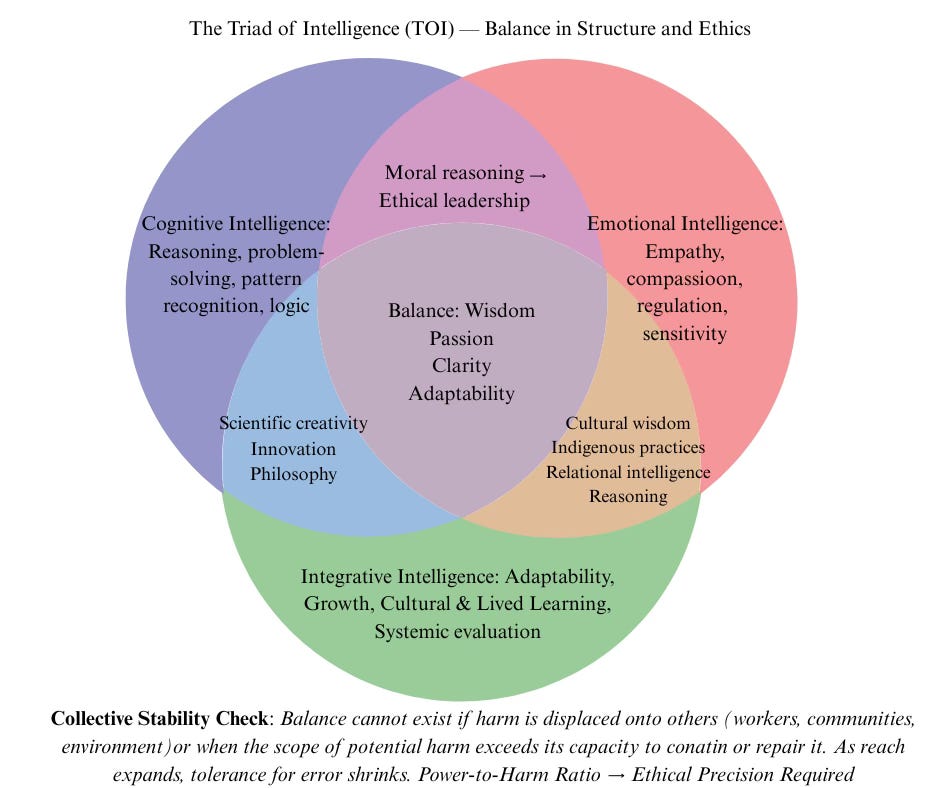
These profiles are not written to praise or condemn but to clarify: to reveal how intelligence, when detached from empathy and reflection, can reorganize the moral landscape of an entire nation.
“Balance cannot exist if harm is displaced onto others.
The more reach you have, the less harm you are allowed to export.” — Triad of Intelligence
Overview — The Architect of Moral Markets
Betsy DeVos presents herself as a moral reformer and champion of “school choice.”
In practice, she represents the commodification of morality itself — the conversion of faith and philanthropy into a delivery system for power.
Where her brother Erik Prince militarizes control, DeVos spiritualizes it.
Both operate within the same family ecosystem: private wealth leveraged to shape public systems, insulated by religious conviction and political networks that reward loyalty over learning.
Under the Triad lens, DeVos exhibits powerful Cognitive (Blue) and Integrative (Green) function — strategic, organized, adaptive — but an emotionally constricted Red domain.
She feels moral passion, but it is bounded by ideology rather than informed by empathy.
Her system reframes privatization as virtue, and harm as “choice.”
She has not simply changed policy; she has redesigned the moral vocabulary of American education — and through it, the emotional wiring of democracy itself.
🕸 2. Network Ecosystem — The Architecture of Influence
Betsy DeVos does not operate as a lone philanthropist.
She is the civilian arm of a larger privatization network — a machine that translates ideology into infrastructure.
Her genius lies not in any single policy, but in how she fuses religion, finance, and governance into one seamless operating system.
Where most philanthropists distribute wealth downward, DeVos recycles it laterally — through foundations, PACs, think tanks, and nonprofits that reinforce one another’s agendas until they appear inevitable.
This is integration without reciprocity: connection without correction.
American Federation for Children (AFC) — Founded and funded by DeVos to promote “school choice.” AFC invests heavily in state-level elections, targeting legislators who support vouchers, charter expansion, and deregulation. Its influence extends into both policy drafting and media framing, effectively merging campaign strategy with ideological messaging.
Alliance for School Choice — The nonprofit counterpart to AFC, offering a charitable façade to the same political agenda. This “philanthropic camouflage” enables tax-sheltered influence while presenting privatization as public good.
Council for National Policy (CNP) — A hub of religious conservatives, financiers, and strategists. The DeVos family has long been intertwined with CNP, using it as a crossroad for money, messaging, and mobilization. It provides the emotional branding (faith, family, patriotism) that moralizes economic control.
Heritage Foundation, Mackinac Center, and ALEC — Ideological engines that draft “model bills” dismantling public accountability. Their language of “innovation” and “freedom” masks a deeper goal: transforming education into a private market.
Family Foundations and Dark-Money Channels — Multiple DeVos-linked 501(c)(3) and (c)(4) entities redistribute capital through scholarships and policy “incentives,” creating a moral supply chain that bypasses democratic oversight.
These nodes together form a faith-finance feedback loop:
Religion provides moral cover.
Money provides amplification.
Policy provides permanence.
Each element reinforces the other until the public sphere itself begins to sound like a sermon written by investors.
This is not accidental — it is design.
The DeVos network has spent decades rebranding inequality as choice and control as compassion.
Every new voucher program or deregulation effort carries the same hidden payload:
the redistribution of public accountability into private hands.
The Triad calls this “ethical inversion” — when integration becomes domination and morality becomes marketing.
The structure works because it looks benevolent.
And that is the most sophisticated form of imbalance there is.
Betsy DeVos exemplifies what the Triad calls functional imbalance: an intelligence that performs with excellence in design but with ethical blindness in execution.
Her brilliance lies in her ability to connect ideology, infrastructure, and capital — yet she uses that integration to concentrate control rather than expand care.
Below is her Triad profile:
DeVos’s Cognitive domain is formidable. She thinks in systems, not slogans. Her mind sees pathways between money, messaging, and legislation that others overlook.
Her success in reshaping education policy was no accident — it was a masterclass in applied systems logic.
Strengths
Strategic orchestration — Built durable pipelines connecting donors, think tanks, and state legislatures.
Financial dexterity — Repackaged ideology as investment, turning belief into policy capital.
Narrative engineering — Controlled framing of “choice” to make extraction sound like empowerment.
Risks / Imbalances
Tunnel logic — Optimizes for privatization even as evidence shows widening inequality.
Confirmation as conviction — Treats opposition not as data but as sin.
Language as camouflage — Converts moral certainty into policy defense, insulating ideas from criticism.
Balance Note (Blue): High clarity, low humility. Intelligence applied without reflection becomes dogma disguised as reform.
DeVos’s emotional domain is disciplined but narrow. She radiates calm authority and moral conviction — qualities that evoke trust in her base.
Yet her empathy has boundaries drawn by ideology. She listens selectively and feels deeply only for those within her moral circle.
Strengths
Emotional composure — Maintains unflappable calm under scrutiny, projecting moral strength.
Moral storytelling — Frames political ambition as divine duty, allowing followers to feel righteous while advancing her agenda.
Risks / Imbalances
Empathy gatekeeping — Compassion flows inward (to allies, believers) but rarely outward to those excluded from her worldview.
Defensive righteousness — Redefines critique as persecution, moralizing disagreement instead of examining it.
Emotional outsourcing — Delegates empathy to faith rather than practicing it as dialogue.
Balance Note (Red): Emotion used as recruitment, not reflection. Passion becomes performance when it cannot tolerate dissent.
If her brother Erik built a militarized network of control, Betsy built a moralized one.
Her Integrative Intelligence fuses faith, policy, and finance into an ecosystem that rewards alignment and punishes deviation.
It is integration without balance — coherence without conscience.
Strengths
Network architect — Links religion, business, and government into a mutually reinforcing triad.
Message adaptability — Reframes privatization as “freedom,” austerity as “efficiency,” and exclusion as “values.”
Systemic foresight — Designs infrastructures that outlast elections and survive scandal.
Risks / Imbalances
Ethical siloing — Integrates power structures while excluding public participation.
Exported harm — Shifts the cost of reform onto teachers, families, and children.
Closed-loop control — Treats feedback as threat, ensuring self-preservation at the expense of collective learning.
Balance Note (Green): Integration weaponized. The machinery of connection used not to distribute care, but to consolidate control.
Every system has a center of gravity.
For balanced leaders, that center is humility — the willingness to revise when harm becomes visible.
For Betsy DeVos, the center is certainty.
She embodies what the Triad calls a rigid equilibrium: a posture that looks stable because it never moves.
Her stillness feels like conviction, but it is really the absence of feedback — a moral architecture built on walls, not windows.
DeVos’s composure and religious framing create the impression of spiritual alignment.
But beneath the surface, her system depends on asymmetrical accountability:
others must answer to her standards, but she answers only to God.
This conviction grants her a sense of divine immunity — an emotional calm that resists reflection.
In the Triad’s terms, she replaces balance (interdependence) with control (certainty).
Her center remains fixed because it is anchored in ideology, not empathy.
DeVos’s version of balance operates through a kind of moral economy:
Faith becomes the currency of credibility.
Wealth becomes proof of divine favor.
Policy becomes a tool of purification.
It is a theology of order — one that seeks to cleanse institutions rather than reform them.
Her moral logic treats dissent as decay, and thus her reforms always remove rather than repair.
In this framework, education is not a public trust; it is a testing ground for obedience.
The Triad identifies a unique danger in this pattern: when intellect and conviction unite without emotional calibration, they create a self-sealing loop of moral logic.
Every policy becomes self-justifying because it originates from perceived divine right rather than empirical review.
This produces what the Triad calls “ethical stasis” — a system that cannot evolve because it confuses immovability with virtue.
Her certainty becomes her sanctuary — and her greatest ethical risk.
True balance is not composure; it is correction.
Betsy DeVos’s center is calm, but not conscious. It does not self-adjust — it deflects.
And any system that cannot be corrected by harm is destined to reproduce it.
Every system reveals its ethics in how it handles harm.
Betsy DeVos’s legacy is not defined by her intentions but by her redistribution of consequence — how her decisions insulated elites while transferring risk downward.
Her reforms were marketed as liberation; in reality, they restructured where harm lands.
As U.S. Secretary of Education, DeVos rescinded dozens of protections for students, borrowers, and survivors of sexual assault.
She weakened Title IX guidance, relaxed accountability for predatory for-profit colleges, and dismantled disability and civil rights oversight mechanisms.
Each rollback framed bureaucracy as oppression — yet the result was the removal of safety nets for the most vulnerable.
In Triad terms, this was cognitive precision without emotional calibration: a calculated efficiency that treated protection as inefficiency.
Outcome: Power-to-harm transfer from institutions to individuals — students left to self-advocate in systems designed to outlast them.
During the COVID-19 pandemic, DeVos attempted to direct CARES Act funds to private and religious schools, diverting money intended for struggling public districts.
A federal court blocked the effort, but the attempt revealed the underlying moral algorithm:
Privatization as righteousness, public welfare as waste.
This was integrative imbalance in action — a network using crisis as opportunity to expand itself.
Outcome: Public schools absorbed financial strain while private institutions received amplified narrative legitimacy.
DeVos’s decades-long influence in Michigan created one of the nation’s most deregulated charter environments.
The state became a test case for what happens when ideological “freedom” overrides empirical accountability: declining academic outcomes, rising segregation, and public funds funneled into unvetted operators.
Each failure was reframed as proof that “more reform” was needed — a feedback loop of harm mistaken for innovation.
Outcome: Community schools destabilized, teacher morale eroded, public trust hollowed.
Even while holding office, DeVos retained financial ties to education-related firms and foundations.
Her office blurred public duty with private interest — lobbying for deregulation that would directly benefit sectors in which her family invested.
This merging of moral authority and financial power exemplifies Green imbalance: integration used not to bridge divides, but to consolidate influence.
Outcome: Ethical opacity normalized. Democracy’s checks replaced by faith-based branding.
Beyond data and policy, DeVos’s reforms inflicted a subtler form of harm: moral fatigue among educators and communities.
Teachers felt devalued, students felt unseen, and families internalized blame for systemic deprivation.
It is a quiet trauma — one that drains collective energy and normalizes inequity.
Outcome: A spiritually exhausted education system mistaking endurance for progress.
In the Triad’s moral calculus, these are not administrative missteps — they are patterns of institutional harm displacement.
Each decision moved instability away from the powerful and onto the people who could least afford it.
Each reform tightened the system’s control while claiming to set it free.
Balance Note (Accountability):
Harm cannot be sanctified through intention.
Once moral certainty replaces moral responsibility, ethics become administration — and injustice becomes infrastructure.
The Triad of Intelligence measures balance not by belief or intent, but by the Power-to-Harm Ratio:
How much harm does a system produce compared to its capacity to repair?
Betsy DeVos’s ratio is critically inverted.
Her network’s reach is vast — spanning education, religion, finance, and politics — yet its repair mechanisms are almost nonexistent.
Each reform she advances transfers the weight of instability downward, leaving the public to absorb the consequences of her convictions.
Teachers became the first line of sacrifice.
While DeVos championed “freedom” from bureaucracy, she quietly dismantled the scaffolding that sustained educators’ livelihoods.
Wages stagnated, benefits eroded, and respect collapsed — all framed as “efficiency.”
Result: Emotional burnout and attrition at historic highs.
Balance diagnosis: Labor redefined as charity, professionalism replaced by obedience.
“School choice” became the moral branding of deprivation.
Families were told they had freedom, but that freedom came at the expense of stability for others.
Each new voucher created a vacuum somewhere else — a redistribution of opportunity disguised as empowerment.
Result: Two education systems emerged: one curated for the chosen, another neglected for the rest.
Balance diagnosis: Emotional justice collapsed — empathy replaced by market logic.
Public schools are more than classrooms; they are civic anchors — the places where democracy learns itself.
DeVos’s privatization agenda eroded that foundation, fracturing communities along lines of class, faith, and geography.
Once schools lose their public identity, communities lose their collective mirror.
Result: Fragmented trust, localized despair, widening civic apathy.
Balance diagnosis: Integration of wealth, disintegration of community.
Every imbalance in education becomes a fracture in democracy.
When information, access, and empathy are stratified, citizens lose the ability to reason across difference.
DeVos’s reforms normalized governance by branding — where truth becomes relative to belief and data secondary to devotion.
Result: A more polarized, less informed electorate — one that mistakes moral certainty for wisdom.
Balance diagnosis: Blue intelligence detached from Red conscience, leaving Green integration weaponized.
The Triad’s balance equation compares three primary variables: reach, accountability, and repair capacity.
When these move out of sync, the system’s Power-to-Harm Ratio begins to tilt toward collapse.
In Betsy DeVos’s ecosystem, reach is global, spanning education, philanthropy, politics, and faith networks.
Accountability, however, is fragmented—diffused through nonprofits and policy layers that blur ownership.
Repair capacity is minimal, because the very communities harmed by privatization lack both voice and resources to reverse it.
Meanwhile, the public sector carries the opposite pattern: high accountability, moderate repair, but shrinking reach.
It reacts rather than designs, constantly absorbing the instability exported by privatized networks.
And at the base, communities operate with no formal accountability mechanisms at all—only informal bonds and overextended goodwill.
They become the shock absorbers of systemic imbalance, absorbing emotional and material harm until burnout replaces participation.
The result is predictable:
DeVos’s network appears stable because it externalizes chaos.
Public institutions appear inefficient because they inherit what others refuse to hold.
Communities appear apathetic because exhaustion looks like indifference from above.
In Triad language, this is rigid equilibrium masquerading as progress—a balance sustained only by continual harm displacement.
When harm scales faster than repair, the system begins to consume its own stability to survive.
Balance Note (Collective Stability):
Betsy DeVos’s system sustains itself by externalizing instability.
Each act of reform becomes a quiet act of extraction — moral, financial, emotional.
The Triad calls this pseudo-balance: order maintained through others’ imbalance.
The Triad of Intelligence teaches that imbalance cannot be punished out of existence; it must be integrated through reflection and repair.
For Betsy DeVos and the networks she represents, restoration begins not with rebranding but with reorientation — moving from control to cooperation, from conviction to conscience.
Below are the pathways the Triad prescribes for ethical recalibration in her domain.
True reform begins where certainty ends.
DeVos’s power was built on moral confidence; her restoration requires moral curiosity.
Pathway:
Establish open listening forums between policymakers and public-school educators.
Invite criticism as data, not defiance.
Practice what the Triad calls reflective reciprocity — allowing external voices to reshape internal belief.
Principle: Wisdom grows at the speed of humility.
The moral center of democracy is pluralism — the ability to coexist without hierarchy of worth.
DeVos’s reforms privileged one moral vocabulary at the expense of all others.
Pathway:
Include secular, interfaith, and marginalized voices as equals in policy councils.
Require transparency for faith-based funding to prevent moral monopolies.
Treat diversity not as tokenism, but as collective moral calibration.
Principle: Faith that excludes is ideology; faith that listens becomes wisdom.
The Triad measures intelligence by feedback, not faith.
Any claim of success must be tested against real-world outcomes — especially those affecting vulnerable populations.
Pathway:
Mandate independent audits of voucher and charter outcomes by race, disability, and income.
Publicly release longitudinal data on community impact.
Replace ideological narratives with measurable well-being metrics.
Principle: Transparency is compassion made visible.
Philanthropy has long been the DeVos brand of benevolence.
But repair requires more than giving; it requires returning — acknowledging harm and reinvesting where stability was lost.
Pathway:
Redirect private wealth into teacher training, mental health support, and infrastructure for underserved districts.
Fund community-led repair projects without branding or control.
Use influence to strengthen the very public systems once weakened by privatization.
Principle: Restoration is not charity — it is restitution.
The emotional deficit of DeVos’s system is not cruelty but distance.
To rebalance, she must bridge that gap — from certainty to sensitivity, from preaching to presence.
Pathway:
Engage directly with those harmed by policy: teachers, students, and families excluded from choice narratives.
Model emotional accountability through public acknowledgment of error.
Normalize vulnerability as leadership, not weakness.
Principle: Conviction purified by empathy becomes conscience.
The Triad insists that intelligence, to be whole, must redefine what “winning” means.
In education, the measure of success cannot be efficiency or enrollment; it must be equity and emotional safety.
Pathway:
Evaluate reforms by reduction in harm, not increase in control.
Reward collaboration over competition in funding models.
Institutionalize repair as policy — every reform should include a built-in restitution plan.
Principle: Balance is not neutrality; it is active protection of collective well-being.
Balance Note (Restoration):
Power regains its humanity when it learns to care faster than it controls.
The path to equilibrium begins the moment a leader stops defending their virtue and starts repairing their impact.
The Adams Archive does not exist to humiliate or sanctify.
It exists to hold a mirror to systems powerful enough to shape the moral imagination of a nation.
Betsy DeVos is not merely an individual; she is the embodiment of a recurring equation in American life — the conversion of faith into capital, and of capital into control.
Her story reveals a deeper paradox:
A person can believe they are saving souls while systematically eroding the structures that protect them.
She sought to make schools moral, yet her reforms left them fragile.
She preached freedom, yet her system tightened the bonds of inequity.
She built with conviction, but without correction.
In the Triad of Intelligence, every imbalance becomes visible when the Power-to-Harm Ratio tips too far.
DeVos’s network teaches us a lesson much larger than education:
When morality becomes a marketplace, virtue becomes a brand, and truth becomes a product.
That is not faith — it is faith repurposed.
It is the quiet collapse of empathy under the weight of efficiency.
But balance is still possible.
The same cognitive precision that built these systems can be redirected toward repair.
The same emotional conviction that justified harm can be reoriented toward healing.
And the same integrative genius that created networks of control can create networks of restoration — if the will to listen outweighs the fear of being wrong.
The Triad’s Mandate:
Think clearly. (Blue)
Feel deeply. (Red)
Act integratively. (Green)
Stay centered even when certainty tempts you to stand still. (Balance)
Final Reflection:
Betsy DeVos reminds us that imbalance is not always loud.
Sometimes it is serene, prayerful, and polite — a smile that believes it’s saving you even as it steals your voice.
The task before us is not to destroy such power, but to illuminate it — to show that true stability does not arise from control, but from care.
Because balance is not about who wins.
It’s about who heals.
And the future of education — and democracy itself — depends on remembering that difference.
~By Abby Jo Adams
— The Adams Archive, Vol. I: “Betsy DeVos” (2025)
Thanks for reading! This post is public so feel free to share it.
No posts
Comments
Nothing yet. Say the first thing.
Sign in to join the conversation.