
The Adams Archive uses the Triad of Intelligence (TOI) — Cognitive (Blue), Emotional (Red), Integrative (Green), and Center Balance — to map how people and systems convert power into influence.
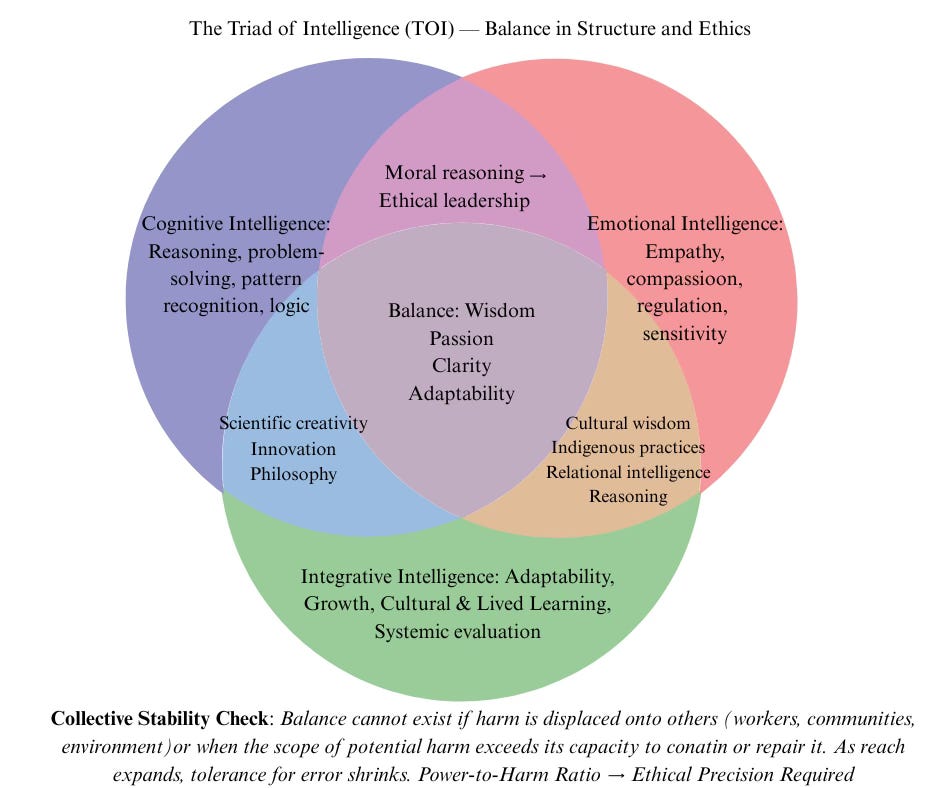
These profiles are not written to praise or condemn but to clarify:
to reveal how intelligence, when detached from empathy and reflection, can reorganize the moral and emotional wiring of an entire nation.
“Balance cannot exist if harm is displaced onto others.
The more reach you have, the less harm you are allowed to export.” — Triad of Intelligence
Turning Point USA presents itself as a youth movement for “faith, freedom, and the Constitution.”
In practice, it is a marketing engine for ideological obedience — a machine that translates outrage into identity, and identity into political capital.
Where Betsy DeVos spiritualizes control and Erik Prince militarizes it, Turning Point emotionalizes it.
It is the affective arm of a privatization empire — a network designed to recruit hearts before minds, using belonging as a form of behavioral conditioning.
Under the Triad lens, Turning Point operates as a collective personality:
high in Emotional (Red) charge, high in Integrative (Green) spread, but low in Cognitive (Blue) calibration and Center balance.
Its message resonates not because it is logical, but because it feels like purpose.
The movement transforms insecurity into loyalty by converting confusion into clarity—no matter how false the clarity may be.
Turning Point perfected the emotional algorithm of modern propaganda.
It does not sell policy—it sells permission: to be angry, righteous, certain, and seen.
It offers young people a script for meaning in an era of chaos—then swaps empathy for ideology.
The result is a culture of performative conviction, where debate becomes theater and moral certainty replaces moral reflection.
Like DeVos, the movement’s founder Charlie Kirk mastered the art of moral framing.
He presented political allegiance as spiritual duty and dissent as corruption of the soul.
This is not civic education—it is emotional capture, designed to flood the nervous system with belonging until autonomy feels like betrayal.
Turning Point is not just a nonprofit; it’s an ecosystem of emotional engineering.
Through podcasts, conferences, influencer pipelines, and affiliated groups like Turning Point Faith and Turning Point Academy, it exports a worldview in which “freedom” means loyalty to hierarchy and “truth” means obedience to narrative.
Underneath its patriotic branding lies a profound ethical inversion:
The language of liberty is used to normalize submission.
In the Triad’s moral calculus, this represents Red dominance without Blue reflection — passion untempered by precision — and Green integration without conscience — connection without correction.
The consequence is a generation trained not to think critically, but to feel strategically.
And when feeling becomes the substitute for thinking, democracy becomes performance art for the emotionally manipulated.
Turning Point USA is not a grassroots movement.
It is a vertically integrated influence network that translates elite funding into emotional loyalty, disguised as student activism.
Its architecture reveals how twenty-first-century power scales—not through legislation first, but through identity capture.
Turning Point USA (TPUSA) — Founded in 2012 by the late Charlie Kirk and Bill Montgomery, TPUSA brands itself as the antidote to “liberal indoctrination.”
Its true function is narrative indoctrination: converting political messaging into personal identity through repetition, reward, and belonging.
The organization operates as the training ground for ideological entrepreneurs—individuals who learn to monetize outrage via speaking circuits, campus chapters, and social-media virality.
It has grown from a campus club into a sprawling franchise model with dozens of sub-brands:
Turning Point Action — the political arm that coordinates campaign operations and voter outreach, blurring the line between nonprofit advocacy and partisan machinery.
Turning Point Faith — an ecclesiastical wing that merges Christianity with nationalism, reframing civic duty as divine warfare.
Turning Point Academy — its newest expansion into K-12 education, exporting ideological curricula under the language of “patriotic renewal.”
Turning Point Live / Real America’s Voice — a media studio producing daily outrage content that gamifies politics for youth consumption.
Together, these branches form what the Triad calls a closed-loop influence ecosystem: emotion generates engagement, engagement generates revenue, and revenue reinforces emotion.
It is integration without reciprocity—connection designed to amplify belief, not balance it.
Behind its student-friendly branding lies a deep bench of corporate and ideological sponsors.
Dark-money channels, religious financiers, and political super-PACs—many overlapping with the DeVos-Prince orbit—feed its expansion:
Donor Trusts and Family Foundations connected to the Council for National Policy, the Koch network, and DeVos-affiliated philanthropies supply the fiscal backbone.
Political PACs such as Turning Point Action PAC and America First Works serve as distribution hubs for campaign coordination.
Religious networks—from evangelical megachurches to local youth ministries—provide recruiting pipelines and emotional legitimacy.
Media conglomerates like Fox News, The Daily Wire, and One America News amplify its narratives, creating a feedback loop where ideological content doubles as entertainment.
This lattice of donors, churches, and media forms what the Triad describes as an emotional supply chain—each node converting attention into allegiance.
Money flows upward, outrage flows downward, and stability is sacrificed to keep circulation alive.
Turning Point’s genius lies in recognizing that the modern battlefield is the feed.
Its social-media strategy operationalizes the psychology of dopamine and belonging.
Moral simplicity becomes the hook; indignation becomes the product.
Every meme, clip, and sound bite is optimized for maximum emotional resonance and minimal cognitive friction—what TOI terms Red amplification over Blue reflection.
In this design, the algorithm becomes a missionary: it rewards heat over light, speed over accuracy, performance over presence.
Turning Point’s reach now extends far beyond college campuses:
Campus chapters — Over 3,000 nationwide, often granted preferential access to university spaces while opposing diversity or inclusion initiatives.
Faith partnerships — Pastors receive training kits and talking points blending theology with political messaging, eroding the boundary between pulpit and party.
Local governance pipelines — Through “School Board Watchlist” and “Educate Don’t Indoctrinate” campaigns, TPUSA weaponizes parental anxiety into political mobilization, echoing the privatization playbook pioneered by DeVos.
These vectors create an illusion of spontaneity; in truth, they represent strategic decentralization—a design borrowed from military and corporate logistics alike.
Each chapter acts autonomously enough to evade accountability but remains tethered to centralized messaging.
In Triad terms, Turning Point’s ecosystem exemplifies Green overreach supported by Red dominance.
It integrates networks brilliantly but only to multiply conviction, not consciousness.
The system sustains itself through emotional capitalism—profit and influence extracted from perpetual outrage.
The outcome is predictable:
Dialogue declines; performance rises.
Certainty sells; curiosity starves.
Youth mistake belonging for belief, and belief for truth.
It is the architecture of control disguised as connection—a mirror of America’s broader spiritual crisis, where the feeling of freedom replaces the function of it.
Turning Point USA was born in the lecture hall, but its true conquest began in the classroom.
What started as a student movement “for free speech” has evolved into an apparatus for ideological containment—a campaign to control not just what students say, but what teachers teach and what communities believe is safe to think.
Turning Point’s early rhetoric celebrated “open dialogue.”
But as its influence grew, that ideal inverted.
Today, free speech within its network means approved speech—views that reinforce the organization’s moral hierarchy.
Opposition, nuance, or complexity are reframed as threats to truth.
Campus chapters and affiliated speakers now operate less like debate clubs and more like emotional militias—mobilized to create spectacle, record outrage moments, and intimidate educators.
The goal is not persuasion; it’s performance.
Each viral clip feeds the algorithm that sustains the machine.
In Triad terms, this marks a collapse of Cognitive (Blue) precision under the weight of Red emotional dominance.
Reason becomes a servant of reaction.
Facts exist only to decorate feeling.
Turning Point’s educational ventures reveal a more strategic layer.
Through Turning Point Academy and partnerships with private schools, the organization is advancing a new moral syllabus—one that replaces civic literacy with cultural loyalty.
Key features include:
Selective history — Reframing civil rights and labor movements as “Marxist distortions.”
Faith nationalism — Introducing “Biblical citizenship” modules that recast Christianity as the nation’s political foundation.
Anti-CRT and “Parental Rights” campaigns — Redefining academic inquiry as indoctrination, and ideological policing as protection.
These initiatives are marketed as “patriotic education,” but they function as curricular control mechanisms, ensuring that empathy, pluralism, and systemic critique are filtered out of the next generation’s moral vocabulary.
This is integration without conscience—a Green imbalance where networks interlock to expand influence, not understanding.
Turning Point’s “School Board Watchlist” and local “Parents’ Rights” projects mirror the same outsourcing model the DeVos family perfected in education policy.
Fear becomes a recruitment tool: parents are told they are defending their children from corruption, while in reality they are defending a political supply chain.
It’s a subtle emotional transference:
Protectiveness becomes persecution.
Concern becomes control.
Faith becomes filter.
These tactics succeed because they translate emotion into governance—a formula as old as propaganda itself.
Every emotional reaction—anger, fear, belonging—is harvested, quantified, and repurposed into social control.
By launching Turning Point Faith and Turning Point Academy simultaneously, the organization built a dual recruitment system—one emotional, one institutional.
Faith captures moral allegiance through community and ritual.
Academy captures cognitive allegiance through selective curriculum.
Together, they create what the Triad identifies as a closed learning loop:
Students are taught to equate emotional certainty with truth, and teachers are trained to equate neutrality with betrayal.
In this environment, curiosity is not rewarded; it is pathologized.
This produces a generation of thinkers who are emotionally certain but intellectually dependent—a dynamic of pseudo-maturity that feels like freedom but functions as obedience.
The harm of this model extends beyond misinformation—it reshapes identity.
When belonging is built on fear of dissent, young people internalize fragility as faith.
They learn to defend certainty, not explore complexity.
In psychological terms, Turning Point’s culture mirrors authoritarian conditioning wrapped in influencer aesthetics.
The emotional cost is profound:
Teachers experience surveillance and burnout.
Students experience cognitive dissonance between authenticity and acceptance.
Communities fracture as trust gives way to tribal loyalty.
The result is a collective regression—a retreat from reflective democracy into performative faith.
Turning Point’s educational expansion represents a Triad collapse along three axes:
Blue (Cognitive): Learning replaced by loyalty.
Red (Emotional): Empathy replaced by indignation.
Green (Integrative): Connection replaced by conformity.
The system presents itself as unified and moral, but it is a harmony achieved through suppression—what the Triad defines as rigid equilibrium, or stability sustained only by silencing difference.
Turning Point USA is not a single mind — it is a collective psyche: a hive of conviction trained to feel faster than it thinks.
Through the Triad lens, its intelligence system reveals itself as Red-dominant (Emotional) and Green-hyperextended (Integrative), powered by Blue-functional but distorted (Cognitive) logic and a Center of pseudo-balance that mistakes unity for wisdom.
The result:
a movement that runs on emotional electricity but moral short-circuiting — energized, efficient, and unstable.
Turning Point’s Cognitive intelligence excels at design but fails at depth.
Its architects understand the mechanics of attention, persuasion, and virality with surgical precision.
They know that information no longer needs to be true — only engaging.
This is intellect adapted to the attention economy, detached from reflection.
Strengths
Systemic framing: Seamlessly integrates marketing, media, and mobilization under a single ideological banner.
Psychological targeting: Masters emotional segmentation—knowing which fears, values, and phrases activate which audiences.
Narrative agility: Reacts to opposition by instantly reframing criticism as persecution, turning accountability into publicity.
Risks / Imbalances
Truth compression: Reduces complex realities into digestible moral binaries.
Reactive logic: Prioritizes dominance in discourse over discovery in dialogue.
Cognitive outsourcing: Delegates thinking to algorithms, influencers, and faith leaders—externalizing intellect to maintain internal cohesion.
Balance Note (Blue):
High coordination, low contemplation.
An efficient mind with no mirror — optimizing for certainty even when wrong.
Turning Point’s emotional domain is where its real genius lies—and where its most dangerous imbalance emerges.
It has perfected emotional capitalism: the conversion of moral energy into monetized outrage.
This is Red energy unbounded—passion without reflection, empathy replaced by validation loops.
Every rally, meme, or soundbite functions as emotional choreography, guiding followers through synchronized indignation.
Strengths
Emotional magnetism: Creates belonging through shared struggle, giving isolated youth a sense of mission.
Righteous tone: Uses conviction to mask fragility—anger feels like strength, loyalty feels like love.
Community theater: Transforms politics into a social identity, rewarding conformity with emotional safety.
Risks / Imbalances
Empathy collapse: Compassion narrows to in-group identity; outsiders become existential threats.
Emotional addiction: Followers chase outrage highs to feel alive, mistaking intensity for meaning.
Faith as filter: Uses religion not for reflection, but for insulation from cognitive dissonance.
Balance Note (Red):
Emotion divorced from humility breeds devotion without discernment.
This is not feeling—it’s conditioning disguised as passion.
Turning Point’s integrative capacity is extraordinary: it merges religion, media, finance, and education into a seamless operating system.
It knows how to connect — but not how to correct.
In the Triad model, this is integration without conscience, the same imbalance seen in the DeVos and Prince networks but manifested here as mass identity engineering rather than policy or militarization.
Strengths
Network synergy: Aligns political, religious, and entertainment channels into one cultural feedback loop.
Adaptive scalability: Replicates itself through franchise chapters, influencers, and micro-movements that can survive leadership scandals.
Ecosystem mimicry: Appears grassroots while operating as a centralized communications machine.
Risks / Imbalances
Ethical diffusion: No one individual owns harm; accountability dissolves across the network.
Narrative parasitism: Absorbs language of justice (“freedom,” “truth”) while draining it of sincerity.
Cultural homogenization: Destroys pluralism under the guise of unity, replacing collective complexity with emotional uniformity.
Balance Note (Green):
Integration weaponized — harmony achieved through hierarchy.
Connection that consumes rather than coexists.
Every system has a center of gravity.
Turning Point’s center appears steady because it never allows contradiction to enter.
It is not balance—it is containment.
The organization’s identity thrives on emotional equilibrium maintained through polarization.
Its followers experience serenity not from peace, but from predictability—knowing exactly who to blame and what to believe.
The Illusion of Unity
Outrage becomes routine, creating a rhythm that feels like community.
Certainty replaces curiosity; conformity masquerades as calm.
“Faith in freedom” becomes faith in control—a paradox invisible to those living inside it.
The Moral Algorithm
Turning Point’s balance is algorithmic, not ethical.
It remains centered because it continually recalibrates emotional energy, not moral insight.
Like a pendulum fixed to outrage, it always swings but never evolves.
Balance Note (Center):
True balance listens; false balance echoes.
Turning Point’s center is tranquil only because dissent is silenced.
It is harmony without heart—a choir tuned to one note: certainty.
To understand why this system sustains itself so effectively, we have to look beyond ideology into its emotional and neurological design — the collective mind that drives the machine.
Turning Point USA does not simply mobilize followers; it merges them.
It functions less as an organization and more as a collective nervous system—a synchronized emotional field that rewards outrage and punishes introspection.
In Triad terms, it operates as a Red-locked consciousness: emotion fused to identity, detached from reflection, amplified through constant feedback.
Each chapter, influencer, and follower acts like a synapse in a shared brain wired for threat detection.
Fear becomes neurotransmitter; outrage becomes oxygen.
Every speech, post, or chant reinforces the same emotional rhythm—belonging through conflict.
What starts as political passion evolves into a neurological pattern of reactive unity: a form of group regulation where the system only feels safe when someone else is to blame.
This is not accidental design—it’s behavioral engineering.
Turning Point has mastered the psychological formula of the modern attention economy: stimulate, polarize, reward, repeat.
In the short term, it provides meaning and momentum. In the long term, it creates dependency.
The nervous system becomes trained to seek intensity instead of insight.
Psychologically, this reflects a phenomenon known as identity fusion—when the boundaries between self and group blur so completely that harm to the movement feels like personal injury.
Followers no longer support Turning Point; they embody it.
Criticism feels like violence.
Questioning feels like betrayal.
This is why dialogue fails—because to disagree with the narrative is to risk emotional exile.
Under the Triad, this is Red dominance overriding Blue cognition—emotion consuming thought until only conviction remains.
The result is a population that cannot self-regulate without conflict.
Outrage becomes a physiological need.
At the individual level, this system exploits unhealed wounds of disconnection.
Many who are drawn to Turning Point come from environments marked by instability—fractured communities, absent belonging, or moral exhaustion from a culture that feels chaotic and unsafe.
The movement offers emotional order disguised as moral clarity.
From a trauma-informed lens, this is what psychologists call borrowed regulation: the temporary sense of calm that comes from outsourcing one’s emotional stability to a dominant figure or ideology.
Certainty numbs confusion. Belonging soothes fear.
But as with any anesthetic, dependence grows.
To stay regulated, the follower must keep feeding the system—scrolling, shouting, reposting, reaffirming.
This is how conviction becomes addiction.
And like all addictions, it requires increasing doses of intensity to avoid withdrawal.
Every new controversy or outrage serves as emotional maintenance, keeping the collective body alive at the cost of its individual parts.
Turning Point’s communication strategy mirrors the neuropsychology of trauma: it keeps the nervous system in a perpetual fight-or-flight state.
The algorithm ensures that followers never truly rest—there is always another threat, another “enemy,” another ideological battle to wage.
This constant arousal masquerades as purpose, but it is actually dysregulation disguised as devotion.
It prevents reflection, because reflection would collapse the illusion of control.
In the Triad framework, this represents an inverted balance:
Blue (Cognitive): hijacked by slogans.
Red (Emotional): overactivated by design.
Green (Integrative): misused for synchronization, not synthesis.
Center (Balance): stable only in tension.
The psychological machinery of Turning Point reveals a paradox:
It gives people the feeling of control by keeping them emotionally unstable.
It is a system where inner peace is impossible because chaos is the currency.
And as long as that imbalance remains profitable, the collective will continue to mistake agitation for aliveness.
The cost of this imbalance becomes visible in the harm it exports—how emotion, once weaponized, reshapes the very institutions meant to protect reflection.
Every system reveals its ethics in how it handles harm.
Turning Point USA does not prevent harm — it repurposes it.
Its machinery converts collective frustration into political fuel, exporting emotional instability onto the very people it claims to empower.
In the Triad’s terms, this is Red dominance externalizing its burnout, Blue distortion rationalizing it, and Green expansion amplifying it until chaos looks like culture.
Turning Point’s greatest harm is psychological, not political.
Its ecosystem teaches young people that identity must be anchored in opposition.
Through repetition, reward, and ridicule, it reconditions empathy into aggression.
Rallies and media content operate like emotional training camps:
outrage is valorized as virtue,
curiosity is pathologized as weakness, and
disagreement is moralized as betrayal.
This conditioning produces what psychologists call “moral contagion”—when belonging to a group becomes inseparable from sharing its anger.
Followers begin to feel their ideology before they ever understand it.
This is emotional capture disguised as conviction.
Outcome: A generation mistaking reaction for reason, loyalty for leadership.
Balance diagnosis: Emotional overidentification — the Red domain consuming both self and system.
Through its “School Board Watchlist,” “Educate Don’t Indoctrinate,” and campus filming campaigns, Turning Point has normalized surveillance as citizenship.
Teachers and professors now work under threat of exposure for discussing race, gender, or historical inequity — topics labeled “Marxist” or “anti-American” by its network.
The effect is a chilling of thought itself.
Classrooms once built for dialogue now operate under quiet fear: educators self-censor to avoid harassment, and students learn to perform ideology for safety.
In Triad language, this is Cognitive (Blue) constriction under Emotional (Red) coercion — logic held hostage by loyalty.
The movement’s claim to “protect freedom” thus becomes an act of emotional colonization: controlling thought through fear of feeling.
Outcome: Intellectual repression framed as moral restoration.
Balance diagnosis: Rational inhibition — Blue clarity replaced by defensive conformity.
Through Turning Point Faith and its network of affiliated pastors, the organization has fused religious devotion with political identity.
This fusion dissolves critical boundaries: congregations are told that voting patterns determine spiritual worth, and disagreement with the party line equates to sin.
The result is a faith system that confuses conviction with compliance.
Churches become extensions of campaign strategy rather than sanctuaries of reflection.
Neighbors stop seeing one another as souls and start seeing one another as sides.
In Triad terms, this is Integrative (Green) distortion — systems connecting but collapsing into control.
Instead of building moral bridges, Turning Point turns faith into infrastructure for obedience.
Outcome: Communities spiritually fractured, empathy subordinated to ideology.
Balance diagnosis: Green imbalance — connection without correction, coherence without compassion.
Turning Point’s digital media empire—spanning Turning Point Live, Real America’s Voice, and influencer networks—functions as a propaganda engine optimized for emotional volatility.
The system rewards outrage, shames reflection, and profits from polarization.
Young people caught in this loop experience psychological whiplash: a constant cycle of stimulation and fatigue, leading to desensitization and emotional dependency.
The algorithm becomes both church and drug.
This is not free speech; it’s engineered speech.
A feedback loop where emotional harm becomes a monetizable product, and the more society fractures, the more the machine thrives.
Outcome: Collective burnout, empathy erosion, and normalized extremism.
Balance diagnosis: Red-Blue inversion — emotion hijacks reason, reason justifies emotion.
Turning Point’s greatest systemic impact is its quiet reshaping of the civic imagination.
When young citizens are taught to equate disagreement with disloyalty, democracy loses its capacity to regenerate itself.
Dialogue becomes performance; persuasion becomes humiliation; compromise becomes betrayal.
This emotional fatigue mirrors DeVos’s functional imbalance and Prince’s ethical inversion—but on a generational scale.
Instead of privatizing schools or militarizing borders, Turning Point privatizes meaning itself.
It sells certainty as salvation in a world that requires complexity to survive.
In the Triad’s framework, this marks the final stage of imbalance:
Center collapse—when the system’s inner calm depends entirely on others’ instability.
Outcome: Democracy rebranded as devotion; civic life reduced to spectacle.
Balance diagnosis: Ethical stasis — a moral system unable to evolve because it confuses immovability with strength.
Turning Point’s power lies not in how loudly it speaks, but in how deeply it rewires emotional norms.
It has redefined harm as heroism, and resistance as morality.
But every system that sustains itself through outrage consumes its own empathy first.
In the Triad’s moral calculus:
Harm cannot be sanctified through loyalty.
Once emotional certainty replaces emotional accountability, what remains is not a movement — it is a mood disorder with a marketing budget.🌍 Collective Stability Check — The Power-to-Harm Ratio
The Triad of Intelligence measures balance not by belief or intent, but by the relationship between reach, accountability, and repair capacity.
When a system’s influence expands faster than its ability to repair harm, the Power-to-Harm Ratio tips toward collapse.
Turning Point USA represents one of the most dangerous modern inversions of that ratio.
Its emotional reach is massive, its accountability fragmented, and its repair capacity almost nonexistent.
It is a network that sustains itself through perpetual emotional combustion—a machine that requires division to stay alive.
Turning Point’s reach is unprecedented for a youth organization.
Its brand saturates schools, churches, and digital platforms, producing a generation fluent in outrage and fluent in distrust.
It has become an emotional operating system for a portion of America’s youth—offering identity where institutions have failed to offer belonging.
But influence without integration becomes infection.
Turning Point’s ideology spreads faster than it can process reflection.
It recruits at the speed of dopamine and educates at the pace of distraction.
In Triad terms, this is Green overextension—integration as expansion, not evolution.
Balance marker: Reach exceeds reflection.
Turning Point’s network functions like an immune system built to reject critique.
Its public face—students, influencers, and church partners—creates the illusion of distributed ownership, while real control remains centralized among elite financiers, executives, and political operatives.
This diffusion of responsibility allows harm to pass invisibly through the system.
No one is ever accountable, because everyone is merely “doing their part.”
Like Erik Prince’s corporate web or Betsy DeVos’s philanthropic maze, Turning Point’s structure dilutes ethics through decentralization.
Accountability becomes emotional, not structural—followers confess loyalty, not responsibility.
Balance marker: Accountability disguised as authenticity.
A healthy system repairs by listening.
Turning Point repairs by recruiting.
When harm surfaces—racist incidents at rallies, bullying of students, misinformation exposed—the organization’s instinct is not to reflect but to retaliate.
Critique is reframed as persecution, dissent as disloyalty.
The result is moral recursion—a loop where error becomes evidence of righteousness.
Every exposed failure becomes fuel for further conviction.
The system sustains itself not by resolving tension, but by rebranding it as proof of divine purpose.
Balance marker: Reflection replaced by repetition.
The emotional economy of Turning Point operates like a spiritual Ponzi scheme:
outrage is invested, loyalty yields short-term belonging, and empathy is liquidated to keep morale high.
But the returns diminish.
Each new scandal, protest, or boycott must out-scream the last to maintain momentum.
This creates what the Triad calls a harm-dependency loop:
Conflict generates engagement.
Engagement generates money.
Money funds more conflict.
The cycle only ends when empathy outpaces outrage—but empathy has been systematically erased from the equation.
Balance marker: Harm as profit model — an economy of instability.
When emotional imbalance becomes cultural infrastructure, its effects cascade:
Students internalize cynicism and intolerance as self-protection.
Teachers withdraw from engagement, leaving moral education to influencers.
Parents absorb fear-based narratives that fracture family and community bonds.
Democracy itself becomes performative, sustained by spectacle rather than trust.
Each group becomes an unwilling shock absorber for the instability Turning Point exports.
The nation grows exhausted, mistaking numbness for neutrality.
In Triad terms, this is the hallmark of pseudo-stability—a calm that depends on others’ chaos.
Balance marker: Systemic stillness masking collective fatigue.
Turning Point’s systemic equation reveals an ethical imbalance that mirrors the wider cultural crisis of emotional capitalism. Its reach—the capacity to mobilize emotion and shape public sentiment—has expanded exponentially across schools, churches, and digital platforms. Yet this vast influence lacks an internal mechanism for reflection. In other words, reach has outpaced reflection.
Meanwhile, accountability within the organization remains fragmented and largely performative. Public apologies are rare; moral ownership is often deflected through branding, faith rhetoric, or the claim of “representing the people.” In practice, this means control is centralized, while responsibility is diffused—a hallmark of systems designed to sustain power without transparency. Turning Point presents its structure as decentralized grassroots energy, but beneath the surface, it operates with corporate precision. This creates an illusion of collective agency while keeping moral authority in the hands of a few.
Finally, repair capacity—the ability to integrate feedback, correct harm, and evolve ethically—is nearly absent. When errors or ethical breaches occur, they are reframed as persecution rather than prompts for reform. Critique becomes a weapon to reinforce victimhood, turning reflection into repetition. As a result, every scandal, protest, or backlash is absorbed into the narrative as further proof of righteousness.
When these forces combine—expanding reach, fragmented accountability, and negligible repair—the system enters a state of pseudo-stability. It appears united and powerful, but that steadiness depends on continual external tension. The organization stays balanced only because it exports instability into the public sphere: teachers, students, and communities absorb the moral dissonance that the movement refuses to process.
In Triad terms, this represents a critically inverted Power-to-Harm Ratio. Turning Point’s influence grows through its imbalance, and its calm persists only because others are left to carry its emotional turbulence. The system’s serenity is borrowed, not earned. And any balance built on borrowed stability will eventually collapse under the weight of its own denial.
Turning Point’s system does not collapse because it outsources collapse—to students, to educators, to democracy itself.
Its balance is parasitic, not symbiotic.
Every moral victory it claims is paid for with someone else’s peace of mind.
In the Triad’s framework, this is the final stage before ethical implosion:
a system that can no longer distinguish strength from survival.
True stability cannot be built on other people’s exhaustion.
And yet, that is precisely how Turning Point sustains itself—by convincing a weary public that outrage is oxygen.🌿 Restorative Pathways — The Road Back to Balance
The Triad of Intelligence teaches that imbalance cannot be punished out of existence — it must be integrated through awareness and repair.
Turning Point USA’s crisis is not one of ideology but of emotional integrity: a system that has mistaken certainty for strength and performance for purpose.
Restoration, therefore, begins not with rebranding, but with relearning how to feel and think at the same time.
Below are the pathways the Triad prescribes for recalibration — not to destroy the system, but to evolve it.
Freedom of thought cannot exist without the freedom to be wrong.
Turning Point’s first step toward balance must be the reintroduction of intellectual humility.
Pathway:
Reinstate independent fact-checking and source transparency in all educational and media materials.
Encourage student chapters to host structured dialogues with ideological opposites, measured not by “wins” but by quality of understanding.
Partner with neutral civic organizations to co-develop nonpartisan critical-thinking curricula.
Principle:
Intelligence matures when truth outweighs loyalty.
A system built on outrage must relearn empathy as a skill, not a slogan.
Turning Point’s leaders and followers alike must confront how much of their conviction is actually fear in disguise.
Pathway:
Institute emotional intelligence workshops for campus and church leaders, emphasizing compassion as strength.
Create restorative circles between teachers, parents, and students harmed by the group’s campaigns.
Replace “enemy” rhetoric with storytelling projects that humanize disagreement.
Principle:
Feeling deeply is not weakness — it is the discipline of care.
Turning Point has proven that integration without conscience scales chaos.
To restore balance, it must invert its network logic — moving from expansion to reciprocity.
Pathway:
Require all Turning Point-affiliated events to include representation from opposing viewpoints or marginalized voices.
Reinvest resources into community-led educational initiatives rather than centralized branding.
Audit donor influence and disclose funding sources to restore public trust.
Principle:
Connection without correction is corruption. Integration requires accountability.
The intersection of faith and politics must evolve from control to contemplation.
If Turning Point’s leaders truly believe in divine purpose, they must accept that truth cannot fear inquiry.
Pathway:
Develop interfaith partnerships emphasizing pluralism and shared moral responsibility.
Encourage religious leaders to preach humility as a national virtue, not dominance as divine will.
Replace the “spiritual warfare” narrative with one of stewardship, empathy, and care for the collective.
Principle:
Faith that cannot question itself will eventually worship its own shadow.
Democracy is not sustained by votes alone but by the emotional literacy of its citizens.
Turning Point’s greatest contribution could still be to evolve into a movement that teaches how to think, not what to feel.
Pathway:
Launch national programs in media literacy and emotional regulation within schools and youth ministries.
Establish “Civic Listening Labs” where students explore social issues collaboratively rather than competitively.
Measure success not in followers gained, but in empathy restored.
Principle:
The purpose of education is not indoctrination — it is integration.
For Turning Point to survive ethically, it must abandon the addiction to virality and adopt metrics of vitality—the well-being of the communities it influences.
Pathway:
Publicly publish annual “Impact Balance Reports” assessing the emotional and civic outcomes of its programs.
Reward leaders not for audience size, but for reduction in harm, misinformation, and polarization.
Shift the organization’s mission statement from “winning the culture war” to “healing the civic fabric.”
Principle:
Balance is not neutrality — it is active care for the collective.
Power regains its humanity the moment it listens without defense.
Turning Point’s future depends on whether it can transform emotion into empathy and connection into conscience.
The same charisma that mobilized division can mobilize dialogue — but only if its leaders are brave enough to stand still long enough to listen.
In the Triad’s view:
Blue (Cognitive) must learn humility.
Red (Emotional) must learn vulnerability.
Green (Integrative) must learn reciprocity.
And the Center must finally learn to breathe — not to control, but to care.
Because systems that forget how to feel cannot be reformed by force —
they can only be restored by truth spoken gently enough to be heard.✨
Closing Reflection — The Mirror and the Mandate
The Adams Archive does not exist to humiliate or to sanctify.
It exists to hold a mirror to power — not only political, but emotional — so that we might see where conviction becomes control and where faith forgets to feel.
Turning Point USA is not merely an organization.
It is an archetype — the emotional shadow of a nation that has confused passion for principle.
It reveals what happens when collective pain seeks purpose and finds performance instead.
Where DeVos monetized morality and Prince privatized protection, Turning Point emotionalized authority.
It turned identity into industry and outrage into oxygen.
But beneath the slogans and stages lies something deeper: a generation searching for meaning in a world that taught them competition before compassion.
Their loyalty is not born of evil; it is born of emptiness.
The Triad of Intelligence shows that every imbalance hides a longing for restoration.
Behind Turning Point’s noise is the quiet ache of disconnection — young people desperate to belong to something that feels righteous, even if it costs them their reflection.
They were told that empathy is weakness, that certainty is strength, and that dissent is sin.
But these are not truths. They are trauma responses with branding.
Balance, however, is still possible.
The same Blue intellect that scripts propaganda can be retrained for truth.
The same Red fire that fuels outrage can be redirected toward compassion.
The same Green networks that amplify division can be repurposed for dialogue.
And the same Center that defends certainty can finally learn to breathe — to anchor itself not in ideology, but in awareness.
Because balance is not silence. It is synthesis — the courage to hold contradiction without collapsing into chaos.
Turning Point’s story is our story:
A reflection of how easily conviction can become addiction when we forget that the goal of freedom is not dominance, but interdependence.
Democracy does not need more warriors; it needs more witnesses — people brave enough to see what is, not just what they wish were true.
So let this profile end not with condemnation, but with invitation.
To every student, parent, teacher, or follower who has felt both empowered and exhausted by this movement: you were never meant to live inside someone else’s algorithm.
Your heart is older than their headlines.
Your mind is wiser than their slogans.
And your worth was never meant to depend on the applause of a crowd.
The Triad’s mandate remains the same:
Think clearly. (Blue)
Feel deeply. (Red)
Act integratively. (Green)
And stay centered — not by standing still, but by standing true. (Balance)
Because the measure of intelligence is not how powerfully we speak,
but how gently we can hear.
And the future of democracy — like the soul of humanity — will depend on whether we can remember how to listen before we burn.
~By Abby Jo Adams
— The Adams Archive, Vol. III: “Turning Point USA” (2025)
Thanks for reading! This post is public so feel free to share it.
No posts
Comments
Nothing yet. Say the first thing.
Sign in to join the conversation.