
There’s been a lot of talk recently about “The American Math Crisis” (here, here, and here, for starters). After a steady rise in standardized test scores from the 1990s to the aughts, scores began declining around 2013. Students aren’t prepared for college! Test scores keep dropping! Grade inflation is everywhere! And don’t get me started on cellphones! (Seriously, don’t get me started on cellphones.) I’ve been reading about and listening to the hand-wringing, wondering, like everyone else, where to place the blame. And I think there’s a big piece of the puzzle that most people have missed.
As someone deeply involved in math education, bells started ringing in my head when I heard the year 2013, as I know the Common Core State Standards were published in 2010. And it took a few years for states to start adopting them, new curricula to be published or updated, and schools to start using them. Oh crap, I thought; here’s more fuel for the Common Core Haters’ fire. (The Common Core debate is old news at this point. The backlash against Common Core was so strong that many states have now abandoned the standards or, in a thinly veiled attempt to placate opponents, renamed them as their own state standards.)
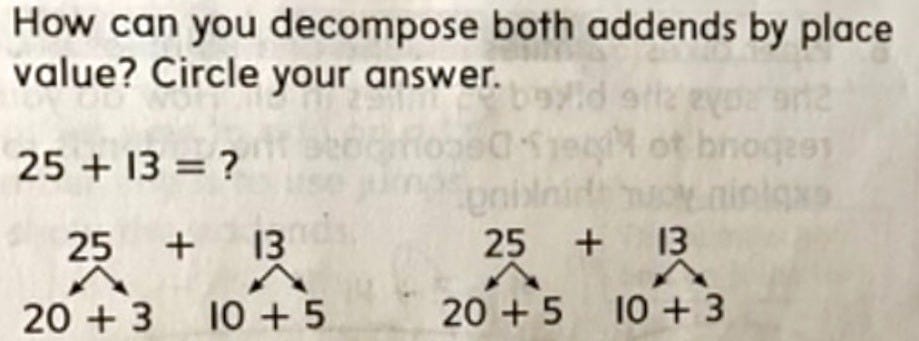
Quick review for those of you who have somehow managed to avoid this debate: the Common Core State Standards are basically what people refer to as “new math,” or “the way they’re teaching math these days.” This new math was around way before before 2010, but the Common Core was the most recent attempt to nationalize how math was taught, hence why everyone was suddenly seeing it in classrooms. It calls for an emphasis on conceptual understanding rather than just procedural understanding (despite what critics say, it does not throw procedural understanding, or skills, out the window). It’s the reason you might see a problem like this in second grade math:
Text within this block will maintain its original spacing when published
From Reveal Math K-12, published by McGraw Hill
Of course people are frustrated! Most of us old enough to be responsible for children weren’t taught this way. What on earth does it mean to decompose addends? What even is an addend? And what are those little arrows coming from each number? And – the real question – why on earth would we be teaching this way when just stacking the numbers (the “standard algorithm”) works?
My answer, and the answer of defenders of the Common Core for over a decade now, is that we’re trying to teach students to understand what they’re doing. Conceptual understanding will give them more fluency and flexibility with numbers and will last much longer than any memorization of a procedure will. Don’t believe me? Here, try to solve this in your head:
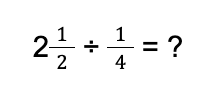
Here’s most people’s thought process (I’ve given this problem a number of times in parent workshops):
Oh shit, fractions.
I know I learned this.
Wait, I remember something about flipping something.
I’m taking too long.
Do I flip the first number? But it’s two AND a half, not just a half. How do I flip that?
I feel stupid.
I think I multiply something, right?
Did I remember deodorant today? I’m definitely sweating.
If you have good number sense – and it’s usually the people who say they were bad at math in school who approach the problem this way – you might figure it out like this:
I see ½ and ¼, so I’m going to think about money. I know division means how many of the second number fit into the first number. So how many quarters fit into $2.50? There are 4 quarters in a dollar, so 8 quarters in two dollars, so 10 quarters in $2.50. The answer is 10.
The person who solves it the second way has number sense, meaning they can use numbers flexibly, manipulating them in their head. They understand the meaning of division and can apply it in a novel way. The person who approaches it the first way has memorized an algorithm. They may or may not have strong number sense, but their go-to method, whether or not it’s efficient given the current problem, is to try to apply the algorithm.
Memorizing algorithms, drill and kill, math fluency without understanding, has not worked for us as a society. Whenever people (my very own mother included!) say, “What do you mean? It worked for me!” I want to say well good for you! Think about the millions of people it didn’t work for. Think about how the cashier clerk struggled to figure out your change. Think about how much educational disparities have continued to grow over the years. (I have been polite enough to bite my tongue and not say that, but now I’m shouting it from the rooftops.)
Now imagine you’re a teacher, and you’ve just been handed a curriculum that asks you to teach math for deep conceptual understanding. You need training in how to use this complicated new curriculum, especially if you’ve been teaching the old-school way. You’ve been given a teacher guide, student workbooks, homework books, an online component, digital tools to enhance instruction, a practice/fluency component, extra support books and lessons, guidance for teaching English Language Learners, a Spanish version, and a whole box of tools and manipulatives to use in the classroom. Meanwhile, you have thirty students, eight of whom have IEPs and who should get tailored instruction, three of whom got in a fight at recess, your classroom is really small and a few of the desks are broken, the Chromebooks keep getting stolen so you’re not allowed to use them anymore, you have a new student who only speaks Tamil, you don’t have a Special Education co-teacher because that person quit and the school has yet to find a replacement, your Promethean board only works intermittently and the pens went missing months ago, you have to cover someone else’s class during your one prep period…Ok, I’ll stop. I could keep going about how hard teachers’ jobs are these days, but I think you get the idea.
My point is that complex math programs need well trained and well prepared teachers to teach them effectively. Many, perhaps most, teachers are not well trained in these curricula, and they sure as hell don’t have the time to be well prepared. Please do not think for a second that I’m putting the blame on teachers. Schools and districts often don’t have the money to invest in the training that’s supposed to come along with a new math program. Teachers don’t have the free time to re-learn all of the math the way they need to. And they’re often rated on how well their students perform on standardized tests, so they have very little incentive to use the program with fidelity; they just need their kids to know how to multiply. These math programs are research-backed, coherent, and thorough, but we throw them at people and expect amazing results.
I led a professional development session for teachers earlier this week on big ideas in math (based on Randall Charles’ 2005 article of the same name). One veteran teacher in the group kindly said towards the end of the session “This is all great, but HOW am I supposed to do this? Our standards, and what the kids are tested on, don’t value this, so please come into my classroom and show me how to actually do this.” Another teacher chimed in that the district keeps coming up with new initiatives without giving teachers any concrete way of implementing them. They keep dumping more and more responsibility on teachers until teachers are ready to break.
These teachers had a great point. Even my session was sending the message, “Here’s a way you can change your teaching! Now go do it!” Support has proven to be critical to teacher success. Recent test results from Mississippi confirm that time and money spent on teachers’ learning can make a tremendous difference. Between 2013 and 2024, Mississippi’s students made incredible gains on national assessments of fourth grade achievement. They didn’t do this by just adopting a new curriculum. According to Dr. Laurie Todd Smith,
The Literacy-Based Promotion Act did more than require teachers to use phonics instruction; it rebuilt our early-literacy system from the classroom up. The Act required that every K–3 teacher be retrained in evidence-based reading instruction through the LETRS training. The Act required that reading coaches be deployed in the lowest-performing districts to model instruction and provide daily feedback to teachers.
Daily feedback. Can you imagine? That would be considered such a luxury in most schools right now.
Along with well trained teachers, we need parents and caregivers who understand and can support their children’s schooling. Rather than throwing up their hands at “new math,” imagine if parents explained to their kids how they figured out their grocery bill by decomposing addends (it sounds like I’m speaking another language, but I guarantee you know how to do this). If when a kid brought home a fraction division problem, their grown-up knew they could draw a picture to model it. If when their child struggled on a math test, they didn’t get mad at the school and write hate-mail to the writers of the Common Core, but took a minute to try to understand what their kid wasn’t understanding.
This is why my friend and colleague Kayla Roby Schlichting of KRS Math and Metamorphosis TLC recently led a workshop in NYC for elementary school parents on how their children were learning math. Why another friend and colleague, Ify Anako of The Learning Hamlet, (yes, I love my colleagues) is bringing together parents and teachers of our youngest learners. I’ve led parent workshops as well and recently launched a YouTube channel to help caregivers help their children with math. It’s not because I love talking on camera (I really don’t) but because I think it is so critical that people understand how math is being taught.
The “Mississippi Miracle” has taught us that we can only expect large-scale change if we coordinate our efforts. We need teachers, principals, school board leaders, policy makers, and parents all on board. I even want my eighty-one-year-old mother on board so she stops telling me that new math is ridiculous. Because it’s really not. It’s what we do in our heads if we have number sense. It seems new because we’re trying to raise every child’s level of understanding by more explicitly teaching that number sense. The crisis is that we’re not spending time and money preparing everyone to help today’s children.
No posts
Comments
Nothing yet. Say the first thing.
Sign in to join the conversation.