
“Hey sweetie, do we have enough Chanukah candles for this year? I’m not sure if we need to buy more,” I said to my second grader on the first night of Chanukah. She had no idea her dad had just bought a new box of candles and we were all set for the eight nights. In her eyes, I had just asked for help with something important, and, as the type A person she is, she was delighted to be the authority on something in our house. Using her fingers to keep track of the nights, she added 2+3+4+5+6+7+8+9 and proclaimed we needed 44 candles. Lo and behold, that was exactly the number in the box! What good fortune!
If I had said to my daughter, “I have a fun math problem for you! Can you add 2+3+4+5+6+7+8+9?” she probably would have rolled her eyes and gone back to playing Animal Crossing.
First of all, I want to say that this anecdote was more relevant when I started writing it nearly a month ago. Then I had sinus surgery, then the kids were all home for two weeks, and then I got Covid, so it has been a really fun month! longer break than I intended. But hold onto that Chanukah ploy for next year (if you observe). And please forgive me if my unfocused Covid brain is evident in this post.
Secondly, I want to point out that I hate the implications of the title of this post, but I thought it would resonate (ahem, that’s a fancy way of saying I wanted clicks). I hate that we think we need to sneak math into our kids’ lives. Why is math stigmatized such that people groan when they see actual math problems? Why do they run off to read but complain that math is too boring and too hard? A lot has been written on that, and there is plenty more to say, so for now I’m just going to say I think it comes down to two things: the way it’s taught and the way we (parents, teachers, society) talk about it. While this post won’t solve our massive societal problem[s], I think getting your kids to think about numbers and actually enjoy solving problems is a small win. So let’s dive into that.
The term math teachers and researchers use for seeing and drawing out the math in everyday phenomena is mathematizing. Mathematizing means recognizing that anticipating Chanukah candle needs is a math question. That divvying up a package of cookies equally among friends – which young children can do! – relies on an understanding of equal shares, which is the foundation of division. It means recognizing that math is indeed all around us. I don’t mean a page of multiplication facts or an Algebra exam, but the problems that create the need for math. If we start by noticing and wondering about the numbers and patterns in our lives, we can pretty quickly mathematize everything. And we can teach our kids to mathematize too.
Here’s another recent example. At basketball practice a few weeks ago (I help coach my daughter’s 2nd grade team), the other coach and I wanted to play 3 on 3. We briefly puzzled aloud over how to split the nine girls up until several girls chimed in, “We need three teams! Three teams of three!” Most of them barely know what multiplication is, but they can divide if the problem is relevant to them. Does this mean they would know how to answer a division problem on a page? No. They understand what it means to have equal groups, and they can work out the group size in situations like this, and probably in much harder situations too. Even if they haven’t learned the formal symbols and language for division, the question was interesting and immediately relevant to them. They all wanted to claim their two besties as fast as they could!
Obviously, we coaches could have easily split the girls into three groups of three without wondering aloud, but by making our thinking visible (or audible), we gave the girls a chance to do some math…without knowing they were solving a math problem. We also gave them some ownership over the situation. One of my professors in graduate school was a master at wondering aloud. We legitimately didn’t know if he knew any of the answers to the questions we asked him. Turns out he knew every answer, and he just wanted to force us to figure out them out for ourselves. He was one of the most effective teachers I’ve ever had.
Mathematizing is partly about mindset. It means being open to seeing the math in everyday phenomena. When kids respond to new math learning with “ugh, when am I ever going to use this?!” I want to shout “Actually all the time!! Look around you – you’ll see addition, subtraction, solving for unknowns, figuring out rates, calculating area…all of that! All the time!” But you have to be open to seeing it, curious enough to wonder aloud, confident enough to know that the problem is figure-out-able.
Some more examples of mathematizing: I’m only a few months into my Substack journey, so the algorithm is still figuring me out. For a couple weeks, it thought I was really into baking. I’m not – or at least I wasn’t. It started showing me posts like this:
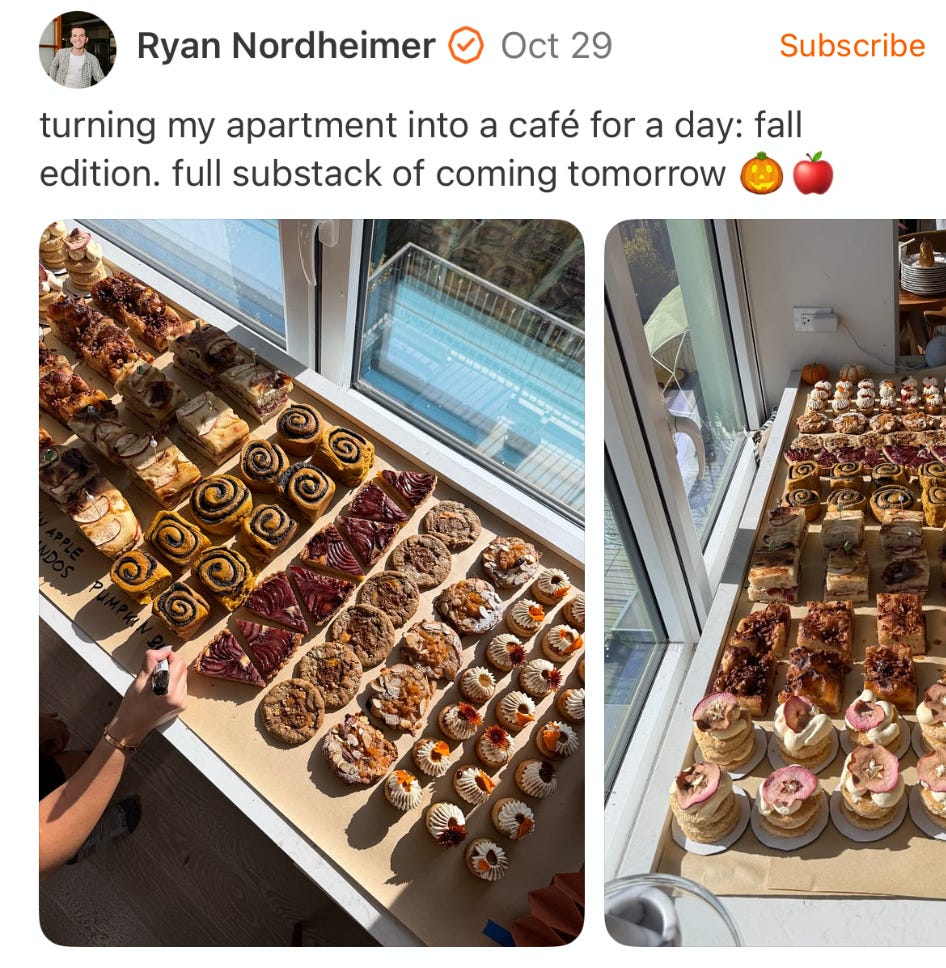

And now I’m really into (pictures of) baked goods! and , I have no idea how you made it to my feed, and you’re probably wondering why you’re being discussed in a math substack, but thank you for your contributions to the world of number talks. And also, your baked goods look both beautiful and delicious.
Each of these images garners so many questions: How many swirled pastries do you see? What fraction of the total baked goods are pink? How many baked goods do you see total? How did you count them? The questions are endless, and they’re maybe more important than the answers. Mathematizing means asking the questions. If you can get a child to think about pretty much anything having to do with numbers or space when looking at these images, you’ve gotten them to mathematize. As Ta-Nehisi Coates wrote, and has been my email signature for about five years now, “The questions, ultimately, are more necessary than the answers.”
The most important thing we can do for our kids mathematically is to ask questions. I don’t mean ask them what the square root of 246 is. I mean wonder aloud about numbers, space, and patterns that arise in our lives and are relevant to them. Here’s a list of things I have definitely said to my second grader in the last year that have gotten her to do math:
“Maybe we should make twice as much pancake mix this weekend since we have visitors. Hmm, I wonder how much of each ingredient we’ll need.”
“No screens until after we’ve been driving for half an hour [doctor’s suggestion to prevent car sickness]. It’s 11:21 now…hang on, I have to merge…” [daughter figures out what time 30 minutes from now will be while I’m merging]
“We have twenty-two pieces of candy, and there are four of you. How can we make sure this is fair?”
“I don’t know if there are enough ice cream sandwiches left for each of you to have one for the next three nights! Do we need to buy more?”
“Do you think we can fit all of those Magic Treehouse books on that one shelf?”
“That Lego set costs $50. If you save your allowance money every week, you could buy it with your own money soon. We’re kind of busy the next few weekends…When do you think you’ll have enough money to go buy that Lego set?”
And the inevitable follow-up: “I could take you to Five Below today, but then you’ll have to wait even longer until you have enough for the Lego set. How much longer will you have to wait if you spend your money at Five Below?” [“And is it worth it for the crap you’ll buy there??” I usually don’t say that part out loud.]
These are all things I could easily figure out on my own, but if I wonder aloud about them, I get my daughter wondering too, and more often than not she is motivated to answer the question. If she’s not, well, we could think through it together. Note that these aren’t “math problems” in the traditional sense, where you use pencil and paper to apply an algorithm and get a nice neat answer. These are questions that mathematize moments of everyday life. Math becomes necessary to answer these questions.1
So I invite you - parents, caregivers, teachers, bakers - to mathematize the world around you. Your kids will follow your lead. Ask the questions out loud and ask for their help solving them. Maybe eventually we won’t have to bury the math in a pile of baked goods, but for now, if it helps get the kid thinking, let’s do it.
Ok, one last baked goods picture, because this one is so rich (get it?):
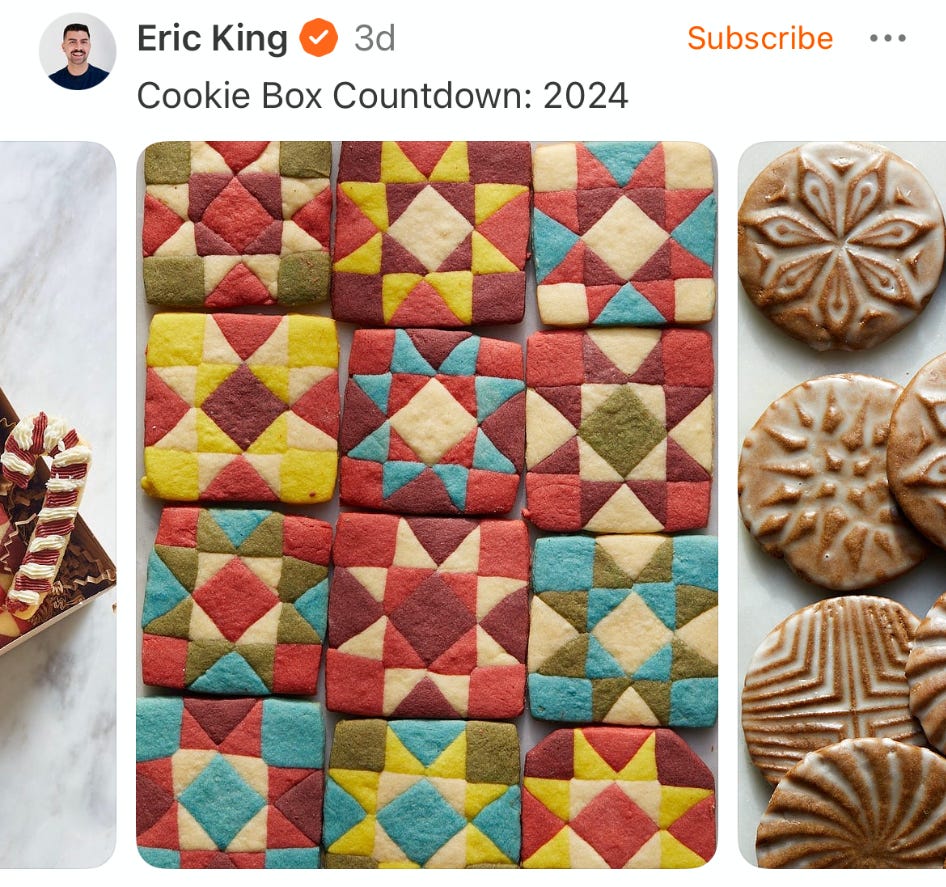
Thank you, , creator of beautiful and mathematical quilted cookies. These should go on Dan Finkel and Katherine Cook’s Fraction Talks page on their website mathforlove.
Make Math Make Sense is a reader-supported publication. To receive new posts and support my work, consider becoming a free or paid subscriber.
Another way of saying this is that if we make math problematic, it becomes more authentic. If the questions are about how we can afford a new Lego set, how to divide up some candy, or how to organize our books, we can see how math is a tool to answer the question. I’ve been attributing the phrase “make math problematic” to , but I think it originally came from James Hiebert. Both deserve credit.
Comments
Nothing yet. Say the first thing.
Sign in to join the conversation.