
“Help!” the text reads. “My son has no idea how to do this problem. How do I help him?” I got this message from one of my friends last night. This was the picture accompanying the message:
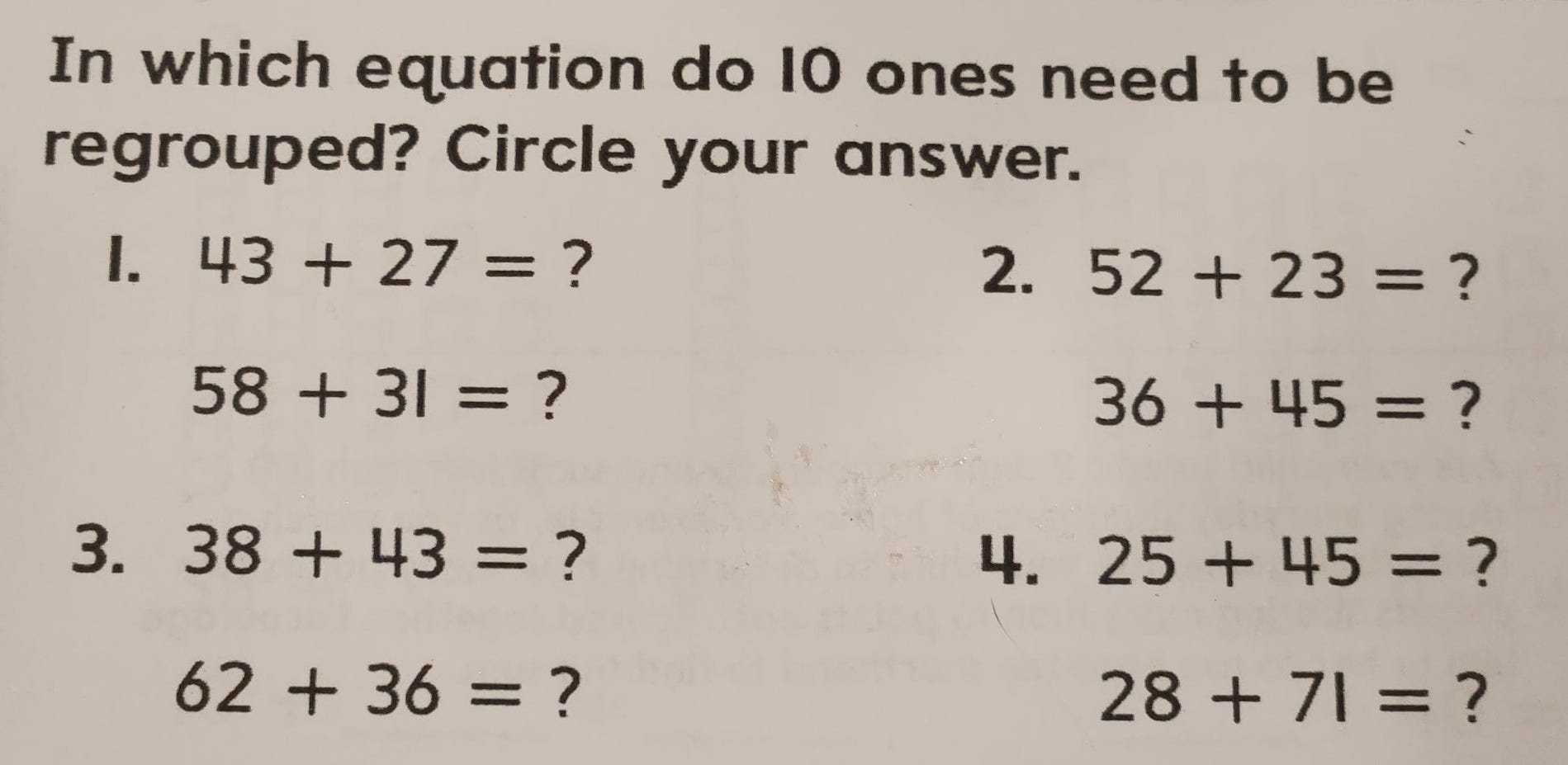
Not what you were expecting, right? That friend’s son is in second grade with my daughter, and I’ve been getting texts like this from several parent friends since our kids were in kindergarten. These parents are nurses, doctors, stay-at-home moms, professionals – all very smart people! They got through second-grade math just fine 30 or 40 years ago. They clearly understand that we use a base 10 number system, and they could easily add any of these numbers if they needed to. What they don’t understand are the directions.
Something that to teachers seems so obvious – regrouping ones to make a new ten – can seem baffling if presented with language or models that people didn’t grow up with. These second graders have been decomposing addends to make friendly numbers for easier addition, regrouping, and using number lines and part-whole models to show addition and subtraction. Every word I bolded in that sentence is likely new to a 30- or 40-something parent.
There are two things going on here. One is that the way we teach math these days relies much more on language than it used to. If a parent doesn’t know the meaning of these words, they’re going to struggle to help their child. If a child has missed the meaning of these words, if they’re an English Language Learner, if they have a language processing difference, if, if, if – they’re going to struggle to know what to do.
But if we can help students and caregivers understand what the task is asking, we’ve won half the battle. I explained to my friend over text that regrouping is what we used to call carrying, and that the problem is asking which equations have enough ones to require regrouping or carrying. She was able to help her son from there.
The other change from how most of us learned math is that we teach flexibility and number sense in a much more explicit way than we used to (or at least than I learned). Many of the later problems in this child’s homework packet asked them to put together two or more addends in whatever way they wanted. They could use a number line, they could decompose the numbers into tens and ones, they could make a friendly number and use compensation – whichever strategy makes the most sense to them. And this is great! But most parents, having been taught that there is one correct way to add numbers, and it involves stacking the numbers on top of each other, worry that any help they give is not what the teacher or curriculum wants.
Usually once I explain what the problem is asking or what the model means (“use base 10 shorthand to add these numbers” was another problem on the page), my parent friends say something along the lines of “Duh, of course!” Some of them feel embarrassed to ask me for help, like they should be able to do this second grade math without a problem. But it’s not the math that’s tripping them up; it’s the language and the models that they never learned.
Gone (hopefully) are the days when students would have a lengthy sheet of repetitive problems that they could solve with the standard algorithm. What we have now is an attempt to help students understand why the algorithms work, to see that math makes sense in context. It’s not a random collection of rules to follow, but rather a tool to understand the world. One concept emerges from another, and we see how these concepts and strategies are useful. Rather than addends, decomposing, and friendly numbers being abstract concepts, we see that they are tools for helping us use and make sense of numbers in our world. Math makes sense.
Here’s an example: When you go to the grocery store, especially if you’re on a budget, you probably keep a loose track in your head of how much you’re spending. Are you using the standard algorithm to find the exact sum of your groceries ($5.98 for eggs, $3.41 for a handful of apples, $2.49 for asparagus, $18.85 for kitty litter…)? No. At least nobody I know is doing that. Instead, you’re probably rounding prices to friendly numbers and using compensation strategies ($6 for eggs, about $3.50 for apples, $3ish for asparagus, about $19 for kitty litter, but a bit less than that because I rounded up…). You’re using the strategies that today’s math teaching emphasizes without realizing it.
The reason my friends need help helping their kids is that they haven’t been taught the language and models their kids are being taught. Do we need parent workshops? More and clearer communication from school about how and what kids are being taught? More of an acceptance and enthusiasm for math in everyday conversation? Less demonization of new standards and a greater willingness to learn? Yes, yes, yes, and yes.
And we might also ask ourselves (and principals and school boards and fellow parents) why the child needs an adult’s help on their homework in the first place. Why can’t we leave education to the teachers and let the kids be kids at home? Why send home work that kids can’t do on their own, that teaches them that math is something to be anxious about, that creates a struggle? Is it so important for them to do those extra few problems at home that we’re willing to sacrifice children’s natural curiosity for math and play?
Comments
Nothing yet. Say the first thing.
Sign in to join the conversation.