
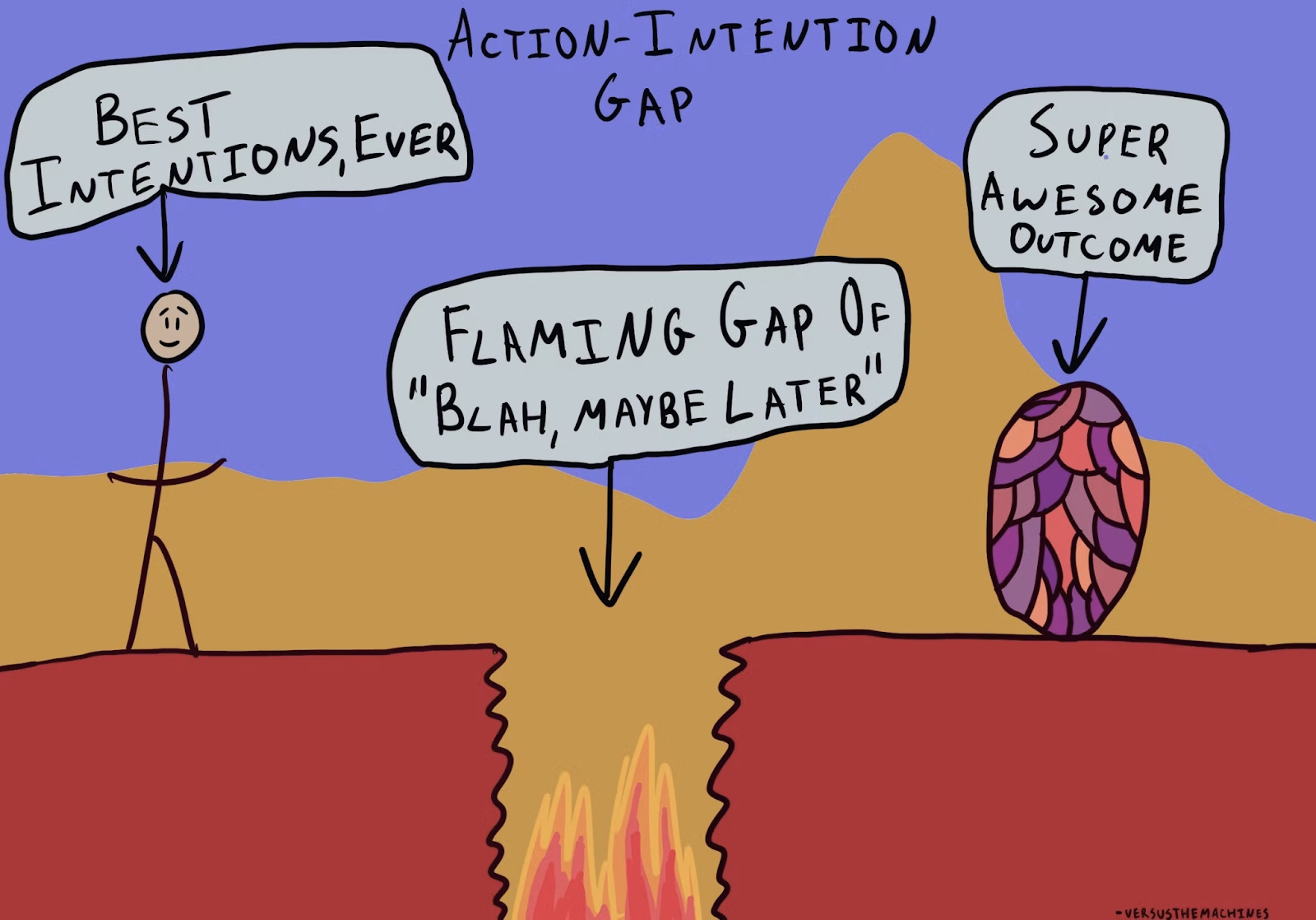
(Image from Intention-Action Gap. (n.d.). The Decision Lab. https://thedecisionlab.com/reference-guide/psychology/intention-action-gap)
I show this image (and cite it - don’t worry!) in every PD I do. Not just because it makes teachers laugh (it does), but because it made everything click for me. And here’s why.
Imagine this scenario. You teach 5th grade math. It’s that time of year when your instructional materials say you should be teaching the standard algorithm for multi-digit multiplication. You want students to figure out how and why the standard algorithm works, making connections to various strategies and other algorithms they may have been using. After all, it’s pretty magical when you realize why an algorithm works, right?
But, as you trudge through the lesson you’ve planned, you realize the kids aren’t getting it. So you find yourself digging in to the steps of the algorithm even more. Maybe you even tell them a trick or two to remember where to write the numbers, despite having read – and loved! – Nix the Tricks, “13 Rules that Expire,” and other polemics against memorizing tricks. You’ve just sabotaged your well planned lesson…and the kids still aren’t getting it.
As an instructional coach, I encounter teachers every day who say something along the lines of, “Sure, I believe all students can succeed in math, but some of them just need to memorize the algorithm.” Or, “of course, I’d love to do number talks every day, but I just don’t have time!” Even teachers who seem to wholeheartedly believe that students learn through wrestling with ideas, trying new strategies, failing and finally breaking through often end up resorting to direct instruction when they hadn’t intended to.
Teachers have a myriad of readily available – and valid – reasons for not following through on their intentions. (Coaching aside: believing, and not just pretending to believe, that their reasons are valid is fundamental to forming a coaching relationship.) They mention the state test, the need to keep up with grade-level colleagues, or a pacing guide that dictates their moves like a heartless despot. Some say their class is too wild, not ready for any kind of fun or discussion, that they only “behave” or “get it” when they’re working independently on calculations. Believe me, I’ve been there. I’ve watched myself become the teacher I never wanted to be.
So why does this happen? Why do teachers with the best intentions end up doing exactly what they set out not to do?
Psychologists call this phenomenon the intention-action gap or value-action gap. I prefer the latter name, as it highlights that an intention usually comes from something we value. This gap comes up in all aspects of life: think of how many people join gyms in January and then never go! And how many of us promise to reach out to old friends but just never do it? Do we value these old friendships? Of course we do. So why, then, don’t our actions reflect our values?
Behavioral theorists have studied this gap for decades. The most convincing theory I have read on why it exists comes from a 2000 book called How the Way We Talk Can Change the Way We Work. More specifically, I read about Lisa Lahey’s and Robert Kegan’s theory on behavioral change in a 2002 interview by Dennis Sparks published in the Journal of Staff Development called “Inner Conflicts, Inner Strengths.” That article is pretty old at this point, but I’ve been thinking about it ever since I first read it.
Most people or institutions think about change using what Lahey and Kegan call a two-column approach: what change do I intend to make? (column 1) And what are the barriers to that change? (column 2) These two steps are easy. Think back to pretty much every staff meeting you’ve ever been to. Whenever someone says they want to implement a change, there are a dozen reasons why that change will be hard to enact.
Lahey and Kegan argue, though, that there’s something else at play: a competing commitment (column 3) that blocks our path to change. Often – or usually – these competing commitments are unconscious. And they are nearly always tied to an underlying assumption (column 4). The key to change, they argue, is to investigate column 4.
So let’s bring this back to our 5th-grade teacher who now has their head down, appalled that they just derailed their own lesson. This teacher obviously has an intention to provide thoughtfully planned instruction. Let’s say the explicit intention is to support students in discovering the standard algorithm, rather than having it be taught via direct instruction. An obstacle to this might have been time – the teacher wants the whole class to have mastered the algorithm by a certain date, and, as we all know, students all get to understandings on their own timeline.
So why did the teacher not stick to his or her commitment? There is most likely a competing commitment here that is tugging at the teacher’s unconscious. Maybe the competing commitment is that the teacher doesn’t want students to go home confused. Or maybe the teacher wants the students to have this skill down pat before moving on to the next unit. Or maybe the teacher is worried that a supervisor will come into the room, see struggling students, and give them a low mark on their observation, so they’ve committed to not letting them struggle.
Underneath all of these competing commitments is a hidden assumption, which is that students won’t get to the understanding on their own on the teacher’s timeline. I think this is what is at the heart of all of the moments when we act against our values: that we don’t truly believe students can do it. We’ve read the books and blogs, attended conferences, bought into new curriculum materials, but there is still doubt hidden deep within us that tells us students won’t be able to “get it.” Or at least that many students won’t. We act against our own intentions because of an assumption about what students need.
Maybe that assumption is specific to a subset of students. Maybe the teacher believes that many will get to the understanding on their own, but that many others will not. Despite all outward intentions, the teacher clings to a tiny seed of a belief that these students need direct instruction. And so the teacher sabotages their own plans.
I’m an avid gardener, so let’s make a gardening metaphor out of this. You’ve got a beautiful plant in your garden, but there is a weed that keeps popping up in the middle of it. When you see the weed, you cut it down or tear it out. Problem solved! But then the weed comes back. It keeps coming back and interfering with your beautiful plant because deep down in the soil is a teeny tiny bulb, no bigger than a baby’s thumbnail (I’m talking about you, lesser celandine). If you want to eradicate the weed for good, you have to find that tiny bulb and get rid of it. Otherwise that darned weed is going to keep coming back, despite your best efforts to fight it.
So how do we get rid of the bulbs, those tiny seeds of belief that will mess with our best intentions? The key, according to Lahey and Kegan, is to identify the bulb: that underlying assumption that you didn’t even realize was there. I would argue that all teachers need to experience math as a student, to struggle and make breakthroughs, to work in a diverse group of learners and benefit from it, to truly change their belief system. No amount of reading or being talked at is going to convince us that teaching math for understanding (as opposed to memorization and regurgitation) actually works for all students.
The implications of this are far-reaching. We need to change teacher education programs. We need to change the way many districts approach PD. We need to put teacher experience of mathematics at the center of everything we do.
Or maybe we can start small. The next time you sabotage yourself or don’t follow through on your assumptions, ask yourself why. Then ask yourself why again. Then maybe one more time. Keep digging until you get to that little seed of a belief preventing you from changing, and then ask how to get rid of that seed once and for all.
No posts
Comments
Nothing yet. Say the first thing.
Sign in to join the conversation.