
Happy Earth Day! I am writing this back in Santa Barbara, where I lived for two years during graduate school, and the sun I am sitting under outside at this coffee shop is burning me hot with nostalgia. Weird to be back.
But even more fitting that I am back in Santa Barbara on Earth Day (unplanned)!! The conception of Earth Day and subsequent environmental movements were inspired by the aftermath of the devastating 1969 Santa Barbara oil spill. The first official Earth Day was April 22, 1970. Senator Gaylord Nelson (of Wisconsin, randomly) was frustrated by the oil spill and concerned about deteriorating environmental conditions, so he organized a day dedicated to environmental demonstrations. He thought it appropriate to merge existing student anti-war protests of the time with anti-pollution protests as a segue into the larger modern eco-movement.
I wrote the following a few months ago, and it’s been sitting dormant in my drafts. But if today is not the best day to post it, what other day is?? My hope, today especially, but every day after, is that we always keep Earth in mind. That we strive towards a more eco-centric life and less ego-centric.
Everything is a system, as my dad, a retired systems engineer, would say. Smaller parts coming together to make up a bigger part, a system is the sum of all its parts. Everything behind the scenes needs to work together effectively to have a good system in place. Another way to put it is that a system is a set of principles according to which something is done, an organized framework, an interconnected network.
Today, I think about the system we live in. I talk about that a lot, how we are born into this “system” we can’t control, and all of the big, overwhelming problems of our world are systemic
We are involuntarily integrated into this large, overarching system that is the interconnected network. Changing something at the overall systems level is the largest hurdle, as it involves changing all the smaller things that work in tandem to uphold the system. Our lives are intertwined in this organized framework that we are almost required to adhere to. Or risk social isolation.
Systems are complex, and that’s why there are a million ways we could go to make a dent in systemic change. So, we pick one area and do our darndest.
We could talk about systems all day. But one thing is true about this “system” we find ourselves in: it is human-centered. Humans are at the top of the pyramid, and everything we’ve created is to our ultimate benefit to keep us hailing at the top. It’s an ego-centered system. This kind of ego-centered living is the norm. Think overconsumption, resource exploitation, and extractive practices we often don’t think twice about.
Ego-systems thinking shapes culture, fashion, the environment, the economy, everything. Throughout the building of our human empire, we’ve separated ourselves from nature. Nature is our subordinate, viewed as supporting us, and beneath our level of sentience. Therefore, we use it and exploit it however we want for our own gain. In this norm, our relationship with nature is not a reciprocal relationship; it’s a one-sided transaction.
And maybe living with humans at the top of the hierarchy with our needs first was positive at some point. But it is ultimately not sustainable. Using nature as our extractive playground and mining site is actually counterproductive to our benefit. If we remember that humans can only exist because of the services the environment provides us, the literal oxygen we breathe, and so it’s silly to view us as independently all-mighty and continue to rely on the degradation of earth, when, without nature, we are…. Nothing.
A book I read recently, Why Fish Don’t Exist, explains this best:
“When you actually examine the range of life on earth, it takes a lot of acrobatics to sort it into a single hierarchy with humans at the top. We dont have the biggest Brain or the best memory. We aren’t the strongest or fastest or most prolific. We aren’t the only ones that mate for life or show altruism. Use tools or language. We don’t have many copies of genes. Not newest creation. There is no ladder. It’s a system more about convenience than truth”
Every organism on this earth is more complex than we can even understand, as complex as we are, yet we denounce them as lesser than us, lower than us, of less importance.
As the book also says, “Humans tend to downplay similarities between the other animals and us as a way of maintaining our spot on top of the imaginary ladder.” … Imaginary.
My favorite industry to analyze everything under the lens of is fashion, if you’re new here.
Fashion exists as a way to benefit humans. How many clothes can we make as quickly as possible to serve those human needs (or, really, as it has become now, their wants)? Whatever we have to do to get there is what we will do. Take down a bunch of forests, conduct large-scale industrialized cotton cultivation, and dig deep into the ground for oily plastic material that we want to put on our skin. All for the ego, not the eco!
This human-centered life is also a linear way of living. Ego = human at the top of the pyramid. Us above everything else = linear.
The alternative, and what humans culturally and historically used to be good at, is eco-center living. In this system, we live in a circle. We are equally placed amongst our natural comrades, which makes sense because we are animals ourselves. We are nature. In this system, we learn to coexist with natural and ecological systems.
But to achieve this interconnected utopia, it doesn’t mean we all need to go live in a forest, use leaves as toilet paper, and live the remainder of our days naked in Adam and Eve mode.
I mean, unless you want to. By all means.
But it’s a collective set of value changes that would gradually push us towards that eco-aligned life. From extraction to coexistence.
When we change what we value, we will be able to change everything else stemming from those set values. Instead of strictly monetization and revenue, we can value social welfare, environmental welfare, community health, etc.
Indigenous communities and knowledge know this eco-centered coexistence best. Through regenerative practices, community-first approaches, permaculture, naturally circular economies, and resource sharing, many of the roots of these civilizations come back to those eco practices.
One such example of this can be seen in the ancestral Hawaiian economic system. Communities lived in social systems that mirrored hydrological cycles and water’s naturally regenerative processes. Water is used, then recycled and returned to the system, rather than used linearly.
They used the circular water system as not only a guiding model within their economy, but also as a primary indicator of wealth and wellbeing. Abundance and accessibility to water sources indicated healthy societies. The result is a socially and environmentally equitable water system, with a continuous flow of resource distribution, and healthier relationships to communities and the land.
‘Land’ in the Hawaiian language is called “āina”. But the idea of it is more than just the noun we know as ‘land’. It’s a concept of how people interact with a place, and how all of nature and land are interconnected with humanity, pointing to the inherent reciprocal relationship between humans and their environment.
Modern-day applications of eco-centered systems include regenerative fashion, biomimicry, and community-driven circularity projects.
Ponda is a company producing plant-based insulation that replaces synthetic down and feather products in puffer jackets. Their Biopuff® material is derived from regenerative wetland fibers that are not only a source of responsible, biobased product, but also actively work to restore wetlands. By extracting fibers from a plant called Typha latifolia (a plant that naturally wets peatlands), Ponda’s puff insulation can bring degraded lands back to healthy levels of productivity and resilience.
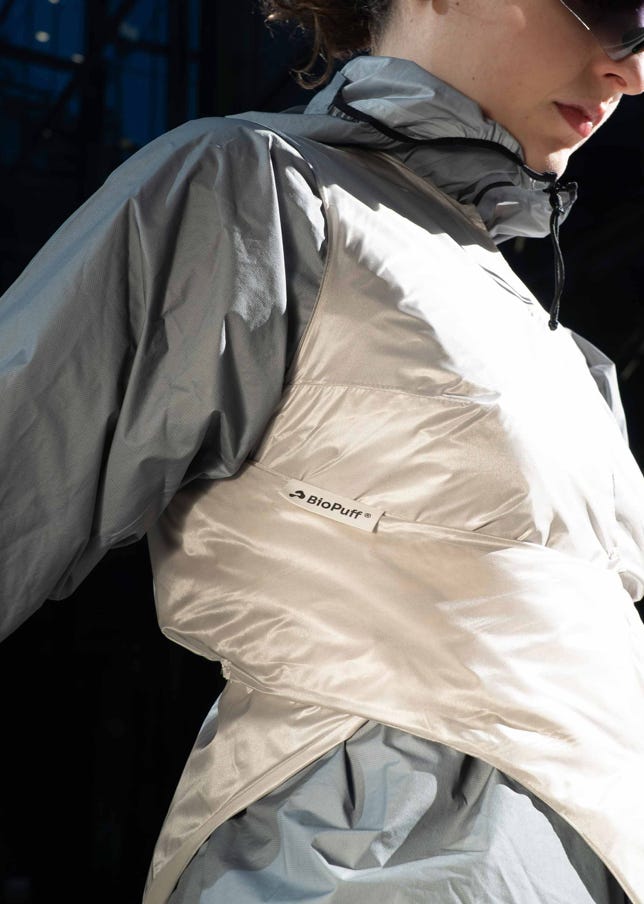
They’re halfway towards their goal of being a 100-hectare wetland system capable of producing enough fiber for 100,000 jackets each year. While it’s not an operation currently at scale yet, it offers a glimpse into the systems that could arise from more nature-aligned value changes.
Shifting fashion towards circular systems in harmony with the ECOsystem will inherently create more social equity in supply chains. Handling the earth more gently also means handling people more gently, with more regard for the impact that the processes and institutions on which we rely have.
Earth Day is the easiest day to celebrate the Earth. Post a few of your favorite dramatic landscape pictures, pick up some trash, and gawk in awe at the views around you today. But what am I doing, and what can any of us do that spans impact beyond Earth Day?
It’s an everyday choice to make every Earth Day (which I think Senator Gaylord Nelson would also be in favor of). Mindset shifts, ethical decisions, living with the world, not merely in the world.
I try not to view myself as above it all. I actually often find myself in disbelief and revering natural elements and forces. The way the tide turns while we’re sleeping, the way waves defiantly crash their whitewash onto sturdy rocks, the way winds blow and rustle even the strongest trees. Think of all the animals that could eat us alive. All of the fungi or parasites that could eat us from the inside.
Remembering these wonders, I am reminded that we are not the most powerful or the most important. If all of nature and the ecosystems failed and ceased to exist, we would also die off. However, Earth and her green and blue-coated ecosystems have existed without us, just fine. It does not need us; we need it. And isn’t that so humbling? Why the hell are we destroying it then?
HAPPY EARTH DAY, EVERYONE. IT IS COOL TO CARE ABOUT AND LOVE THE EARTH EVERY DAY.
Xoxo
No posts
Comments
Nothing yet. Say the first thing.
Sign in to join the conversation.