
To wrap up February, which seemed like a big month for sustainable fashion developments, I thought I’d dive deeper into the topic that’s been top of my mind this month. Low impact materials in athletic wear. Specifically ones made without any type of plastic, but that still retain the same performance properties of light weight, breathable, flexible, and sweat-wicking.

It’s a tricky mission all around to transition away from synthetic materials, though athletic wear I find to be the trickiest. Especailly as a runner, I sweat a lot and need to wear breathable, moisture-wicking, not absorbing, athletic clothes. In the past for working out, I’ve always succombed to the Nike, Adidas, or anything I can snag secondhand for an affordable price (I’ve never been able to justify spending $100 on a pair of leggings). Purely because these are the only widely accessible options in active wear fashion. Performance wear still lives in a world dependent on fossil-fuel based polyester, spandex, and elastane. For a reason too - it delivers the wear we want, at a price we want, and there aren’t yet great alternatives to live up to the standard at a commmercial scale.
Recently, there’s more demand to stray away from these materials. PFAs and plastics are now seen as a big reputational risk for brands. Some countries like Belgium and France are cracking down on policies banning levels of PFAs in clothing. So, the pressure is on to find alternatives, and it’s no longer just a niche demand from the eco granola girlies.
Apart from its cost effectiveness, polyester is a popular high performing material because of its quick drying properties, water resistence, and insulation. Nylon blended with spandex or elastane is popular because of its stretch elasticity, and durability, making it ideal for wear and tear, while also being breathable. Spandex also has high sweat absorption, stretching, breathability, and offers unrestricted movement.
High performance has high standards, espcially for athletes who need these flexible, breathable properties in clothes, it’s basically a nonnegotiable.
So far, I’ve been digging more into the promising alternative of biobased materials. It’s a persistent challenge in athletic wear, though, for them to live up to the high performance standards of typical fossil-fuel based materials.
I’m no materials expert by any means. In my mind, I’ve always associated “biobased” with completely plant-based, naturally derived, a fiber clean of any type of sneaky synthetic or man-made plastic.
And I initially planned for this essay to center around the hopes and praises of a plastic/synthetic-free athletic future with biobased alternatives as the solution, but the more I dug, the more I realized, that is not necessarily the case.
There are variations of “biobased”, and they can be a bit confusing, so I broke it down for clarity.
General definition of biobased materials: “Produced from renewable biomass sources such as wood or fiber crops, or algae, fungi, agricultural waste, or end of life textiles that can be converted”.
3 different types:
Natural biobased materials - natural fibers derived directly from plants or animals via simple extraction and processing, such as cotton, bamboo fibers, silk, and wool. With 100% pure, natural fibers, the challenge is its hard to mimic the performance of a typical athletic fiber.
Semi-synthetic or regenerated biobased - extracted from natural cellulosic molecules such as agricultural waste or biomass resources, but then uses man-made processes to spin those molecules into a fiber. Man-made but from bio-sources, like viscose and lyocell.
Synthetic biobased - produced by extracting monomers from bio-sources like sugar, starch, or plant oils using a chemical synthesis or fermentation, and then eventually processing the monomers into fibers through man-made spinning processes. Still synthetic, but substitue fossil fuel based fibers for biomass molecules. Polylactic Acid (PLA) fiber is only commercially available syntheitc biobased fiber, biodegradable, under certian industrial conditions.
So, the second two variations are technically still “synthetic” fibers. However, all bio-based fibers are said to be biodegradable and less resource intensive due to being derived from renewable biomaterials.
Synthetic biobased may not be as biodegradable as they’ve claimed to be, and may still contain some amounts of plastic. According to a recent study at Scripps Instiute of Oceanography, while monitoring the biodegradability of natural, synthetic, and semi-synthetic fibers, all of the natural fibers biodegraded, but the synthetic biobased materials (PLA) did not fully biodegrade in the ocean, as they were thought to.
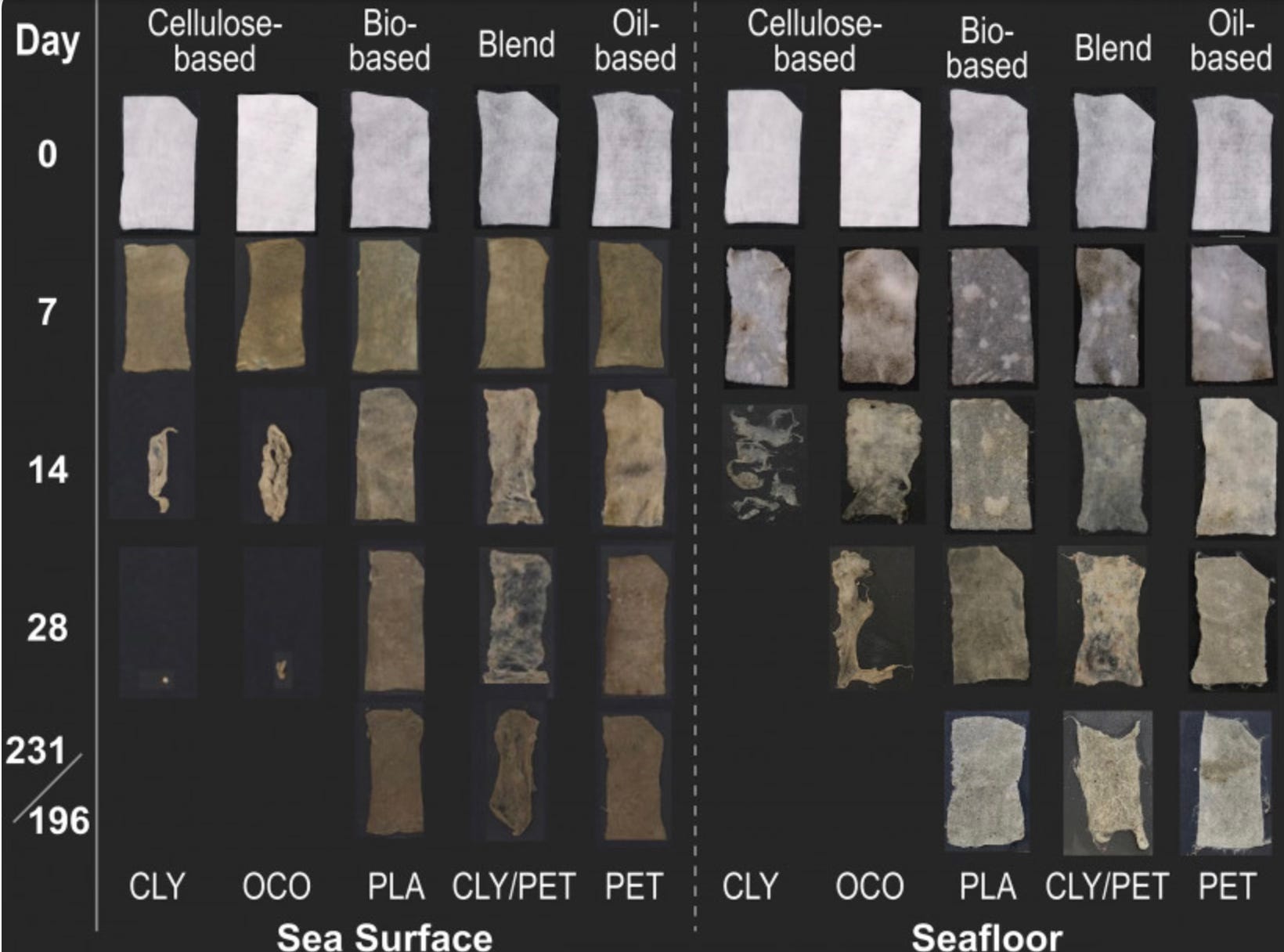
Biobased fibers also do not guarantee plastic-free, as some still contain blends of regenerated plastic or synthetic components to give it those performance properties. Some biobased synthetic fibers are considered “bioplastics”, and may be treated with harsh chemicals during processing. And for biobased mixed with recycled poly or nylon content, recent research shows that recycled plastics release 55% more microplastics than virgin from shedding and washing.
Okay so maybe they’re not a perfect, free-from-plastic or synthetic alternative. But could they offer a promising alternative to petroleum-based synthetic athletic wear? That’s the question I rewired for myself after digging into all of this biobased research. Ah, semantics.
While they may not be perfect zero impact solutions, I still wanted to highlight some recent innovations on the right path towards progress. Challenging the industry norm that high-performance wear must be made from fossil fuel-based fibers, and offering alternative pathways.
Performance without toxicity exhibit from The Mills Fabrica caught my attention a couple of weeks ago — a gallery exhibition spotlighting the, “technologies redefining performance wear for a cleaner, healthier future.” It started Jan 26th and runs until June 26th, so if you’re in London, you should go! Its in collaboration with Japanese outdoor and lifestyle apparel brand, Goldwin (makes North Face products in Japan and South Korea). Goldwin has partnered with a few material innovators to showcase material alternatives in performance gear.
Goldwin x Spiber: BrewedProtein TM Fiber
Spiber is a plant-based textile fiber made from sugarcane. It shares similar properties to wool, cashmere, and silk while also having durable outerwear properties.
It’s engineered at the molecular level using a percision fermentation process of plant derived ingredients to produce a man-made protein fiber - hence why they call it a BrewedProtein fiber.
It’s protein based finish is said to “elevate” polyester with natural touch, odor control, and moisture regulation, while maintaining durability and quick drying properties. Its protein-based surface provides protective functions as well, such as wind resistance.
Spiber’s eco-fleece product: The brands Goldwin and J. L-A.L collabortated to drop a product launch of a T-shirt and fleece jacket featuring Spiber’s BrewedProtein fiber, with the fleece made from BrewedProtein.
Goldwin x Bioworks: PlaX fiber
Goldwin is also partnering with Bioworks material innovator, that also makes a biobased fiber for fleece.
Bioworks’ plant-based synthetic fiber: Fiber called PlaX, and is made from PLA and derived from sugarcane. Its said to overcome issues that have previously hindered regular PLA’s ability to perform to polyester standards, and can replace the typical plastic fibers while living up to their performance. The fiber has undergone three years of intense performance testing to meet Goldwin’s “high standards” of quality, durability, and dyeability.
Vivobarefoot Brand: A regenerative business model?
Finally, from that exhibit, is Vivobarefoot brand making shoes out of regenerative algae-derived foam outsoles, biobased polymers, and recycled natural fibers. They claim regenerative business, product, and community.
On a different note, I am kind of obsessed with Vivobarefoot’s branding. “Free your feet” is the brand’s tagline, all about creating shoes for how humans evolved to move, “natural, connected, and free”. Its “living barefoot” motto values dance, diversity, and an open minded, creative community, believing in the power of connection between planetary and human health. I can get behind that!

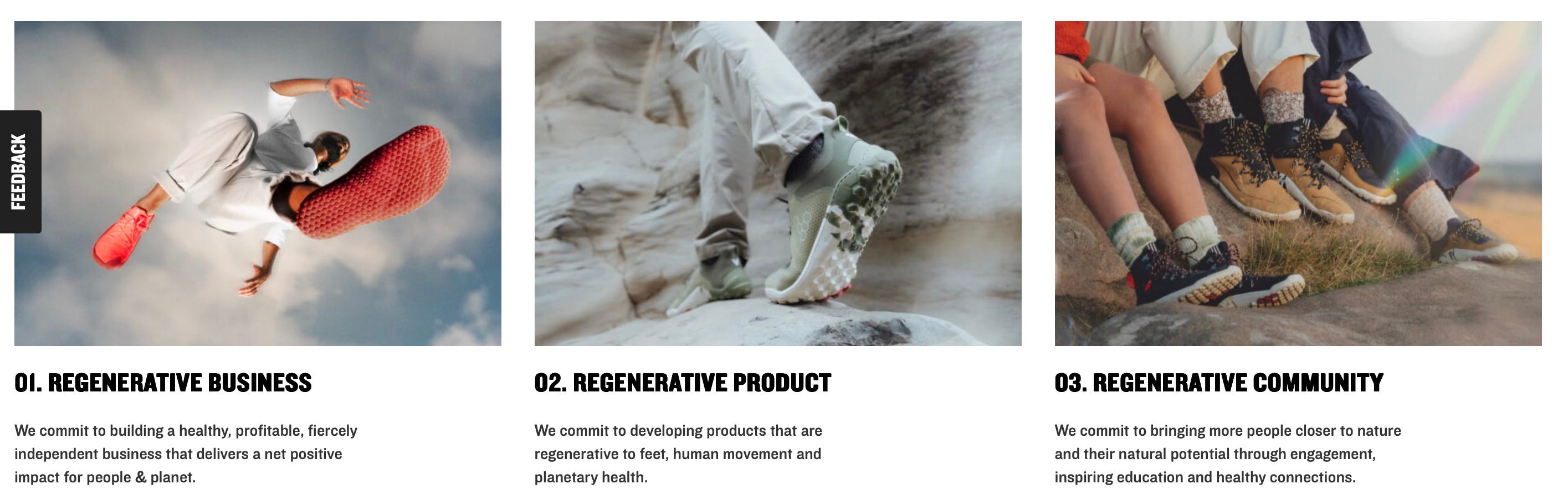
Overall, when I think about enviornmental health and athleticisim going hand in hand… this exhibit seems to display that well.
Industry NGO, Fashion for Good, is evaluating biobased and recycled elastane to fit into circular systems in their new project, “Strenghtening Circularity”.
Elastane is known for its remarkable stretch, made from petroleum-based polyurethane. Recongizing that elastane is in about 80% of all clothing, it seeks to open up pathways for scaling lower impact, high-performing alternatives. The issue with elastane is that even in minimal amounts, it poses as a technical barrier to breaking down post-life. If a multi-material product has even just traces of elastane, it essentially blocks the success of textile recycling for cotton and polyester components.
This project tackles two different avenues of low impact elastane options: 1.) testing elastane alternatives made from biobased materials and other non-elastane feedstocks, and 2.) testing recycled elastane from other elastane recycling innovations.
Both of thse workstreams are important. Making elastane from recycled elastane challenges the “circularity” barrier in performance materials, and making elastane from biobased materials challenges the “needs to be made with petroleum-based synthetics” assumption in performance materials.
Material recycling company, Return to Vendor, is designing a mono-material stretch fabric from recycled nylon. Nylon on its own is not normally stretchy and elastic, which is why its blended with spandex and elastane. But when its blended into mixed materials its hard to recycle (as the previous project points out).
Making a high-perfomrance, mono-material stretch fiber from recycled nylon is a HUGE move for circularity in athletic wear!
Do athletic clothes NEED to be made with plastic from fossil-fuel derived plastics for performance? My final answer is no. The industry innovations above are showing proof against that.
Do athletic clothes NEED to be made with some type of biobased plastic derivative for performance? My answer is.. kind of. For true athletic performance comparability.
There are 100% natural, no plastic at all athletic products out there. I have not tried them, so I can’t vouch. I am honestly a bit skeptical about its performance though, and how stretchy, sweat-resistant, or breathable cotton or wool can be… Let me know if you’ve found some that truly work well in sweaty workouts!
Overall, I think that if these new material innovations, biobased or recycled, synthetic or natural, can deliver the same performance of our fossil fuel foes, then that is worth celebrating! I’d gladly wear some algae or sugarcane on my body for a comparable, light-weight, durable athletic wear. But, as with everything in fashion, it’s about scaling and investment. Fingers crossed that with the PFA ban policies, consumer demand for alternatives, and a collective fatigue with polyester wiggling its sticky fingers into everything we wear, that we can truly start to veer away.
Thanks for reading!! Would love to hear your thoughts on biobased, performance, or any fav brands or alternatives you swear by for athletic clothes.
No posts
Comments
Nothing yet. Say the first thing.
Sign in to join the conversation.