
In the rapidly evolving world of Large Language Models (LLMs), terms like “Agents” and “Skills” are thrown around constantly. If you look under the hood of a framework like Claude or a custom DevOps AI, you might notice something confusing: the instructions for a Skill often look exactly like the instructions for an Agent. They both live in .md files, they both use structured natural language, and they both define behaviors.
So, why distinguish between them? Because while their “DNA” (Markdown) is similar, their “Biology” (how the AI pursues them) is entirely different.
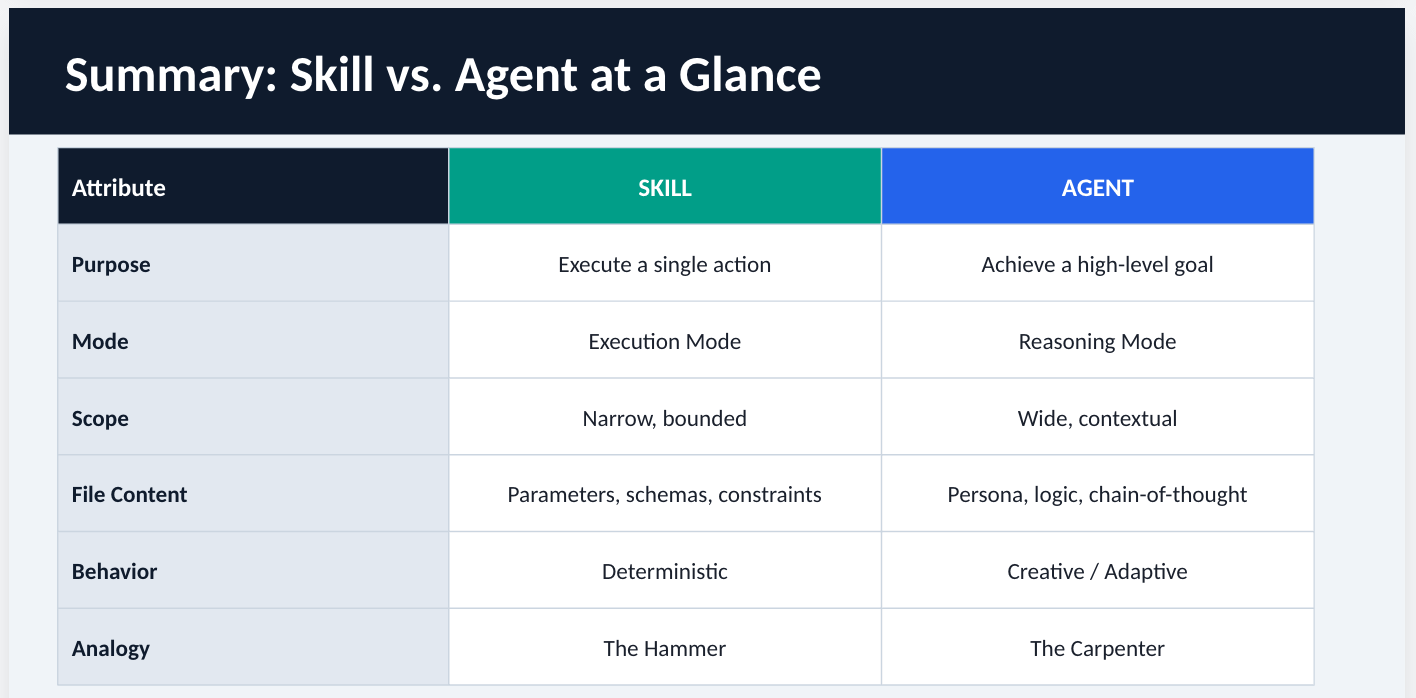
A Skill is a discrete, bounded capability. Think of it as a specialized tool in a digital Swiss Army knife, designed to perform one specific task with high reliability.
Claude’s Perspective: When Claude sees a skill, it views it as a contract. This contract stipulates: “If I provide input X in this exact format, I am guaranteed to get output Y.” It is a technical handshake where the AI relinquishes creative control in favor of procedural accuracy.
The Scope: A skill doesn’t think about the big picture or the ultimate “why” of a user’s request. For example, a
fetch_github_reposkill doesn’t care if you are fetching the repo to debug a crash, audit security, or simply learn the syntax; its only responsibility is to navigate the API authentication, handle pagination, and return the raw code string. It is a servant of the process, not the goal.The Content: In a
skills.mdfile, you focus on parameters, constraints, and schemas. The language here is often clinical and precise, defining the exact boundaries of what the tool can and cannot do. You are defining the mechanics of an action.
The Analogy: A Skill is a Hammer. It is excellent at hitting nails, but it has no opinion on whether you are building a bookshelf or a birdhouse, and it certainly won’t decide to start swinging on its own.
An Agent is an autonomous entity designed to achieve a high-level goal by managing its own thoughts, planning its own trajectory, and executing actions.
Claude’s Perspective: When Claude acts as an agent, it moves from “Execution Mode” to “Reasoning Mode.” It adopts a persona and maintains a stateful memory of the task’s progress. Most importantly, it possesses the authority to decide which skills to use, when to use them, and — crucially — when to stop because the goal has been met or the path is blocked.
The Scope: An agent is goal-oriented and context-aware. It looks at a prompt like “Migrate this app to AWS,” realizes that this isn’t a single step, and begins a mental breakdown of the problem. It identifies that it must first analyze the local environment, then provision cloud resources, and finally deploy the code. It manages the transitions between these phases.
The Content: In an
agents.mdfile, you focus on Persona, Logic, and Chain of Thought. The instructions here are strategic, telling the AI how to think when it encounters an error or how to prioritize competing interests. You are defining the intent and the judgment of the entity.
The Analogy: An Agent is the Carpenter. They know how to use the hammer, the saw, and the drill. They look at a blueprint, manage the timeline, and adjust their technique if they hit a knot in the wood. They turn a collection of movements into a finished home.
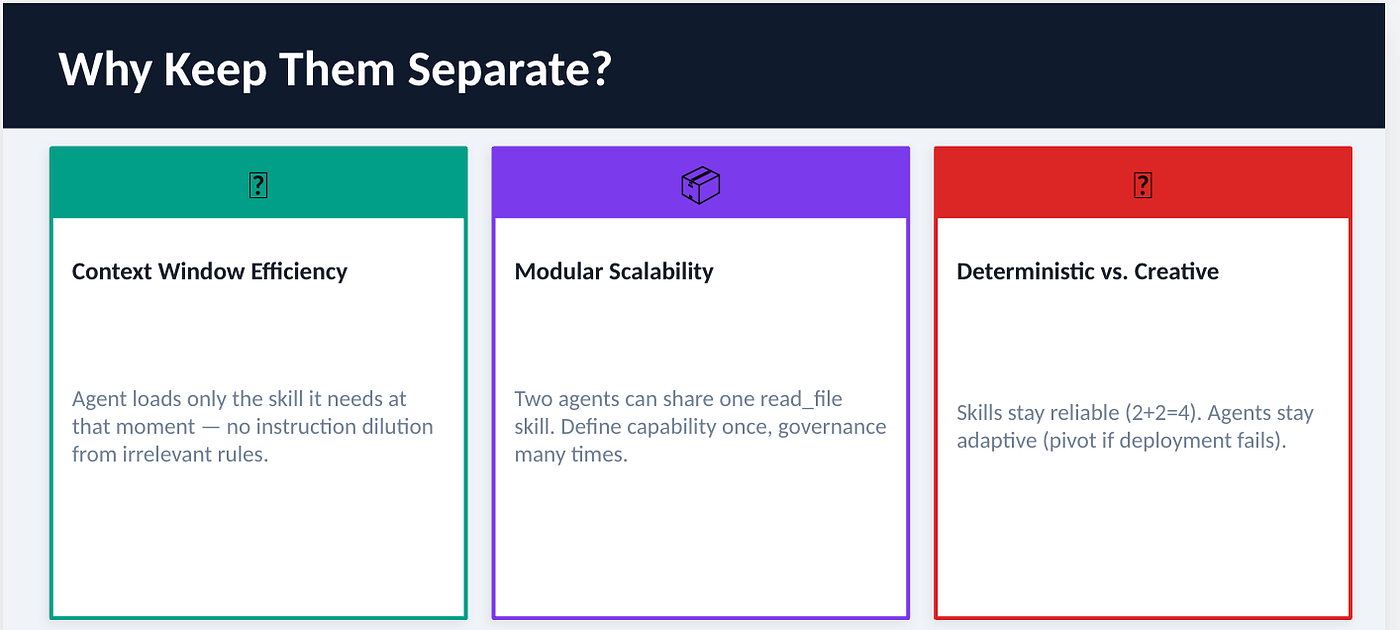
Technically, you could write a single massive Markdown file that combines everything. However, the separation into Agents and Skills is an architectural choice for Scale, Precision, and Context Management.
Context Window Efficiency: If you put every instruction into the primary Agent, the “Context Window” (the AI’s active memory) gets cluttered with irrelevant details. By keeping Skills separate, the Agent only “loads” the specific skill it needs at that exact moment. This prevents “Instruction Dilution,” where the AI starts ignoring rules because there are too many of them.
Modular Scalability: You can write a “Security Auditor” Agent and a “DevOps Engineer” Agent. Both might need the same
read_fileskill. By separating them, you don’t have to duplicate the technical code for reading files in both places. You define the Capability once (Skill) and the Governance twice (Agents).Deterministic vs. Creative: Skills are meant to be Deterministic (predictable). You want a calculator to always return 4 when you add 2+2. Agents are meant to be Creative (adaptive). You want an agent to pivot if a deployment fails. Keeping them separate ensures that your tools remain reliable while your logic remains flexible.
One of the most powerful reasons to separate these entities is the ability to run Parallel Agent Processing.
In a traditional “Sequential” setup, one Agent does everything one step at a time. If it needs to research five topics, it does them one by one. In a Multi-Agent architecture, the “Lead Agent” can delegate work to several “Sub-Agents” simultaneously.
How it works: A high-level goal like “Audit this 50-file repository for security flaws” is broken down. The Lead Agent identifies 10 key modules and spawns 10 Sub-Agents at once.
The Latency Benefit: If one file takes 30 seconds to audit, a sequential agent takes 5 minutes (30s x 10). A parallel system can finish the entire job in roughly 40 seconds (including coordination time).
Cross-Checking: Parallel agents can also act as “Reviewers.” While Agent A generates a solution, Agent B (running in parallel) can begin analyzing the draft for security risks, effectively “vibe-checking” the work in real-time before it’s even presented to the user.
If you are building an AI system, don’t just build a library of skills. Without an Agentic layer to manage them, your AI is just a powerful engine without a driver. Conversely, an Agent without Skills is a brilliant strategist with no hands.
To build truly “smart” systems, define your Skills for precision and your Agents for purpose. By separating the how from the why, you enable modular growth and high-speed parallel processing that a monolithic “all-in-one” prompt could never achieve.
Comments
Nothing yet. Say the first thing.
Sign in to join the conversation.