
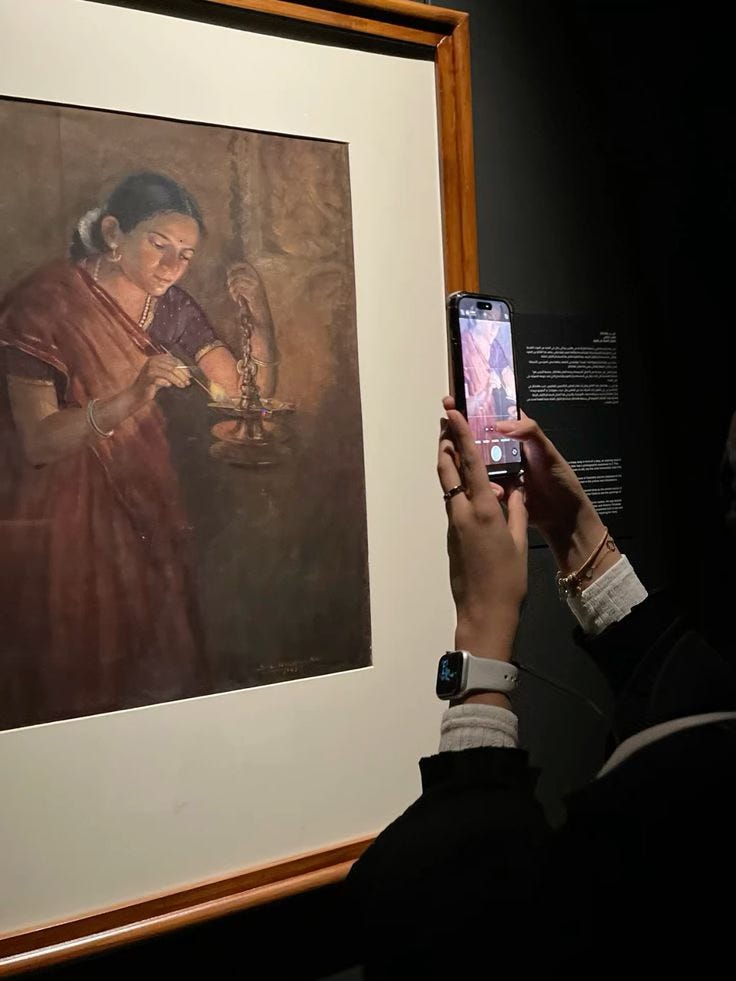
Okay so picture this; you’re standing in the British Museum. you’ve paid like £0 entry because they at least have the audacity to make it free. and you’re looking at this absolutely stunning bronze Nataraja , Shiva mid dance, cosmic fire in his hands, the whole universe in his pose. it’s breathtaking. it genuinely is.
and then you read the little placard next to it.
“Hindu idol. South India, c. 11th century. Acquired 1909.”
Acquired. Acquired. ACQUIRED. That is the most polite euphemism for theft in the English language and I will not be taking questions.
“The museum is not a neutral space. It never was. Every curatorial choice, what to display, how to label it, whose story gets told, is a political act.”
But here’s the thing that actually broke my brain when I started thinking about it: the theft is the obvious part. the part we talk about. the real violence , the quieter, more insidious one…is what happens to the object once it’s in there. it’s not just that the Nataraja is in London. it’s that the Nataraja is now an artifact. a specimen. a curiosity behind glass, stripped of its context, its ritual, its living relationship with the people who made it sacred.
it went from being something people actively prayed to, danced in front of, brought flowers to, to being something people take Instagram reels in front of. and somehow that transformation is never in the placard.
QUICK CONTEXT DROP
The term “museum” itself comes from the Greek “mouseion”, a place of the Muses, a site of learning. What the colonial museum actually became was something else: a theatre of empire. A place where the world’s cultures could be flattened, categorised, and consumed by a European audience without leaving home. Edward Said called it the “museumification” of the East. But honestly “colonial loot display centre” also works.
Here’s a thought experiment. walk into any major Western museum… the V&A, the Louvre, the Met; and look at how the Indian collection is presented. what’s the framing? it’s almost always one of three things: spiritual mysticism, exotic craftsmanship, or ancient civilisation (with an implied “but look how far they’ve come” undertone that I will not be entertaining).
BUT what you almost never get is: here is an object from a living tradition. here is what the people who made this actually believed about it. here is what was lost when it was taken. here is the community that still considers this sacred and has been asking for it back for decades.
THE QUESTION NOBODY ASKS
When a Chola bronze is described as “Hindu religious art” by a Western museum, and as a living murti by a Tamil community, which framing is considered the authoritative one? And why?
The “implied visitor” of these museums is, was, and has largely remained: a Western, educated, secular person who approaches these objects with aesthetic curiosity. not devotion. not grief. not political rage. curiosity. the kind of detached appreciation that only works when the object has been successfully separated from its living context.
and here’s the uncomfortable part, when we go to these museums, we’re often unconsciously inhabiting that same gaze. we’ve been trained to. we learned to look at our own heritage through the lens of “isn’t this fascinating” instead of “this is mine and it was taken.”
I know what you’re thinking. okay Aarya, colonial museums are bad, we know, but at least our museums here in India are better right?
babes. I say this with love. have you been to the National Museum in Delhi?
the colonial gaze didn’t just stay in London. we internalised it. our own post-independence museum infrastructure was built largely on the framework the British left behind, the Archaeological Survey of India, the curatorial categories, the very idea of what counts as “art” worth preserving vs what’s just “folk” or “craft.” (notice how “folk” always seems to mean things made by lower castes and tribal communities? interesting that.)
the Mughal miniatures are in the “Islamic art” section. the Deccani bronzes are under “South Indian religious sculpture.” the living traditions these objects come from are nowhere in the building. there’s no map from the object to the community. there’s no acknowledgment that some of these communities are still here, still making, still practicing.
“We built national museums to say ‘this is ours’ …but curated them to say ‘this is past.’ The living culture became heritage. Heritage became exhibit. The people became footnotes.”
I’m not going to pretend I have a clean policy answer. this is a substack, not a UN resolution. but here’s what I do think:
The repatriation debate is important but it’s not the whole conversation. because even if every single object came back tomorrow, and they won’t, but hypothetically, we’d still need to reckon with the question of how they’d be displayed. what story gets told. whose expertise is centred. whether communities are consulted or just thanked in a press release.
there are museums doing this differently. the Tirumala Tirupati Devasthanams museum in Andhra approaches sacred objects as part of a living tradition, not a dead one. some community archives and local cultural institutions in Tamil Nadu, Rajasthan, and Kerala are building models where curation happens from within. it’s not perfect. but it’s different.
the question isn’t just “give it back.” it’s “and then what?” what does it mean to display an object in a way that doesn’t strip it of its context? what does it mean to let communities be the authors of their own heritage, not just the subjects of someone else’s?
next time you’re in a museum, here or abroad… I want you to notice the placard. not just what it says, but what it doesn’t say. who it’s written for. what it assumes you already know, and what it assumes you don’t need to know.
the gaze is always there. the question is whether you’re aware you’re standing in it.
share it with someone who also stood in front of a British Museum placard and felt something they couldn’t quite name. that feeling has a name. we’re just learning the vocabulary.
No posts
Comments
Nothing yet. Say the first thing.
Sign in to join the conversation.