
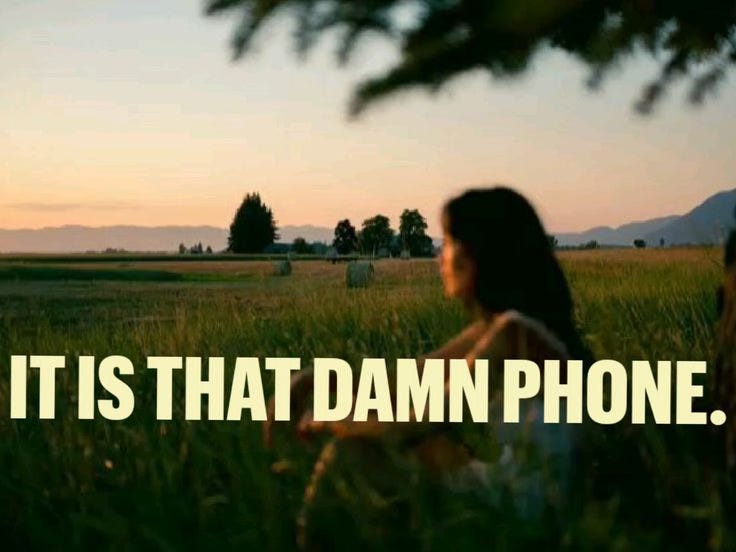
There’s something quietly devastating about opening your phone at 6 am and knowing, without asking, the emotional temperature of thirty people you haven’t spoken to in months. That an acquaintance is grieving. That someone you used to be close to is rebuilding. That a person you barely know just had the best night of their life, and you watched it happen through a rectangle in your hand, uninvited, in real time. No conversation required. No vulnerability exchanged. Just a story, a post, a location tag, and suddenly you’re holding information you never consented to carry.
We talk about social media making us disconnected, and yeah, sure, that’s true, but I think that framing actually undersells the problem. The issue isn’t that we’re disconnected. It’s that we’re over-connected in a way that human psychology was never architected to handle. We weren’t built for this volume. Not emotionally, not neurologically, not socially.
Anthropologists will tell you that for most of human history, the average person maintained meaningful relationships with roughly 150 people. Dunbar’s number. Your village, essentially. You knew their faces, their rhythms, their drama. You knew who was feuding with whom and whose harvest failed. But that knowledge was earned through proximity, through time, through the slow accumulation of shared experience. You didn’t just open an app and receive it.
Now we have thousands of followers, and we are expected to be normal about it….
The thing nobody talks about enough is what social saturation does to attraction specifically. And I mean attraction in the broadest sense possible, romantic, platonic, intellectual, the pull you feel toward a person when they interest you. That pull used to require space to generate. Not absence, people get that wrong all the time, but genuine space. The kind where you don’t know yet. Where there’s still something to discover.
Think about how you used to get to know someone before all of this. You’d notice things. Slowly. The way they ordered coffee. What they got weirdly passionate about at dinner. A habit that would only surface after you’d spent enough time together for their performance of themselves to relax. There was an unfolding. And the unfolding was the point. The attraction lived there, in the gradual, in the not-yet-knowing.
That process has been fundamentally disrupted and we’re all just walking around pretending it hasn’t.
Now you talk to someone for the first time, and you already know their top artists, their situational political opinions, how they react when they’re annoyed, what they looked like in 2019, and probably something vaguely traumatic they disclosed during a vulnerable era of posting. You arrive already full. There’s nothing left to discover because they’ve already pre-disclosed everything, not to you specifically, but to the internet, which you are currently a part of. The mystery doesn’t just get solved early. It gets pre-empted entirely.
Somewhere along the way, we confused intimacy with immediacy, and I think that confusion is actually ruining us.
Intimacy is a slow construction. It’s what happens when someone sees an unannounced imperfection, not one you captioned thoughtfully, but one that just appears, accidentally, because you’ve been around each other long enough for your guard to drop. It’s the laugh that’s embarrassing and weird. The opinion they’re almost ashamed of. The fear they mention once, offhandedly, and then never bring up again, but you remember. That’s intimacy. It accrues. It compounds.
Immediacy is just access. And we’ve mistaken access for closeness in a way that I think is making genuine closeness feel kind of impossible.
When everything is pre-disclosed, when your attachment style is literally in your bio, when you post your therapy breakthroughs and your childhood wounds and your hot takes on your own emotional unavailability, you’re not being intimate. You’re broadcasting. And broadcasting, by definition, is not intimate. It’s the opposite. It’s performed vulnerability, which is almost a contradiction in terms, because vulnerability is only vulnerable when it’s given specifically, to someone who has earned it, in a context that makes it mean something.
I want to be careful here because I’m not making a “phones bad, go touch grass” argument. That take is boring and also I am extremely chronically online and would never survive 1873. What I’m actually pointing at is something more structural, which is that the architecture of social media is fundamentally at odds with the architecture of human intimacy, and nobody warned us about that before we all signed up.
The platforms are designed around disclosure. More sharing, more engagement, more access, more connection, theoretically. But human psychology is built around selective disclosure. Around the idea that what you choose to reveal, to whom, and when, is precisely what makes revelation meaningful. The whole value of someone telling you something is that they’re telling you. Not their 12,000 followers and also you.
When everything is ambient, when I can just absorb your life by scrolling, the act of you telling me something loses its social weight. You can’t give me something I already have.
The saddest part of all this, and I do think it’s genuinely sad, is that we’re becoming less legible to each other even as we become more transparent. You’d think more information would mean better understanding. But that’s not how people work. People are not information sets. You don’t understand someone by accumulating data points about them. You understand them through time, through context, through being in the room when they react to something unexpected, through the texture of repeated experience.
What we have now is a lot of content about people, and very little experience of them. And content about a person is not the same as knowing them. But it can trick you into thinking it is. Which might be the most insidious thing about all of it. You finish someone’s substack and you feel like you get them. You watch their stories for six months and you feel a familiarity that isn’t mutual and isn’t earned. It’s parasocial in the clinical sense, and we’ve normalized it so completely that we now apply the same logic to people we actually know.
We consume our real relationships the same way we consume strangers. And then we wonder why nothing feels intimate anymore.
I think what I’m grieving, when I think about all of this, is the specific pleasure of slow discovery. Of learning one small thing at a time. The attraction that grows in the pauses, in what hasn’t been said yet, in the version of a person that only appears after the performance drops. That’s still technically possible. But it requires a deliberate resistance to a system that is actively working against it, and most people are not equipped for that resistance because most people don’t even know they need it.
We got socially saturated before we had language for what was being lost. And now we’re all just a little too full, a little too knowing, a little too seen by people who don’t actually know us at all, reaching through our screens for the kind of intimacy that only grows in the quiet, in the space between updates, in the things that don’t get posted because some things are still, somehow, just for us.
No posts
Comments
Nothing yet. Say the first thing.
Sign in to join the conversation.