
Good evening, everyone. Lots to cover today. Ethics watchdogs are sounding the alarm, saying Trump’s corruption dwarfs his entire first term, and I break some of it down below. I’m doing a major deep dive to map out the full picture for you, but here’s a preview to start.
Meanwhile, Trump is facing ridicule for having to flee an Iranian assassination plot in a catering truck, there’s another major food recall in the United States, Trump is rapidly escalating DNA collection of undocumented individuals, Trump Media suffered its largest loss to date as Truth Social hangs in the balance, and the Kennedy Center was forced to pay out after failing in its lawsuit against an artist who canceled a performance. And more.
A couple of other notes. First, so many of you are excited for the Pritzker interview that instead of doing it live, I’m pre-recording it and will send it out to all of you as part of tomorrow’s evening update. I’m also preparing to launch a major nightly live show, so stay tuned. Your support makes that a reality.
Here’s the news:
Ethics Watchdogs Sound the Alarm:
Trump is rapidly consolidating power across nearly every check on the presidency: he’s stretched executive authority into Congress’s territory by clawing back appropriated funds, imposing sweeping tariffs, and dismantling federal agencies, while sidelining inspectors general and once-insulated agency appointees. He’s simultaneously targeted free expression by intimidating news outlets, defunding public media, threatening to jail reporters, and pressuring museums and universities to reshape how history and information are presented. On the legal front, he’s erased the traditional wall between the White House and DOJ, using it to pursue investigations of political opponents while pardoning allies, including Jan. 6 rioters convicted of violence, even as courts accuse his administration of defying orders. He’s fused his family’s business interests with official policy without regard for ethics concerns, and his administration has gutted public-health and scientific institutions, from slashing the childhood vaccine schedule to halting USAID’s global health work, further centralizing control over information Americans rely on to make decisions.
Ethics watchdog groups say Trump’s second-term corruption dwarfs his first, even as public attention has grown numb to it: last year’s protest outside Trump’s $TRUMP meme-coin dinner drew roughly 100 demonstrators calling it the “Mount Everest of corruption,” but a similar crypto-contest luncheon at Mar-a-Lago this year drew no protests at all, with Public Citizen’s Lisa Gilbert noting “as profiteering becomes the norm, it’s harder to explain why it’s outrageous.” Groups like CREW, Public Citizen, and the Campaign Legal Center have expanded staff and launched new tracking tools to keep pace, and a recent Echelon Insights poll found the share of Americans citing corruption as the top issue has more than doubled since December 2024, from 8% to 17%. Still, accountability has been scarce compared to the first term, when three Cabinet officials were forced out over ethics scandals. CREW’s Jordan Libowitz summed up the shift: “In the first term, there was at least a head nod towards Trump as president being separate from Trump the businessman. Now that’s gone.”
The financial scale of alleged self-dealing has exploded: Trump made roughly $2.2 billion last year according to the New York Times, driven mainly by cryptocurrency deals that now form the bulk of his net worth, plus up to $117 million in legal settlements and $125 million from foreign golf and real estate deals, twice his 2017 haul. He’s made over 21,000 securities trades often timed to market-moving events he triggered, per Bloomberg, while his sons’ defense-tech investment portfolio has generated more than $3 billion in direct government business. Within days of his second inauguration, the administration fired 17 inspectors general, gutting oversight infrastructure, and a $500 million Emirati-backed deal for a stake in the family’s World Liberty Financial crypto venture included payments tied to top Middle East negotiator Steve Witkoff’s family. The White House disputes any conflict of interest, with spokesperson Anna Kelly calling the allegations a “tired narrative” and saying Trump’s assets are held in “fully discretionary accounts.”
Familiar categories of first-term scandal have resurfaced at a larger scale: travel to Trump properties is up 14% from the same point in his first term (270 visits so far), with golfing costs projected to reach $300 million this term, twice the first-term total, and Cabinet-level travel controversies now center less on the trips themselves than on what happens during them, like FBI Director Kash Patel’s taxpayer-funded Hawaii “VIP snorkel” and Olympics trip. Branded merchandise has become ubiquitous, from a White House study turned into a MAGA-merchandise showroom to a pending trademark on “Trump 250” products, while Truth Social generates ad revenue off communications the public needs to read to hear from the president. The Doral golf club, which Trump abandoned as a 2019 G7 host after bipartisan backlash, hosted a summit of Latin American leaders this March and is now slated for this year’s G20 with little GOP pushback. Trump’s birthday spectacle in June, a UFC event on the White House lawn sponsored by World Liberty Financial and featuring $12,000 commemorative coins “designed by” Trump, drew a failed lawsuit from the Public Integrity Project, which called it “a volcano of corruption.”
A federal judge in Boston blocked the US Postal Service nationwide from implementing part of Trump’s executive order tightening mail-in voting rules ahead of the November midterms, expanding an earlier June ruling that had only stopped enforcement in 23 mostly Democratic-led states. Judge Indira Talwani, an Obama appointee, ruled the executive branch has no constitutional authority to regulate elections since that power belongs to the states, writing that being less than 90 days from the November 3 midterms made the injunction critical to prevent the administration from changing election rules “on the eve of the election.” The order had directed states to hand over lists of voters eligible for mail ballots, with USPS set to refuse delivering ballots for states that didn’t comply. Neither the White House nor the Justice Department immediately responded to requests for comment.
Trump Plane
Trump’s covert departure from Turkey aboard a decoy plane, reportedly involving a catering truck used to move him from the old Air Force One to a smaller aircraft after a NATO summit, has spawned a wave of AI-generated memes and jokes online. Social media users, including MeidasTouch’s Ron Filipkowski, imagined the 80-year-old president hidden in catering carts, laundry bins, and McDonald’s-branded trucks, riffing on his 2024 campaign drive-thru photo op. The Washington Post and New York Times reported the maneuver was prompted by an Iranian assassination threat, with the original Air Force One serving as a “decoy” while still carrying reporters and staff. A White House spokesperson defended the secrecy by citing threats against Trump, while sidestepping questions about the safety of the Qatari-gifted jet, which reportedly lacks adequate security measures.

Florida-based Corte Argentino USA is recalling nearly 30,000 pounds of raw beef imported from Argentina after it was shipped directly to distributors and retailers in Florida and Texas without undergoing required USDA import reinspection, a lapse discovered during routine FSIS checks. The affected products, including cuts like top sirloin butt, eye round, and knuckle, were produced between May 15-20 with use-by dates in mid-to-late September, and carry the shipping mark 26644-AA. No illnesses have been reported, but the FSIS is urging anyone with the products to discard or return them rather than eat them. It’s the second such recall in recent months tied to skipped import inspections, following a July recall of over 12,000 pounds of bacon imported from Canada.
A new DOJ Office of Legal Counsel memo, issued Monday and first reported by Punchbowl, argues that executive privilege can extend beyond White House staff to cover the president’s communications with outside “private advisers,” a non-binding opinion that would broaden who Trump could shield from congressional investigations. OLC’s T. Elliot Gaiser wrote that the same need for “candid, objective, and even blunt or harsh opinions” that justifies privilege for internal staff applies just as strongly to outside counsel the president relies on, and that without confidentiality his ability to “decide and act quickly” would be hindered. The claim isn’t absolute, limited to advice given “in performance of a President’s responsibilities” and while “shaping policies and making decisions,” but it could still be used to stymie investigations into a president who is frequently in contact with outside business leaders and has struck deals while in office. It’s not the administration’s first move to narrow White House transparency: in April, OLC argued the White House shouldn’t have to comply with the Presidential Records Act, though a federal judge ordered continued compliance in May, citing constitutional text, precedent, and nearly 50 years of practice. The opinion comes as Democrats eye a potential House majority and the investigations that could follow.
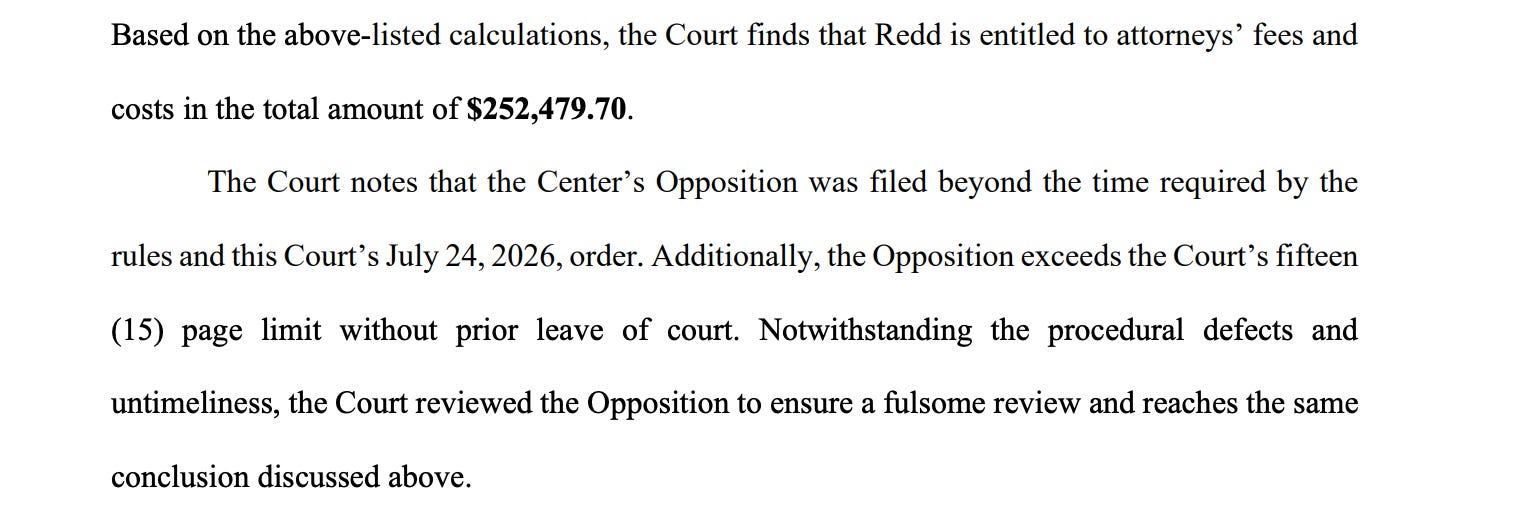
A DC Superior Court judge ordered the Trump-controlled Kennedy Center to pay jazz musician Chuck Redd $252,000 in legal fees after its breach-of-contract lawsuit against him was dismissed in June. The Kennedy Center sued Redd, who’d performed at its annual Christmas Eve concert every year since 2006, after he pulled out citing Trump’s push to rename the institution the “Trump Kennedy Center”; then-president Richard Grenell had threatened to seek $1 million in damages from Redd over what he called a “political stunt.” Judge Tanya Jones Bosier found no valid breach-of-contract claim, and Redd’s attorney Lisa Banks said the fee award was appropriate since “no citizen should have to spend time and money fending off baseless and politically motivated lawsuits.” Redd was one of several artists who distanced themselves from the venue after Trump installed himself as board chairman and appointed allies to leadership, a shakeup that has reportedly left staff fearful of retaliation for speaking out.
Trump Media Failing:
Trump Media & Technology Group, which owns Truth Social, reported a $238 million loss for the second quarter as it branched into ventures like crypto and online betting. New CEO Kevin McGurn announced the company is now pivoting back to focus on social media after a year chasing those other bets, saying “we made the disciplined choice to pivot in order to invest more time and resources in our most important initiatives.” Revenue came in at just $1.7 million, though that’s up 89% year over year. The company still plans to close its previously announced nuclear fusion merger with TAE Technologies by year’s end, and holds over $400 million in cash plus $1.2 billion in bitcoin-related assets, against $1 billion in debt from convertible notes.
A key part of the pivot is Truth API, a new paid service selling early access to Trump’s posts (and those of other top users) to Wall Street trading firms for $60,000 to $100,000 a month, letting them trade ahead of market-moving policy announcements; McGurn said 10 firms, mostly high-frequency traders, have already signed up. Government ethics watchdogs have blasted the service, with Washington University’s Kathleen Clark calling it “brazen corruption” and an improper use of presidential power for personal enrichment. McGurn has pushed back, arguing that selling licensed real-time data through commercial APIs is standard practice across tech, finance, and media. The company also faces a possible cash crunch if lenders exercise their option in November to demand early repayment of $1 billion in convertible notes, though it currently has ample liquidity.
Iran war:
Iran’s Supreme Leader Mojtaba Khamenei has elevated six hardliners to top security positions this week, including national security chief Mohsen Rezaie and Basij militia head Hossein Taeb, a US-sanctioned figure tied to the 2009 protest crackdown, undercutting Trump’s claims that the war has produced “more reasonable” leadership in Tehran. Analysts describe the reshuffle as a shift from Ali Khamenei’s cautious deterrence toward “offensive deterrence,” combining more aggressive posturing toward the US with tighter, more granular domestic surveillance reaching into neighborhoods and mosques. Rezaie has explicitly called for sustained pressure and “a steady dose of pain” on Trump, and experts say Iran’s strategy includes prolonging the conflict to hurt Trump’s allies in the midterms, driven partly by a belief that Iran’s restrained response to Soleimani’s 2020 killing only invited more US pressure. Most appointees have intelligence backgrounds, reflecting what one scholar called a move toward a “security-dominated bureaucratic regime,” possibly also aimed at shoring up loyalists ahead of potential unrest from economic strain. Mojtaba Khamenei himself has not appeared publicly since becoming supreme leader in March, leaving analysts uncertain whether he is truly driving these changes.
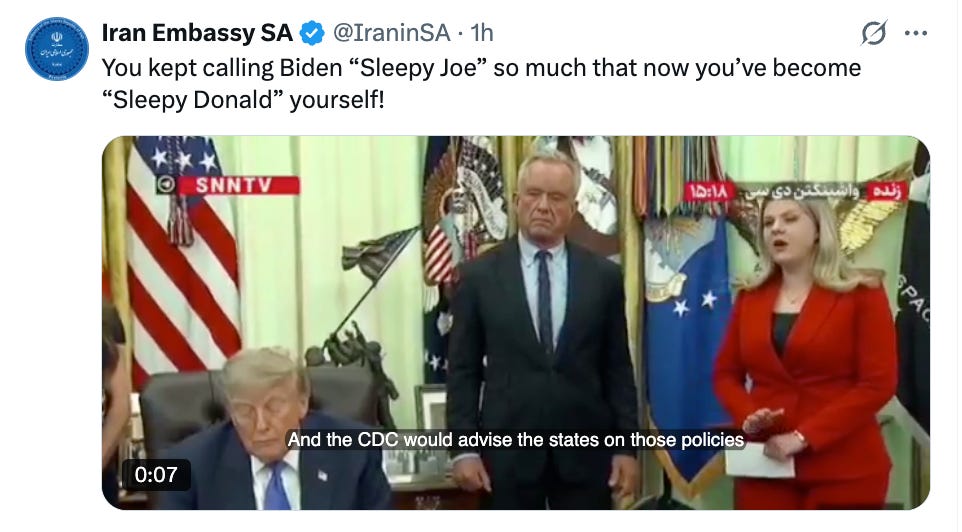
Iran says President Trump “kept calling Biden ‘Sleepy Joe’ so much that now you’ve become ‘Sleepy Donald’ yourself.”
Maritime violence spread across the region’s key waterways Tuesday: Yemen accused Iran-backed Houthis of a “double-tap” strike on the cargo ship Tihamah in the Bab al-Mandeb Strait, killing four crew members and two rescue workers who arrived after the initial strike; separately, the US military fired Hellfire missiles from a helicopter to disable the engine room of a Panama-flagged vessel, the M/V Vela Nova, after it ignored warnings and tried to breach the US blockade toward an Iranian port. CENTCOM said it has redirected 55 commercial vessels, disabled three, and boarded two since reimposing the blockade in July. A separate, still-unclear incident involving a container ship and unidentified military forces was also reported by UK maritime monitors in the Gulf of Oman. Together these mark an escalation, with the Houthi strike representing a likely first fatality event since their blockade declaration and a sign the Iran conflict is spilling into wider regional shipping lanes.
Despite Trump’s claim Monday that the Strait of Hormuz is “open” and under US Navy control, shipping data doesn’t support it: only seven to eight vessels crossed the strait Tuesday, compared with a pre-war daily average of 120, according to MarineTraffic and Kpler. The US Energy Information Administration has raised its 2026 price forecasts accordingly, now projecting Brent crude to average $87 a barrel (up from $82 a month ago) and gasoline to hit $3.78 a gallon, well above the pre-war $2.98 average. Reopening prospects are dimming as both sides raise conditions: Iran is demanding the US lift its naval blockade and pay damages, while Trump is now demanding Iran compensate the US for unspecified past harms. Iran is separately racing to repair gas-processing facilities in Asaluyeh that were damaged in the war, though officials warn some capacity won’t be restored before winter, worsening an existing energy shortfall of roughly 230 million cubic meters per day.
Other news:
A new analysis from judicial watchdog Court Accountability, shared exclusively with the Guardian, found Supreme Court Justice Samuel Alito gained between $390,000 and $2.9 million from oil and gas holdings since joining the court in 2005, mostly tied to a mineral interest in Oklahoma held by his wife. The findings arrive as the court prepares to hear Suncor v. Boulder on October 5, a case in which oil companies Suncor and Exxon are seeking to block local governments from suing fossil fuel producers over climate damages, with the Trump administration backing the industry. Critics, including Court Accountability co-founder Lisa Graves, argue Alito’s fossil fuel wealth should require recusal since his “impartiality might reasonably be questioned,” but the court has said he isn’t required to step aside because his holdings don’t include Suncor or ExxonMobil directly. The analysis also flags ties between the oil company leasing Alito’s family land and hedge fund Elliott Investment Management, whose founder Paul Singer previously gave Alito an undisclosed private jet trip and whose fund holds a major stake in Suncor. Alito has a long record of siding with fossil fuel interests in major environmental rulings, though he has recused himself from other cases involving companies he holds stock in directly.
In Falls Church, Virginia, an ICE agent allegedly pointed his gun through a woman’s car window and threatened to arrest her after accusing her of nearly running agents over, an accusation she denied and disputed using her dash cam footage; when she repeatedly called out the lie and cited her recording as proof, the agents ultimately walked away without arresting her or presenting any evidence of a crime.
ICE’s DNA collection has exploded under the second Trump administration, with Georgetown Law’s Center on Privacy and Technology estimating the agency added as many as 920,000 genetic profiles to the FBI’s CODIS criminal database in 2025 alone, up from roughly 20,000 total between 2020 and 2021, making DHS the largest single source of new profiles in the nation’s criminal DNA system despite most detainees having no criminal conviction. The program, which stems from a 2020 DOJ rule change and a subsequent ICE directive requiring DNA collection from nearly everyone in custody, has extended to families and children as young as 14 at facilities like Dilley, Texas, with CBP records showing 492 children under 14, including a 4-year-old, had their DNA sent to the FBI between January 2025 and January 2026. An ICE attorney’s internal email undercuts the government’s identification rationale, stating the program’s “primary purpose” is building “a national DNA database for solving crimes” rather than confirming identity, and refusal to comply is now being criminally prosecuted, as in the case of Hugo Moreno-Mendez, who was convicted and sentenced to time served after refusing multiple swab attempts.
The Pentagon’s newly delivered but unreleased annual civilian casualty report claims no civilians died in 2025’s Caribbean and Pacific boat strikes, despite the U.S. having killed more than 120 people in those strikes last year (over 220 to date) that experts call extrajudicial killings, with one Pentagon official calling the report “a fucking joke” and another a “total whitewash”; the same report found 153 civilians killed and nearly 250 wounded in the 2025 Yemen campaign, far below the Yemen Data Project’s count of at least 238 killed and 467 injured, and comes amid Hegseth-era cuts that have reduced CENTCOM’s civilian harm team from ten staffers to one, leaving 15 Yemen incidents still unreviewed and raising alarm about the Pentagon’s ability to investigate the far larger volume of civilian harm expected from the ongoing Iran war.
Today’s primaries drew heavy DOJ involvement, with roughly 20 federal election monitors from the Civil Rights Division deployed to Hennepin and Ramsey counties, Minnesota’s two largest, as part of the administration’s “nationwide effort to ensure free and fair elections.” Both counties declined to let monitors inside polling sites, so they’re staying 100ft outside per state law, while Minnesota’s secretary of state, Steve Simon, said state officials will in turn observe the federal monitors given ongoing anxieties about DOJ activity near polling places. The primaries themselves are consequential: Minnesota has a marquee Democratic Senate primary between progressive Lt. Gov. Peggy Flanagan and Rep. Angie Craig, plus a governor’s race, while Wisconsin Democrats are weighing a democratic socialist gubernatorial candidate amid a broader progressive wave. In South Carolina, ten Republicans, including Trump-endorsed interim Senator Darline Graham, are competing in a compressed special primary to permanently fill her late brother Lindsey Graham’s seat, with a runoff likely on August 25.
A jellyfish swarm forced France’s EDF utility to shut down parts of the Gravelines nuclear plant on August 11, exactly one year after a similar jellyfish invasion took the plant offline on the same date in 2025. Despite spending hundreds of thousands of euros on preventive measures, including cameras and fishing boats patrolling 24/7, the swarm grew from about 100 kilograms to “several dozen tons” over the weekend and overwhelmed the plant’s defenses by blocking pumping systems. It’s the latest in a string of climate-linked disruptions hitting French nuclear plants this summer, as rising sea temperatures make jellyfish swarms more common while heatwaves and droughts separately force other reactors offline due to water supply issues. Greenpeace France seized on the incident to argue nuclear plants are ill-equipped to handle climate change’s effects.
The White House has asked the Justice Department to weigh new charges against former Olympian David Hearn after DC US attorney Jeanine Pirro dropped the vandalism case against him on July 31, citing insufficient evidence that damage to the Lincoln Memorial reflecting pool was actually vandalism rather than a flawed installation. Trump has publicly attacked Pirro over the dismissal, saying she “choked,” and the request to revive the case was first reported by the Wall Street Journal; the basis for potential new charges remains unclear. The move is notable because the DOJ traditionally operates independently from the White House, and Hearn’s lawyers called it “another bizarre turn” and said it would mark the first time a case the DOJ itself admitted it lacked evidence for came “back from the dead.” The DOJ declined to say whether it’s considering new charges, and newly confirmed Attorney General Todd Blanche sidestepped questions about the dismissal while noting Trump has the authority to fire US attorneys.
The Timber fire has grown to 2,000 acres in Monterey County’s Los Padres National Forest since starting Sunday, prompting evacuations along California’s Big Sur coast that have emptied famed tourist spots like the Nepenthe restaurant, the Henry Miller Memorial Library, and the Alila Ventana resort during peak season. Nearly 500 personnel are battling the blaze, which is 5% contained; crews are focused on protecting homes and stopping the fire from crossing the Pacific Coast Highway, part of which is closed to non-residents. The fire is moving slowly through grass, brush, and oak woodland rather than tree tops, and its cause remains under investigation, with 259 buildings currently threatened. It’s part of a broader wildfire surge across the western US and Canada, including a fatal, evacuation-forcing fire near Peachland and Summerland, British Columbia, a blaze north of Reno that displaced 5,500 people, and Oregon’s worst wildfire season on record.
Russia has freed former US Marine Robert Gilman, 32, after Putin granted a humanitarian pardon following his rapid health decline in a Russian prison. Gilman, an English teacher who briefly served in the Marines, was arrested in January 2022 in Voronezh for allegedly kicking a police officer while drunk, a charge his family disputes, saying he was ill and kicked the officer accidentally; he was later sentenced to four and a half years. He’d reportedly been transferred in late June to a psychiatric ward in a catatonic-like “dissociative stupor,” prompting the White House and State Department to press Moscow for his release. Trump said he personally spoke with Putin to secure the release and stressed “no exchange took place,” unusual for Russia, which typically trades prisoners; Gilman was flying to Washington Dulles to be greeted by envoy Steve Witkoff and deputy assistant Sebastian Gorka. His release follows a similar 2025 swap for teacher Marc Fogel and comes amid signs Moscow is working to improve ties with the Trump administration.
Jacob “Jake” Whisenant, a 30-year-old climber from Mammoth Lakes known for record-setting speed ascents, died August 3 in a climbing-related incident in the Sequoia and Kings Canyon wilderness while attempting a first ascent. Whisenant had made headlines in 2024 for climbing El Capitan’s 2,000-foot route with partner Brant Hysell in just under three hours, and in May completed the famed Nose route twice in a single day. His fiancee, Emma London, described getting “the call that no one ever wants to get” and said he fell to his death while climbing; friends and family say he’s remembered for his dedication to every hobby he pursued and his deep respect for nature. A GoFundMe launched by friend Bailee Moore aims to create memorials in the places Whisenant loved climbing.
A Florida paddleboarder named Mike Head rescued a woman from an alligator attack in Marion County’s Silver River over the weekend after hearing others yell “Gator!” He paddled toward her, saw the alligator’s jaws locked onto her arm, and struck it with his paddle until it let go, then used a rope as a makeshift tourniquet to stop her bleeding while another boater helped bring her to shore. Authorities later trapped a 9-foot-8-inch alligator from the area. The attack follows a string of others in Florida this summer, including a fatal one in late July that killed 31-year-old Brittany Clark in Seminole County. The state’s Fish and Wildlife Conservation Commission notes alligators live in all 67 Florida counties and advises against feeding them, urging people to swim only in designated areas during daylight and keep pets leashed near water.
The State Department has canceled more than 175,000 visas since Trump returned to office, roughly quadrupling the pace of revocations compared to Biden’s final year (about 40,000 in 2024), with monthly revocations climbing from about 8,000 in 2025 to over 10,000 in 2026. Officials cite crimes like assault, DUI, and drug offenses as leading causes, but the department hasn’t broken down how many of the 175,000 stem from serious crimes versus minor infractions, and critics like the American Immigration Council say lumping foreign policy cases, DUIs, and political speech together makes the headline number “almost meaningless.” Some revocations explicitly targeted political speech, including foreign nationals who commented on Charlie Kirk’s killing (one saying he “died too late”) and the widely covered case of Tufts student Rümeysa Öztürk, whose visa was pulled after co-writing an op-ed critical of the university’s Gaza stance before a judge dismissed the case against her. The system stems from a “continuous vetting” program screening about 55 million visa holders, and is separate from deportations, which have topped 605,000 under a different agency, DHS, as part of what the administration calls the largest deportation operation in US history.
Four major US human rights organizations, the American Friends Service Committee, the Center for Constitutional Rights, Human Rights Watch, and the Open Society Institute, sued the Trump administration on Tuesday, arguing its sanctions regime against the International Criminal Court is a “blatantly illegal attack on international justice.” The suit targets Trump’s February 2025 executive order sanctioning ICC officials and judges tied to the court’s investigation of Israeli crimes in Palestine, which followed 2024 arrest warrants for Netanyahu and Yoav Gallant; the sanctions have also hit Palestinian rights groups and UN rapporteur Francesca Albanese. The plaintiffs say the sanctions, though not directly aimed at them, have chilled their ability to represent victims, collaborate with sanctioned Palestinian groups, or even continue practicing law before the ICC, with CCR attorney Katherine Gallagher saying she stopped ICC work entirely to avoid prosecution. It’s the latest in a string of legal challenges, following suits from Dawn and the Taxpayer Alliance Against Genocide, Albanese’s family, and sitting ICC judges, as human rights advocates argue the order shields war crimes perpetrators from accountability while punishing those pursuing it.
See you soon.
— Aaron
Comments
Nothing yet. Say the first thing.
Sign in to join the conversation.