
Good morning. Lots of news to cover. We’re learning more about Trump’s secret catering truck escape, where he allegedly chose to take Natalie Harp and other loyalists while leaving Marco Rubio and Stephen Miller behind on the plane that could have been targeted by Iran. Meanwhile, the MyPillow Guy is melting down and refusing to accept the election results after losing in Minnesota despite Trump’s endorsement. $900 million of your money is being funneled into more White House renovations, ICE is getting shock gloves, and much more.
This afternoon I’ll have Governor JB Pritzker on, and I’m prioritizing questions from paid subscribers. Tomorrow night at 8:15 PM EST, we have our next paid subscriber live.
If you’re here and want to support independent media that will never cave to this White House, subscribe today.
Your support allows me to spend every day reading court opinions, tracking breaking developments, and delivering timely, independent coverage to millions of people. I truly could not do this without you. Thank you for being here.
Here’s the news:
When Trump secretly left Turkey via catering truck last month amid an Iranian assassination threat, he was accompanied by loyalist aides Dan Scavino, Natalie Harp, and Walt Nauta, but no Cabinet officials, notably not Secretary of State Marco Rubio, though Defense Secretary Pete Hegseth ended up boarding the smaller decoy plane separately and appeared to be the senior-most official aboard. The rest of the senior staff, military personnel, Secret Service, and press pool remained on the original Air Force One, which the White House had deemed too risky yet still let carry reporters, prompting Democrats like Sen. Richard Blumenthal to demand a congressional briefing on what precautions were taken to protect those left behind. Trump, addressing the operation publicly for the first time, said the Secret Service made the call to switch him to another plane and claimed he personally faced greater risk than those on the original aircraft, saying “I may be the most consequential” president and therefore a bigger target. The White House has still not disclosed who remained on the original jet more than a month after the operation and two days after the Post first revealed the ruse. Scavino, Harp, and Nauta, all longtime Trump loyalists from his post-presidency Mar-a-Lago inner circle, did not respond to requests for comment.
The Washington Post confirmed that the Trump administration plans to spend at least $900 million on White House construction, a much larger figure than previously reported, funded mostly by taxpayers through a maneuver that bypasses Congress. Rather than seeking direct appropriations, officials funneled $875 million into the Executive Residence’s small “White House Repair and Restoration” maintenance account, normally funded at just $2.5 million a year, by transferring $500 million from the Secret Service and White House Military Office plus $305 million in private donations, with $70 million from unidentified sources; the Executive Residence isn’t subject to standard public-records disclosure rules, keeping the contracts confidential. The bulk of the money covers Trump’s East Wing ballroom overhaul (previously estimated at $600 million, half taxpayer-funded) along with Lafayette Square upgrades, a new helipad, and a visitor screening facility.
A federal appeals court ruled last week that the ballroom project requires congressional approval, since “Congress has exclusive authority to regulate the construction and demolition of White House structures,” and Trump has vowed to appeal to the Supreme Court. Experts call the funding maneuvers highly unusual, with one former OMB official warning that “if the executive can do anything they want with appropriated funds, then the executive can do anything they want, period,” while the White House insists the spending is consistent with Congress’s original intent and necessary “to beautify the People’s House.”

Jonathan Reiner, a George Washington University medicine professor and Dick Cheney’s former cardiologist, wrote in the New York Times that the public “deserves answers” about Trump’s health, arguing the 80-year-old president’s ailments are “easy to see” despite White House reassurances. He questions the administration’s explanation for Trump’s persistent dark hand bruising, blamed on handshakes and high-dose aspirin, noting the bruising appears on both hands even though Trump only shakes with his right. Reiner also flags the recently disclosed diagnosis of chronic venous insufficiency, pointing out that no leg swelling was noted in Trump’s prior physical despite the condition typically developing gradually, meaning true chronic swelling shouldn’t have appeared so suddenly and that acute swelling could instead signal more serious heart or kidney issues. He further presses for explanations of Trump’s public napping episodes and his repeated administration of the Montreal Cognitive Assessment, a dementia screening tool, which Trump has mischaracterized as an IQ test. Reiner concludes that unlike a monarchy, American democracy requires the public have confidence in their leader’s health and capacity to govern, arguing “we have been kept in the dark too long.”
Election results:
Trump-endorsed Mike Lindell lost Minnesota’s Republican gubernatorial primary to House Speaker Lisa Demuth, who took about 43.5% of the vote to Lindell’s 32.4% with 97% counted, but the “MyPillow guy” and prominent 2020 election denier is refusing to concede, claiming irregularities and insisting on waiting for remaining “day-of” votes to be counted. Trump had campaigned hard for Lindell, giving him his “COMPLETE AND TOTAL ENDORSEMENT” in July and urging his 13 million Truth Social followers to vote for him on Election Day itself, even appearing at a Bedminster gala in Lindell’s honor hours after two US service members died in the Iran war. Demuth will now face Democratic Sen. Amy Klobuchar in November.
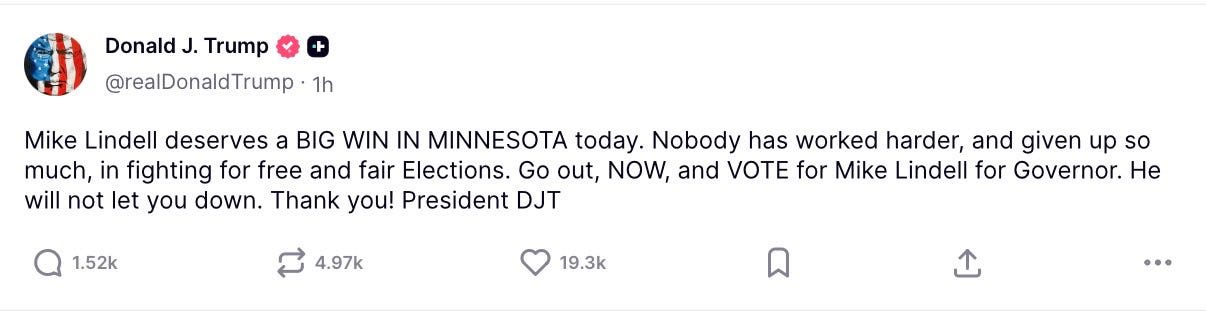
Lindell’s loss marks the third Trump-endorsed candidate defeated in primaries this cycle, following Tennessee Rep. Andy Ogles and Michigan Rep. Amir Hassan last week, adding to a string of embarrassments for the president. Lindell has a long history of spreading debunked 2020 election fraud claims, once even blaming “Satan” for rigged voting machines, which has cost him dearly in court: he’s been ordered to pay Smartmatic USA over $56,000 for defamation, owed DHL $780,000 in a separate contract dispute, and settled a $1.3 billion defamation suit from Dominion Voting Systems (now Liberty Vote) in July under confidential terms. He told the AP in 2023 that the legal fees from these fights had left him effectively out of money.
Milwaukee County Executive David Crowley narrowly won Wisconsin’s Democratic gubernatorial primary over democratic socialist Francesca Hong, 39.8% to 39.4%, an upset given he’d actually dropped out of the race a month earlier before re-entering days later with outgoing Gov. Tony Evers’ endorsement as moderates scrambled for an alternative to Hong. Hong had led in the polls for much of the race but faced late scrutiny over her electability and past positions, including calls to defund police and abolish the Senate, which she walked back; she also didn’t get backing from national democratic socialist figures like Bernie Sanders or AOC. Crowley significantly outspent her on ads ($4 million to under $500,000) and will now face Trump-backed Republican Rep. Tom Tiffany, who easily won his own primary, in a marquee November matchup that will determine who holds power during the 2028 presidential election. If elected, Crowley would become Wisconsin’s first Black governor.
Appointed Sen. Darline Graham was forced into an August 25 GOP Senate primary runoff against Rep. Ralph Norman after failing to win outright, despite Trump’s “complete and total endorsement” issued just days after her brother Lindsey Graham’s death in July. Graham, who has never held elected office and was appointed to fill her brother’s seat, saw some voters push back on her thin résumé and question whether Trump’s backing would sway them, with one South Carolina voter telling NBC he sympathized with her loss but didn’t think that alone warranted giving her the seat. It’s the latest instance this year of a Trump-endorsed candidate failing to win a Republican nomination outright, following a similar runoff scenario in the state’s gubernatorial primary earlier this year. The winner will face Democrat Annie Andrews in November and will be heavily favored in a state that hasn’t elected a Democratic senator since 1998, while Graham pointed to her role passing a Russia-Iran sanctions bill named after her brother as evidence she’s already delivering results in her brief tenure.
Minnesota Lt. Gov. Peggy Flanagan won the Democratic Senate primary over moderate Rep. Angie Craig, another win for the party’s progressive wing, despite being significantly outspent (Craig and allies spent nearly $20 million on ads versus Flanagan’s $4.7 million). Flanagan, who would be the first Native American woman in the Senate if elected, framed the race as “the many versus the money” and was endorsed by Sens. Bernie Sanders and Elizabeth Warren, while immigration became a major flashpoint after federal agents killed two US citizens in Minneapolis this year; Flanagan called for ICE to be “ripped apart,” while Craig faced criticism for her earlier vote for the Laken Riley Act, which she said she regrets. On the Republican side, former NFL sideline reporter Michele Tafoya won her primary despite lacking the state GOP’s formal endorsement, running as an outsider vowing to fight “corruption” and keep “men out of women’s sports,” with national Republicans viewing her as their best shot in a state Trump lost by just 4 points in 2024. Both Flanagan and Craig have pledged to unite behind whoever won in order to block Trump from gaining a Senate seat this fall.
14-term Connecticut Rep. John Larson, 78, lost his Democratic primary to former Hartford Mayor Luke Bronin, 47, becoming the 10th House member (seven Democrats, three Republicans) to lose a primary this year amid a broader push to replace older incumbents with younger leadership. Bronin ran explicitly on generational change, arguing Trump’s second term demands new energy from Democrats, and outraised Larson while winning the state party’s convention endorsement despite Larson’s backing from the entire congressional delegation, House Minority Leader Hakeem Jeffries, and major unions. Larson touted his record, including work on Social Security, and argued Bronin “has no record,” while Bronin countered that after nearly 50 years in politics, Larson had “gotten stuck in a routine.” The race adds to a pattern this cycle of primary voters, across both parties, rejecting long-serving incumbents in favor of fresher faces.
ICE:
ICE plans to spend up to $20 million by March on thousands of “Glove” devices, electric-shock gloves made by Compliant Technologies LLC of Lexington, Kentucky, according to a DHS notice published Monday. The manufacturer says the gloves deliver a painful shock directly to skin that brings people into compliance in under three seconds without leaving burns or scars, and markets them as a “humane, low-optics, de-escalation solution,” though they’ve previously been used mainly in jail settings. John Peters of the Institute for the Prevention of In-Custody Deaths, who studies the device, described the sensation as sharp and immediate, “like a bee sting,” and said ICE’s purchase would likely be the company’s largest to date, envisioning use in removing uncooperative people from cars, homes, and detention facilities. The manufacturer warns against using the gloves as punishment or on people merely being verbally defiant, or on children, pregnant women, elderly, or disabled individuals.
Civil rights advocates reacted with alarm, arguing the gloves add a low-visibility way to inflict pain onto an agency already facing criticism for excessive force with minimal oversight amid Trump’s immigration crackdown. ACLU deputy policing director Jenn Rolnick Borchetta said “ICE spent the last year showing this country they are too quick to use force,” warning that shocks delivered “with the slight push of a button that maybe nobody else can see” create “a recipe for harm to the public,” and she questioned using such devices at all in civil immigration enforcement, which isn’t a criminal matter. Compliant Technologies CEO Jeff Niklaus declined to comment when asked about the deal. The purchase adds to a growing list of enforcement tools and tactics drawing scrutiny as ICE’s role and budget have expanded significantly under the administration’s immigration agenda.
Other News:
US annual inflation cooled to 3.4% in July, its second straight monthly slowdown, as gas prices fell 2.9% and the Consumer Price Index rose just 0.1% month-over-month, in line with expectations. The easing followed a three-year inflation high earlier this year driven by the Iran war’s energy shock, with prices moderating as peace talks progressed, though negotiations remain unsteady. Shelter costs, roughly a third of the CPI basket, rose just 0.1% as hotel and lodging prices fell, while grocery prices dipped 0.1% and core inflation (excluding food and energy) held at 2.5%, matching its lowest level in nearly five years. Still, wage growth of 3.2% isn’t keeping pace with price increases, leaving some cost-of-living pressure intact even as the slowdown could ease pressure on Fed Chairman Kevin Warsh to raise interest rates further.
Trump-endorsed Texas Senate candidate Ken Paxton clammed up during a tele-townhall this week when a voter directly asked why he cheated on his wife, deflecting by saying he wouldn’t discuss “personal issues” and instead touting his kids and grandchildren. The question echoes broader scrutiny of Paxton’s personal life: his wife, state Sen. Angela Paxton, filed for divorce on “biblical grounds” in 2025 after accusing him of adultery, and he was recently seen vacationing in Europe over the Fourth of July with his mistress, Christian influencer Tracy Duhon, while Americans marked 250 years of independence from Britain. Hecklers have also confronted him publicly over the affair and over a controversial plea deal he gave a man accused of repeatedly sexually abusing a child, and he was previously impeached (though acquitted) by the Texas legislature in 2023 over bribery and abuse-of-trust allegations. Trump endorsed Paxton anyway, calling him “extremely loyal,” but Paxton now trails or is deadlocked with Democratic opponent James Talarico in recent polling after having beaten incumbent Sen. John Cornyn in the primary. Paxton’s campaign dismissed the reporting as a “baseless, lie-filled tabloid story” and did not directly answer questions about the allegations.
Trump made a brief but showy appearance Tuesday at the finale of his self-created Freedom 250 Patriot Games, a three-day youth athletic event in Geneva, Ohio, for 14-to-17-year-olds competing for a $250,000 prize, that the Post describes as feeling more like a campaign rally than a sporting event. Attendees and families repeatedly credited Trump personally for the event’s existence, with religious devotionals, Bible verses on athletes’ bodies, and chants of “2028” and “We love you, President Trump” overshadowing the actual competition, while the White House-backed Freedom 250 nonprofit barely promoted the games outside its own channels and drew few non-white participants. ESPN broadcast the event as part of an apparent smoothing-over with the Trump administration after the FCC ordered an early review of ABC’s local station license renewals this spring, according to several contractors; reporters were also barred from moving freely around the venue starting Monday after the Post’s initial coverage, and journalists had to agree not to reveal the winners’ identities until ABC’s Thursday broadcast. Trump himself spoke only briefly, calling the athletes “incredible,” danced to “Y.M.C.A.” after the winners were announced, then walked away without speaking to them before departing less than 90 minutes after arriving.

Ukraine carried out what President Zelenskyy called a “unique” nighttime operation, striking Russia’s naval base at Novorossiysk, the last major stronghold of Russia’s Black Sea fleet, using anti-ship missiles, jet-powered drones, and sea drones that hit air defenses, piers, and other port infrastructure. Hundreds of drones also targeted Anapa, Gelendzhik, and the Temryuk district; Russia claims it downed over 500 of them, but the strikes still killed an eight-year-old child and another person, wounded 12 others, and damaged four industrial plants and 21 residential buildings in the Krasnodar region. Novorossiysk hosts a major oil terminal tied to Kazakh crude exports involving Chevron and ExxonMobil, prompting past US State Department objections to Ukrainian strikes there. Separately, air defenses reportedly downed 115 drones over Russian-annexed Sevastopol, while Russia hit back overnight with 138 long-range drones and missiles across Ukraine, killing two in the Kherson region and destroying a shopping mall in Zaporizhzhia. Zelenskyy also warned that Ukrainian intelligence indicates Putin is planning to mobilize several hundred thousand more Russian troops by year’s end, signaling no intent to wind down the war despite battlefield stalemates and US-led diplomatic efforts.
A 53-year-old Kansas man, Ronald H. Williams, fatally shot his four young children and their mother before killing himself Tuesday in Windfield, calling 911 himself to confess before the shooting occurred. Police had prior contact with Williams, including past reports of gunfire and “aggressive behavior” near the home, though officers said there was never enough evidence to act on those complaints; he was also a registered sex offender following a 1998 conviction involving a 15-year-old victim. After the 911 call, officers retreated upon hearing a gunshot and treated the scene as a barricade situation for roughly two hours before a SWAT team breached the home and found the bodies of Williams, 44-year-old Kelly L. George, and their children, ages 9, 7, 5, and 3. The Kansas Bureau of Investigation has joined the case and is working to determine a motive, including interviews with relatives and neighbors, while police stressed there is no ongoing threat to the community.
A deadly wildfire in British Columbia has forced roughly 20,000 people to flee and grew significantly overnight despite calm winds, killing an 80-year-old woman and burning toward the town of Summerland; 193 firefighters, including 100 recently arrived from Mexico, are battling the blaze while officials call it one of the province’s largest evacuations ever. Another 10,000 residents have been told to prepare for possible evacuation as more than 100 wildfires burn across British Columbia, and RCMP are investigating whether the fire was deliberately set, though no determination has been made. Evacuees described emotional scrambles to grab keepsakes and pets, with several vowing to help rebuild the close-knit community regardless of what they find when they return. Meanwhile in the US, California’s Big Sur fire has closed a 7-mile stretch of Highway 1, a blaze near Reno has grown past 90 square miles and displaced over 4,000 people (with a woman arrested for allegedly starting a related fire), and a wildland firefighter near Ely, Minnesota died from a medical emergency, adding to at least eight other wildfire-related deaths in the US this year.
Tennessee, Alabama, and Oklahoma are set to execute inmates Thursday, marking the first time in nearly 16 years that three people have been put to death in the US on the same day, a scheduling coincidence driven by a small handful of states, mainly Florida, Alabama, and Texas, that account for most executions nationally. Tennessee’s execution of Anthony Hines, 66, is drawing particular scrutiny after a previous lethal injection attempt in May was aborted due to IV line problems; Hines, who has had two strokes leaving him partially paralyzed, argues the same risk applies to him, but courts and the governor have declined to intervene. Alabama plans to execute Jeremy Williams, 42, for the 2021 rape and murder of a 5-year-old girl, a crime prosecutors say he filmed and continued to abuse her body afterward; Williams pleaded guilty and has asked for his death sentence to be carried out, making this an unusually fast case from conviction to execution. Oklahoma is scheduled to execute Carlos Cuesta-Rodriguez, 70, for murdering his girlfriend in 2003 by shooting her in one eye, then waiting roughly eight minutes as she screamed before fatally shooting her other eye; he told the state’s parole board he doesn’t want clemency despite a history of trauma and mental illness raised by his attorneys.
See you soon.
— Aaron
Comments
Nothing yet. Say the first thing.
Sign in to join the conversation.