
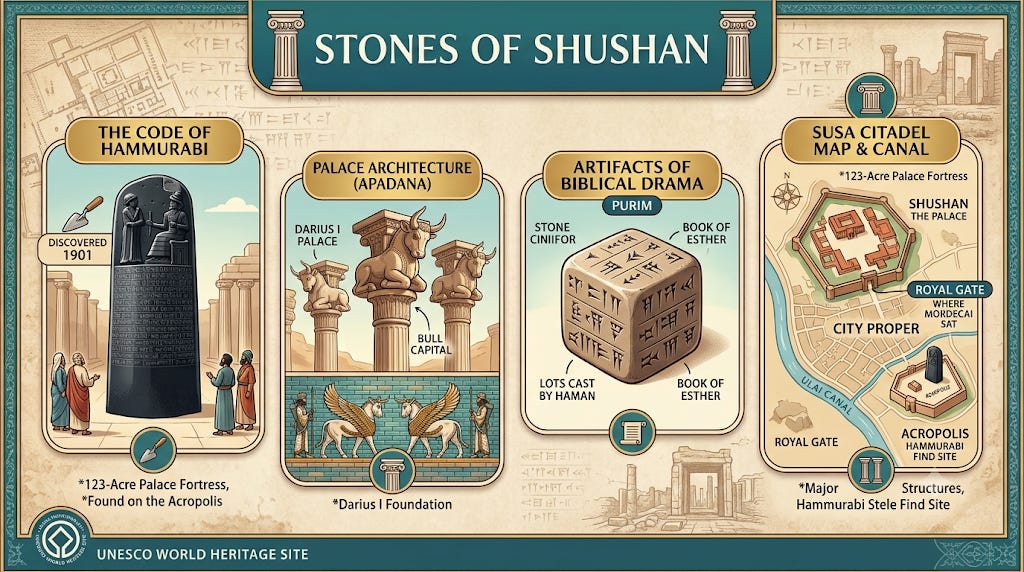
Situated in the fertile, sun-baked uplands of the Susiana Plain, roughly 150 miles north of the Persian Gulf, lies a staggering expanse of archaeological debris. Covering nearly 4,900 acres, the site appears to the modern eye as a vast sea of rolling earthen mounds. Yet buried within this dirt is Shushan (known in secular history as Susa). Once the ancient capital of Elam, it evolved into the primary winter residence of the Achaemenid Persian Kings. While Susa played a central role in Near Eastern politics for thousands of years, its legacy lives most vividly in the pages of biblical literature and the ground turned over by 19th-century excavators.
                  [ ARCHAEOLOGICAL LAYOUT OF SUSA ]
        +-------------------------------------------------+
        |                 THE APADANA                     |
        |     (1-Acre Throne Room with 36 Bull Capitals)  |
        +-------------------------------------------------+
        |    INNER COURTS   | HOUSE OF KING | WOMEN'S QUARTERS |
        +-------------------------------------------------+
        |                 PALACE GARDENS                  |
        +-------------------------------------------------+
        |                  THE ROYAL GATE                 |
        |         (Public Square Where Mordecai Sat)      |
        +-------------------------------------------------+
                          ||           ||
             [ Bridge Over Ulai / Eulaeus Canal ]
                          ||           ||
        +-------------------------------------------------+
        |                 SUSA CITY PROPER                |
        +-------------------------------------------------+
For readers of Hebrew scripture, Susa is not a mythic landscape; it is a physical location with precise administrative boundaries. The Bible explicitly distinguishes between the broader city (“Susa the city”) and the fortified royal quarter (“Susa the Citadel” or “Shushan the Palace”), a detail confirmed by modern spatial mapping.
Daniel’s Apocalyptic Visions: During the Babylonian captivity, the prophet Daniel recorded seeing a vision while standing in the citadel of Susa by the Ulai (Eulaeus) Canal (Daniel 8:2). It was along these waters that he saw the symbolic clash of the ram and the goat, predicting the fall of the Medo-Persian Empire to Alexander the Great.
Nehemiah’s Royal Audience: In the 5th century BCE, Nehemiah served as the royal cupbearer to King Artaxerxes I inside the palace walls. It was within these halls that he received news of Jerusalem’s broken walls, grieved, and successfully petitioned the king for a royal commission to rebuild the city (Nehemiah 1:1–2:8).
The High-Stakes Politics of Esther: The entire narrative of the Book of Esther—from King Ahasuerus’s (Xerxes I) 180-day royal feast to the geopolitical maneuvers of Mordecai and Queen Esther—unfolds entirely within the architectural confines of this compound.
For centuries, scholars debated the historical reliability of the Book of Esther, often dismissing its intricate descriptions of courtyards, marble pillars, and royal protocols as literary exaggeration. That view changed dramatically in the mid-19th century.
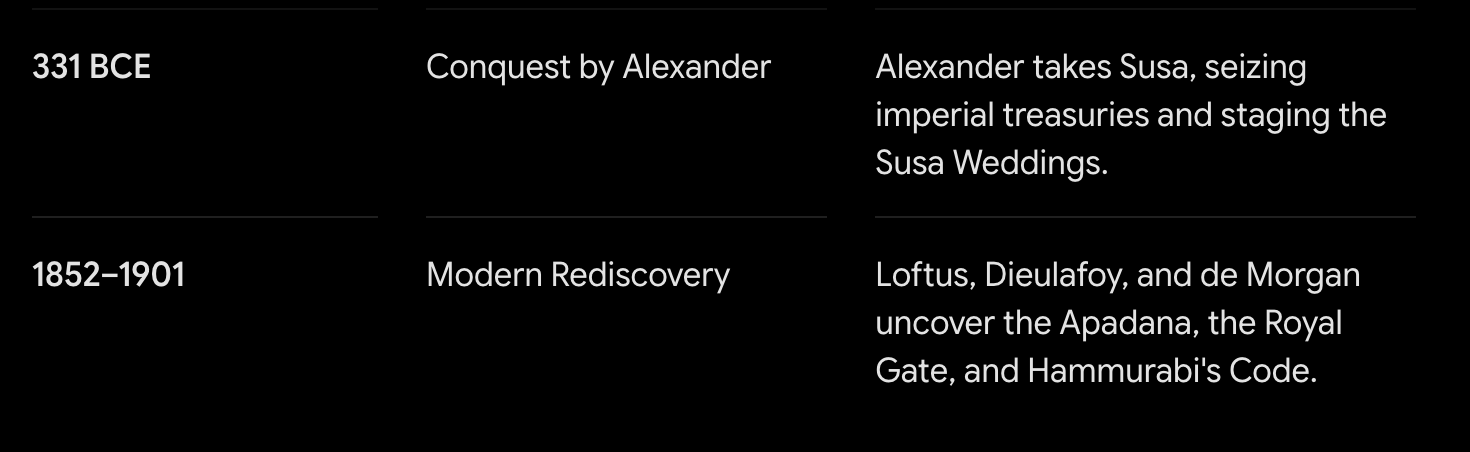
In 1852, British geologist W.K. Loftus opened the first systematic archaeological trenches at Susa, identifying the outline of a massive Achaemenid palace. Decades later, between 1884 and 1886, French civil engineer Marcel-Auguste Dieulafoy and his wife Jane conducted extensive excavations.
They uncovered a 123-acre palace-fortress constructed on a massive artificial platform elevated above the surrounding plain.
At the heart of the complex lay the Apadana, a monumental audience hall founded by Darius I and finished under Artaxerxes.
Scale: The hall itself covered roughly one full acre.
Columns: The roof was supported by 36 towering stone columns, each standing nearly 65 feet tall.
Architecture: The tops of these columns were crowned with massive double-bull capitals—sculpted stones depicting kneeling bulls—spanning heavy cedar timber imported directly from Mount Lebanon.
The layout revealed a direct line of sight from the inner courtyard into the central throne room, perfectly matching Esther 5:1, where Esther stands in the inner court “facing the king’s hall” while Xerxes sits upon his royal throne.
Archaeological digs across the palace precincts yielded specific artifacts that illustrate daily administrative and ritual life in Achaemenid Persia:
Excavators cleared the monumental King’s Gate, a massive freestanding entrance building connected to the palace complex. This public square served as an administrative tribunal where officials gathered—the precise location where Mordecai sat and overheard the treasonous conspiracy against King Xerxes (Esther 2:21).
Among the smaller objects recovered from Susa was a stone, four-sided die engraved with numbers. Known as a Pur (plural Purim), this artifact illustrated the ancient Near Eastern practice of casting lots to determine favorable dates for legal or royal decisions—the same mechanism employed by the vizier Haman (Esther 3:7, 9:24).
In late 1901, a French archaeological expedition led by Jacques de Morgan made an unexpected breakthrough on the acropolis mound of Susa.
Workers unearthed three large fragments of a polished, seven-foot-tall black basalt stele: The Code of Hammurabi.
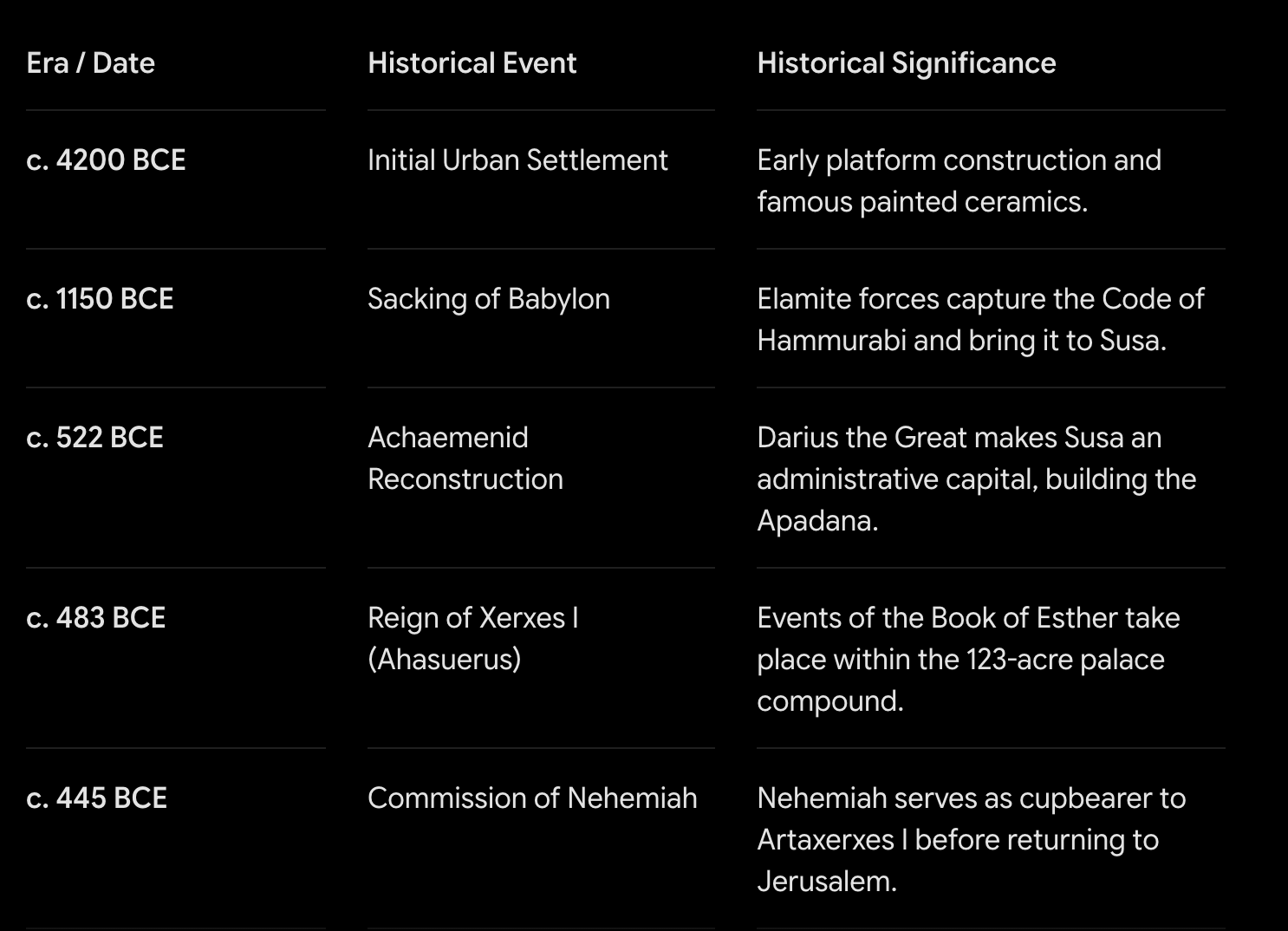
Though originally carved in Babylon around 1750 BCE, the stele was found buried in Susa. In the 12th century BCE, the Elamite King Shutruk-Nakhunte raided Mesopotamian cities, carried the legal monument back to Susa as a trophy of war, and placed it in the temple of the Elamite god Inshushinak.
Its recovery at Susa highlights how the city functioned for millennia as a central storehouse for the art, law, and wealth of ancient Near Eastern empires.
“Great is Inshushinak, Lord of Susa... who granted the city its foundations and held its borders against the nations.” — Elamite Royal Inscription
Susa’s ruins stand as a physical intersection of ancient law, imperial architecture, and historical narrative. From the courts of Darius to the shovels of 19th-century archaeology, Shushan remains one of the most thoroughly documented cities of the ancient world.
1. Which ancient civilization originally established Susa as its capital thousands of years before the Persian Empire?
A) Babylonia
B) Elam
C) Assyria
D) Sumer
2. Who was the Achaemenid Persian king who founded the famous palace complex at Susa?
A) Cyrus the Great
B) Darius I (Darius the Great)
C) Xerxes I
D) Artaxerxes II
3. Which prophet in the Hebrew Bible received visions of a ram and a goat while standing by the Ulai Canal in Susa?
A) Ezekiel
B) Isaiah
C) Daniel
D) Jeremiah
4. Which biblical figure began their career as royal cupbearer to King Artaxerxes I inside the palace at Susa?
A) Nehemiah
B) Ezra
C) Mordecai
D) Zerubbabel
5. The monumental Achaemenid palace complex uncovered at Susa covered approximately how many total acres?
A) 45 acres
B) 85 acres
C) 123 acres
D) 250 acres
6. The throne room of the palace (the Apadana) featured 36 massive stone columns topped with capitals sculpted into which shape?
A) Winged lions
B) Kneeling bulls
C) Eagles
D) Lotus flowers
7. Where in the palace complex did Mordecai routinely sit when serving the royal court, as mentioned in the Book of Esther?
A) The Inner Courtyard
B) The Palace Gate
C) The House of the Women
D) The Royal Treasury
8. What small archaeological artifact recovered at Susa illustrates the custom of casting “lots” (Purim) described in Esther 3:7?
A) A quadrangular die (Pur)
B) A clay cylinder
C) A set of bronze coins
D) A inscribed stone seal
9. Why was the famous Stele of Hammurabi’s Code discovered at Susa in 1901, even though Hammurabi was the King of Babylon?
A) Hammurabi ruled from Susa late in his life
B) It was seized by an Elamite king as a war trophy
C) Persian scholars brought it there to study ancient law
D) Babylon and Susa shared a single legal system
10. Which French archaeologist led the 1901 acropolis expedition that unearthed the Code of Hammurabi at Susa?
A) W.K. Loftus
B) Marcel-Auguste Dieulafoy
C) Jacques de Morgan
D) Austen Henry Layard
B) Elam — Susa was originally the legendary capital of the kingdom of Elam starting around 4200 BCE, long before being integrated into Persian rule.
B) Darius I (Darius the Great) — Inscriptions at Susa confirm Darius I founded the grand palace complex, which was later expanded and completed under Xerxes and Artaxerxes.
C) Daniel — In Daniel 8:2, the prophet records receiving apocalyptic visions while standing in the citadel of Susa by the Ulai (Eulaeus) Canal.
A) Nehemiah — Nehemiah 1:1–2:8 records Nehemiah serving as cupbearer to Artaxerxes I in Shushan before requesting permission to rebuild Jerusalem’s walls.
C) 123 acres — Excavations by French and British teams revealed that the sprawling royal palace fortress covered approximately 123 acres.
B) Kneeling bulls — The 65-foot columns of the Apadana were crowned with massive double-bull capitals that supported heavy timber roof beams imported from Lebanon.
B) The Palace Gate — Mordecai sat at the monumental King’s Gate, a major public entryway and administrative court in the palace complex.
A) A quadrangular die (Pur) — Archaeologists uncovered a four-sided numbered die (Pur), physical evidence of the lottery-casting custom referenced in the Book of Esther.
B) It was seized by an Elamite king as a war trophy — In the 12th century BCE, the Elamite King Shutruk-Nakhunte raided Babylon and brought Hammurabi’s black basalt stele back to Susa as spoils of war.
C) Jacques de Morgan — Jacques de Morgan led the French archaeological mission on the acropolis of Susa that recovered the three fragments of Hammurabi’s stele in late 1901.
Iran & the Bible
·
Jul 21
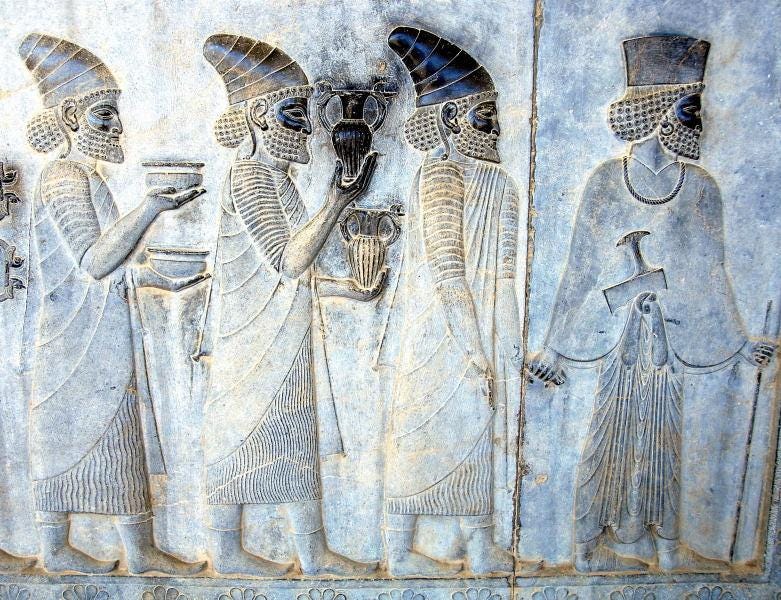
In May 2024, I had the opportunity to visit the Institute for the Study of Ancient Cultures (ISAC) Museum (formerly the Oriental Institute) at the University of Chicago with Ted Wright of EPIC Archaeology, an experience that brought the ancient Near East vividly to life. The museum houses one of the most significant collections of artifacts from Mesopot…
Thank you for reading Dr. Aaron Judkins Substack. As a token of our appreciation, we’re offering you a limited-time offer of 20% off a paid subscription for your first year. Thanks again for reading.
PS. If you loved this article, be sure to head over to our Ancient Pathways Patreon site and see my film “Qumran 2 Petra” where we take you onsite at the Pool of Siloam.
Comments
Nothing yet. Say the first thing.
Sign in to join the conversation.