
The centuries between the rise of the Neo-Assyrian Empire and the Persian invasions of Greece witnessed one of the most dramatic political transformations in ancient history.
Assyria established an empire through military organization, siege warfare, deportation, and intimidation. Its fall allowed Babylon, Media, Egypt, and Lydia to compete for control of the Near East. Out of this divided political landscape arose Cyrus the Great, who united the Persians and Medes and founded the Achaemenid Persian Empire.
Within a few generations, Persian authority extended from Central Asia and the Indus Valley to Egypt and the Aegean coast. This expansion eventually brought Persia into direct conflict with the independent Greek city-states, culminating in the famous battles of Marathon, Thermopylae, Salamis, and Plataea.
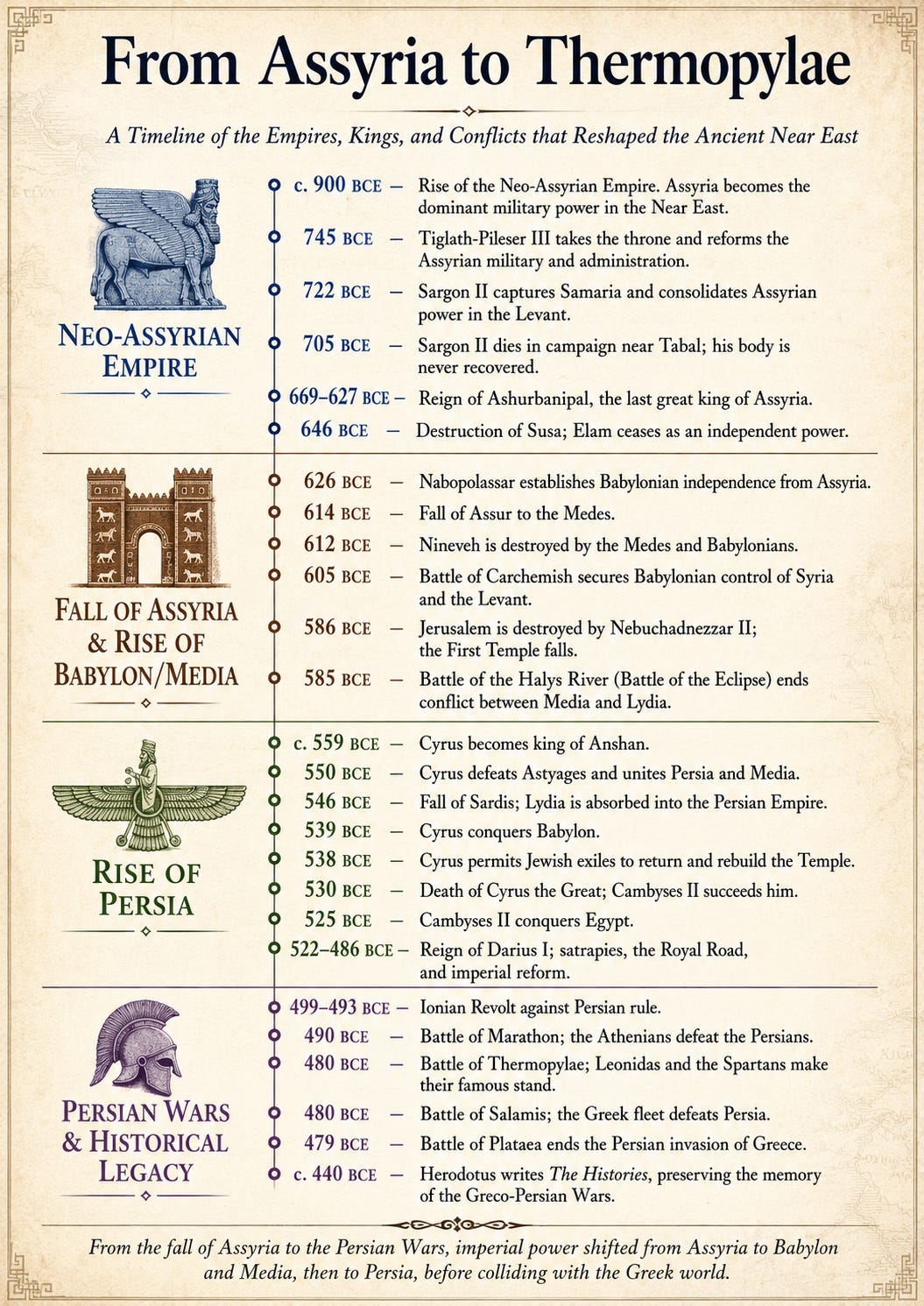
Circa 900 BCE — Assyria Emerges as a Regional Power
The Neo-Assyrian Empire became the dominant military force in the ancient Near East. Its armies made extensive use of iron weaponry, cavalry, siege towers, battering rams, and specialized military units.
Assyria’s rulers also developed a centralized administrative system capable of controlling territories across Mesopotamia, Anatolia, Syria, and the Levant.
883–859 BCE — Reign of Ashurnasirpal II
Ashurnasirpal II expanded Assyrian territory and constructed a new royal capital at Kalhu, known today as Nimrud.
His inscriptions emphasized the terror inflicted upon rebellious cities. Fear was not merely a consequence of Assyrian warfare; it was an intentional instrument of imperial policy.
859–824 BCE — Reign of Shalmaneser III
Shalmaneser III continued Assyria’s western expansion.
In 853 BCE, he fought a coalition of Syrian and Levantine rulers at the Battle of Qarqar. Although Assyria claimed victory, the coalition temporarily slowed its advance.
745 BCE — Tiglath-Pileser III Ascends the Throne
Tiglath-Pileser III transformed Assyria into an even more centralized military state.
He reduced the power of provincial governors, strengthened the standing army, expanded the use of cavalry, and imposed direct Assyrian administration over conquered territories.
His campaigns brought parts of Babylonia, Syria, Israel, and neighboring regions under Assyrian control.
727–722 BCE — Shalmaneser V and the Siege of Samaria
Shalmaneser V continued Assyrian campaigns in the Levant and began the siege of Samaria, the capital of the northern Kingdom of Israel.
The city fell around 722 BCE, during the transition between Shalmaneser V and his successor, Sargon II.
722 BCE — Sargon II Becomes King
Sargon II claimed responsibility for the capture of Samaria and the deportation of thousands of Israelites.
He suppressed rebellions in Babylon and Elam, defeated enemies in Anatolia and Urartu, and constructed a new capital at Dur-Sharrukin, near modern Khorsabad.
705 BCE — The Death of Sargon II
Sargon II died during a military campaign near Tabal in Anatolia, possibly while fighting Cimmerian forces.
His body was never recovered.
For the Assyrians, the loss of a king without a proper burial was a terrible omen. His death created a political and religious crisis for his successor.
705–681 BCE — Reign of Sennacherib
Sennacherib moved the Assyrian capital to Nineveh and transformed it into one of the greatest cities of the ancient world.
He built the enormous “Palace Without Rival,” expanded the city walls, and constructed an elaborate system of canals and aqueducts.
701 BCE — The Assyrian Invasion of Judah
Sennacherib invaded Judah during the reign of King Hezekiah.
The Assyrians captured numerous fortified cities and surrounded Jerusalem. The campaign is described in Assyrian inscriptions and in the biblical books of Kings, Chronicles, and Isaiah.
Although Jerusalem did not fall, Judah remained under intense Assyrian pressure.
681–669 BCE — Reign of Esarhaddon
Esarhaddon rebuilt Babylon after its destruction under Sennacherib.
He also extended Assyrian power into Egypt, capturing Memphis in 671 BCE. For a brief period, Assyria controlled territory stretching from Mesopotamia to the Nile Valley.
669–627 BCE — Reign of Ashurbanipal
Ashurbanipal was the last great king of Assyria.
He was both a military ruler and a patron of learning. His royal library at Nineveh preserved thousands of cuneiform tablets, including literary, religious, scientific, and administrative texts.
646 BCE — Destruction of Elam
Ashurbanipal’s forces devastated the Elamite capital of Susa.
Assyrian accounts describe the destruction of temples, royal monuments, and tombs. Elam ceased to exist as an independent regional power.
The victory demonstrated Assyria’s strength, but the constant warfare also contributed to the exhaustion of the empire.
The Seventh Century BCE — The Medes, Scythians, and Cimmerians
The Medes were an Iranian people who occupied territory east of Assyria.
Beyond them lived mobile steppe peoples, including the Scythians and Cimmerians. Assyrian texts sometimes applied the term Umman Manda to distant or poorly defined tribal groups beyond the empire’s borders.
The expression has been interpreted as something resembling “the horde from who knows where.”
Circa 653 BCE — Scythian and Cimmerian Invasions
Scythian and Cimmerian horsemen invaded Median territory.
According to later traditions, the Medes remained under Scythian domination for approximately twenty-eight years. During this period, distinctions among Medes, Scythians, Cimmerians, and other Iranian-speaking or steppe populations may have become blurred.
Circa 625 BCE — Military Reforms of Cyaxares
Cyaxares, king of the Medes, reorganized his forces into specialized units of archers, spearmen, and cavalry.
These reforms created a disciplined Median army capable of challenging Assyria.
Circa 630–620 BCE — Assyria Begins to Collapse
After the death of Ashurbanipal, Assyria was weakened by civil war, succession disputes, military overextension, and economic pressure.
Provincial territories began to rebel, while the Medes, Babylonians, Scythians, and other peoples attacked Assyria’s borders.
626 BCE — Nabopolassar Establishes Babylonian Independence
Nabopolassar seized control of Babylon and rejected Assyrian authority.
His rule marked the beginning of the Neo-Babylonian, or Chaldean, Empire.
616 BCE — Babylon Attacks Assyria
Babylonian forces began major attacks against Assyrian territory.
The conflict quickly developed into a coordinated campaign to dismantle the Assyrian state.
615 BCE — The Medes Join the War
Cyaxares and the Medes allied with Nabopolassar and the Babylonians.
The alliance combined Babylonian resources with the reorganized Median military.
614 BCE — The Fall of Assur
The Medes captured Assur, the ancient religious heart of Assyria.
The loss of the city was both a military defeat and a devastating symbolic blow.
612 BCE — The Destruction of Nineveh
The Medes and Babylonians, possibly assisted by Scythian forces, besieged and destroyed Nineveh.
The Assyrian capital was burned and its defenses overwhelmed. King Sinsharishkun was probably killed during the city’s destruction.
The fall of Nineveh was later celebrated in the biblical Book of Nahum, which presents Assyria’s destruction as divine judgment for its violence and oppression.
609 BCE — The End of Assyrian Independence
Remaining Assyrian forces attempted to continue resistance from Harran.
They were defeated, and Assyria ceased to exist as an independent imperial power.
The political landscape of the Near East was now divided among Babylon, Media, Egypt, and Lydia.
605 BCE — The Battle of Carchemish
Babylonian forces under Nebuchadnezzar defeated the Egyptians and the remaining Assyrian forces at Carchemish.
The victory gave Babylon control over Syria and much of the Levant.
605–562 BCE — Reign of Nebuchadnezzar II
Nebuchadnezzar expanded the Neo-Babylonian Empire to its greatest extent.
Babylon became a major center of architecture, mathematics, astronomy, religion, and administration. Monumental projects associated with his reign include the Ishtar Gate and the extensive rebuilding of the city.
597 BCE — First Babylonian Capture of Jerusalem
Nebuchadnezzar captured Jerusalem and deported members of Judah’s royal family, military leadership, craftsmen, and elite population to Babylon.
586 BCE — Destruction of Jerusalem
After another rebellion, Babylonian forces returned to Jerusalem.
The city was captured, the First Temple was destroyed, and additional Judeans were taken into exile. The Babylonian Captivity became one of the defining events of Jewish history.
Circa 585 BCE — War Between Media and Lydia
The Median Empire under Cyaxares expanded westward until it came into conflict with Lydia, ruled by King Alyattes.
According to tradition, tensions were intensified by a dispute involving Scythian refugees.
May 28, 585 BCE — The Battle of the Halys River
During a battle between the Medes and Lydians, a solar eclipse suddenly darkened the sky.
Both armies interpreted the event as an omen and stopped fighting.
The battle became known as the Battle of the Eclipse. A peace treaty established the Halys River, now called the Kızılırmak, as the boundary between Media and Lydia.
The agreement was strengthened through royal marriage and diplomatic mediation involving Babylon and Cilicia.
Circa 600 BCE — Birth of Cyrus II
Cyrus II, later called Cyrus the Great, was born into the royal family of Anshan in Persia.
His father was Cambyses I. Later traditions identified his mother as Mandane, the daughter of Astyages, king of Media, although the details of Cyrus’s ancestry remain partly legendary.
Circa 559 BCE — Cyrus Becomes King of Anshan
Cyrus inherited the throne of Anshan after the death of his father.
At this time, the Persians were still subordinate to the more powerful Median kingdom.
Circa 553–550 BCE — Cyrus Rebels Against Media
Cyrus revolted against Astyages.
The Median general Harpagus reportedly defected to Cyrus, bringing part of the Median army with him. Later Greek accounts describe Harpagus as seeking revenge against Astyages for a personal act of cruelty.
550 BCE — The Defeat of Astyages
Cyrus defeated Astyages and took control of the Median kingdom.
Rather than destroying the Median political and military system, Cyrus incorporated it into his emerging empire.
The union of Persians and Medes established the foundation of the Achaemenid Persian Empire.
547–546 BCE — Croesus Challenges Persia
Croesus, king of Lydia, became alarmed by Persian expansion.
He consulted the Oracle of Delphi and was reportedly told that if he attacked Persia, he would destroy a great empire.
Croesus assumed the prophecy referred to the Persian Empire. In reality, the empire destroyed would be his own.
547 BCE — The Battle of Pteria
Croesus crossed the Halys River and confronted Cyrus at Pteria.
The battle was indecisive. Croesus withdrew to Sardis, expecting to rebuild his forces and resume the campaign later.
546 BCE — The Fall of Sardis
Cyrus pursued Croesus before the Lydian king could gather his allies.
Persian forces defeated the Lydian cavalry and besieged Sardis. The city fell after approximately two weeks.
Lydia was absorbed into the Persian Empire.
Ancient accounts disagree about Croesus’s fate. Some traditions claim he was executed, while others say Cyrus spared him and retained him as an adviser.
546–540 BCE — Persian Conquest of Ionia
The Ionian Greek cities along the western coast of Anatolia had previously lived under Lydian authority.
After the fall of Croesus, they attempted to negotiate similar terms with Cyrus. Cyrus refused, remembering that many of the cities had rejected an earlier opportunity to support him.
The Persian general Harpagus was ordered to subdue them.
Cities including Miletus, Ephesus, and Phocaea came under Persian authority. Some communities resisted or abandoned their cities and established settlements elsewhere in the Mediterranean.
Circa 545 BCE — Sparta Warns Cyrus
Sparta sent an envoy warning Cyrus not to harm the Greek cities of Anatolia.
Cyrus reportedly dismissed the warning and mocked the Greek practice of gathering in public marketplaces to conduct business and debate political affairs.
The exchange foreshadowed the cultural and political hostility that would later develop between Persia and mainland Greece.
539 BCE — The Battle of Opis
Cyrus turned his attention toward the Neo-Babylonian Empire.
Babylon’s king, Nabonidus, had become unpopular with influential members of the Babylonian priesthood. His religious policies favored the moon god Sin and appeared to diminish the traditional position of Marduk.
Persian forces defeated the Babylonian army at Opis.
539 BCE — Cyrus Enters Babylon
Babylon was captured with relatively little resistance.
Cyrus presented himself not as a foreign destroyer, but as a legitimate ruler chosen by Marduk to restore order and proper worship.
Nabonidus was removed, while his son Belshazzar—who had acted as regent during his father’s long absence—is associated in the Book of Daniel with the final night of Babylonian rule.
The mysterious words written on the wall—“Mene, Mene, Tekel, Upharsin”—were interpreted as announcing that Babylon had been numbered, weighed, and divided.
The Cyrus Cylinder
The Cyrus Cylinder describes Cyrus restoring temples, returning divine images, and allowing displaced populations to return to their homelands.
It reflects the Persian policy of ruling diverse peoples through local traditions, established religious institutions, and regional elites.
Although it is sometimes described as an early declaration of human rights, it is more accurately understood within the tradition of ancient Mesopotamian royal proclamations.
538 BCE — The Jewish Exiles Return
Cyrus permitted Jewish exiles to return to Jerusalem and rebuild the Temple.
The biblical books of Ezra and Isaiah portray him as an instrument of God. Isaiah even refers to Cyrus as the Lord’s “anointed,” using language associated with a divinely appointed ruler.
Cyrus therefore appears in Greek, Persian, Babylonian, and biblical traditions—sometimes as conqueror, sometimes as liberator, and sometimes as the chosen agent of divine providence.
Circa 530 BCE — Campaign Against the Massagetae
Near the end of his reign, Cyrus campaigned against the Massagetae, a nomadic people living east of the Caspian Sea.
They were ruled by Queen Tomyris.
According to Herodotus, Cyrus used a feast and large quantities of wine to trap part of the Massagetae army. Tomyris’s son, Spargapises, was captured and later took his own life.
530 BCE — Cyrus Is Killed
Tomyris led her forces against Cyrus in a fierce battle.
Cyrus was killed, bringing his reign to an end.
Herodotus reports that Tomyris placed Cyrus’s severed head into a container filled with blood, declaring that she had finally satisfied his thirst for conquest. The account is dramatic and may preserve legend rather than verifiable history.
Cyrus was buried at Pasargadae.
His tomb remained standing when Alexander the Great entered Persia nearly two centuries later.
530–522 BCE — Reign of Cambyses II
Cyrus was succeeded by his son Cambyses II.
Cambyses continued the expansion of the Persian Empire.
525 BCE — The Battle of Pelusium
Cambyses invaded Egypt and defeated the forces of Pharaoh Psamtik III at Pelusium.
Memphis was captured, and Cambyses assumed the title and authority of an Egyptian pharaoh.
Later stories claimed that the Persians exploited Egyptian reverence for sacred animals during the battle, although these accounts may have been exaggerated by hostile Greek writers.
Cambyses attempted additional campaigns toward Nubia and Carthage, but they were unsuccessful.
522 BCE — Death of Cambyses
Cambyses died under uncertain circumstances while returning from Egypt.
His death produced a succession crisis and rebellions throughout the empire.
522–486 BCE — Reign of Darius I
Darius secured the throne after suppressing revolts across the Persian Empire.
He reorganized the empire into approximately twenty provinces, known as satrapies. Each was governed by a satrap who remained accountable to the king.
Darius standardized taxation, strengthened the imperial legal system, and improved communication between distant regions.
The Royal Road
One of Darius’s greatest achievements was the development of the Royal Road, extending from Susa in the east to Sardis in western Anatolia.
The road allowed royal messages, officials, soldiers, and merchants to travel across the empire with remarkable speed.
Persian Coinage
Darius introduced a widely recognized gold coin known as the daric.
Standardized currency encouraged trade and strengthened the economic unity of the empire.
Persepolis
Darius began major construction at Persepolis, which became a ceremonial center of Achaemenid kingship.
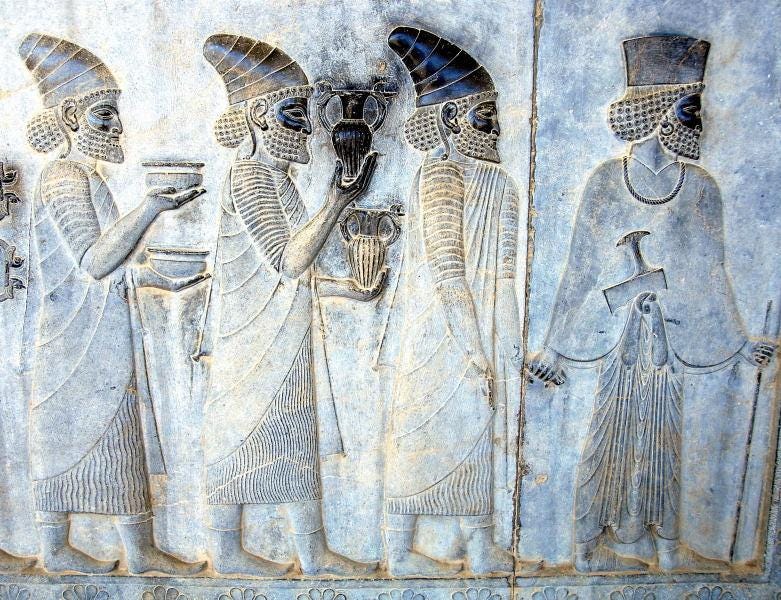
Reliefs at the site depict delegations from many nations bringing tribute to the Persian king, presenting the empire as an ordered union of diverse peoples.
499–493 BCE — Greek Cities Rebel
The Ionian Greek cities rebelled against Persian rule.
Athens and Eretria provided limited assistance, and rebel forces participated in the burning of Sardis.
Persia eventually suppressed the revolt, but Darius did not forget the involvement of the mainland Greeks.
The rebellion created the immediate context for the first Persian invasion of Greece.
490 BCE — Persia Invades Greece
Darius sent a Persian expedition across the Aegean.
The Persian commanders Datis and Artaphernes captured Eretria and then landed at Marathon, northeast of Athens.
The Athenian Victory
The Athenians, joined by soldiers from Plataea, confronted the Persian force.
Under the leadership of Miltiades, the Greeks charged across the plain and defeated the Persians.
Later accounts claimed that approximately 6,400 Persians were killed, compared with 192 Athenians.
The victory prevented the immediate Persian capture of Athens and gave the Greeks confidence that the Persian army could be defeated.
486 BCE — Xerxes Becomes King
Xerxes I succeeded his father Darius.
He inherited both the Persian Empire and the unresolved conflict with Greece.
Preparations for War
Xerxes assembled an enormous army and navy.
Persian engineers constructed bridges across the Hellespont and prepared supply routes through Thrace and Macedonia.
Ancient Greek writers described the Persian force as numbering in the millions. Modern estimates are much lower, although it was still one of the largest military expeditions of the ancient world.
480 BCE — The Persians Enter Greece
A coalition of Greek city-states attempted to block the Persian advance at the narrow pass of Thermopylae.
King Leonidas of Sparta commanded the defending force.
The Greek army initially numbered approximately 7,000 men, including the famous 300 Spartan soldiers.
Three Days at the Pass
The geography of Thermopylae prevented the Persians from using their numerical superiority effectively. For two days, the Greek defenders held the pass and inflicted heavy casualties on the Persian forces.
“Come and Take Them”
Later tradition records that Xerxes demanded that the Greeks surrender their weapons.
Leonidas responded:
“Molon labe.”
“Come and take them.”
The phrase reflects the laconic style associated with Sparta: brief, direct, and defiant.
A local man named Ephialtes revealed a mountain path that allowed Persian forces to move behind the Greek position.
When Leonidas learned that the army was about to be surrounded, he dismissed much of the Greek force.
The 300 Spartans remained, along with approximately 700 Thespians and other defenders.
Leonidas and his men fought to the death.
Their stand did not stop the Persian invasion, but it became one of history’s most enduring examples of military courage, discipline, and sacrifice.
480 BCE — The Greek Fleet Strikes Back
After Thermopylae, Persian forces advanced into central Greece and occupied Athens.
The Greek fleet, guided by the strategy of Themistocles, drew the Persian navy into the narrow waters near Salamis.
The confined space prevented the Persians from using their greater numbers effectively.
The Greek fleet won a decisive victory.
The destruction of much of the Persian navy threatened the army’s supply lines and forced Xerxes to withdraw a large portion of his forces.
479 BCE — The Persian Invasion Ends
The remaining Persian army in Greece was commanded by Mardonius.
A large alliance of Greek city-states confronted the Persians at Plataea.
The Greeks defeated the Persian army, and Mardonius was killed.
The victory at Plataea effectively ended Persia’s attempt to conquer mainland Greece.
Circa 484 BCE — Birth of Herodotus
Herodotus was born at Halicarnassus, a Greek city in Persian-controlled Anatolia.
His position between the Greek and Persian worlds shaped his understanding of both civilizations.
Circa 440 BCE — The Histories
Herodotus composed The Histories to preserve the memory of great events and investigate the causes of the conflict between Greeks and Persians.
His work contains historical inquiry, oral traditions, geography, ethnography, speeches, legends, and moral reflection.
Because of this achievement, Cicero later called him the “Father of History.”
Herodotus is one of the primary sources for Cyrus, Croesus, Tomyris, Darius, Xerxes, Thermopylae, and the Persian Wars. However, his accounts must be read critically, particularly when he reports speeches, enormous army sizes, supernatural omens, or stories obtained through oral tradition.
Greek writers frequently portrayed the Persian Wars as a struggle between freedom and tyranny.
In this interpretation, the independent Greek city-states defended themselves against an enormous eastern empire ruled by an absolute monarch.
Other ancient sources present a different image.
Babylonian inscriptions depict Cyrus as a restorer of temples. The Hebrew Bible presents him as a divinely appointed ruler who liberated exiles and permitted the rebuilding of Jerusalem.
The Persian Empire was capable of immense military violence, but it also governed through provincial administration, local law, religious accommodation, roads, taxation, and cooperation with regional elites.
The contrast reveals an important truth: ancient empires were remembered differently by the peoples who fought them, served them, resisted them, or benefited from their rule.
The fall of Assyria did not simply end one empire. It transformed the entire political order of the ancient Near East. Babylon rose from Assyria’s ruins. The Medes became a major Iranian power. Lydia controlled western Anatolia. Egypt attempted to reclaim influence in Syria and Palestine.
Then Cyrus altered the balance again. By defeating Media, Lydia, and Babylon, he created an empire larger and more diverse than any that had preceded it. Cambyses added Egypt, while Darius transformed the empire through roads, satrapies, standardized taxation, and monumental architecture.
Persian expansion eventually reached the Greek world. At Marathon, Thermopylae, Salamis, and Plataea, the political traditions of Greece collided with the imperial power of Persia. These conflicts shaped how both civilizations were remembered and established narratives—freedom against tyranny, East against West, conqueror against liberator—that continue to influence modern interpretations of the ancient world. Yet the historical reality was more complex.
The Assyrians were builders as well as destroyers. The Babylonians were conquerors as well as scholars. The Persians were imperial rulers as well as administrators and restorers. The Greeks were defenders of independence, but they were also divided by rivalry and war. Together, these peoples created the political and cultural world inherited by Alexander the Great and the civilizations that followed him.
Thank you for reading Dr. Aaron Judkins Substack. As a token of our appreciation, we’re offering you a limited-time offer of 20% off a paid subscription for your first year. Thanks again for reading.
PS. If you loved this article, be sure to head over to our Ancient Pathways Patreon site and see my film “Qumran 2 Petra” where we take you onsite at the Pool of Siloam.

Iran & the Bible
·
Jul 21
In May 2024, I had the opportunity to visit the Institute for the Study of Ancient Cultures (ISAC) Museum (formerly the Oriental Institute) at the University of Chicago with Ted Wright of EPIC Archaeology, an experience that brought the ancient Near East vividly to life. The museum houses one of the most significant collections of artifacts from Mesopot…
Comments
Nothing yet. Say the first thing.
Sign in to join the conversation.