
You are standing in a school parking lot at 2:45 PM. Your phone buzzes: a text from the teacher about a missing assignment. An email from the dentist confirming an appointment you forgot you made. A grocery delivery notification that the one brand of crackers your child will eat has been substituted. And you just... sit there. Not crying. Not angry. Just empty.
If you have experienced that moment — the one where you are not even upset anymore, just hollowed out — you have experienced the hidden cost of being the default parent. And there is research that explains exactly what is happening to your brain, your identity, and your wellbeing.
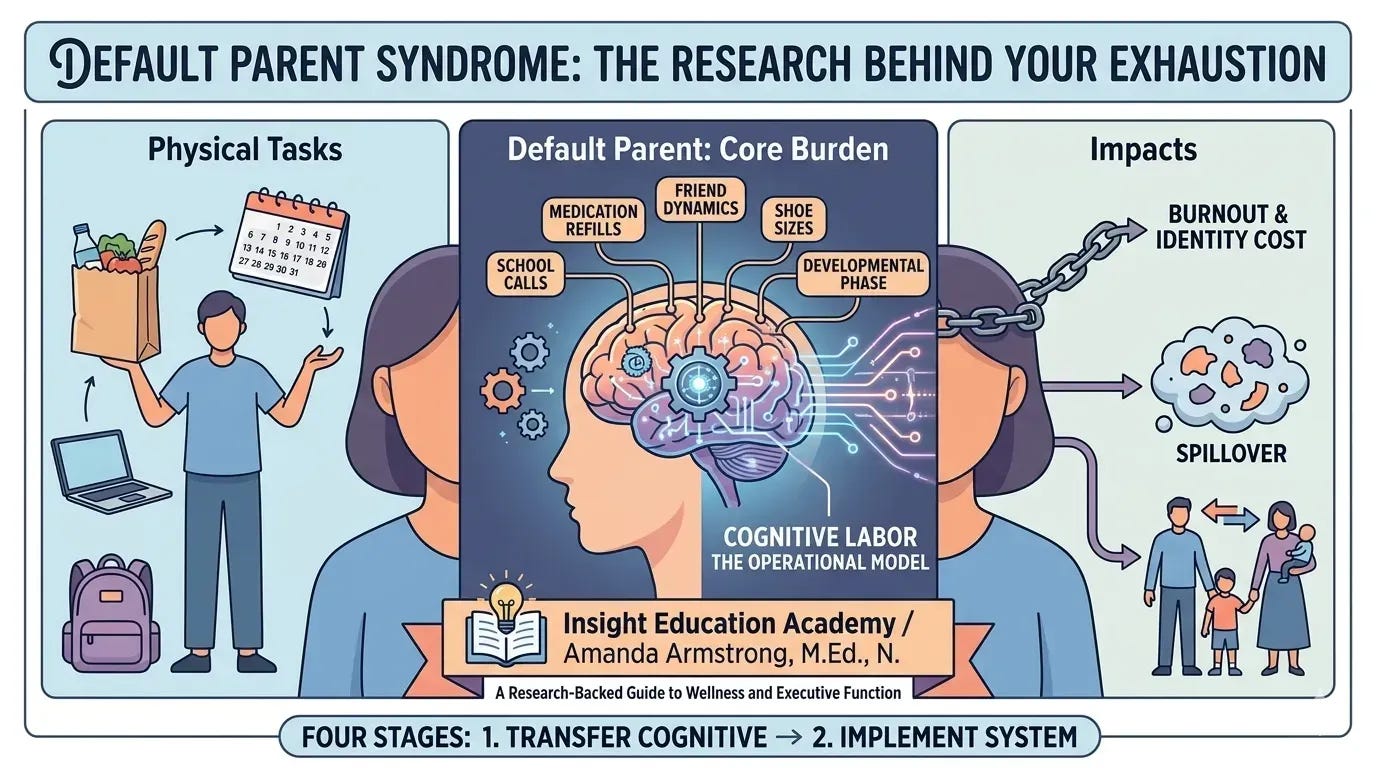
The default parent is the household member whose phone the school calls first. The one who tracks shoe sizes, medication refills, friend dynamics, and which child is going through a developmental phase. The one who holds the family’s entire operational model in their head — not as a choice, but as a default that was never explicitly negotiated.
Even in households where physical tasks are divided equitably, one parent typically carries the vast majority of the cognitive labor: the thinking, planning, anticipating, and monitoring that makes household function possible (Daminger, 2019).
This is not a lifestyle complaint. It is a documented psychological phenomenon with measurable consequences.
Ciciolla and Luthar (2019) conducted one of the most significant studies on this topic, examining the psychological ramifications of being the “captain” of the household. Their findings were unambiguous: women who identified as the household manager — the person responsible for coordinating and overseeing family logistics — reported significantly higher levels of stress, more feelings of emptiness, lower satisfaction in their relationships, and diminished overall wellbeing.
The critical finding was that these outcomes were not primarily driven by the volume of physical tasks. They were driven by the cognitive and emotional labor of management — the constant awareness, planning, and responsibility for ensuring that everything functions.
Daminger (2019) provided the theoretical framework for understanding exactly what cognitive labor entails. She identified four distinct stages:
Anticipating: Identifying that a need exists before anyone else notices. (”The kids will need camp registration by March.”)
Identifying: Researching options and gathering information. (”What camps are available? What are the dates and costs?”)
Deciding: Making the choice. (”We’ll do Camp X for weeks 3 and 5.”)
Monitoring: Ensuring the decision is executed. (”Did I submit the registration? Did the payment go through? Is the packing list ready?”)
Daminger’s research found that women disproportionately carried the first stage — anticipating — which is the most mentally taxing because it requires constant background vigilance with no clear boundaries. You cannot schedule “anticipating.” It runs continuously.
When a partner says “just tell me what to do,” they are offering to help with stages 2 through 4 while leaving the most exhausting stage — the stage that requires holding the entire family operation in working memory — firmly on one person’s shoulders.
Offer (2014) documented what many default parents intuitively know: the cognitive load does not turn off. Her research on “mental labor” and work-family spillover found that parents carrying the cognitive household burden experienced constant intrusion of family-related thoughts during personal, leisure, and professional time.
You are at the gym, thinking about school lunches. You are at dinner with friends, calculating the babysitter timeline. You are lying in bed, mentally reviewing tomorrow’s schedule. The background process is always running, consuming cognitive resources that are never fully available for rest, creativity, or personal fulfillment.
The cognitive labor documented by these researchers operates through the brain’s executive function system — the suite of skills housed primarily in the prefrontal cortex that manages planning, organization, working memory, decision-making, and emotional regulation (Diamond, 2013).
Executive function has finite capacity. Research on ego depletion and decision fatigue demonstrates that the more cognitive demands a person faces in a given period, the less effective their subsequent cognitive performance becomes (Baumeister & Vohs, 2007). Each micro-decision — what to pack in lunches, how to handle a child’s morning emotion, which work email to prioritize, whether to reschedule the dentist — draws from the same neural resource pool.
By mid-afternoon, many default parents are operating with significantly diminished executive function capacity. This explains common late-day experiences: snapping at children over minor provocations, inability to make simple decisions (the “what’s for dinner” paralysis), difficulty engaging in complex thought, emotional flatness or sudden emotional reactivity.
These are not character deficits. They are predictable consequences of chronic prefrontal cortex overload.
Perhaps the most insidious cost of the default parent role is the gradual erosion of identity.
When the majority of your cognitive resources are allocated to anticipating, planning, and managing your family’s needs, there is diminishing capacity for the cognitive work of selfhood: identifying your own wants, pursuing your own interests, maintaining your own social connections, and developing your own goals.
Over time, many default parents find they cannot answer basic identity questions without referencing their role. “What do you want for dinner?” elicits thoughts about family preferences, not personal ones. “What do you enjoy?” produces a blank — not because preferences do not exist, but because the neural pathways for personal-preference processing have been consistently de-prioritized in favor of family-management processing.
This is not a metaphor. This is a description of how neural resource allocation works. The brain strengthens pathways that are used frequently and weakens pathways that are not (Hebb, 1949). If you spend five years primarily using your prefrontal cortex for family management, the neural networks for self-directed thought genuinely atrophy.
Organizational psychologist Christina Maslach identified three dimensions of burnout: emotional exhaustion, depersonalization (emotional detachment from the people you serve), and reduced personal accomplishment (a persistent feeling that nothing you do is enough). While developed for workplace settings, these dimensions map precisely onto the default parent experience (Maslach & Leiter, 2016).
Emotional exhaustion: The “I have nothing left to give” feeling at 8 PM.
Depersonalization: The emotional numbness — going through parenting motions without genuine engagement.
Reduced personal accomplishment: The persistent sense that despite doing everything, you are failing at everything.
Default parent burnout is real, it is measurable, and it is not solved by a weekend away. It requires systemic change.
Delegating tasks (”can you call the dentist?”) does not reduce cognitive labor — it often increases it, because you must now also monitor whether the delegated task was completed. Transferring ownership means giving another person full responsibility for an entire domain: anticipating, identifying, deciding, and monitoring. “You now own all things related to medical care” is fundamentally different from “can you schedule the checkup.”
Each standard you maintain — the quality of packed lunches, the organization of the playroom, the thoughtfulness of birthday parties — costs executive function resources. Many of these standards were absorbed from cultural expectations, social media comparison, or intergenerational patterns rather than deliberately chosen.
Conduct a deliberate audit: which standards serve your family’s actual wellbeing, and which serve appearances or unexamined expectations? Lower or eliminate the latter. The cognitive savings compound daily.
Finish this sentence without mentioning your children, your partner, or your responsibilities: “I am a person who ___.”
If that is difficult, it is data — not failure. It reflects a neural resource allocation pattern that can be deliberately reversed. Begin with one small, regular identity-investment: a weekly activity that is exclusively yours, a creative project, a friendship you maintain for your own enjoyment. The goal is to rebuild the neural pathways for self-directed thought.
Thanks for reading Insights From Insight! This post is public so feel free to share it.
References
Baumeister, R. F., & Vohs, K. D. (2007). Self-regulation, ego depletion, and motivation. Social and Personality Psychology Compass, 1(1), 115–128. https://doi.org/10.1111/j.1751-9004.2007.00001.x
Ciciolla, L., & Luthar, S. S. (2019). Invisible household labor and ramifications for adjustment: Mothers as captains of households. Sex Roles, 81(7-8), 467–486. https://doi.org/10.1007/s11199-018-0998-z
Daminger, A. (2019). The cognitive dimension of household labor. American Sociological Review, 84(4), 609–633. https://doi.org/10.1177/0003122419859007
Diamond, A. (2013). Executive functions. Annual Review of Psychology, 64, 135–168. https://doi.org/10.1146/annurev-psych-113011-143750
Hebb, D. O. (1949). The organization of behavior: A neuropsychological theory. Wiley.
Maslach, C., & Leiter, M. P. (2016). Understanding the burnout experience: Recent research and its implications for psychiatry. World Psychiatry, 15(2), 103–111. https://doi.org/10.1002/wps.20311
Offer, S. (2014). The costs of thinking about work and family: Mental labor, work–family spillover, and gender inequality among couples with children. Sociological Forum, 29(4), 916–936. https://doi.org/10.1111/socf.12126
Upgrade to a paid subscription for just $8 to download my printable cheat sheet of 10 essential boundary-setting scripts.

No posts
Comments
Nothing yet. Say the first thing.
Sign in to join the conversation.