
This post originally appeared on my blog in December 2025. I'm resurfacing it here because it's one of the most-responded-to things I've ever written — and because this week's video, "The Default Parent Trap," picks up right where it left off. If this is your first time reading it, welcome. If you've read it before, read it again. It hits different the second time.

And the first step towards a different life isn’t trying harder—it’s naming what’s happening. Without guilt, without shame, and without judgement.
A lot of moms are doing two jobs at once:
The tasks you can see (meals, laundry, driving, homework help)
The thinking you can’t see (tracking, planning, remembering, anticipating, monitoring)
This work you can’t see is called the mental load—and it’s not “just thinking.” Dean, Churchill, and Ruppanner describe it as two different forms of labor: cognitive labor + emotional labor. Their research highlights why this labor makes us feel so exhausted all the time: it’s often invisible, boundaryless, and enduring (Dean, Churchill, & Ruppanner, 2022).
The. labor is like an attached toddler…it follows you EVERYWHERE you go. When you go to work you are thinking about the soccer game on Saturday and you need to wash the away jersey. It follows you to your dinner with the girls because you had to set up the meal for the family before you left and you are hoping your husband hears the timer on the oven you set. It follows you on vacation as you think about what time you need to pick up the dog from boarding.
This labor is everywhere, all the time.
When you’re the default parent, you’re not just completing task after task.
You’re also
Noticing what needs to happen
Deciding when it should happen
Remembering that it’s happening
Making sure it actually happened
That’s why “help” isn’t worth it. You don’t need “help” with the task. You need to not have to think about it.
Allison Daminger breaks cognitive household labor into four distinct labor:
anticipation
identification
decision-making
monitoring
(Daminger, 2019)
And here’s the part so many default parents see instantly: even if someone else does the task-the actual cooking of the meal or the actual laundry- they (the default parent) often still ends up monitoring it. We have to follow up, check the details, and make sure the wheels don’t come off mid-project.
We have the washer and dryer that was apparently scored by John Williams so the song plays for what feels like 2 full minutes, but for some reason, I am the only one who can hear it. Even though my children now do their own laundry, I am constantly saying “You need to move your clothes to the dryer.”
Maybe it would work better if the washing machine played The Imperial March (Williams). Disney should call Samsung immediately.
So yes, you may have removed certain tasks from your to-do list. But you may still be the one running the operating system.
Sound familiar? Share this with another default parent you know.
Prospective memory demands—the everyday “remembering to remember” - is what researchers are labeling this cognitive and emotional labor that goes into home task completion.
Examples of prospective memory demands are things like:
Remembering picture day
Remembering to sign the permission slip
Remembering the snack schedule
Remembering the dentist follow-up
Remembering the birthday gift
Remembering the meds refill
In research on parents’ prospective memory demands, mothers report greater demands than fathers, especially tasks that are related to taking care of their child (Harrington & Reese-Melancon, 2021). The important part of this research is that the gap isn’t just about doing—it’s about the stages of the task: planning, reminding, executing, and monitoring.
This is why you can feel “on” all the time- even when you are supposed to be sleeping.
Ciciolla and Luthar describe many mothers as the “captains of households”—the person who is keeping routines running and staying on top of things about the kids’ well-being (Ciciolla & Luthar, 2019).
And while that role can look like competence from the outside, their research shows that the captain of the ship has lower life satisfaction. They are literally unhappy on a daily basis.
Translation: being the one who “always knows” can quietly drain you.
This is where the default parent stops being a “mom issue” and starts being a massive systems problem.
Research in Women in the Workplace shows that women are 6% less likely than men to WANT a promotion (80% vs. 86%). Read that again- women don’t even want to be recognized at work. And the report says that the reason why is because of a lack of balance between career support and personal obligations (McKinsey & Company, Women in the Workplace).
This same study also showed that almost 25% of entry- and senior-level women who don’t want a promotion cite personal obligations, compared with 15% of men (McKinsey & Company, Women in the Workplace).
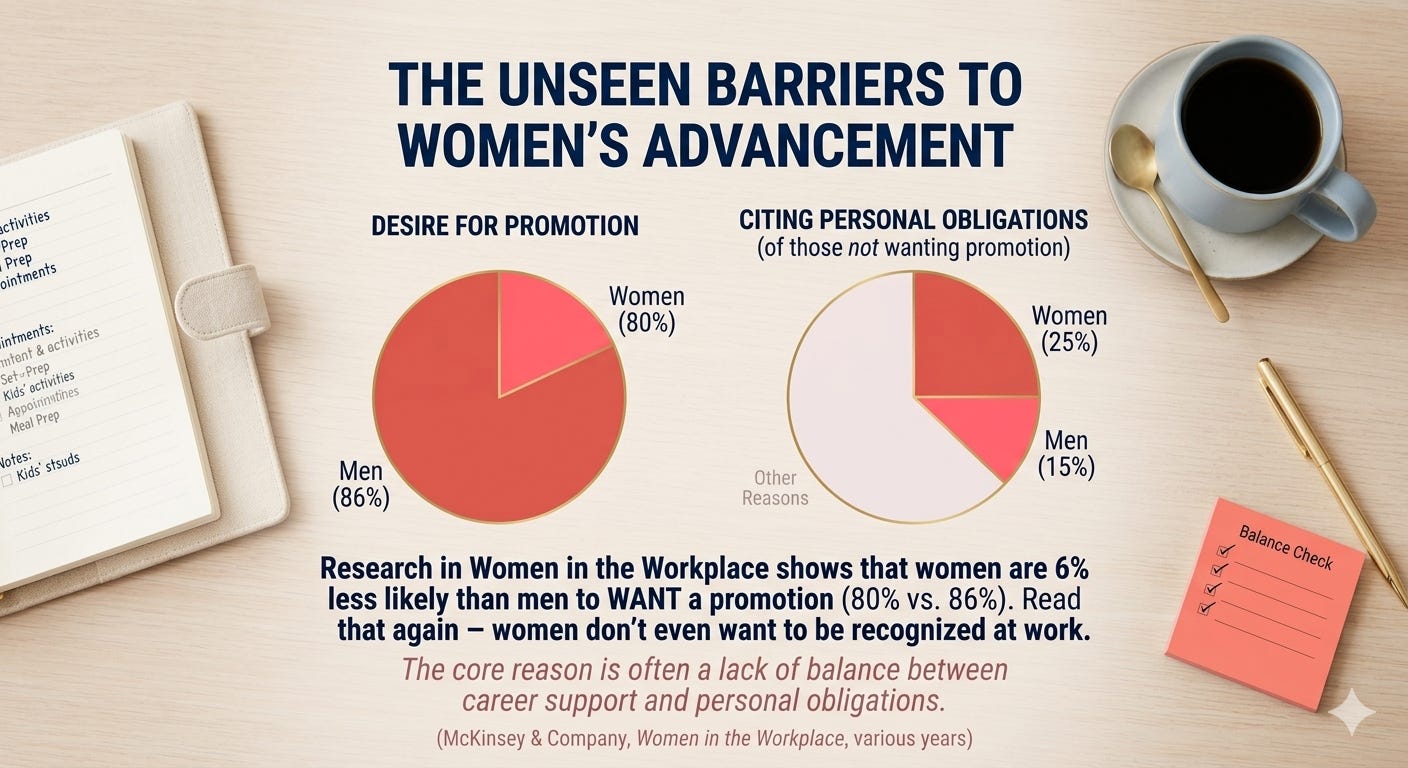
When you’re already carrying the massive cognitive and emotional load at home, “more ” at work doesn’t feel like an advancement or opportunity. It feels like one more thing you are going to have to balance so why would you want that?
So if you’ve ever wondered why you can’t “push” the way you used to—this is a big part of the answer.
This is not entirely the fault of men. Even when families want to share the load, the broader support system is thin.
The U.S. Department of Labor’s overview of the Family and Medical Leave Act (FMLA) is clear: eligible workers can take up to 12 workweeks of unpaid, job-protected leave for certain family and medical reasons—but eligibility depends on factors like time with the employer, hours worked, and employer size (U.S. Department of Labor, FMLA).
That means many families are trying to deal with care needs with limited structural support. Think about who takes off when the kids are sick? Who uses their lunch break to take kids to orientation or dentist appointments?
Let’s keep this actually doable:
Try:
“It isn’t about the task itself—I’m managing the entire system.”
“I need shared ownership and thinking, not help with the doing.”
Naming it reduces shame and creates a vocabulary that names the foundation of the issue.
If cognitive labor includes anticipation and monitoring (Daminger, 2019), then sharing the load requires making those parts super clear for everyone to see.
A simple weekly reset can be enough:
What’s coming up for the kids?
What’s coming up for the house?
What decisions are pending?
Who owns what—start to finish?
A great example of this is dinner. My husband will often make dinner, but deciding what we will have, what items are needed from the store, and taking anything out of the freezer in time for it to be thawed is ALWAYS on my plate. At that point, I might as well just make the meal. What I am asking is for him to be in charge of dinner on Tuesdays, Thursdays, and Fridays. Period. I don’t even need to know what it is.
Prospective memory research points to the importance of external cues and shared tools—because relying on your brain alone keeps you in constant monitoring mode (Harrington & Reese-Melancon, 2021).
Think:
One shared calendar
One shared running list
One place for school info
Not more apps. Just fewer open loops. Our shared calendar has the dinner plan on it now. If I really want to know or if a kid wants to know, we can go look at Thursday’s dinner plan on the calendar.
Calarco and colleagues show how this inequality can just kinda happen even in dual-earner couples—often through patterns that feel “practical” in the moment but become standard practice over time (Calarco et al., 2021).
So if you’re stuck in default-parent mode, it doesn’t mean you chose it.
It often means your family system drifted there. It snuck up on you.
BUT systems can be redesigned.
If you want help getting the mental load out of your head and into something you can actually work with, start with my Executive Function Checklist. It’s designed to help you spot the “open loops” you’re carrying and create a simpler plan—without the shame spiral.
Become a premium subscriber for just $8 a month or you can grab the checklist for free in our private community!
Join a community built for parents, not algorithms.
No Meta. No social media noise. Just a small, mighty network of real parents sharing honest advice, local support, and genuine connections.
Calarco, J. M., Meanwell, E., Anderson, E. M., & Knopf, A. S. (2021). By Default: How Mothers in Different-Sex Dual-Earner Couples Account for Inequalities in Pandemic Parenting. Socius. https://doi.org/10.1177/23780231211038783
Ciciolla, L., & Luthar, S. S. (2019). Invisible household labor and ramifications for adjustment: Mothers as captains of households. Sex Roles.
Daminger, A. (2019). The cognitive dimension of household labor. American Sociological Review, 84(4).
Dean, D., Churchill, B., & Ruppanner, L. (2022). The mental load: building a deeper theoretical understanding… https://doi.org/10.1080/13668803.2021.2002813
Harrington, C., & Reese-Melancon, C. (2021). Who is responsible for remembering? Everyday prospective memory demands in parenthood. Sex Roles.
McKinsey & Company. Women in the Workplace. https://www.mckinsey.com/capabilities/people-and-organizational-performance/our-insights/women-in-the-workplace#/
U.S. Department of Labor. Family and Medical Leave Act (FMLA). https://www.dol.gov/general/topic/benefits-leave/fmla
Williams, John, composer. "The Imperial March (Darth Vader's Theme)." Star Wars: Episode V - The Empire Strikes Back (Original Motion Picture Soundtrack). Performed by the London Symphony Orchestra, Walt Disney Records, 1980. [1, 2, 3, 4, 5]
MIT Direct (backup). The gendered division of cognitive household labor. https://direct.mit.edu/euso/article/26/3/828/127348/The-gendered-division-of-cognitive-household-labor
No posts
Comments
Nothing yet. Say the first thing.
Sign in to join the conversation.