
It took me quite some time to determine how to structure this week’s piece.
And to consider how many layers there are when it comes to focus or being focused…
I even asked ChatGPT and it gave me such heterogeneity and much perplexity!
Think about it…what is the average attention span these days? And how do people in 2026 block out the noise and prioritise the signal?
After you immediately chat, interact or work with someone, where do their attentions (most of the time) immediately go to…? Their phones :(
As a result, what I’ve found (and learned), is that focus is not a personality trait…
It’s not “discipline,” or “motivation,” or something you’re magically born with.
Focus is a biological state, a trainable skill and a performance multiplier.
Whether you’re a researcher in a lab, an athlete on the field or a leader in the arena of decision-making - focus is the force that decides whether your talent becomes output… or disappears into distraction.
Today, I want to unpack focus from three worlds I know well:
science, scholarship and sport
Because the science of focus in the lab…is the same science that wins games in the locker room…and the same science that produces breakthroughs in academia.
Your ability to focus is governed by two brain systems:
The Attentional Network - what you choose to notice.
The Executive Network - how well you regulate impulses.
Both are shaped by three neurochemicals: Dopamine (for motivation); Norepinephrine (for alertness); Acetylcholine (for precision).
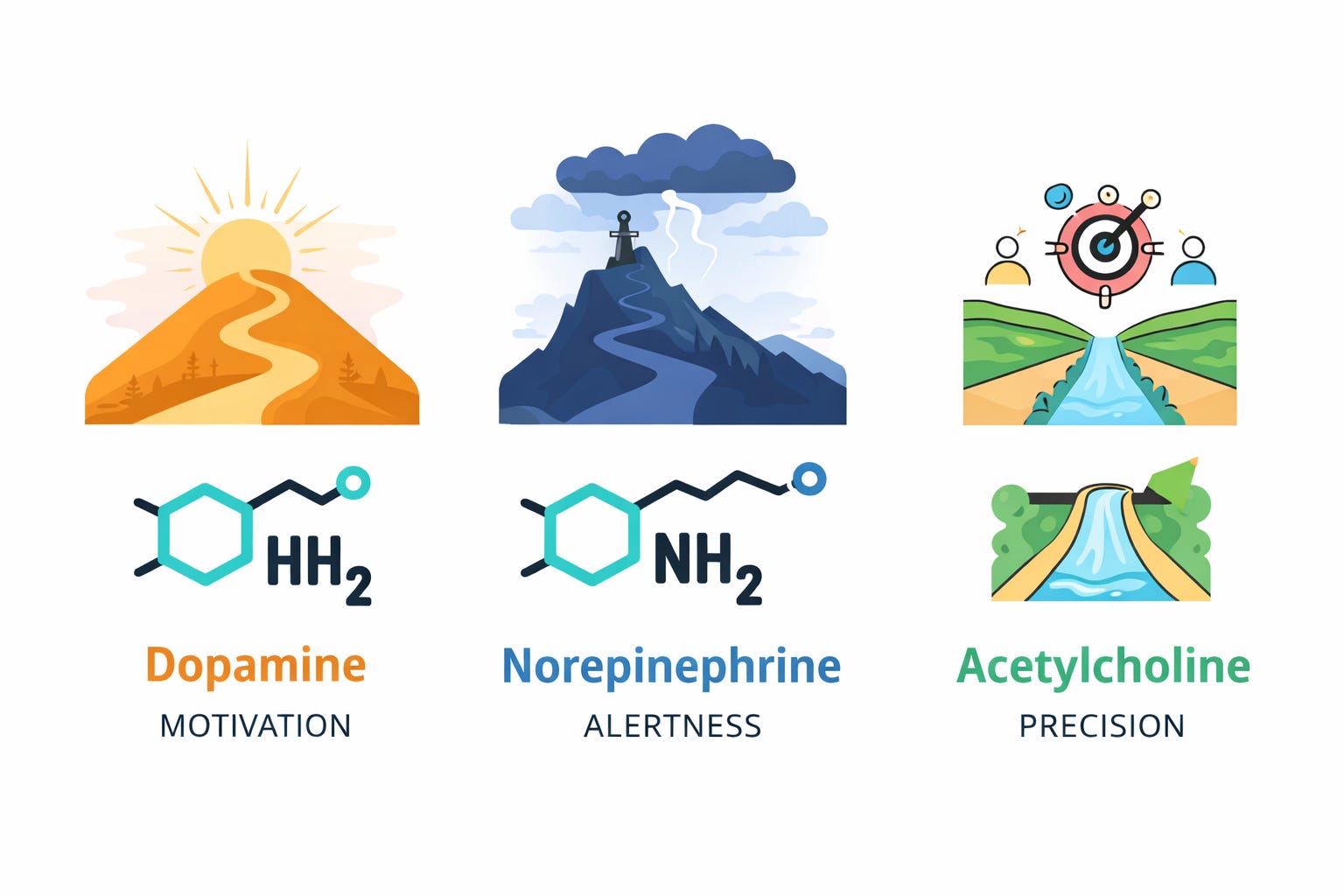
When these three align, you enter the state what athletes call “the zone” or what academics call “deep work” or what neuroscientists call task-specific activation.
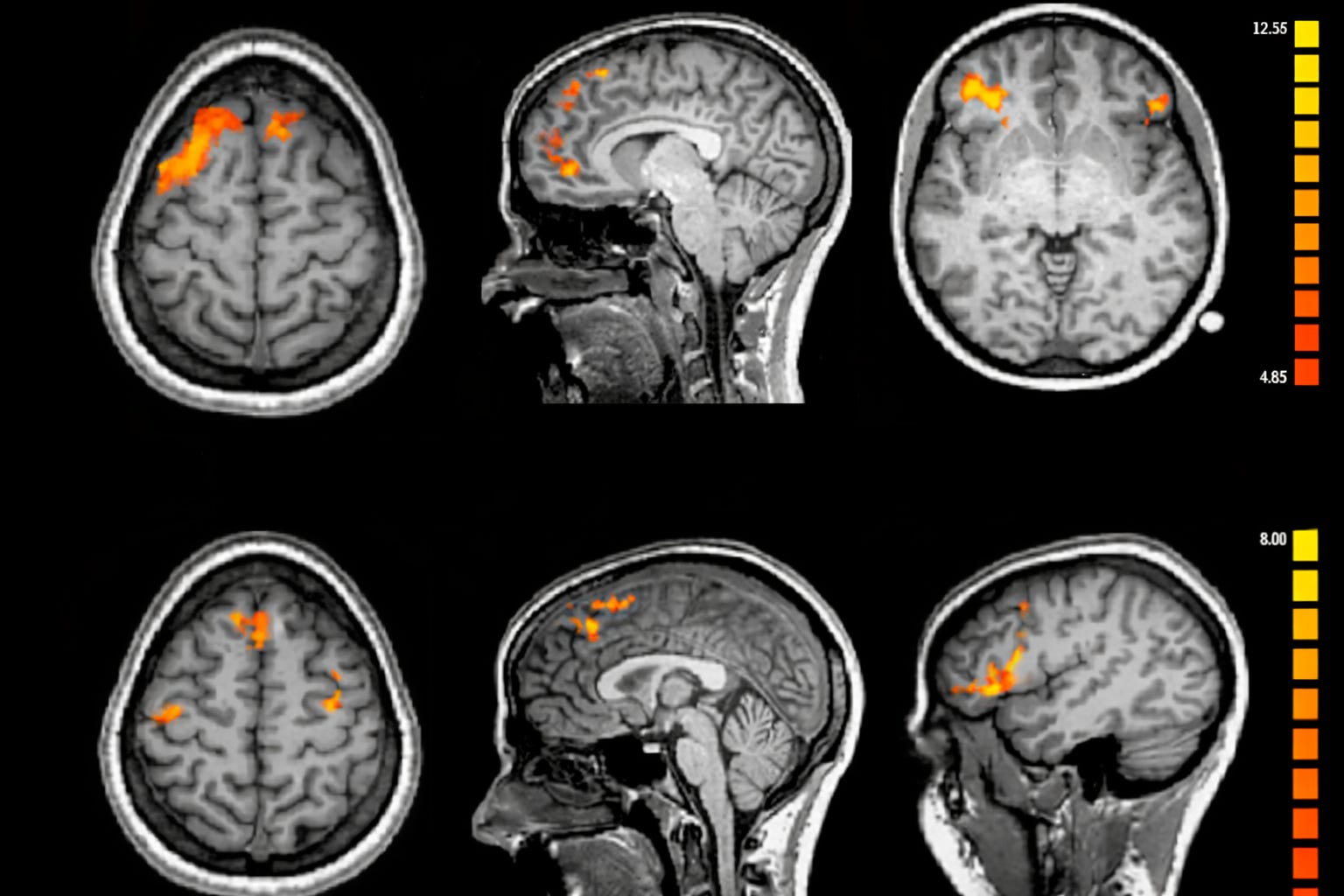
This isn’t necessary willpower. It’s biology!
Unlike effort, you control focus by managing the conditions that create those chemicals.
Focus and neurodivergence are closely linked because differences in brain wiring influence how attention is regulated, sustained and shifted. Conditions such as ADHD, autism or dyslexia do not imply an absence of focus, but rather a different attentional profile, often characterised by fluctuating concentration, heightened sensitivity to stimuli or periods of intense hyperfocus. Neurodivergent individuals may struggle in environments designed for uniform attention patterns, yet thrive when tasks align with their interests and cognitive style. Structured routines, sensory-aware spaces, clear goals and flexible working methods can significantly enhance focus. Understanding neurodivergence reframes attention not as a deficit, but as a variation requiring intentional design and supportive performance strategies.
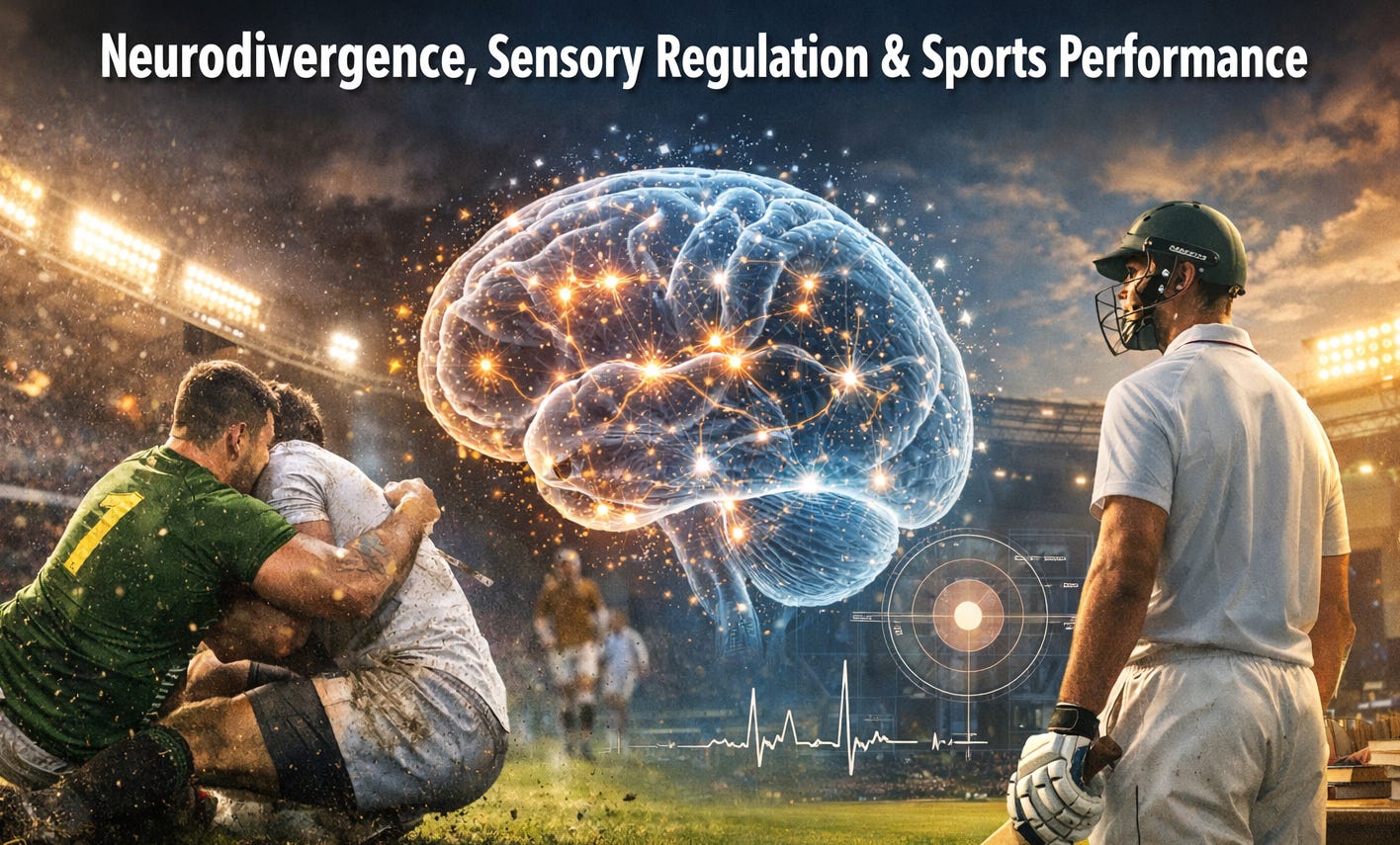
An emerging hypothesis I’ve been working on is that some athletes with neurodivergent attentional or sensory profiles may regulate arousal differently across sporting contexts. Contact sports can provide strong proprioceptive and tactile feedback, which among some individuals may support emotional regulation and focus. Non-contact sports rely more on internal regulation, routine and cognitive control, potentially creating different pressure dynamics. However, there is currently no robust evidence linking national success in specific sports (eg. such as rugby versus cricket in South Africa - think about it!), to population neurodivergence patterns. Performance outcomes are shaped by many factors, including culture, development systems, coaching, resources, etc. This idea remains speculative and would require careful interdisciplinary research to test rigorously.
Elite athletes train focus as deliberately as they train strength.
They use routines, such as: breath sequencing, attentional cues, pre-performance rituals, visualisation and controlled arousal
So, focus is fragile. It breaks under emotion, noise, pressure or negative self-talk.
Athletes know that the brain under pressure wants to widen attention - but performance requires narrowing it.
That “narrowing” is trainable.
In basketball, players practice free throws under crowd noise.
In cricket, batters rehearse anticipation patterns.
In football, players simulate pressure drills.
These aren’t just physical practices - they are neural sculpting.
They teach the brain what to ignore.
And when society is filled with constant distraction, that is a SUPERPOWER!
Academia is also kind of a high-performance sport.
But instead of designing focus protocols, universities often destroy them with either: endless emails, meetings every hour, administrative overload, open-plan offices, constant interruptions and multi-task culture.
What is the likely result?
A system that rewards output but destroys the state required to PRODUCE output
Deep work in academia is not a luxury - it is the foundation of original thought.
If athletes need uninterrupted training blocks, scholars need uninterrupted cognitive blocks…
Without them: papers become summaries, research can become reactive, thinking becomes fragmented and curiosity becomes exhaustion.
Academia speaks of excellence, but excellence requires focus. And focus requires design!
So… what does the Lab teach us about Focus?
Neuroscience gives us four powerful truths about attention:
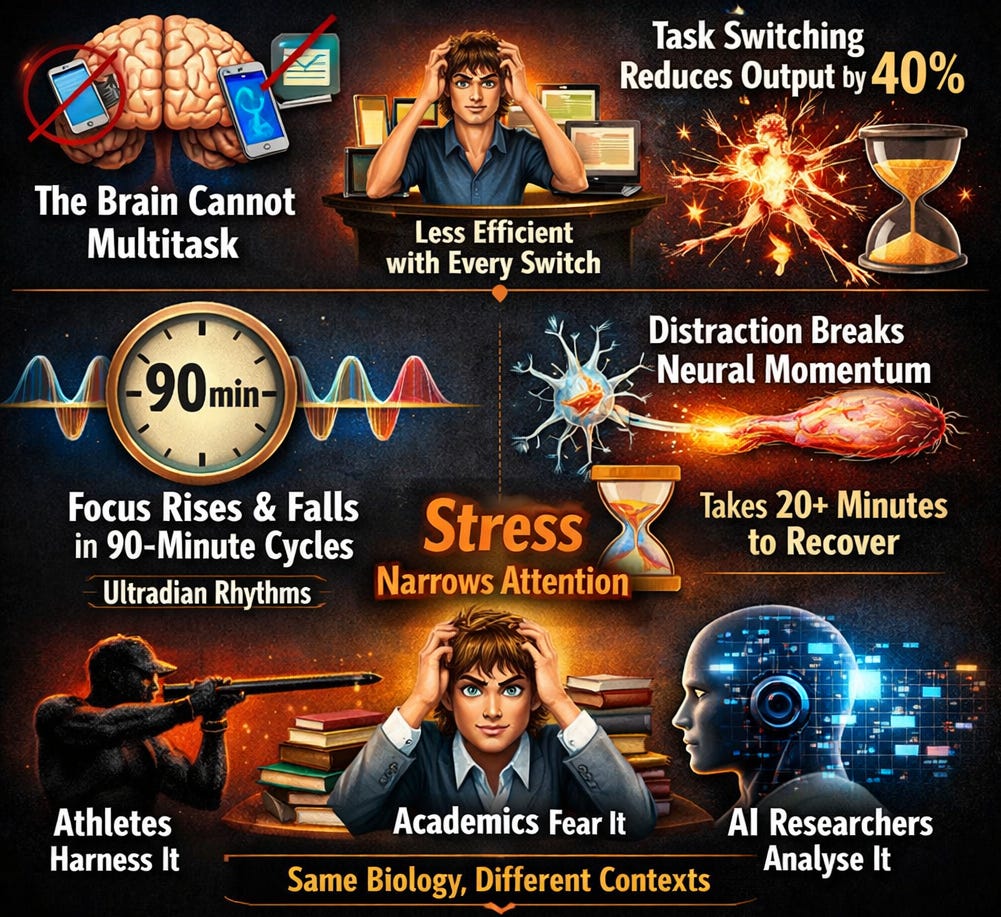
The brain cannot multitask
It switches rapidly - losing efficiency with every switch.
This is why multitasking feels productive but reduces output by up to 40%.
Focus rises and falls in 90-minute cycles
These are Ultradian rhythms, the body’s natural waves of alertness.
Distraction breaks neural momentum
It takes at least 20 minutes to return to the previous depth.
So, remember that the next time you become distracted.
Stress narrows attention
Athletes harness this.
Academics fear it.
AI researchers analyse it.
Every field uses the same biology – but only the context differs.
AI can make you focused…or completely unfocused!
On one hand, AI accelerates workflow, reduces repetitive tasks and generates insights that used to take hours.
Used properly, AI is a focus amplifier.
But used unconsciously (or with laziness), it becomes a mental dopamine casino, through either: new prompts, new ideas, endless options or infinite drafts.
This creates shallow thinking, where the brain jumps from one micro-reward to another.
As a result, focus dies in abundance.
AI doesn’t reduce the need for focus. It increases the need for disciplined attention.
In an age of infinite information (or how we continue to evolve the definition and process of epistemology), focus becomes the filter that decides what matters.
Tools don’t create depth. Attention does!
Distraction is not a modern problem - it’s a human one.
Athletes, for decades, have mastered the art of what performance science calls:
“Attentional gating”
This is the skill of filtering irrelevant signals during high-pressure situations.
Let’s briefly look at three examples: a) A goalkeeper ignoring the crowd; b) A cricket batter ignoring sledging; or C) A sprinter ignoring lane noise.
The science is clear:
Focus is not the absence of noise - it is the ability to choose which noise counts…
Academics need the same ability: to ignore unnecessary admin, ignore intellectual politics, ignore comparison culture, ignore perfectionism or even ignore interruptions disguised as urgency! … Distraction kills innovation more than ignorance ever will.
We often think of focus as a mental state.
But it is also a physical one.
Simple physical actions dramatically improve cognitive focus: low-intensity walking, hydration, cold exposure, controlled breathing, natural light exposure and nutritional stability.
Athletes use these to enter peak states. Academics rarely use them - yet they have the same brain. Focus is a full-body phenomenon.
In the A4 philosophy:
AI enhances attention through automation.
Academia provides the frameworks for deep thinking.
Athletes demonstrate the discipline of focus.
Altruism reminds us what to focus on – which leads to purpose.
Human potential expands when attention is directed with intention.
So… in Closing:
Focus is not about intensity. It’s about clarity.
It’s not about doing more. It’s about doing one thing well.
And it’s not about avoiding distraction - it’s about choosing your signal in a noisy world!
The lab teaches us the biology of focus.
The locker room teaches us the discipline of focus.
Academia teaches us the purpose of focus.
AI teaches us the consequences of focus.
Master these - and you master your potential…
Until next time ;)
🎬 YouTube Channel
👉 https://www.youtube.com/@A4Digest
🌐 Website
👉 https://www.habibnoorbhai.com/
👉 https://www.linkedin.com/in/habib-noorbhai-phd/
🐦 X (Twitter)
No posts
Comments
Nothing yet. Say the first thing.
Sign in to join the conversation.