
Recently, much emphasis has been on AI adoption and neural networks.
How they learn. How they hallucinate. How they outperform humans.
But here’s something fascinating:
The inspiration for these AI systems didn’t come from computer science -
it came from your brain…
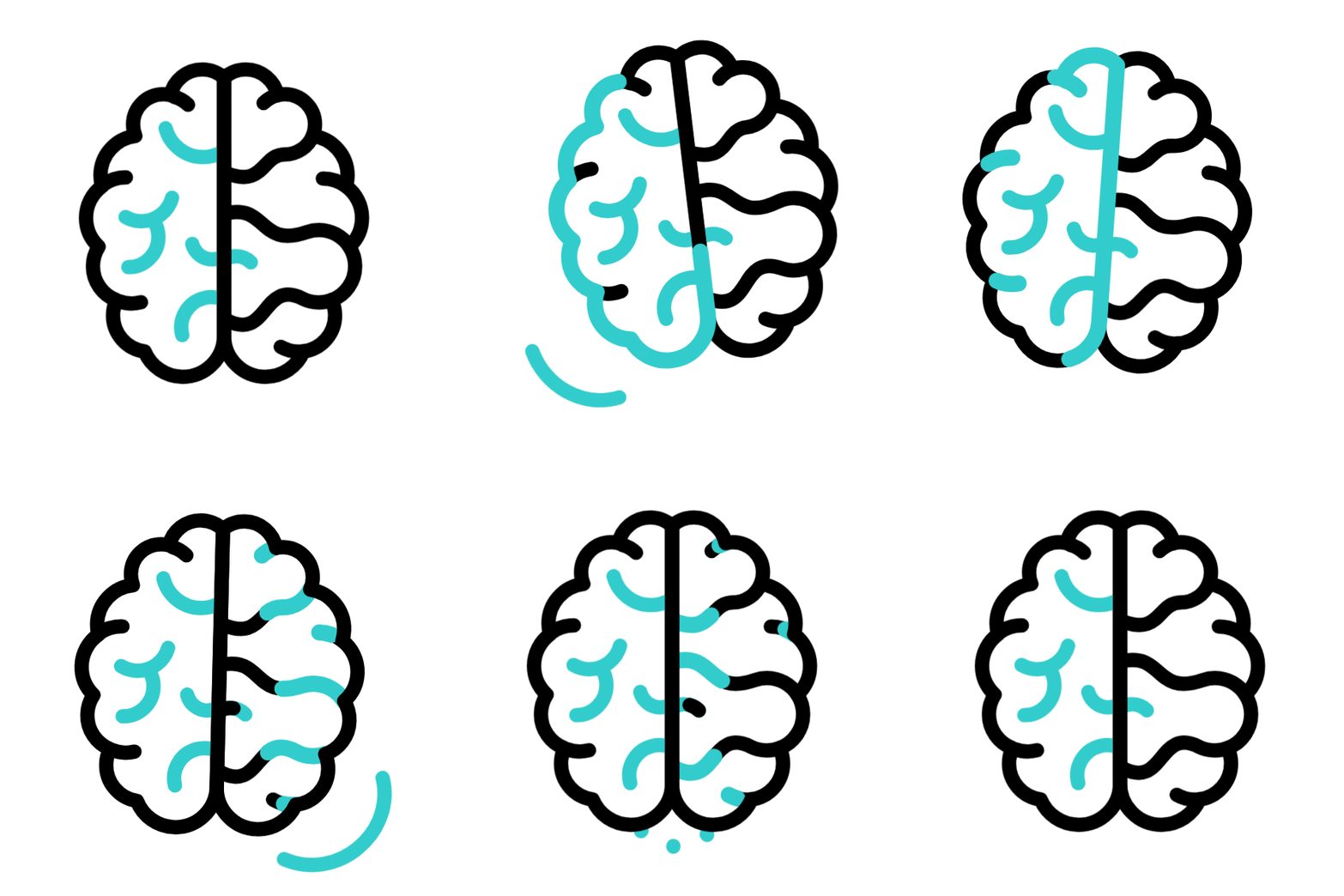
And even though neural networks and human neurons evolved in completely different worlds…
they are more similar and more different - than most people realise.
Today, we’re going to explore:
How the human brain learns.
How artificial neural networks learn.
Where they overlap.
Where they diverge.
And what this means for academics, athletes and all of us navigating an AI-shaped future.
The story of intelligence - biological or artificial - is always a story about learning.
So...Where do Neural Networks actually come from?
Neural networks did not emerge from Silicon Valley.
Their origin story begins in neuroscience labs.
Early researchers in the 1940s and 50s asked a simple, yet profound question:
“What if we could teach machines to learn the way the brain does - through connections, patterns and experience?”
They created mathematical models loosely inspired by neurons:
nodes
layers
weights
activations
A primitive abstraction of how actual neurons fire, adapt and reorganise.
But since then, artificial neural networks have evolved far faster than we expected.
And now, in 2026, we’re not just comparing brains and AI -
we’re learning from their differences.
Same, same…but very different.
So, how does the Human Brain learn?
In terms of Adaptation + Emotion + Embodiment
The human brain is messy - and magnificent.
Human learning is shaped by:
emotion
memory
embodiment
experience
motivation
reward
context
story
culture
A single memory involves thousands of distributed neural circuits firing in synchrony.
Learning is not just computational - it’s lived…
The brain rewires itself continuously through plasticity - the ability to grow, prune, strengthen, reorganise and transform connections based on experience.
This is why:
Athletes improve decision-making through repetition.
Academics improve thinking through reflection.
Children learn languages effortlessly.
Trauma can reshape cognition.
Purpose enhances memory.
Learning in humans is not an algorithm.
It is an embodied, emotional, chemical, electrical, social experience.
It is intelligence with a PULSE.
How do Neural Networks learn?
In terms of Data + Patterns + Optimisation
Neural networks, in contrast, are ruthlessly efficient.
They learn through:
massive datasets
pattern recognition
weight adjustments
gradient descent
reinforcement cycles
No emotion. No culture. No embodiment. No lived memory.
They learn by optimising mathematical functions. That’s it!
This is why AI models can outperform humans at:
prediction
classification
generation
pattern spotting
…because they don’t get tired, bored, emotional, conflicted or self-conscious.
But here’s what they don’t do:
They don’t understand. They don’t feel. They don’t assign meaning. They don’t create purpose. They don’t have experience.
They simulate intelligence - but they do not possess consciousness.
Same, same but very, very different!
So, where do Brains outperform machines?
There are things humans do that neural networks simply cannot:
1. Embodiment
Movement and cognition are linked - athletes are proof of this.
2. Emotion
Emotion shapes learning, memory, motivation and decision-making.
3. Creativity from lived experience
AI can remix. But humans can originate meaning.
4. Context
AI reads words. Humans read situations.
5. Ethics
AI has rules. Humans have values.
These gaps are humanity’s competitive advantage…
What can athletes teach us about REAL intelligence?
Athletes demonstrate that the brain is not in your head -
it is in your body too…
Decision-making in sport happens in:
milliseconds
motion
embodied reaction
sensory integration
No neural network can replicate the lived, physical, emotional intelligence of an elite athlete in the arena.
Machine learning is stats-driven. Human learning is experiential.
Athletes prove that intelligence is not just information - it is intuition shaped through repetition and embodiment.
Same, same…but profoundly different.
What does Academia misunderstand about AI?
Academia often swings between two extremes:
AI will replace us
AI will never match us
Both are wrong!
AI will replace academics who rely on:
memorisation
information transfer
formula-based writing
routine analysis
AI will not replace academics who excel in:
interpretation
conceptual and critical thinking
ethics
synthesis
mentorship
multidisciplinary insight
AI threatens knowledge, but amplifies wisdom.
People who build people…not empires.
So, let’s look at: The Altruistic Brain versus the Optimising Machine
The biggest difference between neural networks and human brains is altruism.
Humans can act with:
compassion
sacrifice
meaning
moral purpose
curiosity
love
faith
hope
AI cannot!
AI is a tool of intelligence. Humans are carriers of conscience.
Neural networks push the mind.
Human networks push the soul.
So, in Closing:
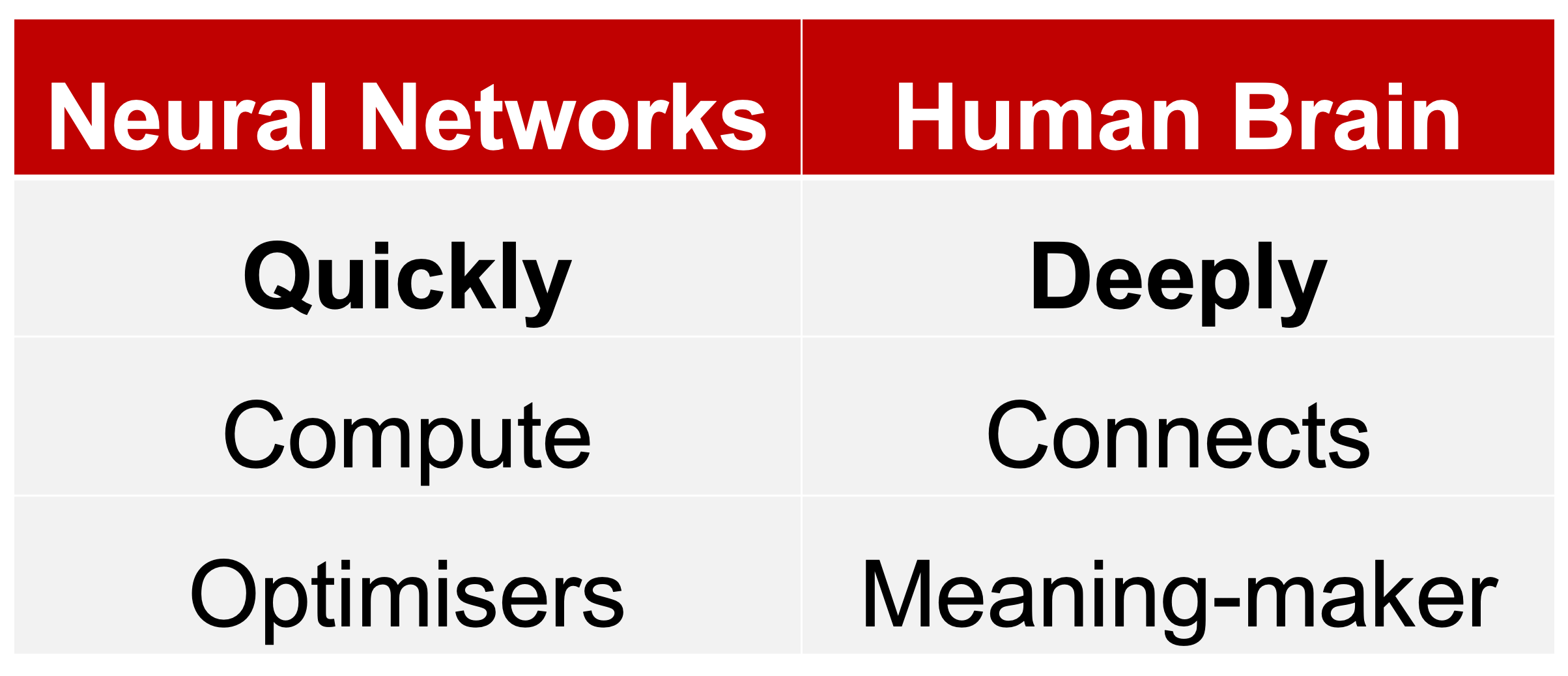
Same inspiration.
Different universe.
And the future will belong to those who understand both systems -
the intelligence of machines and the intelligence of BEING human.
ALSO WATCH:
Subscribe/Follow:
🎬 YouTube Channel
👉 https://www.youtube.com/@A4Digest
🌐 Website
👉 https://www.habibnoorbhai.com/
👉 https://www.linkedin.com/in/habib-noorbhai-phd/
🐦 X (Twitter)
Comments
Nothing yet. Say the first thing.
Sign in to join the conversation.