

Every era thinks its dilemma is unique. And every era is partly right… Technology evolves faster than our values. And when that gap widens, society is forced to confront uncomfortable questions.
Sport has always been one of the clearest arenas where these tensions emerge. Because performance strips ethics down to their essence.
Today, however, something has shifted. This is no longer just about how we perform. It is about what it means to perform at all.
We often romanticise the idea of natural ability or talent.
But human performance has always been enhanced; Footwear, Nutrition, Training systems, Data, Technology, etc.
Every generation adopts new tools…And then draws a moral boundary just beyond its own comfort zone.
The debate has never truly been about enhancement itself.
It has always been about three things:
Fairness
Agency
Meaning
We have enhanced strength before.
We have enhanced endurance before.
But now… we are enhancing something far more fundamental:
Decision-making
Artificial Intelligence does not just help us run faster or train harder.
It helps us see differently, anticipate earlier and choose more efficiently.
And that changes everything. Because decision-making sits at the core of human identity as well as embodied cognition.
At first glance, athletes and machines appear similar.
Both rely on patterns.
Both improve through repetition.
Both optimise outcomes.
But there is a crucial difference:
Athletes decide with consequence.
Machines predict without responsibility.
This is the ethical fault line.
When an athlete makes a decision, they carry the cost (physically, emotionally and socially).
Victory belongs to them. Failure belongs to them.
But when an algorithm influences that decision…
Responsibility becomes diffuse.
Who is accountable then?
The athlete?
The coach?
The data scientist?
The system itself?
Ethics live precisely at this intersection of uncertainty.
Sport compresses life’s biggest ethical questions into moments.
Fairness. Effort. Merit. Outcome.
When enhancement technologies are widely accessible, they are often accepted.
But when access becomes uneven… Enhancement begins to look like advantage.
AI intensifies this divide.
Not everyone has access to:
High-quality data
Advanced infrastructure
Technical expertise
And so performance becomes stratified.
The question is no longer:
Can this improve performance?
But rather:
Who is excluded when it does?
There is another layer to this conversation that is often overlooked.
Coercion
Not through force. But through expectation.
When enhancement becomes the norm, opting out becomes costly.
If everyone trains with predictive systems… Not using them appears irresponsible.
If optimisation becomes standard… Restraint begins to look like weakness.
And slowly, without resistance, choice disappears.
This is where altruism becomes essential.
Not as an abstract ideal… But as a practical constraint.
Altruism asks:
Does this protect the individual?
Does this preserve dignity?
Does this reduce harm?
Enhancement that reduces injury risk and extends careers aligns with this principle.
Enhancement that extracts performance without regard for consequence does not.
The distinction is not technical.
It is moral!
This conversation is no longer confined to athletes.
It extends into:
Academia
Business
Everyday life
AI now enhances:
Productivity
Communication
Decision-making
And the same questions follow us:
At what point does assistance become substitution?
At what point does optimisation erase agency?
At what point does efficiency undermine meaning?
Athletes understand something deeply human:
Winning without integrity feels empty.
Performance without fairness loses its value.
Sport only matters because we believe:
Effort matters
Skill matters
Courage matters
If outcomes become primarily technological…
The meaning of competition dissolves. And so does meaning in other domains.
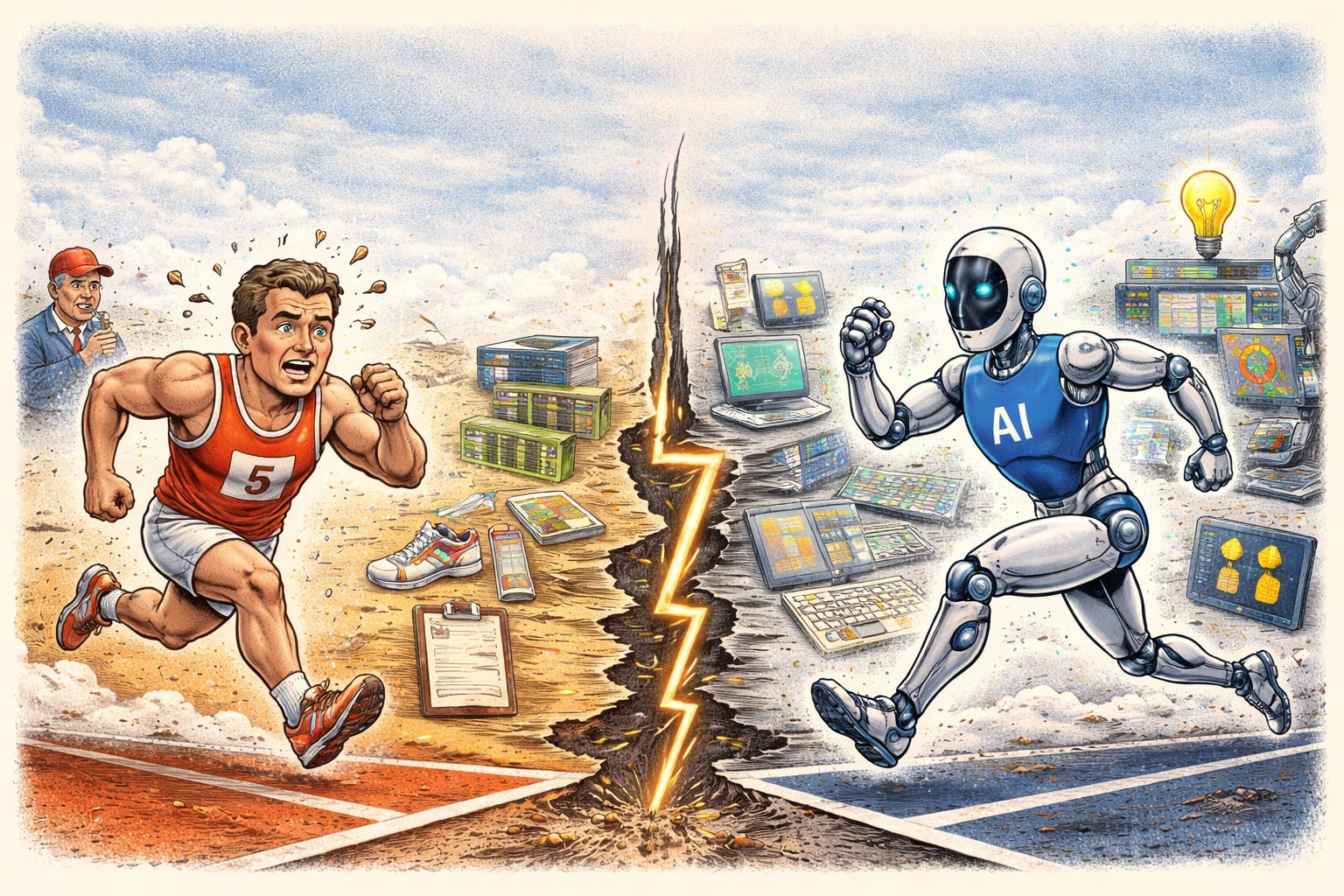
The future is not human versus machine.
It is:
Human WITH machine, under human values…
Technology should:
Sharpen judgement, not replace it
Protect health, not demand sacrifice
Expand possibility, not narrow choice
These are not ideals but are design principles.
The most dangerous assumption we can make is this:
Ethics will catch up later.
They rarely do…
Ethics must be embedded at the point of design, not retrofitted after harm occurs.
This is a shared responsibility:
Scholars
Athletes
Engineers
Leaders
Strategists
Design Thinkers
Not to slow innovation… But to guide it.
Performance has never been only about winning.
It is about how we define excellence.
If excellence becomes detached from integrity… Progress becomes hollow.
Machines can make us faster. But only humans can decide:
What is worth becoming faster for?
And that decision…
cannot be automated ;)
🎬 YouTube Channel
👉 https://www.youtube.com/@A4Digest
🌐 Website
👉 https://www.habibnoorbhai.com/
👉 https://www.linkedin.com/in/habibnoorbhai
🐦 X (Twitter)
No posts
Comments
Nothing yet. Say the first thing.
Sign in to join the conversation.