
There is a sentence that makes many scholars deeply uncomfortable. Not because it is dramatic - but because it feels dangerously close to true.
“Artificial intelligence has killed expertise.”
Not expertise itself. Not scholarship. Not thinking.
But a very particular idea of expertise - one that academia has relied on for a long time.
This week, I want to unpack what is really dying, what is being exposed and what kind of scholar might actually thrive in the age of AI.
Because the threat is not that machines are becoming smarter. The threat is that most institutions (and workplaces) are refusing to evolve.
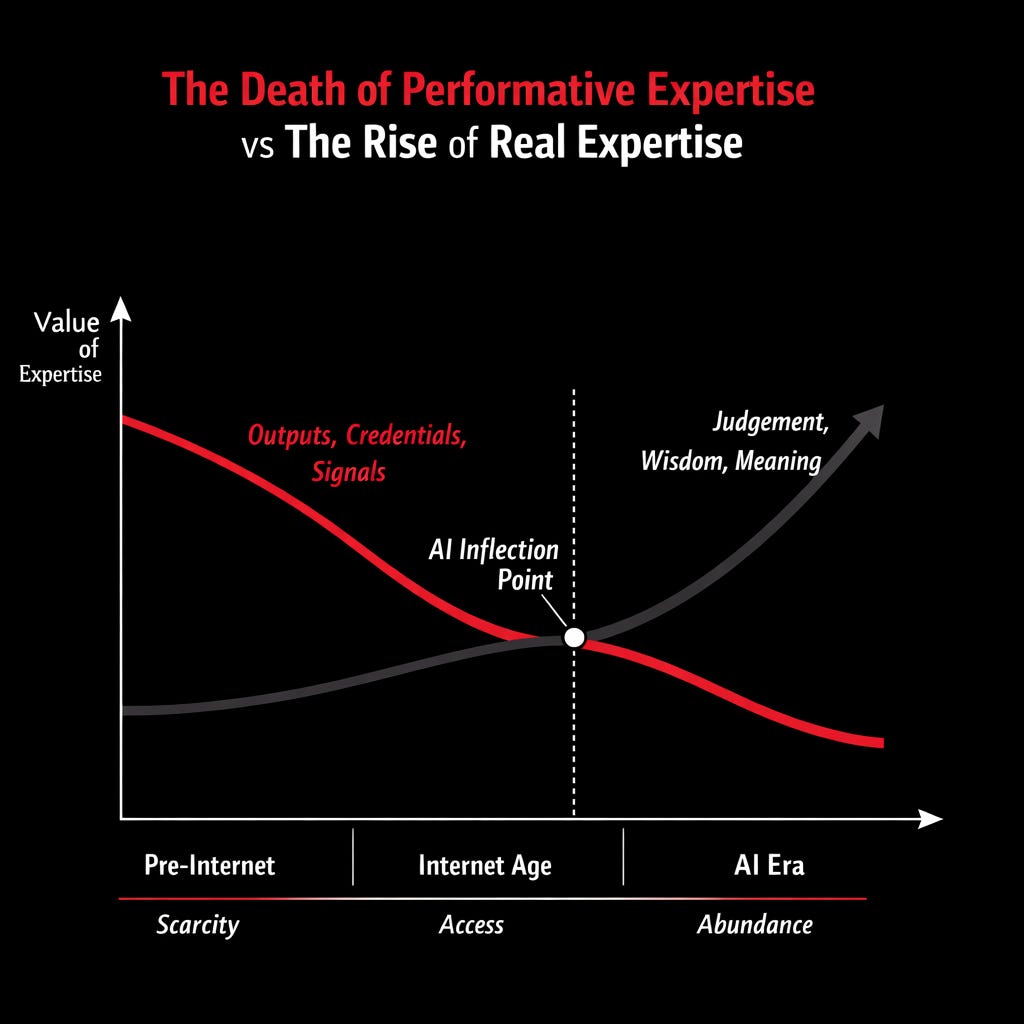
For centuries, expertise was built on scarcity.
Scarcity of information. Scarcity of training. Scarcity of access. OR Scarcity of voice.
To be an expert meant you knew things others did not.
You had read what others had not.
You had access to archives, journals and conversations that were closed, to most people.
Universities were designed around this model.
The professor as the holder of knowledge.
The student as the receiver.
Authority flowed from possession…
The internet weakened this structure. AI has collapsed most of it.
Today, a student can generate summaries of entire disciplines in minutes or even seconds.
They can draft essays, simulate arguments, translate theories, visualise data and interrogate assumptions - all without waiting for permission.
This is not superficial access.
It is cognitive acceleration!
And it forces an uncomfortable realisation:
If everyone can produce expert-looking outputs, then output alone, no longer signals expertise…
This is where the anxiety begins.
Because much of academic identity is tied to visible markers:
Writing style. Technical language. Referencing conventions. Complexity in methodologies.
AI can now mimic all of these convincingly.
Which means the traditional signs of expertise are no longer reliable indicators of depth.
The scholar is no longer distinguishable by what they can produce.
They are distinguishable by how they THINK.
This shift is deeply destabilising.
For many academics, expertise was never just a role - it was an identity.
Being the one with answers. Being the authority in the room. Being consulted. Being deferred to.
AI does not challenge intelligence. It challenges status!
And systems built on status resist that challenge aggressively…
But here’s the paradox:
AI has not made scholars irrelevant. It has made shallow expertise visible…
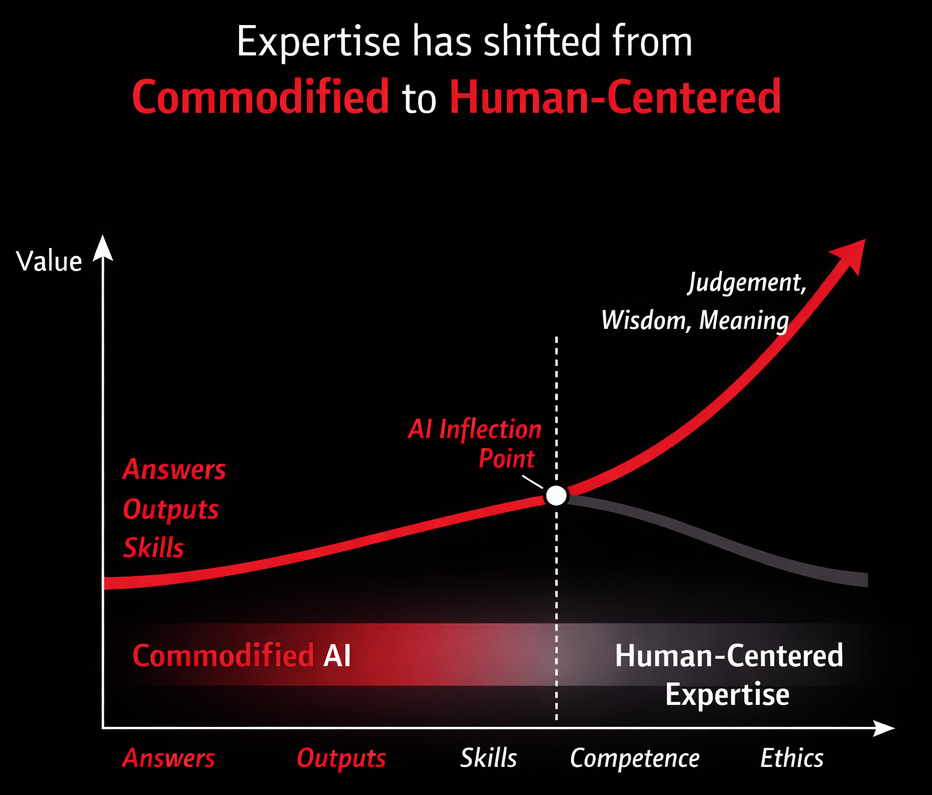
When information becomes abundant, interpretation becomes valuable.
When answers are cheap, judgement becomes rare.
When outputs are automated, meaning-making becomes essential.
This is not the death of expertise.
It is the death of performative expertise.
True expertise has never been about information alone.
It has always lived in:
Context. Discernment. Ethical reasoning. Pattern recognition across domains. Knowing what matters - and what does not.
AI can generate content, sure!
But… It cannot decide what deserves attention.
The most valuable scholars of the next decade will not be those who know the most…
They will be those who can:
a. Frame better questions.
b. Navigate ambiguity.
c. Integrate across disciplines. Yes, a transdisciplinary approach!
d. Explain complexity without flattening it.
e. Hold ethical tension without rushing to resolution.
These are not skills you outsource.
They are capacities you cultivate…
There is also a quieter shift happening - one we rarely acknowledge.
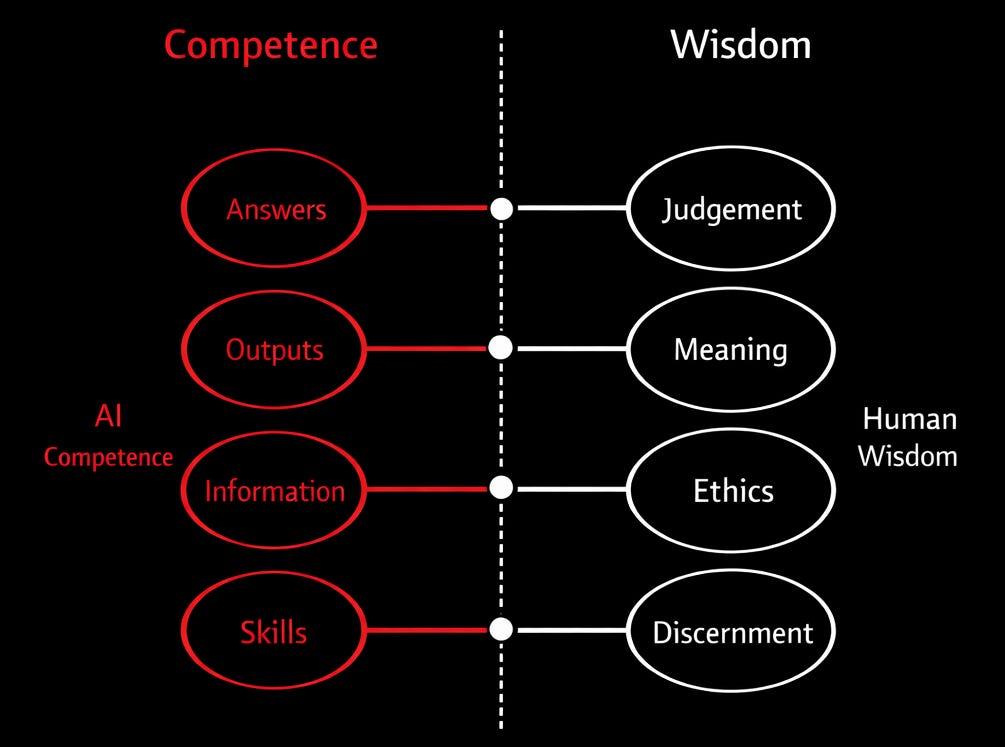
AI exposes the difference between competence and wisdom.
Competence can be simulated.
Wisdom cannot…
Wisdom requires experience, failure, responsibility and reflection.
It requires having lived with the consequences of decisions.
That is why AI struggles with moral judgement.
And why scholars who understand this become more important, not less.
The danger is not AI replacing scholars.
The danger is scholars trying to compete with AI on its terms.
Speed. Volume. Output.
That race cannot be won.
But it does not need to be run.
The scholar’s role is changing - from gatekeeper to guide.
From authority to interpreter.
From producer of information to architect of understanding.
NEW COURSE: If you’re navigating academia and wondering how people actually progress from PhD to professorship - not in theory, but in practice - I’ve built something for you!
Becoming a Professor is my CPD-accredited online course (20 points) for graduate students, postdocs, early-career academics and aspiring professors who want clarity, strategy and momentum.
It covers research mastery, publishing, funding, leadership, resilience and career transitions - with structured lessons, workbooks and real-world frameworks.
Academia rewards strategy, not guesswork!
—> Link to course site: https://www.becomingaprofessor.com/course

This shift also demands humility.
Scholars can no longer hide behind obscurity.
If you cannot explain your work clearly, AI will.
If your contribution relies on complexity rather than clarity, it will be flattened.
This is not anti-intellectual.
It is anti-pretense.
There is a deeper ethical responsibility emerging here.
AI does not decide what knowledge is used for. Humans do!
Scholars must now act as stewards - shaping how AI is applied, constrained and governed.
This is not optional…
Because when expertise loses its ethical anchor, intelligence becomes dangerous.
The scholar of the AI era will not be defined by how much they know.
They will be defined by:
How they reason.
How they judge.
How they mentor.
How they contextualise.
And: How they protect human dignity in automated systems.
These qualities cannot be scrapped, trained or predicted. They must be lived.
So no - AI has not killed expertise.
It has stripped away the illusion that expertise was ever about information alone.
What remains is harder to fake.
And far more valuable.
The future scholar will not compete with machines.
They will complement them - while defending what machines cannot embody.
Which are: Meaning. Responsibility. And Integrity.
And in doing so, they may finally reclaim the most important role of all:
NOT KNOWING EVERYTHING - BUT HELPING OTHERS UNDERSTAND WISELY.
🎬 YouTube Channel
👉 https://www.youtube.com/@A4Digest
🌐 Website
👉 https://www.habibnoorbhai.com/
👉 https://www.linkedin.com/in/habibnoorbhai
🐦 X (Twitter)
No posts
Comments
Nothing yet. Say the first thing.
Sign in to join the conversation.