
Is this regional the most wide-open in the bracket? It might be.
Pressed for time? Join the 6on5 Bracket Contest here!
The Teams
#3 Maine
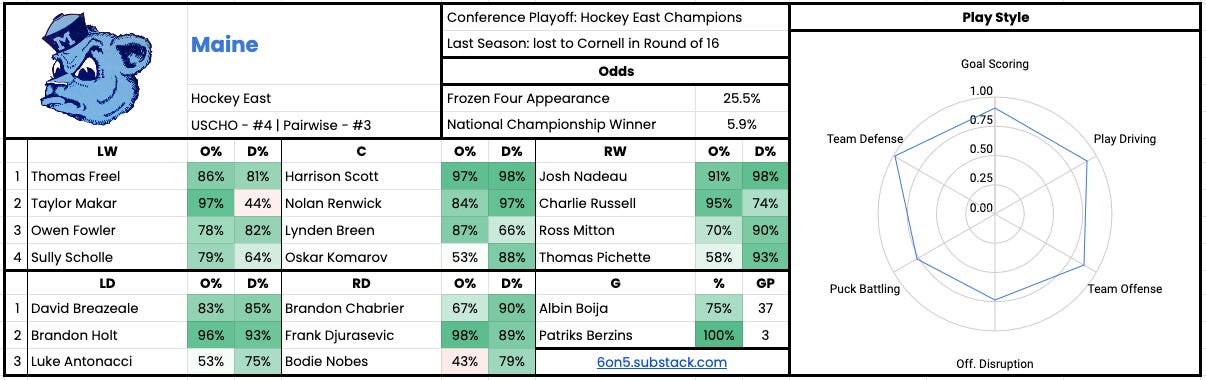
The model doesn’t love Maine… but I’ll talk about this later in the blog (spoiler: the model is maybe wrong, so we have a chance to make it better in the offseason).
I’ve seen Maine play live 5 times this year and watched many more of their games on ESPN+. There may not be a team that rains down havoc on opposing defenders as well as they do.
This starts with an impressive and very experienced forward group, full to the brim with great two-way players and forecheckers. Harrison Scott is the headliner, and he has had a complete career renaissance since his move to Orono — going from sub-par offensive metrics at Bentley to a Hobey Baker campaign in his final season.
They don’t have as much scoring punch as some other teams — but this is okay for the way they play hockey, as they seek to control possession and limit chances for the opposition by hemming them in their end for as long as possible.
Maine’s defense complements these efforts with similar high-end physical and systems play, making the neutral zone and Maine’s defensive zone as difficult to play in as possible. The only teams I can confidently put above them at this position are #1 Boston College and #2 Michigan State, who coincidentally, are the only two teams ahead of them in the polls.
Albin Boija is their full-time starter, and he is the consensus #2 goalie in Hockey East. He’s very very good and can make some big mobile saves when needed, however, one small concern I have is that he sometimes will give up goals in bunches. He’s usually elite, but every so often there will be a period where he and the Black Bear defense flounder for a bit.
#6 UConn
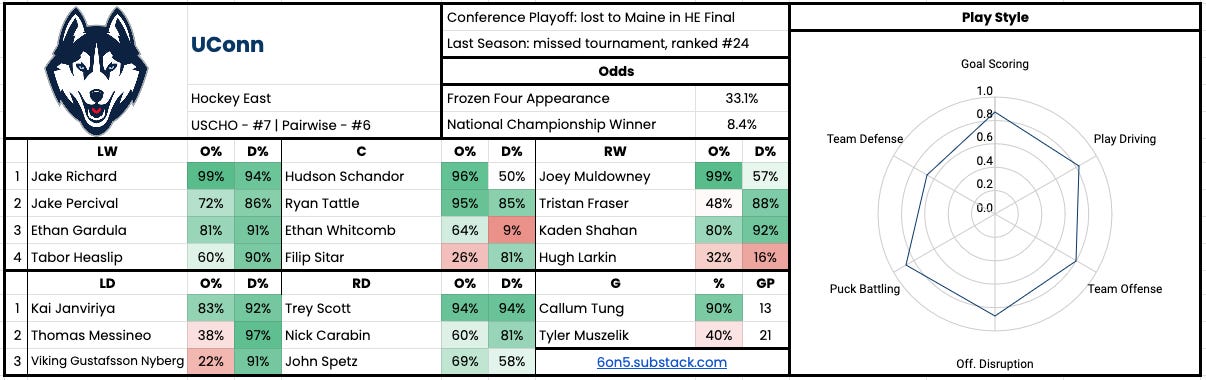
I will start by saying this — my model likes UConn with Callum Tung in net. My model sort of likes UConn with Tyler Muzselik getting starts, but not as much.
Mike Cavanaugh has been using them as a 1A/1B tandem for the last part of the season. I understand why — Muszelik is an upperclassmen and has improved a lot this year, plus Tung has had illness and durability concerns (including cramps in his recent Hockey East semi-final win), but with more rest days in the NCAA tournament maybe things will change.
Stylistically: UConn is best described as Diet Maine.
Their forward group is deep, with some excelling two-way players and forecheckers. There is no one on this team who the Huskies solely rely on for production, and they have an experienced group designed to overwhelm defenses and control possession.
Hudson Schandor won Hockey East Defensive Forward of the Year, which I think… was surprising to some people… but he’s a very capable centerman and alongside Joey Muldowney will be able to do serious damage in the tournament if healthy.
On defense, the Huskies have 6 analytical darlings and a top pairing that provides a nice enough offensive punch that they can help move the puck and provide a point option on the power play. They aren’t elite, but they’re enough for a team with a good goaltending and offense to win games.
#12 Quinnipiac
No one can get rid of these guys, can they?
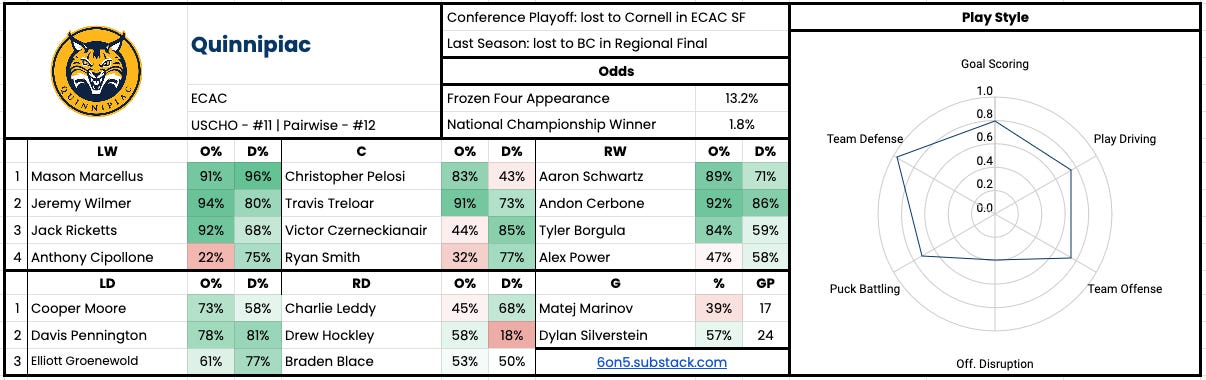
Even in a relatively down year versus their recent highs, the Quinnipiac Bobcats are in the tournament as a #3 seed.
BU transfer Jeremy Wilmer is the Bobcat offense’s leading scorer and point-getter, helping Rand Pecknold replenish a team that lost an awful lot to the portal and pro signings over the offseason. His playmaking ability and finesse is supported by Christopher Pelosi’s most grindy game, and the second line is led by Mason Marcellus who seems like he will be a solid 4-year player for the Bobcats.
They have a solid Top 6, especially for an ECAC team in a year where the conference did have 2-bids, but came quite close to just sending in Quinnipiac or with enough bid thieves, just Cornell.
The defensive group doesn’t have the same micro-stats you might expect based on their actual outputs, but they slow their opposition down with great systems play — just like the dominant Quinnipiac teams of the last few years.
Matej Marinov and Dylan Silverstein have split the crease somewhat even throughout the year, but Marinov was given the start against Cornell in the semi-final. Neither of them are jumping off the page (especially given the team graduated Yaniv Perets just two years ago), but they should be fine enough.
#13 Penn State
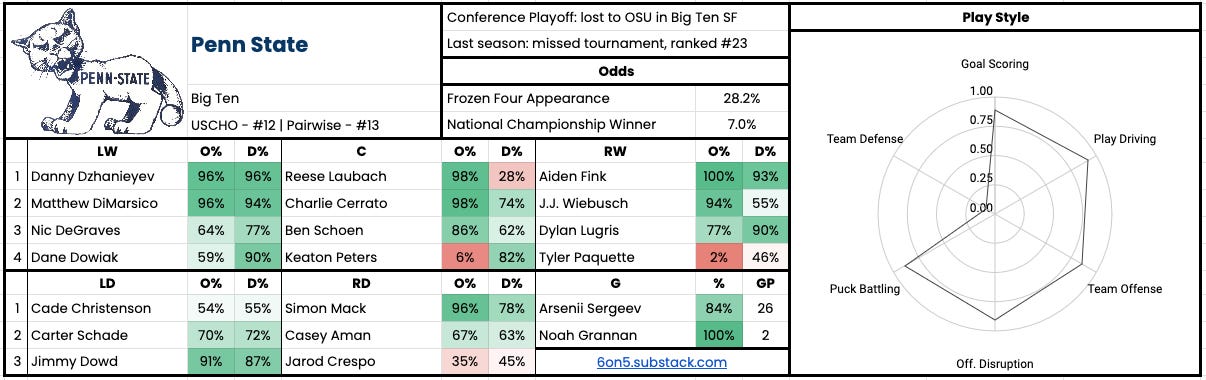
This is what you dream of as a hockey program bidding on hosting a regional. Not only did you make it… but you have a real puncher’s chance of a win at home.
Penn State’s offense is led by Hobey finalist Aiden Fink, who has set the Big Ten ablaze this year. His whole line is capable, but Fink is the engine, having a great season as a play driver but also playing physically.
Fink’s production has shifted more to playmaking the beginning of March, but it hasn’t held the Nittany Lions back, as they’ve averaged 4.25 Goals per Game in this stretch and made it to the Big Ten Semi-Finals.
The Nittany Lion defense doesn’t inspire too much confidence when you look at their Goals and xGoals Against… but some of this comes from the fact they don’t shy away from a boat race. When your team’s games average 6.6 total goals per (roughly .9 above the national average), there is going to be a natural dip in defensive impacts.
I wouldn’t worry too much, although missing Carter Schade who slots in on their second defensive pairing could be a cause for concern, as a less experienced player will be asked to play minutes against a very good Maine forecheck.
UConn transfer Arsenii Sergeev is the starting goaltender, and he has had a solid year for the Nittany Lions earning All-Big Ten 2nd Team honors behind Trey Augustine.
How do they match up?
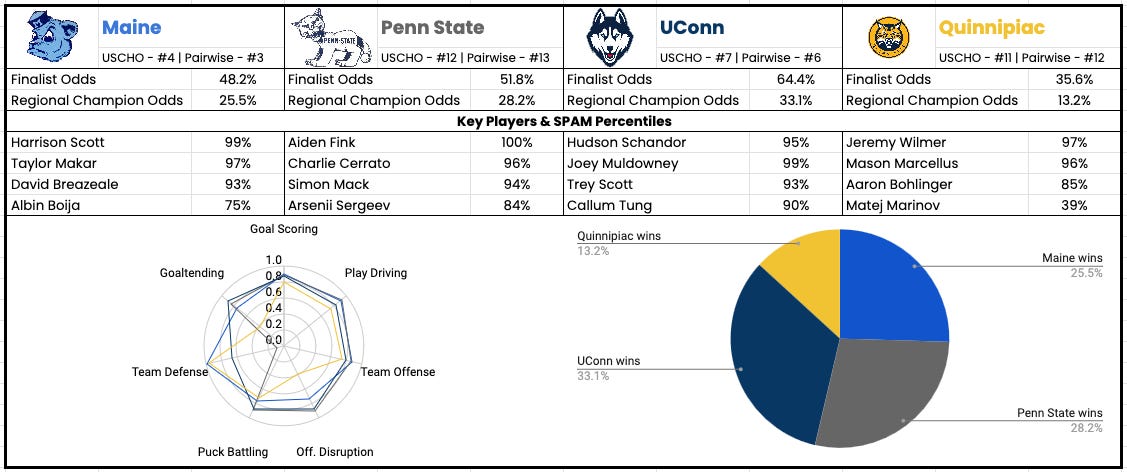
Round of 16
My model has #13 Penn State beating #3 Maine in front of the home crowd… but are you going to listen to a robot? I’m not sure I would either.
One factor here may be that the goalie impact measure seems to have downgraded Albin Boija slightly in recent weeks, which given Maine’s tight margins of victory and play style that emphasizes close games, has a large impact on our formula.
Regardless of what the math says, it’s hard not to like the Black Bears in this head-to-head comparison. They won the title in a hard conference, and they play a relentless game that allows them to play on their terms.
You could convince me that home ice will swing toward Penn State — but odds are plenty of Mainers take the trip and crowd impacts will be neutralized.
#6 UConn should be able to handle #12 Quinnipiac as they did earlier in the year at CT Ice, especially if Callum Tung steps out of the tunnel first.
If for some reason the Huskies reverse their order and Tyler Muzselik starts, I’m much less confident in their ability to beat their in-state rival and can see Rand Pecknold making a miracle happen.
Potential Finals Match-Ups
Any of these match-ups would be very entertaining, as each team could very feasibly come out of the other side on top.
If Maine has a rematch with Quinnipiac or UConn, it’ll be a chance at redemption for a Bobcat team that was swept in Orono and a Husky team that was run out of the building at TD Garden last week.
Maine would be at a clear talent advantage in both games and again, I’ll reference UConn’s goaltending situation. If Tung plays in this hypothetical, it’s a relatively even affair — but last week when he didn’t, Maine was projected as roughly a 65/35 favorite over the Huskies for the Hockey East title.
Worth mentioning: Hudson Schandor missed the Hockey East Final against Maine. His return could have a big impact in a rematch, not offsetting weaker goaltending, but certainly helping.
If Penn State pulls off a first upset, then beating Quinnipiac or UConn feels like much less of a leap of faith. The Bobcats are the #3 seed and just ahead of the Nittany Lions in the rankings, however, the talent ceiling is higher for Penn State.
One could make an argument that QU’s winning experience shines through against a relatively new-to-the-tournament PSU team, but they’ll need to punch above their weight and win what is functionally a road game.
Separately: a Penn State — UConn would be compelling, especially given it would be an Arsenii Sergeev revenge game.
Beyond the Regional
Maine’s low title odds in my model are largely because of a hard first-round draw against Penn State and UConn being credited for their very best lineup, which includes a healthy Hudson Schandor and Callum Tung starting.
Many of the teams ahead of the Black Bears have a first-round match-up where they’re a 65/35 or better favorite, which gives a much higher final calculation. If they survive this, they’ll have really solid chances against any team they can draw from the Toledo regional in a national semi-final.
The 3 other teams all have the potential to go on a run, but I have a hard time seeing them winning a national title over the teams that will stand in their path. My brother really likes Penn State’s chances — so maybe he’s onto something and their high-end talent takes over.
Before you go, play in the 6on5 Bracket Contest!
Videos via InStat
Comments
Nothing yet. Say the first thing.
Sign in to join the conversation.