
6G news and analysis for the week ending Friday, 31st July, 2026.
Welcome to the weekly 6G Futures newsletter. To the surprise of absolutely no-one, geopolitics once again dominates the news. The US National Telecommunications and Information Administration published its ‘Call to Action for 6G Leadership and Security’ on Monday, affirmed by 25 governments. We flagged this initiative back in March, when NTIA administrator Arielle Roth first described her intent to rally allies. The document that has now emerged is more substantial than perhaps many of us expected, with dated commitments at one, three, six and twelve months. It also contains a clause that standards watchers should read closely, in which signatories undertake to avoid duplicating the work of industry-driven technical bodies.
The response from China arrived within 24 hours. Global Times and China Daily ran familiar containment arguments built on well-rehearsed statistics. The more useful analysis came from the South China Morning Post, which gathered comment from Natixis and the University of Chinese Academy of Sciences. Both made a similar point: The declaration is necessary but not sufficient, and its value rests entirely on follow-through in spectrum, industrial policy and R&D.
India supplied some new standards-related data this week. A Bharat 6G Alliance review meeting disclosed that Indian technical contributions to 3GPP rose from 196 in 2020 to 2,943 in 2025. That is a measurable shift in standards participation and considerably more informative than the usual ministerial rhetoric that accompanied it.
Elsewhere in the news this week, ICASA opened consultation on a spectrum roadmap that would expand South Africa’s assignable broadband spectrum more than twentyfold by 2030. e& UAE and Khalifa University published a peer-reviewed study on integrated sensing commercialisation. Plus, we have selected four research papers for you to peruse over the weekend.
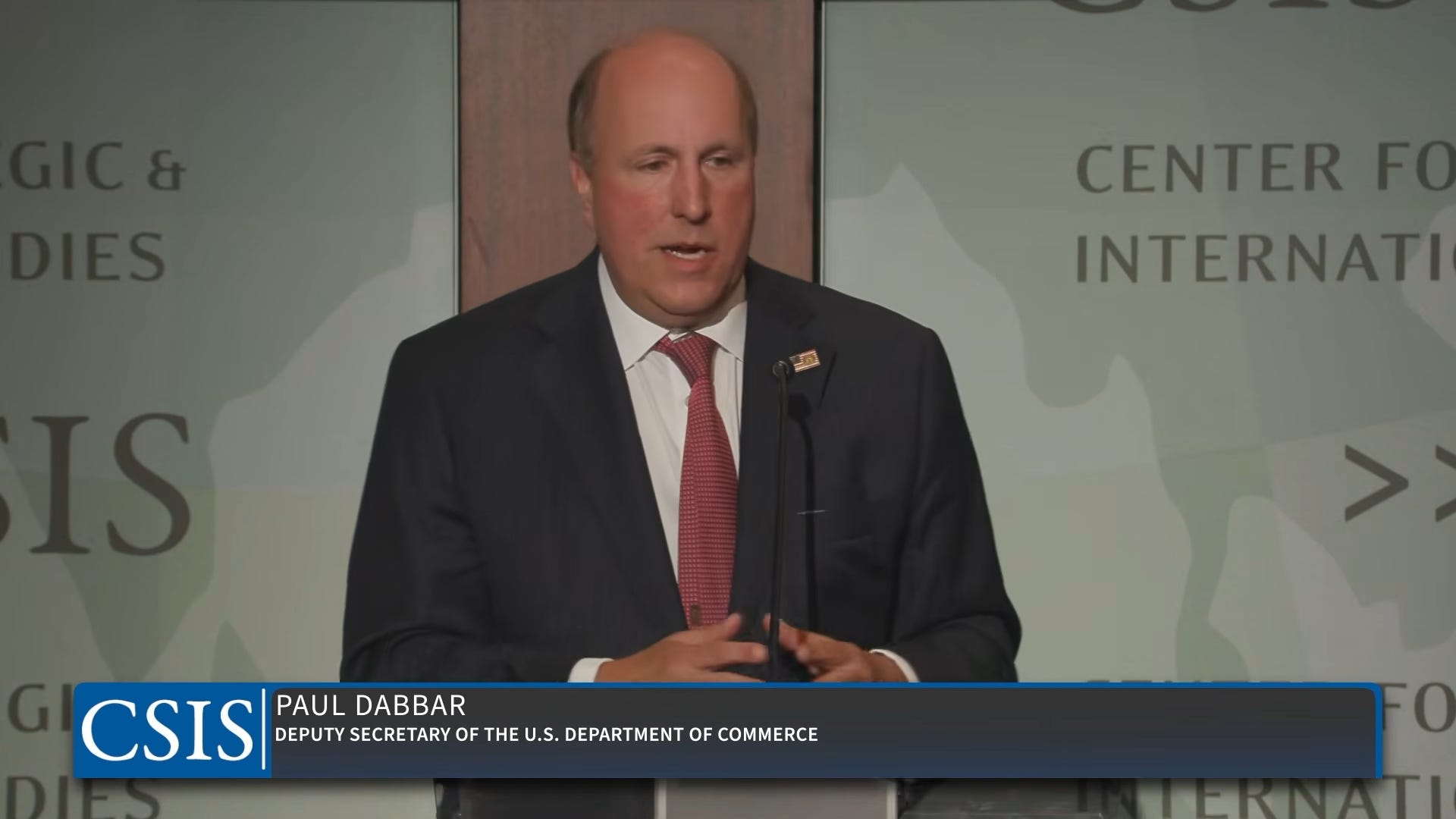
The US National Telecommunications and Information Administration (NTIA) published the Call to Action for 6G Leadership and Security on Monday 27 July. Twenty-five governments have affirmed it, including the United Kingdom, Germany, France, Italy, Japan, the Republic of Korea, Canada and Australia. The initiative was first reported by Politico, which had advance sight of the announcement. It builds on the December 2025 national security presidential memorandum that directed diplomatic coalition building, and on the ‘One Big Beautiful Bill’ Act. Arielle Roth, NTIA administrator, said:
“Today’s action recognises that 6G will be dramatically different from 5G, and that advancing U.S. and allied leadership requires a dramatically different playbook.”
Roth and Commerce Deputy Secretary Paul Dabbar (pictured above) discussed the effort at a launch event hosted by the Center for Strategic & International Studies on Wednesday.
What’s new: The substance is in the timetable rather than the principles. Within one month, each government must designate expert 6G points of contact and a responsible agency. Within three months, they must engage industry stakeholders and begin identifying financial resources. Within twelve months, they convene in person during 2027 to review progress. The signatory list is also broader than the usual security groupings, extending to Costa Rica, Honduras, Panama, Paraguay and Albania.
Why this matters: This is the delivery of the “6G Call for Action” that Roth trailed at a Politico event in March, and it is more disciplined than that early framing suggested. The explicit near-term deliverables give it an agreed mechanism that most multilateral technology declarations lack. There is also a commitment to avoid duplicating industry-driven bodies working on 6G’s technical development. That’s a deliberate (and welcome) signal that the coalition does not intend to write specifications itself. The real target is the World Radiocommunication Conference in Shanghai next year, where spectrum decisions affecting 6G will be negotiated.
Implications for 6G standards: The coalition says that there is no intent to bypass 3GPP or ITU processes. Instead it commits members to coordinating with industry to promote global 6G standards aligned with a shared vision inside standards development organisations. Those two positions are not particularly harmonious! A bloc of 25 governments arriving at WRC-27 with pre-agreed spectrum positions is going to be interesting.
View source material to read more
View source material to read more — Politico
Chinese and Hong Kong outlets responded to the NTIA announcement within a day. The South China Morning Post carried the most substantive analysis, drawing on academic and financial-sector commentary. Shan Guangcun, a professor at the University of Chinese Academy of Sciences, characterised the initiative as an attempt to build a parallel ecosystem across technology, standards, industry and geopolitics. Alicia Garcia-Herrero, chief economist for Asia-Pacific and the Middle East at Natixis, was more measured on its prospects. She said:
“Success will therefore depend less on the alliance declaration itself and more on whether members follow through with concrete spectrum decisions, industrial policy, R&D investment and private-sector collaboration.”
She described the alliance as a necessary but not sufficient step. Global Times and a China Daily editorial took a sharper line, suggesting that the coalition was simply a repeat of the 5G campaign against Huawei and ZTE.
What’s new: Shan put China at 40.3 per cent of global 6G patent applications by the end of last year, with the United States second at around 35.2 per cent (which is new data to us). We have covered China’s share repeatedly, but the US comparison has not previously appeared here. The China Daily editorial also unleashed an economic argument rather than a technical one, citing the Chip 4 precedent (President Biden’s proposed alliance between the US, Japan, South Korea and Taiwan to create a more secure global semiconductor supply chain) and noting that China accounts for roughly 40 per cent of South Korean semiconductor exports.
Why this matters: You have to strip away the rhetoric to discover that there is a serious point underneath. Garcia-Herrero and Shan reach the same conclusion from different directions: declarations do not determine standards outcomes, that’s the role of market adoption, deployment scale and commercial applications. China retains advantages in manufacturing scale and domestic deployment experience that a policy coalition cannot offset. The counter-argument, which the Chinese coverage does not address, is that WRC-27 spectrum allocations are decided by governments rather than markets. That is where a 25-government bloc has leverage.
Implications for 6G standards: Huawei, ZTE and China Mobile remain among the most prolific contributors to 3GPP and nothing in this week’s announcement changes that. The risk to the standards process is fragmentation rather than exclusion. If spectrum positions harden into blocs ahead of WRC-27, 3GPP faces the prospect of specifying 6G radio for regionally divergent band plans.
View source material to read more — SCMP
View source material to read more — Global Times
View source material to read more — China Daily

India’s Department of Telecommunications held a Bharat 6G Alliance review meeting at Vigyan Bhawan in New Delhi, chaired by Communications Minister Jyotiraditya M. Scindia. The meeting disclosed that alliance member organisations now hold more than 7,700 patent filings covering 5G and 6G, including over 4,400 international filings. Indian participation in 3GPP rose from 717 participants in 2020 to 1,787 in 2025. Technical contributions over the same period increased from 196 to 2,943. Devdiscourse and others reported the meeting, which also received an update from TSDSI on India’s role in 6G standardisation. Separately, at the India Mobile Congress 2026 theme launch, Scindia announced the country’s first Telecom Manufacturing Zone in Gwalior and a target of 100 crore 5G users by 2030.
What’s new: The 3GPP participation figures are the first quantified account of India’s standards engagement that we have seen from the government. A fifteen-fold rise in technical contributions over five years is a substantial change in posture. The seven Bharat 6G Alliance working groups now cover spectrum, technology, applications, sustainability, manufacturing, outreach and future use cases.
Why this matters: We have consistently noted that Indian 6G ambition has outpaced delivery and that sustained 3GPP influence requires technical depth rather than funding announcements. These numbers are the first evidence that the gap may be narrowing. Contribution volume is not the same as contribution impact, and 2,943 documents says nothing about how many were agreed. Even so, presence in working groups is the precondition for influence and India now has it. TSDSI remains a 3GPP Organisational Partner, giving those contributions a formal route into the process.
Implications for 6G standards: Indian technical input at this volume will register in Release 21 normative work, particularly on energy-efficient communications and rural coverage where domestic requirements diverge from those of incumbent markets. The stated aim of ensuring Indian use cases reach internationally accepted standards is the correct ambition.
View source material to read more
View source material to read more — IMC 2026
The Independent Communications Authority of South Africa (ICASA) has published its International Mobile Telecommunications Roadmap 2026 for public consultation, alongside draft implementation plans. The roadmap sets a framework for spectrum planning and assignment covering current and future mobile generations, explicitly including IMT-2030. It will be implemented over the next five to ten years. ICASA aims to increase broadband spectrum available for assignment from the current 850 MHz to at least 18,588 MHz by 2030. The regulator says the proposed measures would raise available high-demand spectrum by approximately 215 per cent. ITWeb reported the publication of the plan.
What’s new: The consultation package includes draft assignment plans for individual IMT bands, feasibility studies, and proposed exclusive geographic areas for millimetre-wave spectrum at 24.25 to 27.5 GHz, 37.5 to 43.5 GHz, 45.5 to 47 GHz and 47.2 to 48.2 GHz. ICASA separately published an updated National Radio Frequency Plan, approved by the minister on 2 July.
Why this matters: 6G policy coverage is dominated by the US, Europe, East Asia and the Gulf. South Africa is one of the few African administrations to publish a spectrum roadmap that names IMT-2030 as a planning target and it does so from a realistic starting position. 5G population coverage reached 58 per cent in 2025, against 99.5 per cent for LTE. The roadmap is therefore a 5G completion plan as much as a 6G preparation exercise, which is refreshingly honest. The scale of the proposed increase is notable, though moving from 850 MHz to 18,588 MHz of assignable spectrum in four years would require auction execution that has proved difficult in the past.
Implications for 6G standards: The alignment with ITU Radio Regulations and the WRC-23 confirmation of IMT-2030 places South Africa inside the global framework rather than outside it. African administrations coordinating through the African Telecommunications Union add weight to band identifications at WRC-27, particularly in the upper mid-band ranges that 3GPP expects to use for early 6G.
View source material to read more
e& UAE and Khalifa University have published a peer-reviewed survey in the IEEE Open Journal of the Communications Society examining how integrated sensing and communication (ISAC) could progress from an emerging 6G capability to commercially viable services. ISAC allows a network to sense its physical environment using the same radio infrastructure and spectrum it uses to carry traffic. The paper assesses more than 30 use cases across eight industry domains and applies a multi-criteria framework ranking them by monetisation potential, market scale, technical feasibility and time to market. It identifies industrial automation, connected transportation and low-altitude airspace management as the strongest early opportunities. Marwan Bin Shakar, Chief Technology Officer at e& UAE, said:
“The value of 6G will depend on the industry’s ability to translate advanced technologies into deployable services and sustainable business models.”
What’s new: Peer review is the main advance over the January white paper. The multi-criteria prioritisation framework and the explicit comparison of ISAC against radar, LiDAR and camera-based sensing are also additions.
Why this matters: Operator-led analysis of ISAC economics remains scarce, and the argument that shared infrastructure delivers wide-area sensing at lower incremental cost than dedicated sensor networks is the commercial case for the capability. The review of standardisation activity across ITU-R IMT-2030, 3GPP, ETSI ISG ISAC and IEEE 802.11bf is a useful consolidated reference.
Implications for 6G standards: ISAC architecture work continues in 3GPP SA2, with TR 23.700-14 awaiting a normative work item. Monetisation evidence of this kind helps justify feature prioritisation, though it does not substitute for technical contributions.
View source material to read more
Adnan Aijaz and Xinyi Lin propose treating flexible power demand in 6G infrastructure as schedulable “energy packets” that can be admitted, deferred or reshaped according to renewable availability, carbon intensity, price and traffic priority. They present a base-station model, a RAN architecture for integration, and a telecoms virtual power plant concept for aggregating sites.
Why this matters: Most 6G energy work treats the network purely as a consumer to be optimised. This paper reframes dense RAN deployments as a source of grid flexibility, which changes the commercial calculation. If operators can sell demand response into energy markets, the sustainability case for 6G acquires a revenue line rather than only a cost reduction. The concept remains simulation-stage and depends on grid regulation that varies widely by market.
View source material to read more
Jan García-Morales, Guillem Femenias and Felip Riera-Palou propose sleep-mode strategies for cell-free mmWave massive MIMO networks that account for the uneven geographic distribution of users. Their schemes use goodness-of-fit tests to decide which access points to deactivate, adapting to both the number and the statistical spread of users rather than assuming uniform demand.
Why this matters: We covered antenna-level deactivation in cell-free systems on 5 June. This paper works at the access-point level and, more usefully, discards the uniform traffic assumption that undermines much of the prior literature. Real networks are lumpy, with demand concentrated in a minority of locations. Energy models built on uniform assumptions overstate the achievable savings, so grounding the analysis in realistic spatial distributions matters for anyone costing a cell-free deployment.
View source material to read more
Wafa Hedhly, Leila Musavian and Nikolaos Thomos analyse how fractional Doppler affects systems combining orthogonal time frequency space (OTFS) modulation with non-orthogonal multiple access in heterogeneous vehicular networks. Fractional Doppler arises when the actual Doppler shift does not align with the discrete grid used to represent it, producing interference that degrades detection. The authors show how tuning NOMA power allocation mitigates the effect.
Why this matters: This is the same team whose rate-splitting approach to OFDM and OTFS coexistence we covered on 10 July, and it addresses a complementary problem. OTFS is repeatedly proposed for high-mobility 6G scenarios, and the US Department of War is funding Cohere Technologies to prototype it for sensing. Papers that quantify where OTFS degrades in practice are more useful to standards discussions than those that assume idealised conditions. OFDM remains the likely 6G baseline, and the case for alternatives rests on honest accounting of their impairments.
View source material to read more
Ijaz Ahmad and Erkki Harjula present NanoEdgeGuard, a controller that monitors traffic intensity at edge gateways and enforces tiered rate limits inside the operating system kernel rather than in user space. Testing on a Raspberry Pi gateway with an MQTT broker reduced 99th-percentile alarm round-trip time by 13.3 per cent against a user-space firewall baseline, and cut excess admitted burst traffic by 46 per cent.
Why this matters: Healthcare IoT mixes routine telemetry with rare but time-critical alarms, and traffic bursts can delay the messages that matter most. The tail-latency focus is the right one, since worst-case delay determines clinical safety rather than averages. The 6G framing is looser than the other papers here, as the technique applies equally to current edge deployments. It is best read as evidence for the deterministic edge behaviour that 6G service requirements will need to guarantee.
Comments
Nothing yet. Say the first thing.
Sign in to join the conversation.