
6G news and analysis for the week ending Friday 24th July, 2026.
Spectrum regulation leads this week’s 6G news. Ofcom has determined the UK’s approach to the upper 6 GHz band, one of the most contested frequencies ahead of WRC-27. Instead of selecting either mobile or Wi-Fi, Ofcom has divided the band into priority segments: Wi-Fi has priority in the lower 160 MHz, while mobile has priority in the upper 540 MHz. Wi-Fi can still access the mobile segment, but only through automated frequency coordination. This is the first definitive national decision of its kind and closely aligns with the European RSPG position. In the US, the FCC formally adopted its Upper C-band auction rules on 22 July, confirming the plan that we previously reported.
In other news this week, we focus on silicon access. Viettel reports it is the first global participant in Qualcomm’s 6G Early Access programme, granting early access to 6G chipsets and development tools. The company aims for a pre-commercial 6G call by early 2029, making Viettel a notable initial partner. Also, at a satellite conference in Seoul, KT SAT’s chief executive argued that Korea’s 2035 target for a national low Earth orbit constellation is too late and should be advanced to 2031.
We also cover a channel foundation model roadmap from XJTLU, along with summaries of four research papers on sensing, agentic reasoning, spectrum allocation and token-based communication. Happy reading.

Ofcom published its Statement on the upper 6 GHz band on 20 July, setting out how the UK will authorise both mobile and Wi-Fi services in 6425 to 7125 MHz. The regulator has adopted a prioritised sharing framework rather than a single-technology allocation. A Wi-Fi priority portion covers the lower 160 MHz, from 6425 to 6585 MHz. A mobile priority portion covers the upper 540 MHz, from 6585 to 7125 MHz. Licence-exempt Wi-Fi may also operate in the mobile priority portion, but only where devices are controlled by an Automated Frequency Coordination (AFC) system. Ofcom is separately consulting on draft regulations and an updated Interface Requirement, IR 2030, to extend existing licence-exempt Wi-Fi use into the 6425 to 6585 MHz range.
Two days later, the US FCC adopted final rules for its Upper C-band auction, to be held by July 2027. The order covers 160 MHz between 3.98 and 4.14 GHz, creating a contiguous 440 MHz block when combined with the existing Lower C-band. It makes 3,248 flexible-use licences available. Winning bidders may begin services in the top 75 markets from December 2030, and in remaining markets from July 2031. The Federal Aviation Administration said the rules contain “key safeguards that protect the band of frequencies that aircraft radio altimeters use.”
What’s new: The Ofcom decision represents a significant development. While most administrations have treated the upper 6 GHz band as a choice between licensed mobile and unlicensed Wi-Fi, Ofcom has established priority rights within sub-portions and uses AFC to enable secondary access. The FCC’s update primarily confirms previous plans, with finalised service dates and altimeter safeguards now included in the rules.
Why this matters: The upper 6 GHz band is expected to be central to early mass-market 6G in Europe, and its allocation has been debated for years. Ofcom’s 540 MHz mobile allocation closely matches the EU Radio Spectrum Policy Group’s priority, which we covered in November and February. However, GSMA maintains that 540 MHz is insufficient for 6G, and the RSPG allowed for an additional 160 MHz or 125 MHz after WRC-27. Ofcom’s decision to prioritize the lower 160 MHz for Wi-Fi limits further expansion for mobile. Nokia’s January trials indicated that co-frequency operation between mobile and Wi-Fi can degrade both services. Ofcom’s approach relies on prioritization and coordination, rather than full co-frequency sharing.
Implications for 6G standards: The mobile priority segment falls within 3GPP band n104 and aligns with upper mid-band planning in Release 21. A contiguous 540 MHz block supports the wide channel bandwidths anticipated for 6G. If AFC-based coexistence is successful in practice, other administrations may adopt this model, influencing 3GPP’s coexistence assumptions.
View source material to read more — Ofcom
View source material to read more — FCC
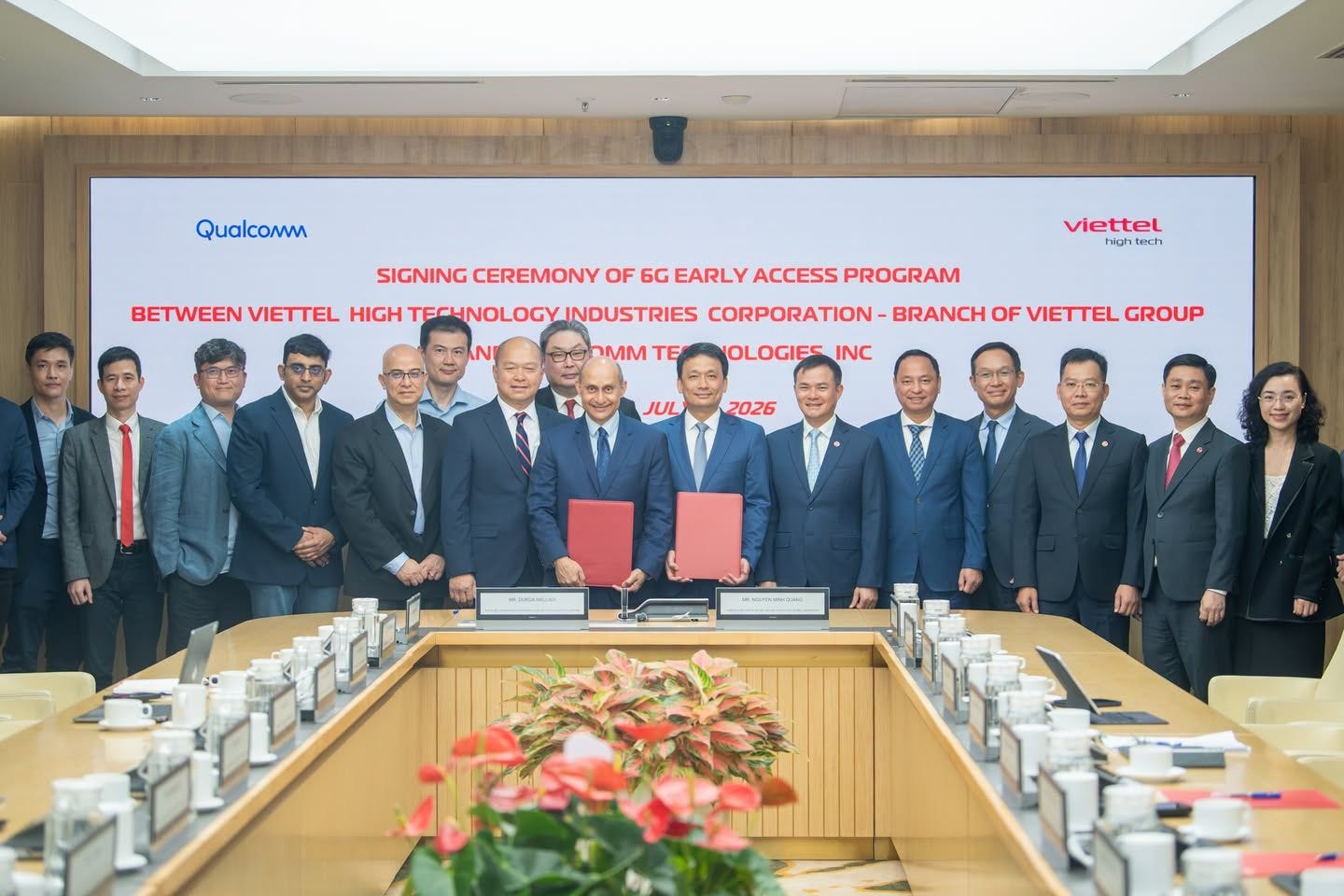
Vietnamese operator Viettel reports it is the first global partner in Qualcomm’s 6G Early Access programme. Under the agreement, Viettel High Tech (its research arm) will receive early access to Qualcomm 6G chipsets, technology platforms, development tools, and engineering support. Qualcomm will provide platform access, technical expertise, and testing methodologies. Viettel will research, test, and integrate these technologies into its network infrastructure and self-developed devices. Both companies aim for a pre-commercial 6G call by early 2029, using a complete network system and devices developed by Viettel.
What’s new: The Early Access programme introduces a new structure below the industry coalition level, shifting the relationship from roadmap alignment to direct access to silicon and tools. Viettel highlights that this is Qualcomm’s first such partnership with a Vietnamese company, rather than with a traditional innovation hub.
Why this matters: Qualcomm’s coalition of over 40 partners, which we covered on 5 March, committed to pre-commercial devices in 2028 and commercial systems from 2029. While a coalition signals intent, the early access programme enables the development of working prototypes, highlighting where Qualcomm sees practical value. Viettel is notable as one of the few operators that designs and manufactures its own radio equipment and devices, making it a true end-to-end integration partner. Vietnam’s ongoing activity in this area includes Ho Chi Minh City’s 6G pilot plan, which we covered in February. The early 2029 target for a pre-commercial call is ambitious and depends on timely Release 21 specifications.
Implications for 6G standards: An operator that develops both base stations and handsets can conduct end-to-end testing of specification-compliant prototypes, which benefits early interoperability efforts. However, no announced activities currently translate into 3GPP contributions. Viettel is not yet a significant participant in working groups, and chipset access alone does not confer influence over standards.
View source material to read more
Speaking at a 6G satellite communication conference in Seoul on 21 July, KT SAT chief executive Choi Kyung-il argued that South Korea’s national low Earth orbit programme is running too late. The Korea AeroSpace Administration said earlier this month that it will launch up to 512 LEO satellites by 2035 to build a Korean satellite communication network. Choi contended that 2035 should be brought forward to 2031, on two grounds. First, satellites launched later cannot occupy the same altitudes as incumbents because of collision risk, so orbital position is effectively a finite territory. Second, Korean space suppliers need deployment track records before global supply chains close around them. He noted that Germany, Japan and India are targeting sovereign satellite networks by 2029.
The defence dimension featured heavily. Lt. Col. Kim Jeong-hwan of the Defense Acquisition Program Administration contrasted geostationary latency of roughly 641 milliseconds with around 30 milliseconds in low Earth orbit, arguing that short latency is essential for controlling unmanned aircraft. Attorney Son Geum-ju of YulChon invoked the recent Anthropic Mythos export-control episode as a warning about dependency. Without ownership of essential infrastructure, he said, “that infrastructure can be restricted at any time by a great power.” Anthropic suspended access to two of its most capable AI models in June to comply with US Department of Commerce export controls, restoring access on 1 July after those controls were lifted.
What’s new: The key development is a commercial satellite operator publicly urging the government to accelerate the national programme by four years, citing the competitive nature of orbital slots and supply chain positions. The Korea AeroSpace Administration’s 512-satellite target is also more specific than previous figures.
Why this matters: KT SAT’s multi-orbit strategy, previously discussed in May, emphasised sovereignty, mobility and universal connectivity. This week, the focus shifts to a specific policy request. Compared to Starlink’s 100,000 and China’s 200,000 satellite filings, which we reported in January, Korea’s 512 satellites offer limited coverage, prompting calls for global partnerships. Japan has committed up to 150 billion yen over three years, with Rakuten Mobile designated as operator. This issue extends beyond Korea, as TN-NTN integration is fundamental to 6G, and most countries will not own the constellations their networks rely on.
Implications for 6G standards: Multi-orbit operation, inter-constellation cooperation, and GNSS-independent positioning are active topics in Release 21 NTN work. The argument that no single national constellation can provide sufficient coverage supports the need for standardized roaming and handover between constellations, rather than relying on a single operator’s fleet.
View source material to read more

A research team at Xi’an Jiaotong-Liverpool University (XJTLU) has published a technical pathway for its Channel Foundation Model (CFM) in the ZTE Technology Journal. Professor Shugong Xu and PhD student Jun Jiang first proposed CFM in 2025 and now detail its construction. CFM treats the wireless channel as the primary subject, using pre-training and fine-tuning methods from large model development. Models learn general-purpose channel representations from extensive, diverse datasets and adapt to specific tasks. Inputs include not only conventional channel state information and impulse response but also multimodal data such as images and location. Xu describes the goal as moving communication systems from “passively adapting to their environment to actively understanding and learning from it.”
What’s new: The team has released two related projects, CSI-CLIP and CSI-MAE, as open source. They have also developed a simulation platform, GREAT-X, to test CFM in dense urban, open suburban, and low-altitude flight scenarios. Industrial validation is conducted through the Low-Altitude Technology Joint Transformation Centre, established with Suzhou Aviation Industry Group, Suzhou Low-Altitude Tech, and research institutions including Gusu Lab.
Why this matters: Channel modelling is where AI-native approaches intersect with physical constraints, and it presents a clear standards challenge. The legacy 3GPP TR 38.901 model faces validity concerns in the upper mid-band, as we previously covered in February. Most wireless AI models are task-specific and do not generalize well, increasing costs at scale. A pre-trained, task-agnostic channel representation could reduce reliance on manually labeled data, addressing operational expenses. The open-source release enables broader testing of these claims. The low-altitude focus aligns with China’s broader industrial initiatives, including efforts by China Mobile and Shanghai’s 6G park.
Implications for 6G standards: The team aims to integrate CFM into international standards. Channel modelling assumptions are fundamental to all RAN1 evaluations, so adopting a foundation-model approach would have broad implications. In the near term, this work aligns with ongoing AI/ML study items for air interface, including CSI feedback and beam management.
View source material to read more
Mehdi Karbalayghareh and colleagues propose AI-integrated sensing and communication (AISAC), a closed-loop framework that combines two usage scenarios the ITU IMT-2030 vision treats separately. They argue that ISAC enables the network to observe the physical world, while AI allows it to learn from these observations. The authors suggest this requires a new physical-layer design principle, where waveform, beam, power, bandwidth, and sensing mode are configured for learning alignment rather than solely for estimation accuracy.
Why this matters: The key insight is that the most accurate sensing configuration by classical standards may not be optimal for training or inference. If true, this challenges the assumption that ISAC and AI can be specified independently and later combined. Both are recognized IMT-2030 usage scenarios, and 3GPP is studying them in parallel.
View source material to read more
Mohammad Farzanullah, Melike Erol-Kantarci, and Lajos Hanzo propose the Perceive-Reason-Act (PERA) paradigm, which integrates Large Wireless AI Models with large language models. The goal is to combine perceptual grounding in wireless telemetry with generalized cognitive reasoning, replacing fragmented, task-specific edge models with a multi-task architecture. A case study examines link-state classification and beam prediction.
Why this matters: The main contribution is the focus on human-readable rationales for physical-layer decisions. Operators have identified trust and explainability as barriers to deploying AI in radio networks. The three-tier design addresses the resource constraints of the wireless edge, where many agentic AI proposals face challenges.
View source material to read more
Vaskar Chakma and Wooyeol Choi present a self-adaptive channel assignment framework for integrated terrestrial and non-terrestrial 6G networks, using Q-learning within a Markov decision process. Agents monitor network load, interference, and traffic dynamics, optimizing for throughput, fairness, and interference. Simulations report a Jain’s fairness index of 0.75 and a 26.3% reduction in interference compared to random allocation.
Why this matters: Spectrum coordination between terrestrial and satellite segments remains an unresolved architectural challenge, as highlighted by this week’s Korean conference. The results are based solely on simulations with random allocation as the baseline, which is a modest benchmark. The primary value lies in the problem formulation rather than the reported performance gains.
View source material to read more
Yaru Fu and colleagues propose token communications (TokCom), which treats tokens as primary entities for information exchange in 6G. They argue that the traditional Shannon framework, focused on reliable bit-level reconstruction for human users, is increasingly unsuitable for networks where interconnected AI agents are the main users. A case study demonstrates token sharing between different language models.
Why this matters: This work expands on the token communication theme previously discussed in June, adopting a broader architectural perspective. The key issue is interoperability. If tokens become the primary transport unit, different models must agree on tokenization, presenting a standardization challenge without a clear owner in the current 3GPP structure.
Comments
Nothing yet. Say the first thing.
Sign in to join the conversation.