
6G news and analysis for the week ending Friday 7th August, 2026.
Spectrum dominates this week’s news with three separate developments that come together rather nicely (for once). At the third APT preparatory meeting for WRC-27 in Sapporo, the ITU-APT Foundation of India and the Bharat 6G Alliance tabled an information document proposing 6425 to 8400 MHz as a harmonised Asia-Pacific “6G Golden Band”. The document was noted rather than adopted, but it is still an important development and is the most expansive regional spectrum vision tabled so far. It also surpasses what European regulators have been prepared to concede.
Out in the real world, Optus and Nokia completed an upper 6 GHz trial in Sydney using 200 MHz of spectrum sitting squarely inside that proposed Golden Band range. The claimed 3.5 Gbps peak is the headline number, but to be honest the coverage result is the more interesting finding. Meanwhile in Washington, the NTIA cleared the study plan for the 4.4 GHz band, putting all four of its pipeline bands under simultaneous study for the first time.
It wasn’t all spectrum this week. Ericsson has been named the sole global vendor in the SK Telecom-led consortium for Korea’s government-backed Hyper-AI Network project. Taiwan’s Executive Yuan approved a NT$27bn programme covering 6G, satellite and all-optical networks. And Cumucore demonstrated local breakout roaming under the EU ORIGAMI project.
As usual, we have selected four research papers for your weekend reading, covering railway sensing, channel extrapolation, vehicular connectivity and deterministic task offloading (hey, it may come up in a pub quiz later...).
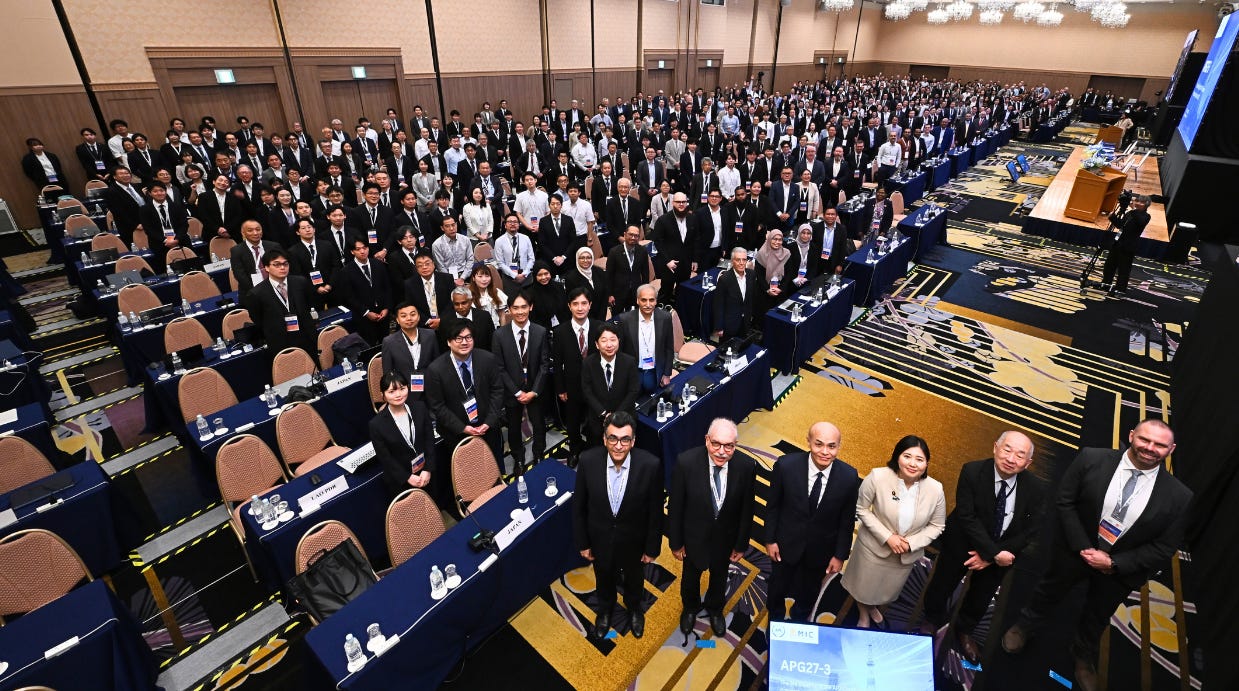
The ITU-APT Foundation of India (IAFI), working with the Bharat 6G Alliance (B6GA), presented an information document on a harmonised Asia-Pacific spectrum roadmap for 6G at the third APT Preparatory Group Meeting for WRC-27 in Sapporo, Japan. The document, designated INF-24, proposes the 6425 to 8400 MHz range as a future harmonised mid-band allocation, branded the “6G Golden Band”. It was formally considered under DG-1.7 of Working Party 2 and noted by the meeting. APG27-3 drew 861 delegates representing 33 APT member countries and 37 affiliate organisations. Bharat Bhatia, President of the ITU-APT Foundation of India and Vice Chairman of APG27, said:
“Our proposal is not about selecting a single band today, it is about creating a shared long-term vision supported by technical studies, collaboration and coexistence with existing services.”
What’s new: The specific range is the real substance here. IAFI recommends that 6425 to 8400 MHz, or at least parts of it, be treated as a regional or global tuning range. This would allow administrations to release spectrum according to national requirements while converging on a common equipment ecosystem. It also sets a long-term objective of 200 to 400 MHz of contiguous spectrum per operator.
Why this matters: The proposed range is considerably wider than anything European regulators have committed to supporting. Ofcom allocated 540 MHz of mobile priority spectrum in the upper 6 GHz band last month, broadly matching the RSPG position, and the GSMA has argued even that is insufficient. The tuning range concept is novel, since it permits national divergence while preserving device economies of scale. It is worth also referencing India’s fifteenfold rise in 3GPP contributions, which is evidence of a country moving from declaratory 6G ambition toward structured, multilateral positioning.
Implications for 6G standards: WRC-27 Agenda Item 1.7 is examining candidate bands for future IMT, and APT Common Proposals carry some weight in that process. If Asia-Pacific converges on 6425 to 8400 MHz while Europe holds nearer 7125 MHz, 3GPP faces the prospect of specifying 6G radio across divergent regional band plans. That is also a hardware cost problem.
View source material to read more
Optus and Nokia have completed a 6G research trial at the Optus Sydney campus, using an existing mobile site alongside a live 5G network. The trial aggregated two 100 MHz channels to use 200 MHz of upper 6 GHz spectrum, from 6890 to 7090 MHz, against a maximum of 100 MHz typically available in the 3.5 GHz band. It used a Nokia AirScale massive MIMO active antenna unit with 768 antenna elements and 128 transceiver chains, a MediaTek M90 test device and a Rohde & Schwarz scanner. Optus reports a peak download speed of 3.5 Gbps. Testing also indicated that the band delivered an outdoor coverage footprint similar to the operator’s existing 5G at 3.5 GHz. Sri Amirthalingam, Chief Technology Officer at Optus, said:
“Achieving 3.5Gbps using upper 6 GHz spectrum demonstrates the significant opportunity this band could provide for future networks as demand for data-intensive applications such as AI services, immersive video, cloud applications and connected devices continues to grow.”
What’s new: The coverage parity result is the finding that really matters here, not so much the peak rate. Optus and Nokia state that upper 6 GHz with a 768-element array matched the outdoor footprint of the operator’s 3.5 GHz 5G layer, implying that much of the existing grid could be reused. The partners also used an AI-powered robotic dog (!) platform to automate indoor signal measurement for network design, which they describe as a world first.
Why this matters: The propagation question has hung over the upper mid-band for years, and this is now the fourth substantial dataset we have tracked. It follows SoftBank and Nokia in Tokyo’s Ginza district, Telefónica and Nokia at Valencia, and Samsung and KT at 7 GHz with a 256-port prototype. The consistency across dense urban Japan, campus Spain and suburban Australia is what gives the coverage argument credibility. The 3.5 Gbps figure sits above the 3 Gbps Samsung and KT reported in February, but the two used different bandwidths and array configurations, so it is not a like-for-like comparison. Australia matters here as a market: Telstra signed a 6G research agreement with Ericsson in May, and the country is now generating its own field data.
Implications for 6G standards: The tested range sits inside 3GPP band n104 and inside the Asia-Pacific tuning range proposed this week in Sapporo. Optus states the results will feed into ITU-R and 3GPP processes. Infrastructure reuse evidence directly supports the migration-from-existing-assets position that operators have pressed throughout the Release 20 requirements work.
View source material to read more
The US National Telecommunications and Information Administration (NTIA) has announced that the Administration has cleared plans to study the 4.4 GHz band for full-power commercial licensed use. With this final study package notified to Congress, plans are now approved for all four bands under consideration: 1.6 GHz, 2.7 GHz, 4.4 GHz and 7 GHz. Approval triggers a 60-day review period by the Commerce and Appropriations Committees before the Office of Management and Budget can release Spectrum Relocation Fund money. Once that period elapses, all four bands will be under study simultaneously. Arielle Roth, Assistant Secretary for Communications and Information and NTIA Administrator, said:
“With today’s announcement on 4.4 GHz, every one of our four pipeline bands is now advancing simultaneously, a historic first that demonstrates we are operating with the speed and precision needed to fulfil our mandate.”
What’s new: This is the completion of a process we have followed in instalments, from the 2.7 GHz Technical Panel approval in April to the Spectrum.gov launch and band-by-band status update in May, when the 4 GHz panel was still reviewing nine departmental plans. The pipeline is now fully engaged.
Why this matters: Congress mandated NTIA to identify 500 MHz of federal spectrum for commercial use within five years, and the President subsequently directed completion of the 7.125 to 7.4 GHz study within twelve months. Running four band studies in parallel is a resourcing decision as much as a policy one and it carries execution risk. Study plans are not spectrum, and the engineering work protecting incumbent federal missions is where these processes historically slow down. The political framing around 6G leadership remains heavier than the technical reality, since these are general-purpose mobile bands rather than 6G-specific ones. That said, the cadence has been consistent for eight months, which is more than can be said for most spectrum pipelines.
Implications for 6G standards: The 4.4 GHz range sits below the upper mid-band consensus forming elsewhere, which makes the US pipeline notably broader than the Asia-Pacific and European positions. Vendors need band certainty by roughly 2028 to have commercial products ready for end-of-decade deployment, so clearance speed feeds directly into Release 21 product planning.
View source material to read more
Ericsson has been selected as the sole global technology partner in the SK Telecom-led consortium for Korea’s Hyper-AI Network Infrastructure Demonstration Project. The initiative is backed by Korea’s Ministry of Science and ICT and the National Information Society Agency, and forms part of the national “AI Highway” agenda. SK Telecom will build AI-RAN pilot networks and demonstrate three physical AI services through 2027, working with network, AI, robotics and industrial partners. In the second phase, the pilot network is expected to be deployed in a live logistics environment at KG Mobility’s Pyeongtaek plant. Ericsson will contribute AI-RAN capability, its Intelligent Automation Platform and AI-powered rApps. Takki Yu, VP and Head of Network R&D at SK Telecom, said:
“Together, we aim to build a strategic win-win partnership, demonstrate real industrial value, and help strengthen Korea’s AI-RAN technology capabilities and ecosystem for the future.”
What’s new: The move from laboratory validation to a working automotive plant in phase two is the part worth watching. The project also intends to compare different vendor architectures, computing configurations and deployment models, which would generate genuinely comparative AI-RAN data rather than single-vendor demonstrations.
Why this matters: Korea now has three overlapping AI-RAN projects running concurrently: the ETRI-led AI-RAN Global Leading Project, the AI Network Alliance launched at MWC, and this ministry-backed demonstration programme. For Ericsson, sole global vendor status builds on the 6G MoU it signed with SK Telecom in March and continues a pattern of operator partnerships stretching from Türkiye to Australia. It’s worth noting the technology base: The project rests on 5G Standalone and 5G-Advanced capabilities, with AI-RAN layered on top. This is 6G preparation rather than pure 6G, and the press release is somewhat candid about that.
Implications for 6G standards: AI-RAN remains an implementation choice rather than a 3GPP requirement, but accumulated deployment evidence shapes what becomes specifiable. Ericsson states the project will generate insights for future standardisation, and comparative vendor data on distributed AI computing would be directly relevant to the AI-native architecture debates running through Release 21.
View source material to read more
Taiwan’s Executive Yuan has approved a NT$27 billion development programme, worth approximately US$833 million, running from 2025 to 2030. The programme supports commercialisation of 6G and satellite applications, deployment of test networks and expansion of the domestic communications ecosystem. It is framed as a shift from early-stage research into commercialisation, building on groundwork completed in 2025. Speaking at a forum on 4 August, Ming-Der Shieh of National Cheng Kung University and the Southern Taiwan Silicon Valley Promotion Office argued that the future of communications will be defined by the convergence of optical infrastructure and AI rather than by speed alone. The story was reported by Digitimes.
What’s new: The funding decision is the substance. Taiwan has also been building practical optical credentials, and the Southern Taiwan Silicon Valley Promotion Office ran a Taiwan-Japan all-optical interconnection test in April 2026 with Chunghwa Telecom, Accton Technology, the National Center for High-Performance Computing and NTT. Test sites were more than 1,000 km apart across a fibre route of roughly 3,000 km, with latency reported as barely perceptible.
Why this matters: Taiwan has been moving steadily rather than loudly. Its Ministry of Digital Affairs opened a 6G spectrum review in May, with an allocation plan promised by the end of 2026, and ITRI signed agreements with 6G-IA and TNO at EuCNC in June. This programme adds the finance. The strategy is straightforward, since Taiwan’s semiconductor and networking supply chain stands to benefit from any 6G upgrade cycle and alignment with NTT’s IOWN roadmap gives local suppliers a route into the optical-AI ecosystem. IOWN’s 2030 targets are ambitious, with a stated 125-fold capacity increase and a 100-fold power efficiency improvement and should be read as programme goals rather than commitments.
Implications for 6G standards: All-optical transport sits largely outside the 3GPP remit but shapes what the radio layer can assume about backhaul and fronthaul. Taiwan’s more direct standards influence runs through ITRI’s European partnerships and its FR3 base station chipset work, rather than through this funding decision.
View source material to read more
Finnish private network software vendor Cumucore has demonstrated a local breakout roaming API as part of the EU-funded ORIGAMI project. The demonstration addresses roaming between non-public networks without routing traffic from the visited network back to the home network. Cumucore used Network Exposure Function and Security Edge Protection Proxy functionality together with network slicing to keep the roaming session managed and secured locally while remaining standards compliant. ORIGAMI, funded under the Smart Networks and Services Joint Undertaking, has run since 2024 and concludes later this year. Jose Costa-Requena, CEO of Cumucore, said:
“As we move toward 6G, we expect to see architectures where the Radio Access Network and Core are more tightly integrated, enabling stronger control mechanisms to differentiate services in non-public mobile networks.”
What’s new: The specific contribution is a working local breakout path for non-public network roaming, built from existing standardised functions rather than new ones. Andres Garcia-Saavedra of NEC Laboratories Europe notes that ORIGAMI has generated 6G architecture research across more than 30 use cases over 30 months.
Why this matters: Enterprise and non-public networks are one of the few 6G revenue arguments that does not depend on consumer behaviour changing. The architectural question ORIGAMI is asking is real, since current roaming assumptions were designed for public networks and sit poorly with enterprises that want traffic to stay on site for latency, sovereignty or security reasons. Andra Lutu of Telefónica frames the result as giving operators and enterprises a genuine choice in how they build and control networks. It should be noted that the functions demonstrated - NEF, SEPP and network slicing - are all 5G Core elements. This is 5G used to probe a 6G question, not a 6G capability. We covered ORIGAMI in November when emnify outlined its role, and the project’s Global Service-Based Architecture concept was submitted to the 3GPP 6G Workshop.
Implications for 6G standards: ORIGAMI concepts are already on record with 3GPP through the workshop process. Whether non-public network roaming gets first-class treatment in the 6G core architecture, rather than the bolt-on status it has today, is a live question for SA2 as Release 21 work firms up.
View source material to read more
Ajeet Kumar Yadav and colleagues apply integrated sensing and communication to railway intrusion detection, one of the 32 potential ISAC use cases identified in 3GPP Release 19. The team generated 22,695 channel state information matrices using a 3D-rendered railway environment and the Sionna radio simulator, then trained a combined 3D convolutional neural network and bidirectional LSTM model. On synthetic data the model reports 99.57 per cent intruder detection accuracy, alongside estimates of position, velocity and time to collision.
Why this matters: Sensing use cases have been long on ambition and short on quantified performance, so a specific safety application with published code is useful. The caveat is significant, since results come entirely from simulated CSI rather than field measurement, and detection accuracy on synthetic data sets an upper bound rather than a deployment expectation. Railway intrusion is nonetheless a credible anchor use case, and it aligns with the environmental sensing scenarios that operators including Telstra tabled at RAN #111.
View source material to read more
Yuan Gao and colleagues, including Shugong Xu, propose a three-stage framework for AI-driven channel extrapolation, which infers complete channel state information from a small known portion. The approach groups neurons with similar weight-space patterns into specialised “experts”, then uses a lightweight gating function fine-tuned per scenario to route between them. The authors report extrapolation error reductions of 1.1 to 19.1 dB and a 38 per cent cut in computational complexity.
Why this matters: Generalisation across scenarios is the persistent weakness of AI in the air interface, and it is the reason operators resist deploying models that work in one cell and fail in the next. This paper attacks that directly, and it complements the channel foundation model roadmap from XJTLU we covered on 24 July, where Xu is also involved. CSI feedback overhead is an active AI/ML study topic in 3GPP RAN1, so computational efficiency claims of this kind have a clear route into the standards conversation.
View source material to read more
Weiqi Chi and colleagues address user association in millimetre-wave vehicular networks, where moving blockages break the stationary assumptions behind conventional multi-armed bandit approaches. They propose a distributed blockage-aware algorithm and a semi-distributed extension that lets vehicles share reward estimates through a macro base station. Simulations on an urban topology report regret reductions of 34.9 and 59.4 per cent respectively against a centralised baseline.
Why this matters: Reliable millimetre-wave connectivity for autonomous driving remains unsolved, and centralised approaches that require full CSI acquisition do not scale to dense base station deployments. The distributed design avoids both centralised CSI and offline training, which matters for practical deployment. Performance held across blockage rates from 10 to 50 per cent, though the evaluation remains simulation-based.
View source material to read more
Keyvan Aghababaiyan, Baldomero Coll-Perales and Javier Gozalvez argue that existing task offloading strategies for the IoT-edge-cloud continuum decide only where a task runs, and assume processing begins immediately on arrival. That assumption creates transient congestion when tasks coincide. Their approach exploits the latency budget of each task to control when execution starts as well as where, spreading workload over time while still meeting deadlines. Reported gains include a 70 per cent higher satisfaction ratio and 40 per cent lower communication resource usage.
Why this matters: Deterministic performance, rather than peak throughput, is the capability operators and industrial users most consistently ask of 6G. This paper makes a simple but underexplored point, that scheduling in time is as important as placement in space when guaranteeing deadlines. Compute placement recurs across 3GPP 6G Workshop submissions under computing-as-a-service headings, and timing control adds a dimension that current architectural discussions largely omit.
Comments
Nothing yet. Say the first thing.
Sign in to join the conversation.