
6G news and analysis for the week ending Friday 22nd May, 2026.
The integration of terrestrial and non-terrestrial networks has been a fixture of 6G discourse since the 3GPP 6G Workshop, but this week it acquired a sharper commercial edge. KT SAT used a Singapore industry conference to reposition itself from a satellite capacity provider into what it calls a “Total Space Solution Provider,” staking a claim on sovereign connectivity and multi-orbit operation as the 6G era’s defining requirements. It is a vision statement rather than a deployment (and we tend to veer away from visionary messages), but it does reflect how seriously satellite operators are taking TN-NTN convergence.
The week’s most grounded result came from KDDI Research and Nokia Bell Labs, who demonstrated a base station technology that cut power consumption by up to 40% at constant throughput, or delivered up to four times the throughput at constant power. With the radio access network accounting for the bulk of network energy use, this is the kind of measured progress that energy-efficiency goals for 6G demand. Remember the use of “Green Native” from last year’s workshop?
A third strand was geographic. Telstra and Ericsson signed a letter of intent on 6G research for Australia, while a Finland–Japan research workshop and a Finland–Korea ministerial meeting underlined how 6G cooperation is being built bilaterally as much as multilaterally.
We also cover a 560 GHz terahertz transmission record from Tokushima University, and four research papers led by a provocative argument for operator-controlled 6G grounded in the Rakuten Mobile experience.
I’ve just returned from hosting TelecomTV’s DSP Leaders World Forum event, so will pick up on relevant 6G news next week. To be fair, there’s wasn’t a lot of direct news, but a huge amount of related AI-native material. Head over to the TelecomTV website for more.
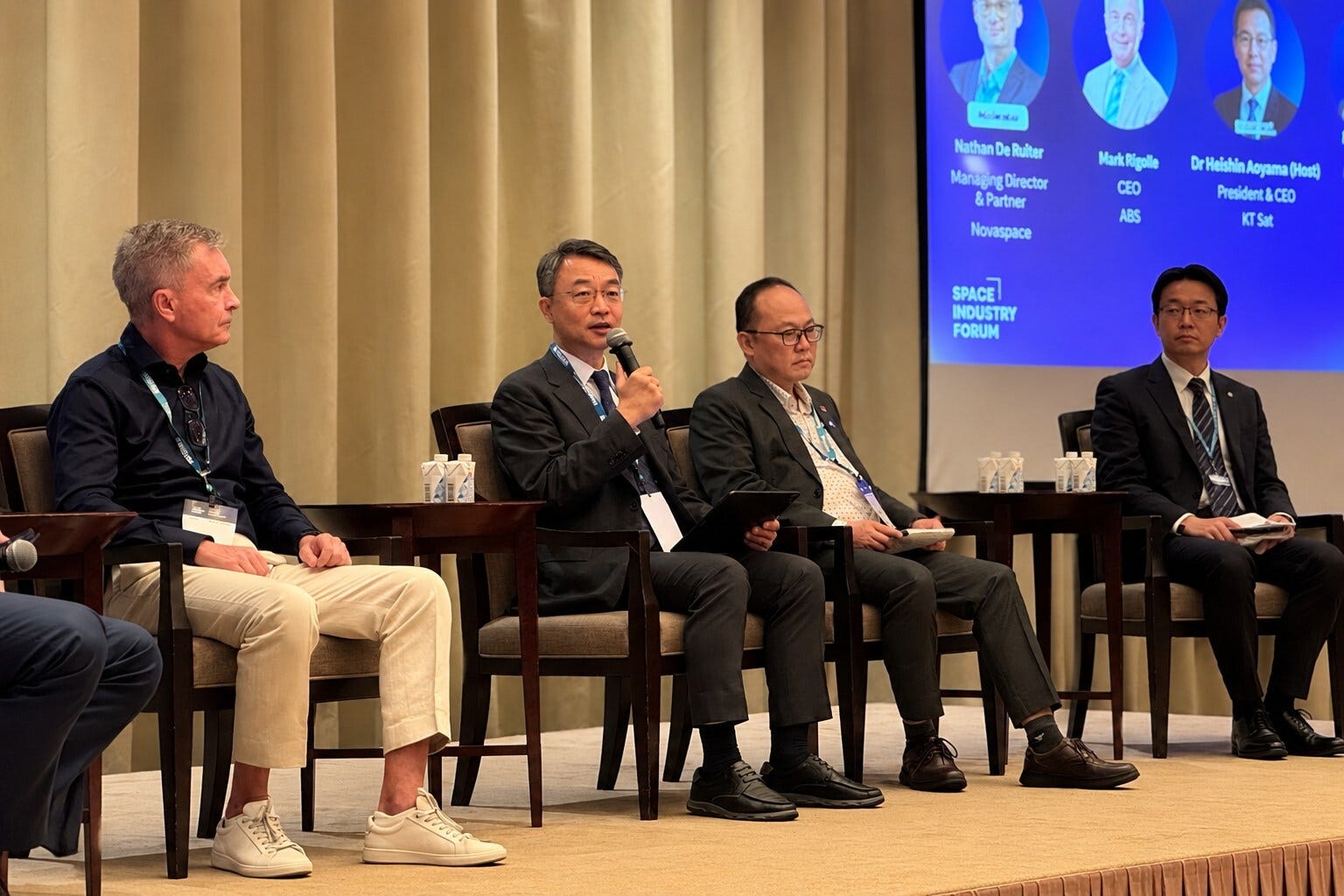
KT SAT, the satellite arm of South Korea’s KT Corp., used a panel at the Space Industry Forum during Asia Tech x Singapore to set out a strategy built around multi-orbit connectivity and sovereign networks. President and CEO Kevin Kyeong-il Choi argued that the industry is moving away from a traditional GEO capacity business towards a managed service model spanning GEO, MEO and LEO. He identified three themes shaping the future market: sovereignty, mobility and universal connectivity. Choi positioned terrestrial-satellite integration as essential to the 6G era, and pointed to the company’s XWAVE-ONE SD-WAN platform, which already combines satellite and terrestrial networks to serve hundreds of vessels.
Choi was explicit on the sovereignty point, stating that “in the future, cooperation among globally interconnected sovereign networks will become increasingly important.”
What’s new: KT SAT showcased an operational concept for defence aviation satellite solutions and a positioning, navigation and timing (PNT) direction based on Two-Way Satellite Time and Frequency Transfer (TWSTFT), which it says can operate in GNSS jamming and spoofing environments. The latter directly addresses GNSS-independent operation, one of the most consistent NTN requirements voiced at the 3GPP 6G Workshop.
Why this matters: Satellite operators are repositioning ahead of 6G, and KT SAT’s framing tracks the broader industry consensus that customers want seamless connectivity rather than a particular orbit. The sovereignty theme is significant: it echoes European concerns about dependency on commercial constellations, but here it comes from an Asian operator and is tied to national security. Multi-orbit operation, GNSS-independent PNT and TN-NTN integration are all live topics in the 3GPP NTN discussion. The caveat is that this is a strategy presentation at an industry forum, not a technical deployment or a standards contribution.
Implications for 6G standards: Multi-orbit cooperation and GNSS-independent operation feature prominently in the NTN priorities extracted from 3GPP submissions and are being studied for Release 21. An operator articulating commercial demand for these capabilities adds weight to the case being made by satellite players such as Thales, SES and SKY Perfect JSAT.
View source material to read more
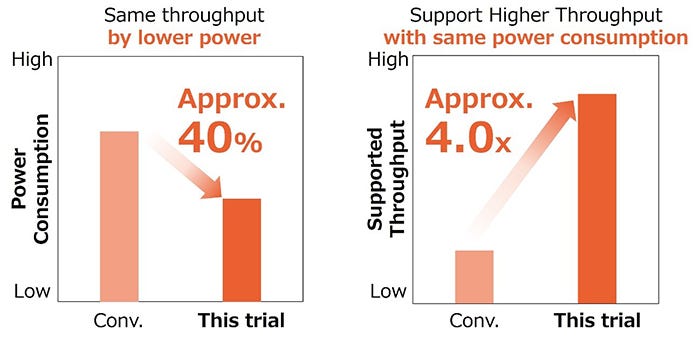
KDDI Research and Nokia Bell Labs have demonstrated a base station technology, called Intelligent 4D Resource Optimisation, that they say reduces power consumption by up to approximately 40% at the same throughput, or supports up to four times the throughput without raising power, compared with existing 5G base station equipment. The proof-of-concept was conducted in March 2026 at Nokia Bell Labs in Murray Hill, New Jersey, in a radio anechoic chamber emulating a commercial 5G deployment, using commercial equipment. The technique jointly optimises four radio resources that have conventionally been controlled separately or only partially together: time, frequency, space and transmission power.
Harish Viswanathan, Head of the Radio Systems Research Lab at Nokia Bell Labs, said energy savings were achievable “through a combination of antenna muting and power control coupled with traffic load dependent intelligent time and frequency resource allocation.”
What’s new: The headline is the integrated, four-dimensional control on commercial hardware, which KDDI Research claims as a world first. Rather than tuning each resource in isolation, the system can, for example, deliberately use more time and frequency resources while suppressing transmission power and muting unused antennas. The two companies signed a further joint research agreement on 23 April 2026 to extend the work.
Why this matters: This is the first concrete result from the Nokia–KDDI Research energy-efficiency collaboration we reported when the partnership was signed in November 2025. Energy is becoming a hard design constraint for 6G rather than an afterthought, driven by the expectation that base stations will densify and that AI traffic will grow sharply. A 40% power reduction at constant throughput is a meaningful figure precisely because it was measured on commercial-grade equipment, not in pure simulation. The work maps directly onto Japan’s Beyond 5G “ultra-low power consumption” requirement and to the sustainability themes that run through almost every operator’s 6G requirements. The figures remain lab-trial results in an emulated environment, so field validation across multiple cells and bands is the necessary next step, which the companies acknowledge.
Implications for 6G standards: The two companies say they intend to pursue standardisation of the technology in the 3GPP 6G specifications. Integrated control of time, frequency, spatial and power resources would feed into the energy-efficiency and massive MIMO power-control work that several operators have flagged as a Release 20/21 priority.
View source material to read more
Telstra and Ericsson have signed a letter of intent to collaborate on 6G research and trials, framed within Telstra’s “Connected Future 30” strategy. The agreement covers joint work on 3GPP standards evolution and gives Telstra engineering teams access to Ericsson’s 6G testbed in Sweden. In a reciprocal arrangement, Ericsson engineers will spend time at Telstra’s Innovation Centre on the Gold Coast to study how 6G behaves in different geographic conditions.
Erik Ekudden, Chief Technology Officer at Ericsson, described a trajectory “from 5G Standalone today, to AI-powered 5G and autonomous networks, towards AI-native 6G,” while Telstra‘s Shailin Sehgal characterised 6G as “the first G which is AI-native.”
What’s new: The reciprocal testbed exchange is the practical core of the agreement: Telstra gains access to Ericsson’s Swedish 6G testbed, and Ericsson gains a real-world Australian environment to test geographic variation. Both parties also flag spectrum access and investment certainty as conditions for realising 6G benefits.
Why this matters: Telstra is a substantive voice in the 3GPP 6G process, having contributed to the workshop and to several RAN #111 coalitions on NTN, ISAC environmental sensing and time-critical communications. This agreement converts that standards engagement into a concrete bilateral research relationship with a tier-one vendor. It also extends Ericsson’s now-familiar pattern of operator partnerships, following deals with Türk Telekom and Turkcell, and it places Australia more firmly on the 6G research map. The “AI-native” language is consistent with industry consensus, though it remains a positioning claim until trials produce results. The “Network as a Product” and environmental-sensing use cases Telstra cites align with its own ISAC submissions to 3GPP.
Implications for 6G standards: Joint work explicitly targeting 3GPP standards evolution, combined with testbed access, creates a pathway from trial data into Release 21 contributions. Telstra’s interest in sensing for public safety, agriculture and weather detection reinforces the ISAC use-case work already tabled at RAN #111.
View source material to read more
Researchers at Tokushima University have demonstrated single-channel wireless transmission at 112 Gbps in the 560 GHz band using soliton microcombs, which they describe as the first 100 Gbps-class wireless link beyond 420 GHz. Conventional electronic methods struggle above roughly 350 GHz because output power falls and phase noise rises. The team sidestepped this by using fibre-coupled microcombs to generate a low-noise terahertz carrier via photomixing, achieving 84 Gbps with QPSK modulation and 112 Gbps with 16QAM. The work is published in Communications Engineering.
Professor Takeshi Yasui of Tokushima University said the result “represents a major step toward practical 6G wireless systems and ultra-high-speed mobile backhaul.”
What’s new: The distinguishing feature is the use of a compact, fibre-coupled silicon nitride micro-resonator with integrated temperature control, which removes the need for precise optical alignment and improves long-term stability. This is positioned as a platform for low-noise terahertz signal generation, with the immediate application being ultra-high-speed mobile backhaul.
Why this matters: Sub-THz and terahertz frequencies are central to the extreme data rate scenarios in the ITU-R IMT-2030 framework, and stable signal generation at these frequencies is one of the harder engineering problems. This result extends the body of high-frequency demonstrations we have tracked, including ETRI’s 200 Gbps sub-THz link and Kyoto University’s THz mobility testbed. The backhaul framing is realistic: terahertz links are far more likely to serve fixed point-to-point backhaul in early 6G than to reach handsets. As ever with these records, the next steps, longer range, higher-order modulation and better terahertz output power, are precisely the unsolved parts.
Implications for 6G standards: Terahertz integration is expected in later 3GPP releases rather than Release 20 or 21, but workshop contributors noted that spectrum above 100 GHz should be considered once efficient implementations exist. Demonstrations of stable, compact signal sources strengthen the evidence base for that longer-term work.
View source material to read more
The University of Oulu, Japan’s National Institute of Information and Communications Technology (NICT) and three Japanese universities met in Oulu on 18–19 May for the third joint workshop under a beyond-5G and 6G research partnership. NICT was joined by researchers from Tokyo University of Science, Shinshu University, Kyushu Institute of Technology and the Advanced Telecommunications Research Institute International (ATR). The agenda ranged across integrated circuits, AI, cybersecurity, software research and the business of 6G networks. The connecting theme was local 6G: networks operated by a single organisation for a campus, factory, port or hospital, where Oulu’s research on spectrum, business models and regulation meets NICT’s parallel work on efficient spectrum use in private networks.
Marja Matinmikko-Blue, Director of Sustainability and Regulation at 6G Flagship, who convened the two days, said the partnership had “moved past the introductions,” with running collaboration on local 6G and a renewed memorandum of understanding now extending the work to 2028.
What’s new: The underlying MoU, originally signed in August 2022, was renewed earlier in 2026 to run until 2028, covering researcher exchange, information sharing and joint projects. The workshop also surfaced collaboration on quantum and AI system security, with Kimmo Halunen’s group releasing a new evaluation framework, and NICT demonstrated a cybernetic avatar robot in Japan operated live from Oulu.
Why this matters: Local, or non-public, networks are an under-discussed but commercially important slice of the 6G picture, sitting between consumer mobile and large-scale industrial deployment. Finland and Japan are two of the most research-active 6G nations, and a sustained three-year partnership with a concrete shared agenda is more substantial than the many statements of intent that characterise international 6G cooperation. The presence of NICT’s new president and Oulu’s faculty dean signals institutional commitment on both sides. This is genuine research collaboration rather than a policy gesture.
Implications for 6G standards: Local 6G touches spectrum policy and regulation as much as radio design, areas where 3GPP intersects with national regulators and the ITU. Research on spectrum sharing and private-network reliability can inform both the deployment scenarios under study in TR 38.914 and the wider regulatory groundwork for 6G.
View source material to read more
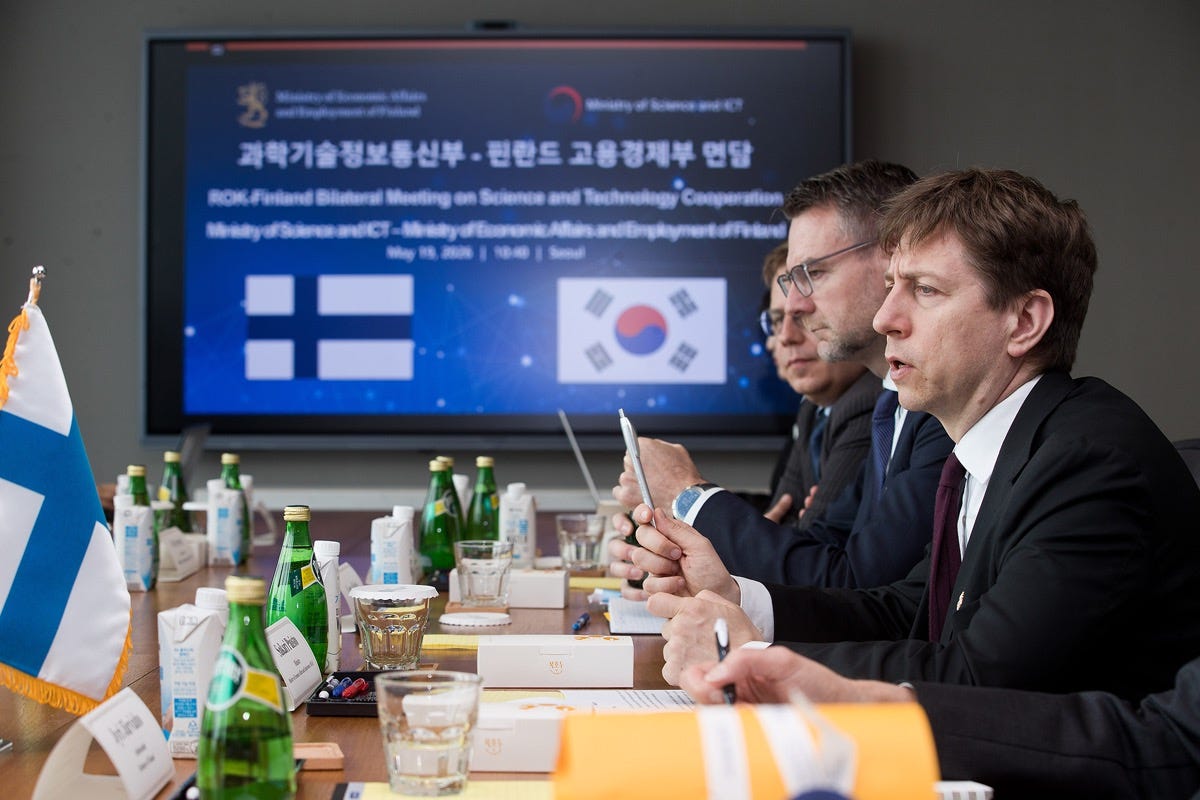
South Korea’s Ministry of Science and ICT (MSIT) and Finland’s Ministry of Employment and the Economy held a ministerial meeting in Seoul on 19 May to strengthen cooperation in science, technology and digital sectors, with AI, quantum computing and 6G identified as central to digital competitiveness. First Vice Minister Koo Hyuk-chae met Finland’s Minister of Employment and the Economy Sakari Puisto, building on the visit of Finnish technology envoy Antti Vasara in March. Both sides welcomed the launch of seven joint projects worth a total of €118.5 million (approximately 206.5 billion KRW) through the EU’s Horizon Europe programme, and agreed to update a 2019 Memorandum of Understanding on Digital Economy Cooperation.
Koo said the combination of “Korea’s excellent ICT manufacturing and operational capabilities and Finland’s advanced source technologies” could generate strong synergy in the future digital market.
What’s new: The substantive development is the move from intent to execution. A new joint research call in 6G and quantum drew roughly 50% more proposals than the previous round, the 2019 MoU is being revised to match current strategic priorities, and the partnership is expanding from information-sharing into practical support for joint projects between research institutions and companies, plus talent exchange.
Why this matters: We covered the first Koo–Vasara meeting in March, organised at Helsinki’s request; this is its concrete follow-up two months on. The pairing is logically complementary: Finland brings foundational technology strength through Nokia and the University of Oulu, while Korea brings manufacturing scale and the systematic national 6G programme we have tracked through AINA, the Samsung 6G fund and Korea’s three-year roadmap. The 50% rise in joint proposals is a useful demand signal that the cooperation is generating real research interest rather than diplomatic communiqués. As with all such partnerships, the open question is whether the activity translates into aligned technical positions inside 3GPP.
Implications for 6G standards: Finland and Korea wield significant 3GPP influence, Finland through Nokia and Korea through TTA and its vendors. Closer alignment, backed by jointly funded Horizon Europe projects, could strengthen coordination on shared standards positions ahead of Release 21 normative work and WRC-27.
View source material to read more
David Soldani argues that five generations of vendor-led architecture have left operators running networks they neither own nor can fully audit, and that 6G should reverse this by putting operator control first and technology last. The paper proposes a three-layer ownership model (own, federate, consume) and an outcome-priced “Guarantee Economy,” using Rakuten Mobile’s cloud-native Open RAN deployment, which reached full-year EBITDA profitability in FY2025, as evidence that operator-controlled 6G is feasible.
Why this Matters: This is a deliberately provocative reframing of the 6G architecture debate around ownership and commercial control rather than radio performance, and it aligns with the cloud-native, AI-native, multi-vendor positions Rakuten and others tabled at the 3GPP 6G Workshop. The author is SVP Next Generation Advanced Research at Rakuten Mobile, so the Rakuten-centric framing should be read with that vantage point in mind, but the underlying argument about vendor dependency is one many operators share.
View source material to read more
This survey consolidates fragmented research across sensing, communication and edge AI into a structured overview of “edge perception,” the ability of the network edge to sense, interpret and act on its physical environment in a task-aware, resource-aware way. It examines how edge AI enhances sensing across in-band and out-of-band modalities, and covers integrated sensing-communication-computation designs and active perception frameworks.
Why this Matters: Edge perception sits at the intersection of ISAC and edge AI, two of the most prominent 6G capabilities, and a well-structured survey is useful for orienting the field as these threads converge. The integrated sensing-communication-computation framing reflects where 3GPP ISAC discussions and AI-native architecture work are heading.
View source material to read more
This paper tackles timely status updating, measured by the Age of Information metric, as a carbon-minimisation problem rather than a pure energy-minimisation one, noting that the carbon cost of a transmission depends on when it happens because grid carbon intensity varies over time. The authors formulate the problem as a constrained Markov Decision Process and propose SAOITHE, a Whittle-index-based scheduler that stays within a carbon budget while lowering Age of Information.
Why this Matters: It is a neat reframing that distinguishes minimising energy from minimising carbon, which matters as sustainability becomes a measurable 6G design target rather than a slogan. Using real-world carbon-intensity traces, the reported gains, around 20–25% in low- and medium-carbon regions and up to 75% in high-carbon settings, suggest meaningful headroom for carbon-aware scheduling in dense 6G edge deployments.
View source material to read more
This paper proposes a framework that uses 6G networks and 6G-enabled cloud computing to address challenges in smart-home automation, including timely updates, real-time big-data processing and security. It adds enhanced security, data pre-processing, big-data intelligence and security-service virtualisation in the cloud, illustrated through application scenarios including safe routing during disasters.
Why this Matters: It is an applications-layer view of what 6G connectivity and edge-cloud capacity could enable in the home and the wider smart city, complementing the more infrastructure-focused research elsewhere in this edition. The disaster-routing case study connects to the resilience and ubiquitous-connectivity themes that recur across 6G requirements work.
Comments
Nothing yet. Say the first thing.
Sign in to join the conversation.