
6G news and analysis for the week ending Friday 15th May, 2026.
Nokia dominated this week’s news with the appointment of Emma Falck as President of Mobile Infrastructure and member of the Group Leadership Team, effective 1 September 2026. Falck arrives from Siemens, where she ran the products division of Smart Infrastructure Buildings. The appointment matters less for who is leaving and more for who is arriving: an industrial automation executive, not a seasoned radio engineer, is being placed in charge of the historic core of Nokia’s business. Read alongside the recent elevation of Pallavi Mahajan to Chief Technology and AI Officer, the leadership pattern at Espoo is now unmistakably oriented toward what CEO Justin Hotard has been calling “physical AI”, networks as infrastructure for autonomous systems, industrial control loops and on-tower compute, rather than simply pipes for consumer data.
The open-source RAN story moved on this week too. Qualcomm has joined the OCUDU Ecosystem Foundation as a Premier Member, with Doug Knisely taking a seat on the Governing Board. This is a notable addition to an initiative we have been tracking since the DoD FutureG Office funded the original DeepSig/SRS contract in October 2025. Separately, NextNav joined OCUDU to contribute work on 3GPP Positioning Reference Signal (PRS) integration for ISAC and PNT (a relevant follow-on from NextNav’s contribution at the recent 3GPP RAN #111 plenary in Fukuoka).
Korea provids the technology stories this week. HFR has joined ETRI’s AI-RAN Global Leading Project to develop GPU-based AI-RAN software, while a KAIST team has published microcomb-based optical chip results that generate ultra-low-noise signals at 22 GHz, 44 GHz and 66 GHz. We also have an OCUDU-relevant announcement from NextNav, a Taiwan spectrum review, a new German NTN test lab, and five research papers covering optical transport, D2C versus 3GPP NTN, traffic prediction, AI-native mobility data and agent-driven channel generation.
Thanks for reading 6G Futures! Subscribe for free to receive new posts and support my work.
Nokia appoints Falck to lead Mobile Infrastructure

Nokia announced the appointment of Emma Falck as President of Mobile Infrastructure and member of the Nokia Group Leadership Team, effective 1 September 2026. Falck joins from Siemens, where she serves as Executive Vice President, Products, Smart Infrastructure Buildings, leading product management, development and supply chain across a global organisation. Before Siemens, she was a Partner and Managing Director at Boston Consulting Group and held senior leadership roles at KONE. She holds a PhD in Computational Physics from Aalto University. Justin Hotard, President and CEO of Nokia, said:
“As AI moves toward physical AI, networks need to become AI-native by design for both 5G Advanced and 6G. Our focus in Mobile Infrastructure is clear: to help our customers succeed by building a software-led infrastructure business that leverages open interfaces, standards, and a rich partner ecosystem to accelerate innovation.”
Falck added that her priority is to “embed AI into our development and delivery processes, and bring the next wave of innovation to our customers.”
A widely read opinion piece by analyst Sebastian Barros placed the appointment in broader context, arguing that the choice of a computational physicist and industrial automation executive (rather than a career radio engineer) represents a structural pivot for Nokia. Barros notes that Falck’s Siemens background covers the digitisation of physical spaces, with experience of the deterministic latency, predictive maintenance and industrial safety requirements of automated infrastructure. The piece reads the appointment as part of a deliberate alignment with the AI-RAN partnership with NVIDIA announced in late 2025, where every cell site is positioned as a potential distributed AI compute node.
What’s new: Falck’s appointment is the latest in a sequence of senior hires that have reoriented Nokia’s leadership away from the traditional radio engineering archetype. The continuity with Hotard’s existing strategy is clear: AI-native networks, software-led infrastructure, open interfaces and partner ecosystems. These are themes that have run through every major Nokia announcement since the Oulu campus opening in September 2025.
Why this matters: Mobile Infrastructure is Nokia’s largest business and the most exposed to the structural pressures on the consumer telecoms market. With RAN revenues barely growing and operators constraining capex, the strategic question for vendors is whether the next revenue pool comes from selling faster radios to operators or from enabling AI workloads and industrial automation on top of the network. Falck’s industrial pedigree positions Nokia for the latter scenario. The leadership signal is consistent with the wider repositioning seen at Ericsson and across the AI-RAN Alliance. It also reinforces the operator-vendor consensus that emerged from the 3GPP 6G Workshop in March 2025, where AI-native, software-defined networks were a near-universal theme.
Implications for 6G standards: Nokia chairs SA3 and contributes heavily across the 3GPP working groups. A leadership team weighted toward computational and industrial AI expertise is likely to push harder on the AI-native and physical AI elements of the 6G specification, including service awareness, deterministic latency for industrial use cases and AI-RAN interfaces. The phrase “AI-native by design for both 5G Advanced and 6G” sets expectations that Nokia will continue to advocate for evolutionary, backward-compatible 6G design.
View source material to read more — Nokia announcement
View source material to read more — Sebastian Barros analysis
Qualcomm and NextNav join OCUDU Ecosystem Foundation
The OCUDU Ecosystem Foundation, hosted by the Linux Foundation, added two notable members this week. Qualcomm Technologies joined as a Premier Member, with Doug Knisely, Senior Director, Technical Standards, taking a seat on the Foundation’s Governing Board. Separately, NextNav, a US specialist in 3D positioning, navigation and timing (PNT), joined as a general member to advance Open RAN integration of 3GPP Positioning Reference Signals (PRS). Qualcomm joins a Premier Member group that already includes AMD, AT&T, DeepSig, Ericsson, Nokia, NVIDIA, Samsung, SoftBank, Software Radio Systems and Verizon, alongside roughly 60 general and associate members. Lorenzo Casaccia, Vice President, Technical Standards at Qualcomm Technologies, said:
“By joining the OCUDU Ecosystem Foundation, Qualcomm Technologies looks forward to contributing its Open RAN and standards expertise to advance open-source CU/DU platforms and accelerate 5G and early 6G Open RAN network innovation and ecosystem.”
NextNav’s contribution will focus on integrating PRS into the OCUDU Technical Project code base, extending the open-source RAN stack to natively support Integrated Sensing and Communications (ISAC) and PNT use cases. Santanu Dasgupta, NextNav’s Vice President of Product Development, said:
“Resilient PNT is a national security imperative. We’re excited to partner with the OCUDU Ecosystem Foundation and the Department of War’s FutureG Office to make ISAC and PNT built-in features of wireless networks.”
NextNav already operates what it describes as the world’s first 5G PNT network, launched in Santa Clara, California, and its sovereign-PNT contribution was tabled at the recent 3GPP TSG RAN #111 plenary in Fukuoka.
What’s new: The Qualcomm membership is significant. The original OCUDU contract was awarded to DeepSig and SRS by the US Department of Defense’s FutureG Office in October 2025. Premier Membership and Board representation by Qualcomm now anchor the leading chipset vendor inside the same open-source initiative. NextNav brings 20 years of PNT field experience, including the only commercially operating 5G PNT deployment.
Why this matters: OCUDU has expanded rapidly from a DoD-funded research contract to a 60-plus member Linux Foundation programme that includes most of the leading RAN vendors and several major US operators. Qualcomm’s involvement aligns its substantial 3GPP and Open RAN standards work with the open-source code base, which has been a notable absence until now. NextNav’s PRS work addresses ISAC and PNT, which are two technologies that featured prominently in 3GPP 6G Workshop submissions and dominated the requirements discussions at RAN #111. Both are also relevant to the US government’s growing emphasis on GNSS-resilient national infrastructure. The Department of War (formerly DoD) reference in NextNav’s quote reflects the recent US executive renaming of the department.
Implications for 6G standards: An open-source RAN stack that natively supports PRS, ISAC and AI-RAN workloads provides a reference implementation that could shape how 3GPP-specified features are deployed in early 6G networks. Qualcomm’s standards leadership inside OCUDU will pull the open-source work closer to the 3GPP specification process. NextNav’s contribution responds directly to the Day 1 positioning proposals tabled by Ericsson, Nokia, T-Mobile USA, ZTE, LG and others at RAN #111.
View source material to read more — Qualcomm joins OCUDU
View source material to read more — NextNav joins OCUDU
Korea sharpens AI-RAN and photonics for 6G
Two announcements from Korean technology organisations this week reinforce the systematic national push on 6G-relevant capabilities. HFR, a Korean telecommunications equipment provider, announced full-scale development of GPU-based AI-RAN software under the ETRI-led “AI-RAN Global Leading Project”. The platform will combine AI-RAN software, an AI-RAN virtual network platform and a real-world base station test network. The HFR work will focus on GPU-based AI-RAN software that simultaneously processes RAN functions and AI workloads. Michael Linton of HFR Networks said:
“To successfully advance into the 6G era, developing AI-RAN technology that seamlessly integrates AI into the wireless network infrastructure is absolutely essential. Through close collaboration with top-tier research institutes and leading global telecommunications companies, we will foster an open 6G AI network ecosystem.”
Separately, KAIST announced that a research team has developed a “microcomb” optical chip capable of generating ultra-low-noise and ultra-stable millimetre-wave signals. The published work reportedly demonstrated world-class performance at 22 GHz, with successful extension to 44 GHz and 66 GHz using a “perfect soliton crystal” state. Reported timing error was 3 femtoseconds. The team is now extending the work to sub-millimetre wave bands above 300 GHz.
What’s new: HFR’s involvement expands the operator and vendor base of ETRI’s AI-RAN Global Leading Project, which we first covered when ETRI announced its broader AI-RAN platform in January 2026. The KAIST microcomb result is significant for two reasons: it demonstrates noise and stability performance suitable for high-frequency communication, and it does so on a chip-scale device that is potentially manufacturable at scale.
Why this matters: Korea has been consolidating its 6G position across every institutional layer: government roadmap, AI-RAN Alliance, TTA standardisation, Samsung 6G investment fund and the Yonsei AI-RAN joint research centre with NVIDIA. HFR’s GPU-based AI-RAN work fits the same template, with a domestic vendor backed by ETRI developing technology that can feed into 3GPP contributions. The KAIST microcomb work attacks a different problem: the local oscillator and signal source challenges that become acute as 6G moves into the upper mid-band and eventually sub-THz frequencies. Stable high-frequency signal generation is a prerequisite for the FR3 and FR4 deployment scenarios under discussion in 3GPP. Compact, low-power signal sources also matter for energy efficiency, which is a near-universal 6G requirement.
Implications for 6G standards: ETRI is already a significant 3GPP contributor, with 12 of its 68 AI-RAN technical contributions previously adopted. Korean-developed AI-RAN software and microcomb-based signal sources could feed into both the AI-native RAN specifications expected in Release 20/21 and the longer-term sub-THz studies that 3GPP RAN1 will return to in later releases.
View source material to read more — HFR
View source material to read more — KAIST
DLR opens NTN test lab in Oberpfaffenhofen
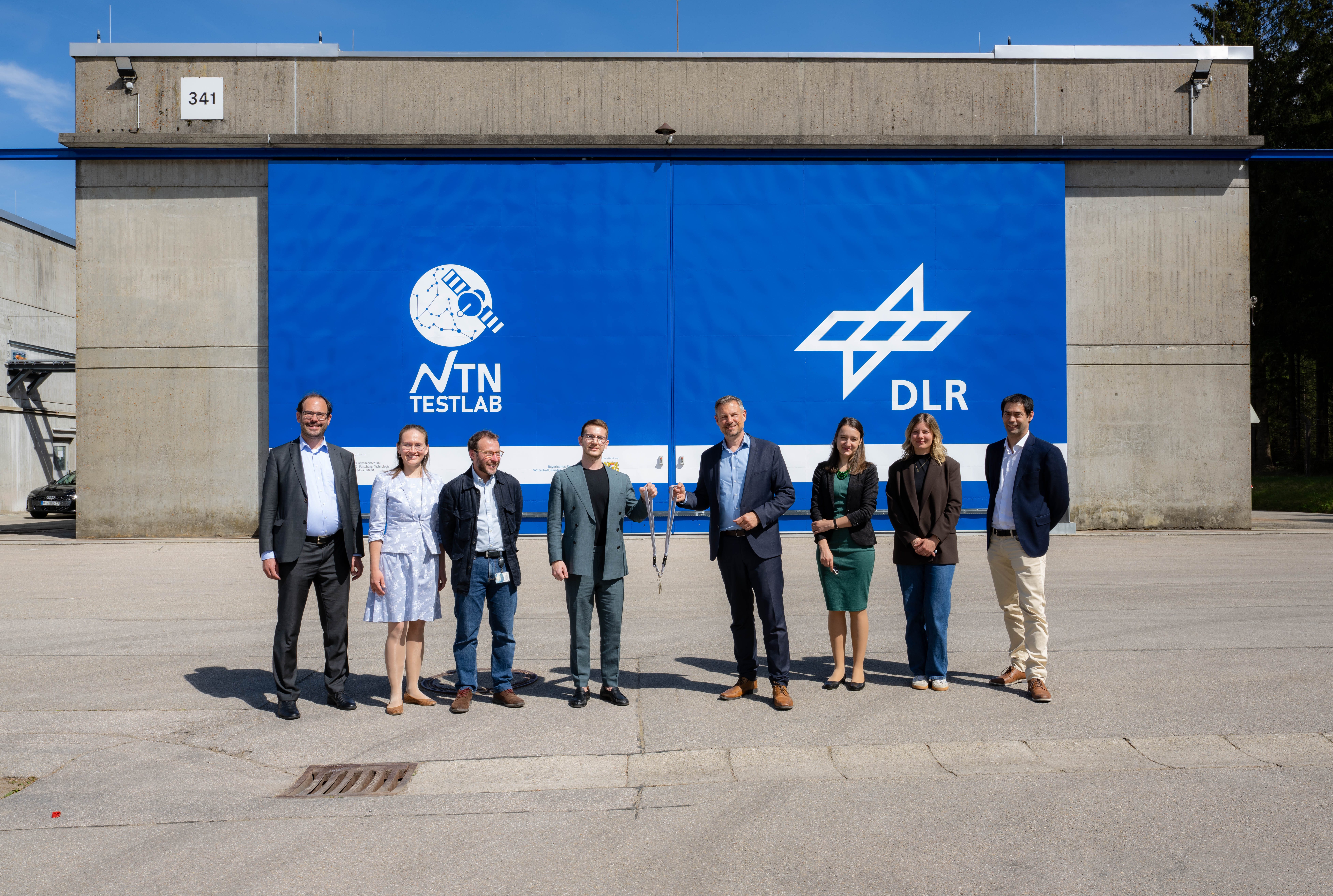
The German Aerospace Center (DLR) Institute of Communications and Navigation has laid the foundation for a new non-terrestrial networks (NTN) test lab at Oberpfaffenhofen. A nearby hall has been leased from EDMO Flugbetriebs GmbH for the project, which is funded by Germany’s Federal Ministry of Research, Technology and Space (BMFTR) under the xG-NOVA project and supported by Bavaria’s State Ministry of Economic Affairs under xG-byNTN. Dr Florian David, Director of the Institute of Communications and Navigation, said:
“We will be able to simulate future network structures and satellite constellations, which can then also be used by other research institutes and industrial partners to test their respective applications.”
What’s new: The shielded laboratory environment will allow interdisciplinary testing of terrestrial, satellite and AI-supported network configurations, including a satellite constellation emulator. The lab is intended to serve both DLR’s own research and external industrial partners.
Why this matters: This is the third major German government-funded 6G infrastructure initiative we have covered in the past 12 months, following the conclusions of 6G NeXt and 6G-TakeOff. Where the earlier projects were time-limited research consortia, the Oberpfaffenhofen test lab is intended as enduring infrastructure available to multiple users. Germany has consistently emphasised NTN integration in its 3GPP contributions and remains one of the largest national funders of 6G research. The “bridge between scientific work and practical application testing” framing addresses a recurring industry concern: that academic NTN research has been disconnected from deployment realities.
Implications for 6G standards: NTN integration was the most universally endorsed theme at the 3GPP 6G Workshop, with submissions from Airbus, ESA, Thales and a 30-company coalition all calling for unified TN/NTN architectures from day one. Shielded test environments capable of emulating multi-orbit constellations are precisely the kind of infrastructure that will validate the assumptions underlying Release 21 NTN specifications.
View source material to read more
Taiwan begins 6G spectrum review
Taiwan’s Ministry of Digital Affairs announced on Wednesday that it has begun preparations for 6G, including a review of spectrum resources and consultations with current users of candidate frequencies. The ministry expects to publish a spectrum allocation plan by the end of 2026. Tseng Wen-fang, Director of the Ministry’s Resource Management Department, told CNA that planning will align with international standards to ensure cross-market device compatibility. The ministry is also examining the integration of satellite and non-terrestrial network technologies to extend high-speed, low-latency coverage.
What’s new: This is Taiwan’s first formal public step on 6G spectrum planning at ministerial level. Industry discussion has converged on the 7.125–8.4 GHz band as a leading candidate, with the Ministry acknowledging that several international bands have emerged as 6G candidates. The piece notes that licensing and deployment typically take more than a year after auction completion, which explains the early start to spectrum review work.
Why this matters: Taiwan has been quietly but consistently active in 6G, with ITRI participating in the 3GPP 6G Workshop in March 2025 and deploying the EU 6G-SANDBOX toolkit later in 2025. The Ministry’s announcement formalises the policy and regulatory dimension. Taiwan’s semiconductor industry has obvious commercial interest in the 6G upgrade cycle, and aligned spectrum policy reduces market fragmentation risk. The integration of NTN is consistent with the broader regional consensus across Korea, Japan and Singapore.
Implications for 6G standards: Spectrum decisions feed back into 3GPP via national position papers presented to WRC-27. Taiwan’s emphasis on alignment with international standards reinforces the operator-led push for a unified 6G band plan rather than fragmented regional allocations.
View source material to read more
Selected research papers published this week
Optical transport for the 6G era
Researchers from the EU-funded ALLEGRO project propose a Digital Subcarrier Multiplexing (DSCM)-enabled Point-to-Multipoint (PtMP) IP-over-WDM architecture for hierarchical access-metro-core networks, scaling to 419 km. The paper compares transponder-based, Point-to-Point and PtMP architectures, claiming CAPEX reduction of 92.0 per cent and power savings of 99.2 per cent over a ten-year horizon compared with a traditional grey-optics benchmark.
Why this Matters: Hierarchical 6G traffic aggregation from cell sites through central offices to the core will place severe pressure on optical transport networks. The DSCM-PtMP approach reduces Optical-Electrical-Optical conversions and exploits coherent transmission to consolidate transponders. The reported reductions are large enough that, even allowing for optimistic assumptions, the architecture deserves serious attention from operators planning their 6G transport roadmap.
View source material to read more
D2C versus 3GPP NTN compared
Researchers from the German Research Center for Artificial Intelligence (DFKI) and University of Kaiserslautern compare Direct-to-Cell (D2C) and standardised 3GPP NTN architectures for global connectivity. The paper analyses standardisation, network architecture, physical-layer innovations, security and operational trade-offs, and examines the implications for 6G use cases including autonomous driving. A hybrid model combining terrestrial 5G, 3GPP NTN broadband and D2C emergency fallback is proposed as the practical path to global coverage.
Why this Matters: D2C, pioneered by SpaceX Starlink and AST SpaceMobile, has dominated headlines because it works with unmodified consumer handsets. The paper makes the systematic case that while D2C enables rapid market entry, 3GPP NTN offers superior performance, security and scalability, particularly for safety-critical applications. The hybrid tri-link argument is consistent with the NTN positions advanced at 3GPP RAN #111 by Ericsson, Nokia and the NTN operator coalition that includes Viasat, AST SpaceMobile and Inmarsat.
View source material to read more
Chain-of-thought reasoning for traffic prediction
A team from the University of Ottawa and Ericsson Canada proposes a chain-of-thought (CoT)-enabled LLM-based mobile traffic prediction framework, evaluated against a real-world 5G measurement dataset covering driving and static scenarios. The 2-shot CoT-LLM improves mean absolute error, root mean square error and R²-score by up to 14.88, 15.03 and 22.41 per cent respectively compared with the 2-shot in-context learning baseline.
Why this Matters: Short-term traffic prediction is foundational for proactive resource allocation in 5G-Advanced and 6G, particularly under AI-driven traffic patterns. The CoT approach addresses known weaknesses of naive LLM prompting on numerical time-series tasks. The work fits the broader AI-RAN agenda that SoftBank, ETRI and NVIDIA have been pursuing through their respective platforms.
View source material to read more
Real-world dataset for AI-native mobility
Researchers from Indian Institute of Technology Madras present a dataset collected from a commercially deployed network covering pedestrian, bike, car, bus and train mobility. The dataset focuses on handover scenarios, beam management and Timing Advance (TA) measurements at signalling events including RACH trigger, MAC CE and PDCCH grant, which are typically missing in existing datasets.
Why this Matters: AI/ML techniques for beam management and mobility procedures rely heavily on training data, and most existing datasets are simulated. A real-world dataset capturing TA at multiple signalling events provides material for training and evaluating models for high-mobility 6G use cases. The work supports the AI-native mobility direction confirmed at 3GPP RAN #111.
View source material to read more
Agent-driven channel generation for AI-native air interface
Researchers from Beijing University of Posts and Telecommunications, China Mobile and others propose a “ChannelAgent” framework: a closed-loop world model combining multi-modal sensing, an agentic intelligent core and execution with feedback updates. As a case study, the framework is applied to path loss prediction using reinforcement-learning-inspired policy adaptation with evolutionary search to derive compact, task-suitable feature subsets.
Why this Matters: Conventional AI models in wireless networks are typically task-specific and require frequent retraining. The agentic, closed-loop approach addresses the autonomous adaptation problem that becomes acute in heterogeneous 6G environments. The involvement of China Mobile indicates that this is research with a direct operator pathway to 3GPP standardisation, particularly around the AI-native air interface work expected in Release 20 and 21.
View source material to read more
Thanks for reading 6G Futures! Subscribe for free to receive new posts and support my work.
Comments
Nothing yet. Say the first thing.
Sign in to join the conversation.