
6G news and analysis for the week ending Friday 8th May, 2026.
This week has seen progress across all three major 6G regions: China, Europe and the United States. Each delivered a substantive development, but the contrasts between them are revealing.
In China, the Ministry of Industry and Information Technology issued a trial frequency permit for the 6 GHz band to the IMT-2030 (6G) Promotion Group, enabling regional technical trials aligned with ITU IMT-2030 performance targets. This is the most positive spectrum action China has taken on 6G to date and follows the Phase Two trials announcement covered in our 23 January edition.
In Europe, the GSMA published investment analysis that claimed an estimated €475 billion is required to bring European mobile networks up to the level of leading global markets by 2035. The problem is that only €270 billion is forecast to materialise. The €205 billion shortfall is a problem for 5G Standalone first, and 6G second. With 5G SA reaching only 2 per cent of Europe’s population compared to 80 per cent in Greater China, the implications for European 6G readiness are uncomfortable.
In the United States, the National Telecommunications and Information Administration launched Spectrum.gov, a transparency-focused hub for federal spectrum policy and 6G pipeline progress. Administrator Arielle Roth used her CTIA Summit keynote to update industry on the 7 GHz, 2.7 GHz and 4 GHz band studies.
Elsewhere, the EU strengthened its international 6G cooperation posture by joining the Global Coalition on Telecommunications as its first strategic partner and by deepening its digital partnership with Japan. We also have five research papers that feed into the ongoing 6G development work.
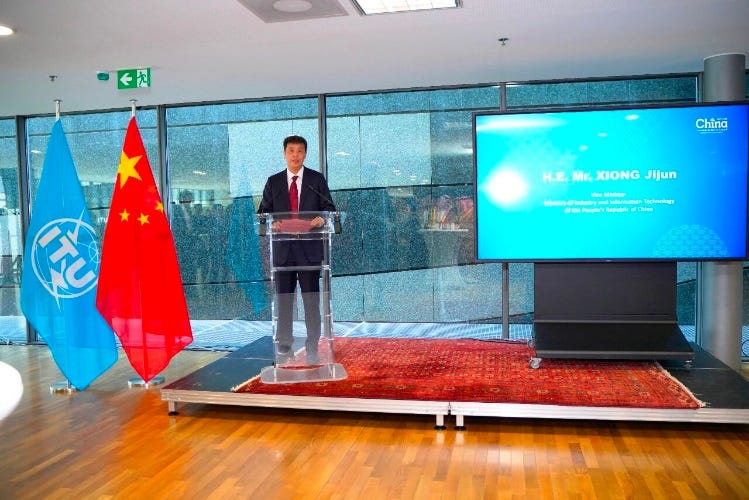
China’s Ministry of Industry and Information Technology (MIIT) has issued a trial frequency usage permit for the 6 GHz band to the IMT-2030 (6G) Promotion Group, enabling 6G technical trials in selected regions. The approval is intended to advance China’s research, standardisation and industrial deployment work for 6G. The trials will focus on the typical application scenarios and key performance indicators defined by the ITU for 6G, including ultra-high data rates, extreme low latency, massive connectivity and integrated sensing and communication capabilities. China Daily quoted the MIIT as saying that the move will “strongly promote the high-quality development of 6G in China.”
What’s new: This is the first time China has formally licensed 6 GHz spectrum for 6G trial use, taking the IMT-2030 Promotion Group’s work out of the laboratory and into regional pilot deployments. The permit covers technical trials aligned with the ITU IMT-2030 framework, providing developers with a sanctioned environment to test core technologies. The IMT-2030 Promotion Group includes leading telecom operators, equipment makers, academic institutions and research organisations.
Why this matters: This builds directly on China’s Phase Two 6G trial programme announced in January, which moved the country from technology component validation toward system-level testing. A formal trial spectrum permit gives Chinese vendors and operators a legitimate testbed in the same band that European, North American and Asian regulators are converging on for 6G. The 6 GHz band sits at the centre of the global FR3 (centimetre-wave) approach, and Chinese trial data generated under this permit will feed into IMT-2030 Promotion Group submissions that ultimately reach 3GPP and ITU-R working groups. Coordinating spectrum availability with the standards trial timetable is exactly what the ITU’s IMT-2030 framework is designed to enable, and China is moving early to take advantage. It also raises the competitive temperature: the US has its 7 GHz pipeline plan, Europe has the RSPG upper 6 GHz guidance, and China now has an active trial permit.
Implications for 6G standards: System-level trial results from Chinese vendors and operators will inform technical contributions to 3GPP Release 20 study items and Release 21 normative work, particularly in areas where the IMT-2030 KPIs guide design choices. The early grant of trial frequencies also strengthens China’s negotiating position ahead of WRC-27 spectrum decisions.
View source material to read more
The GSMA has published Mobile investment needs in Europe, a study by its GSMA Intelligence unit finding that European operators need to invest almost half a trillion euros over the next decade to bring connectivity up to global best-in-class levels. Of the €475 billion required by 2035, only around €270 billion is currently expected to be accessible to operators, leaving an investment gap of approximately €205 billion. The study notes that 5G Standalone reaches only 2 per cent of Europe’s population, compared to 80 per cent in Greater China and almost 50 per cent in India. Vivek Badrinath, Director General of the GSMA, said:
“Europe needs a significantly more pro-investment regulatory environment to secure the continent’s digital future and enhance global competitiveness.”
What’s new: The figures put a sharper number on the European investment problem than the Commission’s own 2023 Digital Decade analysis, which estimated around €174 billion to over €200 billion. The GSMA’s €205 billion shortfall breakdown states that roughly half is needed for 5G coverage on transport routes, €35 billion to extend 5G to the entire population, €38 billion for resilience and €28 billion for AI-based services. Capex per connection in Europe is just €35 compared to €70 for global connectivity leaders. Operators have invested €141 billion since 2021, but Europe has not met its Digital Decade targets.
Why this matters: The financial baseline matters for 6G because 6G investment will land on top of unfinished 5G work. If only 2 per cent of European citizens have access to 5G Standalone, the network architecture that 6G is supposed to evolve from is not yet in place at scale. The GSMA’s three reform proposals (in-market consolidation, effective spectrum management with low-cost renewals, and rebalancing of asymmetric regulation) are familiar arguments. Operator revenues have fallen by an average of 3 per cent per year since 2018 even as mobile internet usage has grown 27 per cent annually. Operators currently fund 85 per cent of network infrastructure investment, and the report’s call for a more balanced relationship with other digital ecosystem players is the latest iteration of the long-running fair contribution debate. The political dimension also matters: with the European Commission preparing the Digital Networks Act, the GSMA is staking its negotiating position. Yet ultimately, whose fault is this? European consumers show no appetite for paying more for higher speeds and the “5G SA” offering doesn’t exactly sell itself. The 5G/6G investment mix is one worth keeping a very close eye on.
Implications for 6G standards: 3GPP standards are technology-neutral, but the European industry’s ability to influence Release 21 normative work depends on commercial scale and deployment evidence. If European operators cannot complete a competitive 5G SA build-out, their voice in shaping 6G features grounded in real-world deployment experience will weaken relative to operators in Asia and North America who have already operationalised SA networks at scale.
View source material to read more

The US National Telecommunications and Information Administration (NTIA) has launched Spectrum.gov, a centralised hub for federal spectrum policy, pipeline progress and WRC-27 preparations. The launch was announced by NTIA Administrator Arielle Roth during her keynote at the 2026 CTIA Summit on 6 May. Roth stated:
“NTIA is launching Spectrum.gov as a centralized hub for updates on federal spectrum policy and 6G pipeline progress, as well as our efforts to unleash the space economy and ensure the U.S. leads the world at WRC-27.”
In the same speech, Roth provided detailed status updates on the spectrum bands being studied for reallocation under the Working Families Tax Cut Act and President Trump’s “Winning the 6G Race” memorandum.
What’s new: The substantive update came in Roth’s CTIA Summit speech rather than the website itself. The 7 GHz band study remains on track for a December 2026 final report. For the 2.7 GHz band, the SRF Technical Panel has approved the relocation plans and OMB has now transmitted them to Congress, with 54 days remaining on the 60-day notification clock. The 4 GHz band Tech Panel has received all nine expected plans from affected military departments and is reviewing them. NTIA also notified the FCC in March that 5 MHz of L-band spectrum (1675–1680 MHz) had been identified, with the next 15 MHz under study including for satellite direct-to-device use. Roth also reported on her bilateral meetings in Geneva on US WRC-27 positions and on commitments expected in the Host Country Agreement with China.
Why this matters: The Trump administration is making good on the 6G memorandum’s spectrum directives faster than its predecessor managed for comparable bands. Roth herself noted that the SRF pipeline process for 2.7 GHz moved twice as fast as the 7 GHz process under the previous administration. The transparency play is also worth noting: federal spectrum policy has historically been opaque, and Spectrum.gov is a deliberate response to industry and Congressional pressure for visibility into the pipeline. The references to the “Winning the 6G Race” memorandum framing and an “Odyssey” metaphor make clear that 6G leadership is being positioned as a national priority. The mention of WRC-27 Host Country Agreement non-negotiables with China is a reminder that the conference itself will be politically charged.
Implications for 6G standards: The pipeline progress on 7 GHz, 2.7 GHz and 4 GHz strengthens the US case for upper mid-band allocations at WRC-27. The 7 GHz band aligns closely with the FR3 frequency range that 3GPP is expected to standardise for 6G. Speed of clearance matters here: vendors need spectrum certainty by 2028 to develop commercial products in time for 6G launch towards the end of the decade.
View source material to read more
The European Union has stepped up its international tech cooperation activity on two fronts within 24 hours. On 4 May, the EU joined the Global Coalition on Telecommunications (GCOT) as its first strategic partner, attending its first GCOT meeting in Ottawa. The Coalition’s existing members are Australia, Canada, Finland, Japan, Sweden, the United Kingdom and the United States. On 5 May in Brussels, the fourth meeting of the EU-Japan Digital Partnership Council produced a wide-ranging set of cooperation steps spanning data, AI, quantum, semiconductors, digital infrastructure and online platforms. For the GCOT partnership, Mélanie Joly, Canada’s Minister of Industry, said:
“Welcoming the European Union as the Global Coalition on Telecommunications’ first strategic partner marks a significant milestone in our shared efforts to build secure, resilient and trusted telecommunications networks.”
For the EU-Japan Digital Partnership, Henna Virkkunen, Executive Vice-President for Tech Sovereignty, Security and Democracy, commented:
“The success of our partnership is rooted in our continued trusted discussions and collaboration. This cooperation enhances innovation and is essential for competitiveness and economic security.”
What’s new: The EU’s GCOT strategic partner role allows it to participate in discussions, contribute to specific workstreams led by member governments and endorse publications on a voluntary basis, but does not include a vote on governance. This is the GCOT’s first new role beyond full membership and follows the addition of Sweden and Finland in March. Separately, the EU-Japan Council launched a Data Strategy Working Group, welcomed progress on the joint EU-Japan 6G research project, and announced a Cooperation Arrangement on AI research and innovation. The launch of the joint quantum project Q-Neko was also confirmed, alongside agreement to expand the EU-Japan adequacy decision to academia and research.
Why this matters: Both moves reinforce a pattern we have been seeing over the past year: European tech cooperation is consolidating around democratic alliances rather than open multilateralism. The GCOT is explicitly framed as a coalition for “secure, resilient and trusted telecommunications,” language that historically has been a coded reference to vendor exclusion policies. The EU-Japan Digital Partnership has been operational since 2022, and the 6G research project mentioned in this week’s joint statement has been advancing in parallel through Horizon Europe and Japanese national funding. Adding both alignments at once strengthens Europe’s standards influence ahead of WRC-27 and 3GPP Release 21 normative work. It also signals that the EU is not relying on bilateral partnerships alone but is building a multi-layered cooperation structure.
Implications for 6G standards: A more aligned position between Europe, Japan and the GCOT membership would simplify coalition-building inside 3GPP and at WRC-27. Joint research projects like Q-Neko and the EU-Japan 6G project create technical evidence that can flow into ITU-R IMT-2030 evaluation and 3GPP study items. The broader question is whether this alignment will translate into concrete technical positions or remain at the level of statements of intent.
View source material to read more — EU on GCOT
View source material to read more — EU-Japan Digital Partnership
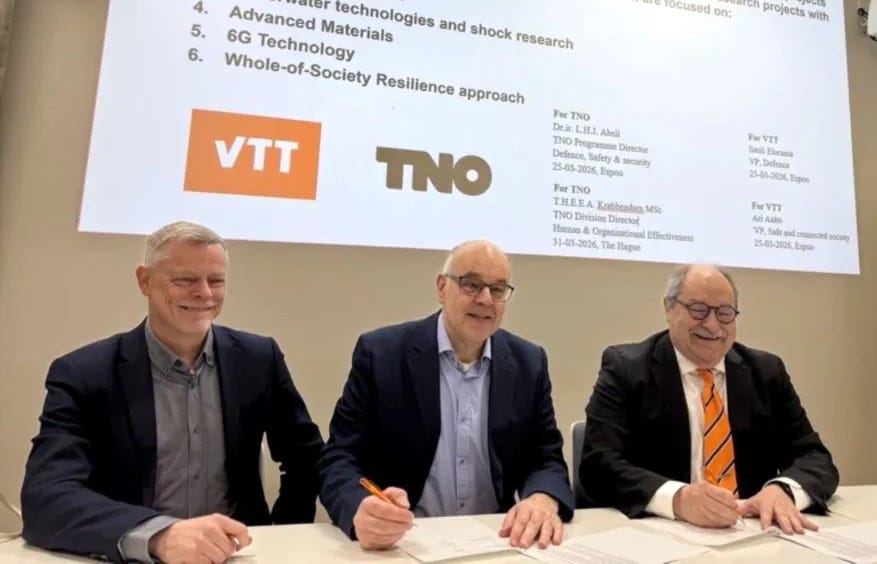
Finland’s VTT Technical Research Centre and the Netherlands’ TNO (Netherlands Organisation for Applied Scientific Research) have signed a Memorandum of Understanding to deepen their joint defence and dual-use technology research, including in 6G. The first research areas selected by the two organisations include drone solutions and counter-drone technologies, sensor technologies, underwater technologies, advanced materials and 6G technology. Sauli Eloranta, Vice President, Defence at VTT, said:
“Expanding our defence collaboration is a strategic move that supports the security and defence goals of both countries and strengthens Europe’s technological sovereignty. By working together, we can achieve more and benefit from each other’s expertise and resources.”
What’s new: The collaboration formally extends VTT-TNO joint work into defence applications of 6G, with explicit reference to dual-use research. Joint testing has already begun at VTT’s Drone Test Centre in Oulu, taking advantage of Finland’s more permissive drone regulation regime relative to the Netherlands. Both organisations have substantial existing 6G research portfolios: VTT through Finland’s 6G Flagship ecosystem and TNO through the Future Network Services (FNS) consortium covered in our 20 March edition.
Why this matters: The defence dimension of 6G research is becoming progressively more visible. The University of Oulu’s NATO DIANA work, covered in the 1 May newsletter, sits alongside the VTT-TNO MoU and the wider European tech sovereignty framing championed by Virkkunen. Sensing-as-a-service is one of the 6G design pillars (covered extensively in 6G workshop submissions from Ericsson, Nokia and NTT DOCOMO), and there is a thin line between civil ISAC use cases and counter-drone defence applications. Finland’s geopolitical position, having joined NATO in 2023, lends additional weight to defence-oriented 6G research. The dual-use framing also matters for funding: civilian R&D programmes can sustain technical work that has clear defence applications.
Implications for 6G standards: 3GPP itself does not standardise defence applications, but the technical foundations being developed in dual-use programmes – particularly in ISAC, counter-drone sensing and resilient networking – do feed civilian standards work. VTT and TNO are both active in EU-funded 6G projects that contribute to 3GPP and ITU IMT-2030 inputs.
View source material to read more
The paper argues that orthogonal frequency-division multiplexing (OFDM), which has underpinned 4G and 5G, increasingly struggles in high-mobility, mmWave and sub-THz environments where Doppler effects degrade performance. The authors examine two emerging 2D waveform paradigms: orthogonal time frequency space (OTFS) and affine frequency-division multiplexing (AFDM). They argue that chirp-based subcarriers are a viable evolution path that retains much of OFDM’s mature infrastructure while offering inherent Doppler robustness.
Why this matters: Waveform design is one of the foundational decisions for 6G radio. Chirp-based waveforms are also well suited to integrated sensing and communications (ISAC), which is a Release 21 priority. If the industry consensus shifts toward chirp-based subcarriers, equipment vendors and silicon designers face significant implications for 6G modem design.
View source material to read more
The paper proposes a four-layer architecture for “Agentic AI-Native 6G,” in which Large Language Model (LLM)-based agents act as bounded, policy-governed reasoning entities within a semantic control plane layered above 3GPP infrastructure. Empirical evaluation reveals a fundamental tradeoff between reasoning capability and system efficiency, leading the authors to argue that heterogeneous deployment of LLM agents across the device-edge-core continuum is necessary.
Why this matters: Most operators and vendors are converging on AI-native 6G architectures, but the precise role of LLM-based agents within deterministic 3GPP infrastructure is still being worked out. The paper’s empirical finding that no single model meets latency, throughput and accuracy requirements simultaneously is a useful counter to the “one big LLM” framing and aligns with the distributed agent approaches being explored by Ericsson, Nokia and Huawei.
View source material to read more
The paper proposes SQSO, a “Sustainable and QoS-aware Satellite Offloading” framework for LEO constellations. The framework adaptively offloads task-critical data from satellites to data centres co-located with renewable power plants, exploiting curtailed renewable energy that would otherwise be stranded. Simulations using Starlink-scale constellations and real-world electricity price data show energy reductions of up to 76 per cent compared to state-of-the-art schemes.
Why this matters: NTN integration is one of the foundational design decisions for 6G, and sustainability is increasingly being treated as a hard constraint rather than a soft principle. The paper’s space-energy co-design framing is novel and addresses a real concern: in-orbit computation accelerates satellite battery degradation, while terrestrial renewable curtailment is a growing problem. The work points toward 6G architectures that account for energy origins, not just energy efficiency.
View source material to read more
The paper presents a tool-based interface design and experimental prototype for agentic AI in the mobile core, using the Model Context Protocol (MCP) and the Agent2Agent (A2A) protocol as foundational protocols. The authors analyse packet-level message flows and break down the latency of end-to-end intent-based operations from prompt injection to task completion.
Why this matters: The convergence of MCP and A2A protocols with telecom core network functions is an early-stage but important architectural shift. Network functions evolving into AI-enabled agents is a recurring theme in 6G workshop submissions, and concrete protocol-level analysis of latency tradeoffs gives vendors a starting point for implementation. Note the overlap with this week’s “Agentic AI-native networks for 6G” paper above.
View source material to read more
The paper proposes PUMA, a multiple-access framework that builds on fluid antenna systems (FAS) at the user equipment. By combining phased array signal aggregation with the spatial flexibility of fluid antennas, PUMA enables interference mitigation at the UE without requiring channel state information at the base station or complex interference cancellation. The architecture targets minimal radio-frequency chain count, potentially as low as one.
Why this matters: Fluid antenna systems and reconfigurable intelligent surfaces are among the more speculative 6G research directions, but hardware-efficient multiple-access schemes that work with single RF chains have practical relevance for low-cost devices and IoT applications. If PUMA’s claimed performance holds in real-world testing, it would offer a route to massive connectivity that does not depend on heavy precoding overhead at the base station.
Comments
Nothing yet. Say the first thing.
Sign in to join the conversation.