
By Sungchul Ji, Ph.D.
Professor Emeritus of Theoretical Cell Biology, Rutgers University
with conceptual assistance from J. Davis and ChatGPT
“The important thing is not to stop questioning.”
— Albert Einstein
For more than a century, neuroscience has been built upon one of the greatest intellectual revolutions in human history: Einstein’s theory of relativity.
At first glance, this statement may seem surprising. What does relativity have to do with the brain?
Quite a lot.
Every experiment in neuroscience assumes that brain activity occurs at particular locations in space and at particular moments in time. Functional MRI (fMRI), electroencephalography (EEG), magnetoencephalography (MEG), and optical imaging all measure events occurring within four-dimensional spacetime.
Implicitly, modern neuroscience views the brain through what mathematicians call a Lorentzian framework.
Recently, however, I began wondering whether this is only half of the story.
What if every neural event possesses not only an external location in spacetime, but also an internal organization that deserves its own geometry?
This simple question has led me toward what I believe may become a complementary framework for understanding the brain.
1. The External Brain
Suppose an fMRI scanner detects activity in the prefrontal cortex.
The scanner tells us
where the activity occurred,
when it occurred,
how strong the blood oxygen signal was,
how long it lasted.
These measurements are indispensable.
They tell us where an event happened.
Mathematically,
every neural event is represented as

where x, y, z denote position, t denotes time.
This is the language of Lorentzian spacetime.
It is extraordinarily successful because it preserves causal relations among events.
Two observers moving relative to one another may assign different coordinates,
yet both describe
the same underlying event.
The Lorentzian framework therefore provides what might be called
the external geometry of the brain.
2. But What Is Missing?
Imagine two pianists performing exactly the same musical score.
The fMRI patterns may look remarkably similar.
Yet one performance may be technically perfect but emotionally empty.
The other may profoundly move its audience.
Where is the difference?
It is not simply
where neurons fired.
Nor merely
when they fired.
It lies in
the organization
of the entire psychophysical event.
This observation suggests another question.
Perhaps neuroscience has become extremely good at locating neural events,
while remaining much less successful at describing
their internal organization.
3. A Second Geometry
Geometry is not limited to describing positions in space.
It can also describe
relationships.
One particularly elegant system uses barycentric coordinates [1].
Instead of locating a point relative to external axes,
barycentric coordinates locate it relative to the vertices of a simplex [2].
Imagine a tetrahedron [3].
Every point inside it can be represented by four numbers

whose sum is always one.
These numbers describe
how the point relates to the four vertices.
This is not another version of Cartesian geometry.
It is
a geometry of relationships.
4. An Internal Coordinate System
Suppose we assign the four vertices of the tetrahedron to four fundamental aspects of living organization [4]:
Energy
Matter
Information
Consciousness
Now every neural event can be described by a relational vector

These coordinates no longer tell us
where
the event occurs.
Instead they tell us
how
the event is internally organized.
The event becomes
not merely
a point in space,
but
a relational state.
5. From Static Points to Dynamic Organization
To represent changing organization,
I have proposed what I call the
Dynamic Body-Centered Tetrahedron (Dynamic BCT) [5].
The Dynamic BCT consists of
four fixed vertices
and
one mobile point.
The moving point represents
the continuously changing balance among
Energy,
Matter,
Information,
and Consciousness.
Instead of studying isolated neural activations,
we study
trajectories
through relational space.
The brain becomes
not simply
a collection of neurons,
but
a continuously evolving organization.
6. External Versus Internal Geometry
The distinction may be summarized simply.
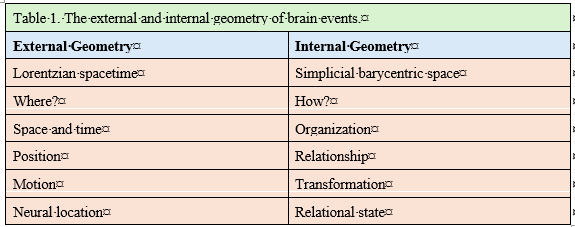
These two descriptions do not compete.
They answer
different questions.
One asks
Where did the event occur?
The other asks
What kind of event was it?
7. The Brain as Two Complementary Spaces
This suggests that every neural event possesses
two coordinate systems.
The first describes
its location.
The second describes
its organization.
Symbolically,

or

The first part belongs to Einstein.
The second remains largely unexplored.
8. Measuring Organization
Is this merely philosophy?
Perhaps not.
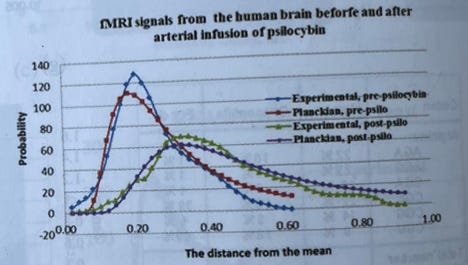
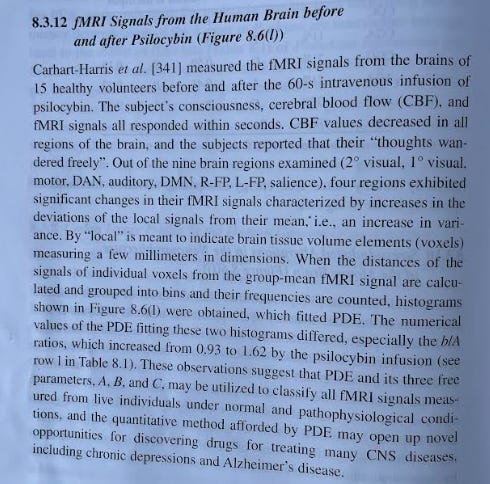
Modern neuroimaging (see Figure 8.6 (l) above) already measures variables corresponding to several of these coordinates.
For example,
functional MRI [7] depends upon
metabolic energy,
blood flow,
molecular processes,
neural signaling.
When combined with
behavioral measurements,
cognitive testing,
and carefully structured first-person reports,
it becomes possible—in principle—to estimate the changing relationships among
Energy,
Matter,
Information,
and Consciousness.
These relationships could then be represented as trajectories within the Dynamic BCT.
In other words,
the geometry of organization becomes measurable.
9. From Gnergonic Space to Gnergitonic Space
I have called this measurable relational domain
Gnergonic Space [7].
It is defined by the changing balance among
Energy,
Matter,
Information,
and Consciousness.
Whether this organizational space is complete remains an open question.
It may represent
only
the observable projection
of a deeper organizational domain,
which I have tentatively called
Gnergitonic Space [7].
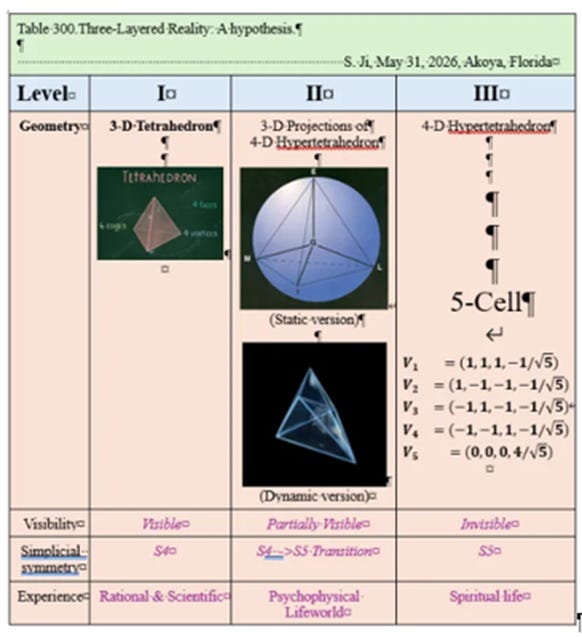
Just as the three-dimensional Dynamic BCT may be viewed as a projection of the four-dimensional 5-cell [8] (see Table 300 below).
Gnergonic Space may represent
a measurable projection
of
a deeper organizing reality.
This remains speculative,
but it is scientifically interesting because it generates testable questions rather than metaphysical assertions.
10. A Complement Rather Than a Replacement
None of this diminishes the importance of relativity.
The Lorentzian framework [9] remains indispensable.
Without it,
modern neuroscience would not exist.
The proposal is not to replace spacetime geometry,
but to complement it.
Einstein taught us
how events are situated
within the universe.
The proposed simplicial framework asks
how those events are organized
from within.
Both perspectives may be necessary.
11. Why This Matters
Perhaps the greatest challenge in neuroscience is not locating neurons,
but understanding
how organization gives rise to experience.
Reductionism has been spectacularly successful in identifying components.
Yet organization resides
not only in components,
but also
in their relationships.
The simplicial barycentric approach described here naturally emphasizes those relationships.
It asks us to think of the brain
less as a machine composed of parts,
and more as
a continuously evolving relational geometry.
12. Looking Forward
The proposal outlined here is admittedly speculative.
The Lorentzian framework is among the most rigorously tested mathematical structures in science.
The simplicial barycentric framework proposed here is still a research hypothesis.
Its future depends entirely upon whether it proves empirically useful.
Can barycentric organizational coordinates predict cognitive states?
Can they classify altered states of consciousness?
Can they distinguish creativity from routine thought?
Can they reveal organizational transitions during meditation, music, psychedelic experiences, or scientific discovery?
These are empirical questions.
That is precisely why the proposal belongs to science rather than metaphysics.
13. Conclusion: From the Geometry of Events to the Geometry of Organization
The history of science often advances by discovering that one description of nature is incomplete rather than incorrect.
Newtonian mechanics was not abolished by relativity; it was placed within a broader framework.
Perhaps something similar awaits neuroscience.
The Lorentzian framework has given us the external geometry of the brain: a magnificent description of where and when neural events occur.
The simplicial barycentric framework proposes an internal geometry: a description of how those events are organized through the changing relationships among Energy, Matter, Information, and Consciousness.
If this complementary approach proves fruitful, neuroscience may undergo a subtle but profound transformation. Instead of viewing the brain solely as an object moving through spacetime, we may begin to understand it as a living organization evolving through a relational space.
The future science of consciousness may therefore require two geometries.
One geometry tells us where the brain is.
The other may tell us what the brain is becoming.
And perhaps the deepest discoveries will emerge not from choosing between these two perspectives, but from learning how they illuminate one another.
References:
[1] Lorentz transformation. https://en.wikipedia.org/wiki/Lorentz_transformation
[1a] Barycengfric coordinagte sysgfem. https://en.wikipedia.org/wiki/Barycentric_coordinate_system
[2] Simplex. https://en.wikipedia.org/wiki/Simplex
[3] Tetrahedron. https://en.wikipedia.org/wiki/Tetrahedron
[4] Ji, S. (2012). Molecular Theory of the Living Cell: Concepts, Molecular Mechanisms, and Biomedical Applications. Springer, New York. P.289. BCT
[5] Ji, S. (2026). Beyond Geometry: Could Dynamic Body-Centered Tetrahedron Model Relationships Rather Than Objects? https:/622622.substack.com/p/beyond-geometry-could-the-dynamic
[6] Functional magnetic resonance imaging. https://en.wikipedia.org/wiki/Functional_magnetic_resonance_imaging
[7] Ji, S. (2026). From Gnergons to Gnergitons: A Metaphorical S4 to S5 Transition. https:/622622.substack.com/publish/posts/detail/209399250?referrer=%2Fpublish%2Fposts
[8] 5-cell. https://en.wikipedia.org/wiki/5-cell
No posts
Comments
Nothing yet. Say the first thing.
Sign in to join the conversation.