
Sungchul Ji, Ph.D.
Professor Emeritus of Theoretical Cell Biology, Rutgers University
with conceptual assistance from ChatGPT
“The Dao that can be spoken is not the eternal Dao.”
— Laozi, Dao De Jing
Over the past several months I have been exploring the possible relationship between modern science and ancient philosophy. Along the way I encountered an interesting problem.
In contemporary discussions of consciousness, spirituality, and even physics, people often invoke the Chinese concept of qi (pronounced chee). Sometimes qi is described as life energy. Sometimes it is identified with electromagnetism, dark matter, quantum fields, or an unknown physical medium.
Recently I read an intriguing proposal that identified qi with a hypothetical physical field underlying consciousness and even the persistence of the soul after death.
Whether such a proposal is ultimately correct remains an open scientific question.
But it raises an important philosophical issue.
Is qi really the same thing as the Dao?
My answer is no.
Understanding why may help clarify both traditional East Asian philosophy and modern attempts to build a science of consciousness.
1. The Meaning of Qi
The Chinese character 氣 (qi) originally referred to breath, vapor, or the invisible movement of air.
Over centuries it acquired a much richer meaning.
Qi came to signify
vital energy,
dynamic process,
material force,
life activity,
and the continuously changing medium through which nature operates.
Traditional Chinese medicine, martial arts, and Daoist internal cultivation all emphasize the harmonious circulation of qi.
Qi is therefore
dynamic.
It is always moving,
transforming,
flowing.
One might think of qi as
the activity of nature.
2. But What Is the Dao?
The Dao (道) is something much deeper.
It is usually translated as
The Way.
Yet no English word fully captures its meaning.
The Dao is
the ultimate source,
the deepest order,
the principle through which all things arise,
the natural unfolding of reality.
The Dao is not simply another force.
Nor is it another object.
It is the ground from which forces, objects, and transformations emerge.
This is why the Dao De Jing begins with the famous warning:
“The Dao that can be spoken is not the eternal Dao.”
The Dao always exceeds our descriptions.
3. Qi Is Not the Dao
This distinction is essential.
Traditional Daoism does not identify qi with the Dao.
Instead,
the relationship is often understood schematically as

The Dao is the source.
Qi is the dynamic manifestation.
The world arises through the transformations of qi.
Qi therefore belongs to the unfolding of reality,
not to its ultimate ground.
Confusing qi with the Dao is a little like confusing
the flowing river
with
the landscape that gives rise to the river.
4. The Contribution of Neo-Confucianism
The distinction became even more sophisticated in Neo-Confucian philosophy, especially in Korea.
One of Korea’s greatest philosophers,
Yi I (Yulgok, 1536–1584),
developed the complementary concepts of
li (理)
and
qi (氣).
Very roughly,
li means
principle,
pattern,
order,
intelligibility,
rational organization.
Qi means
material force,
energy,
dynamic process.
Everything in nature embodies both.
A tree possesses
material substance
and
organizational pattern.
A living organism possesses
biological energy
and
structural order.
Neither alone is sufficient.
Reality requires both.
5. Li Without Qi?
Yulgok argued that
li never exists independently of qi.
Likewise,
qi never exists completely without li.
Pattern without embodiment cannot become actual.
Energy without organization cannot become life.
The two are distinguishable,
yet inseparable
within concrete existence.
This remarkably modern insight resembles today’s distinction between
matter and information,
or
hardware and software.
Neither alone constitutes a functioning computer.
Both are necessary.
6. Where Does the Dao Fit?
Here we must be careful.
Some modern summaries state that
Dao = li + qi.
This captures an important intuition but risks oversimplifying the philosophy.
A more accurate interpretation is that
the Dao is
expressed through
the harmonious interplay of li and qi.
The Dao is not merely their arithmetic sum.
Rather,
li and qi are complementary aspects of reality,
while the Dao is
the Way
through which that complementary reality unfolds.
One might picture the relationship this way:
Dao
│
┌──────┴──────┐
│ │
Li Qi
(principle) (dynamic energy)
│ │
└──────┬────-─┘
│
The Living World
The Dao is therefore
greater than either li or qi alone.
7. From the Lamp to the Dawn: A Modern Interpretation
The distinction among Dao, li, and qi has acquired a new significance for me through recent work on what I have called the Dynamic Body-Centered Tetrahedron (Dynamic BCT) and the Tagore Transition.
Rabindranath Tagore wrote:
“Death is not extinguishing the light; it is only putting out the lamp because the dawn has come.”
For many readers, this is simply a beautiful metaphor about death.
I now believe it may also express a profound principle of organization.
The lamp represents a limited but genuine source of illumination. The dawn represents a more comprehensive illumination that renders the lamp unnecessary without negating the reality of its light.
This image closely parallels the distinction between the observable and the deeper levels of organization.
The Dynamic BCT (Body-Centered Tetrahedron) may be viewed as the lamp. It represents the measurable organization of living systems through the changing relationships among Energy, Matter, Information, and Consciousness.
The 5-cell (also called the Hypertetrahedron) by contrast, represents a higher-dimensional organization that cannot be directly visualized. It resembles the dawn: a larger reality that becomes accessible only through its projections.
This suggests an intriguing correspondence:
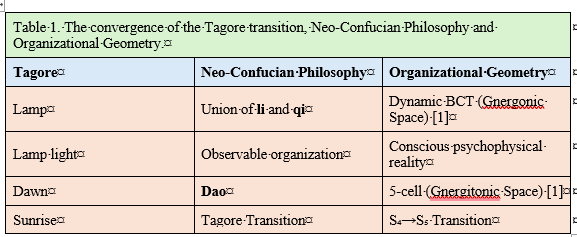
Notice that the correspondence is structural, not literal.
I am not suggesting that the Dao is mathematically identical with a 5-cell, nor that qi can be reduced to energy in the modern physical sense.
Rather, all three frameworks appear to distinguish between a manifest organizational level and a more comprehensive organizing level.
From this perspective, the Tagore Transition [2] is no longer simply about death.
It becomes a general organizational principle:
An observable organization may ultimately be understood as the projection or manifestation of a deeper and more comprehensive order.
This principle seems to recur in geometry, philosophy, psychology, biology, and perhaps even cosmology.
8. Why This Matters Today
Why does this distinction matter?
Because modern discussions often identify qi with
electromagnetism,
quantum fields,
dark matter,
biofields,
or unknown physical forces.
These proposals may eventually prove fruitful.
But if we simply rename every unknown field “qi,”
we risk asking one concept to perform too many jobs.
Qi becomes simultaneously
energy,
information,
consciousness,
soul,
ultimate reality.
Classical philosophy never intended qi to carry all those meanings.
It distinguished different levels of organization.
That distinction remains valuable today.
9. A Modern Analogy
Recently I have been developing a geometric framework involving what I call
Gnergonic Space.
Its four relational coordinates are
Energy,
Matter,
Information,
Consciousness.
These represent measurable organizational relationships.
I have also proposed a deeper hypothetical domain,
which I call
Gnergitonic Space.
Whether such a domain exists remains an open scientific question.
If it does,
its relationship to Gnergonic Space might resemble the relationship between
the invisible four-dimensional 5-cell
and
its visible three-dimensional projection.
Notice something important.
The measurable organization is
not
the deeper organizing principle itself.
It is its observable manifestation.
10. A Possible Conversation Between East and West
This naturally suggests an intriguing dialogue.
Very cautiously,
one might compare the structures as follows.
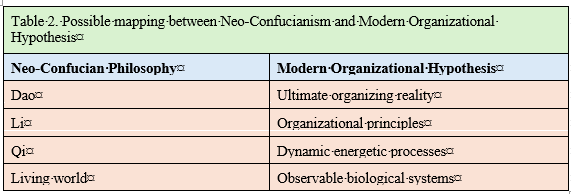
This is not an identity.
It is a structural analogy.
The ancient philosophers were not describing barycentric geometry or neuroscience.
Nor are modern scientists simply rediscovering Neo-Confucianism.
Yet both appear to recognize that reality possesses
different levels of organization
that should not be collapsed into one.
11. Avoiding a Common Confusion
Suppose someone proposes:
“Qi is a physical field connecting consciousness, information, and the persistence of personality after death.”
This is an interesting scientific hypothesis.
But philosophically,
it may actually combine
functions traditionally associated with
qi,
li,
and the Dao.
Recognizing these distinctions does not weaken the proposal.
It strengthens it.
Science advances through conceptual precision.
When different concepts are clearly distinguished,
their relationships become easier to investigate.
12. Beyond Either-Or
Perhaps the deepest lesson from East Asian philosophy is not that reality consists of separate substances,
but that it consists of
complementary relationships.
Energy and pattern.
Movement and order.
Manifestation and source.
Modern science increasingly reaches similar conclusions.
Genes alone do not explain life.
Neurons alone do not explain consciousness.
Energy alone does not explain organization.
Information alone does not explain embodiment.
Reality appears to emerge through relationships rather than isolated entities.
13. Toward a Science of Organization
My own recent work has led me toward what I tentatively call a
Category Theory of Organization.
The central idea is simple.
Perhaps the deepest questions in science concern
not merely
what things are,
but
how different levels of organization relate to one another.
In that light,
the ancient distinction among
Dao,
li,
and
qi
may prove surprisingly modern.
Rather than collapsing everything into one mysterious substance,
it reminds us that reality may possess
multiple complementary levels,
each requiring its own language.
The challenge for contemporary science is not to replace ancient philosophy,
nor for philosophy to replace science.
It is to discover whether the organizational insights of one can illuminate the empirical discoveries of the other.
Looking back, I realize that the distinction among Dao, li, and qi may have anticipated a distinction that modern science is only beginning to articulate. Science has become extraordinarily successful at describing the measurable organization of the world—the “lamp light.” Yet it continues to ask whether that organization points toward deeper organizing principles that cannot themselves be directly observed.
My own proposals concerning the Dynamic Body-Centered Tetrahedron, the 5-cell, Gnergonic and Gnergitonic Spaces, and the Tagore Transition should therefore be understood not as replacements for classical philosophy, but as an attempt to express a similar intuition in the language of twenty-first-century mathematics and science.
Perhaps the future dialogue between East and West will not be a debate over whether Dao, li, qi, Spirit, or consciousness is “correct.” Rather, it may become a shared search for the organizational principles that connect them. If so, the deepest transition in human knowledge may not be from science to spirituality, or from spirituality to science, but from the study of isolated things to the study of organization itself.
Epilogue
One of the enduring strengths of both philosophy and science is that they teach us to distinguish concepts before we attempt to unite them. Qi, li, and the Dao are not competing explanations of reality; they illuminate different aspects of it. Likewise, if modern science eventually discovers new organizational principles underlying consciousness and life, its progress will depend not on declaring ancient ideas “already proven,” but on identifying precisely which ancient insights correspond to which modern discoveries. That careful discrimination is not a limitation—it is the beginning of genuine understanding.
References:
[1] Ji, S. (2026). From Gnergons to Gnergitons: A Metaphorical S4 to S5 Transition
[2] Ji, S. (2026). The Tagore Transition (III; with figures added). Can Science Discover the Dawn Beyond the Lamp? https://622622.substack.com/p/the-tagore-transition-iii-with-figures
No posts
Comments
Nothing yet. Say the first thing.
Sign in to join the conversation.