
By Sungchul Ji, Ph.D.
Professor Emeritus of Theoretical Cell Biology, Rutgers University
with conceptual assistance from ChatGPT
Near-death experiences (NDEs) [1] have fascinated physicians, neuroscientists, philosophers, and spiritual traditions for decades. People who recover from cardiac arrest, drowning, severe trauma, or other life-threatening events sometimes report remarkably vivid experiences: leaving the body, encountering an extraordinary light, meeting deceased relatives, reviewing their lives, or sensing that they approached a boundary beyond which they could not return.
What are these experiences?
Current neuroscience generally interprets them as unusual states of a distressed but still functioning brain. Many religious traditions regard them as glimpses of an afterlife.
Perhaps there is another possibility.
Rather than asking whether NDEs are either purely biological or purely supernatural, we might ask whether they represent transitional phenomena—experiences occurring during the passage between two modes of reality.
This question naturally leads to what I call the Tagore Transition [2].
Death is not extinguishing the light; it is only putting out the lamp because the dawn has come.
— Rabindranath Tagore
1. Rabindranath Tagore’s Vision
Rabindranath Tagore repeatedly portrayed death not as annihilation but as a passage into a larger reality. His poetry suggests that death is not the end of existence but a transition from the familiar into the unknown.
The purpose of the present article is not to prove that poetic intuition is literally true. Rather, it asks a different question:
Can mathematics provide a conceptual language for describing the structure of such a transition?
Inspired by Tagore’s vision, I propose representing the transition from life to death using simplicial geometry.
2. From Tetrahedron to 5-Cell
In my recent work on simplicial geometry, I have proposed representing ordinary human existence by the tetrahedron (S4) [3].
The S4 and S5 notation is borrowed from simplicial geometry [6] but is being used metaphorically rather than as a literal physical model
The tetrahedron symbolizes [4] the structured, observable world of embodied life.
Beyond it lies the 5-cell (S5)—the four-dimensional simplex. In this framework, S5 serves as a mathematical metaphor for a deeper or otherwise inaccessible reality.
Between these two lies the dynamic Body-Centered Tetrahedron (BCT), representing the transition itself.
The resulting sequence is
S4 → Dynamic BCT → S5
where
S4 represents before-death reality,
Dynamic BCT represents the transitional state,
S5 represents after-death reality.
This is a conceptual and geometric model rather than a statement of established physical fact.
3. Where Does the Near-Death Experience Belong?
This framework immediately raises an intriguing question.
If death corresponds to the complete transition from S4 to S5, where should we place the near-death experience?
Three possibilities naturally emerge.
1) NDE belongs entirely to S4
Here NDEs are unusual but entirely biological phenomena generated by a stressed brain.
This corresponds closely to the prevailing neuroscientific interpretation.
2) NDE belongs entirely to S5
Here individuals genuinely enter after-death reality and subsequently return.
Many spiritual traditions implicitly adopt this view.
However, present scientific evidence neither confirms nor rules out this interpretation.
3) NDE occupies the transition
The simplicial framework naturally suggests a third possibility.
Near-death experiences may represent incomplete S4→S5 transitions.
The individual approaches the boundary separating ordinary biological existence from whatever S5 represents, experiences aspects of that transition, and then returns to ordinary life.
In this view, NDE is neither simply S4 nor fully S5.
It is the experience of the passage itself.
4. The Tagore Transition Hypothesis
These considerations lead to the following conceptual hypothesis.
Tagore Transition Hypothesis (TTH) [2]:
Death corresponds to the complete S4→S5 simplicial transition. Near-death experiences are incomplete S4→S5 transitions in which consciousness temporarily acquires access to aspects of S5 before returning to S4.
This hypothesis is not presented as proof of an after-death reality.
Rather, it offers a geometric framework capable of organizing several competing interpretations within one coherent conceptual architecture.
5. Projection Rather Than Destination
One attractive feature of simplicial geometry [6] is that higher-dimensional objects become visible only through lower-dimensional projections.
Applying this idea suggests a subtle interpretation.
Rather than identifying NDE with after-death reality itself, we may regard it as the projection into ordinary consciousness of an incomplete encounter with S5.
The experiencer reports not the entirety of S5 but only those aspects accessible during a reversible transition.
This distinction preserves both scientific caution and philosophical openness.
6. Ontology and Epistemology
The proposal also clarifies an important distinction.
Ontology [7]
Does S5 exist independently of human observation?
The model allows this possibility but does not establish it.
Epistemology [8]
How could we ever obtain knowledge about such a reality?
Near-death experiences become especially interesting because they may constitute the only first-person reports arising from an incomplete transition across the boundary.
Whether those reports reflect a deeper reality, unusual brain dynamics, or some combination of both remains an open scientific question.
7. A Conceptual Map
The proposed framework may be summarized as follows.
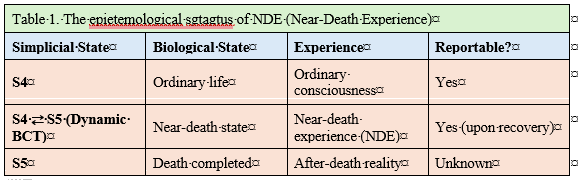
This table highlights the unique epistemological status of NDEs.
They occupy the only region of the proposed transition from which first-person reports may be possible.
8. Why This Matters
The value of this proposal lies less in answering the mystery of death than in reframing the question.
Instead of debating whether NDEs are “real” or “hallucinations,” we may ask whether they exhibit consistent structural features expected of transitional phenomena.
If so, comparative studies across cultures, medical conditions, and historical periods may reveal recurring patterns that any adequate theory must explain.
The simplicial framework therefore generates questions that can, at least in principle, be investigated empirically.
9. Three Complementary Languages
Perhaps the deepest implication of this proposal is methodological.
The article is not fundamentally about death.
It is about three different languages for describing the same mystery.
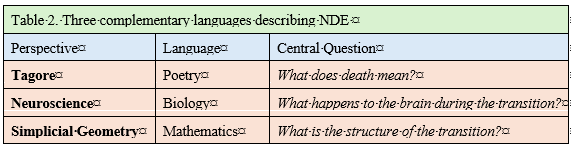
These perspectives need not compete.
Instead, they may illuminate one another.
Poetry inspires the question.
Biology investigates the process.
Mathematics seeks the underlying structure.
10. Conclusion: Returning to Tagore
We began with Tagore’s image of extinguishing the lamp because the dawn has come.
The simplicial framework does not prove that the dawn exists.
Nor does it claim that near-death experiences constitute direct evidence for an after-death reality.
Instead, it proposes that if reality possesses a geometric organization extending beyond ordinary experience, then death, near-death experiences, and the boundary between them may all be understood as stages of a single structural transformation.
In this view, the Tagore Transition is the complete passage from S4 to S5, while near-death experiences represent incomplete transitions that briefly approach the unknown before returning to ordinary life.
Whether this framework is ultimately confirmed, modified, or rejected is a matter for future scientific investigation.
Its purpose is not to settle one of humanity’s oldest mysteries but to offer a new conceptual language in which that mystery may be explored.
Tagore gave humanity a poetic vision of death as transition rather than extinction. Neuroscience seeks to understand the biological processes accompanying that transition. Simplicial geometry asks a different question: Can the transition itself possess an underlying mathematical structure?
If so, poetry, biology, and geometry need not stand in opposition.
They may instead represent three complementary languages describing one of the deepest mysteries of human existence.
Perhaps mathematics does not replace poetry.
Perhaps it allows poetry to become the beginning of a scientific question.
References:
[1] Near-death experience. https://en.wikipedia.org/wiki/Near-death_experience
[2] Ji, S. (2026). The Tagore Transition (III; with figures added). Can Science Discover the Dawn Beyond the Lamp? https://622622.substack.com/p/the-tagore-transition-iii-with-figures
[3] Ji, S. (2026). From Gnergons to Gnergitons: A Metaphorical S4 to S5 transition https://622622.substack.com/p/from-gnergons-to-gnergitons-a-metaphorical
[4] 5-cell. https://en.wikipedia.org/wiki/5-cell
[5] S. (2026). The Body-Centered Tetrahedron (BCT): The Missing Link in an Emerging Geometry of Unified Cosmology
https://622622.substack.com/p/the-body-centered-tetrahedron-bct
[6] Simplex. https://en.wikipedia.org/wiki/Simplex
[7] Ontology. https://en.wikipedia.org/wiki/Ontology
[8] Epistemology. https://en.wikipedia.org/wiki/Epistemology
Comments
Nothing yet. Say the first thing.
Sign in to join the conversation.