
Professor Emeritus of Theoretical Cell Biology, Rutgers University
with conceptual assistance from ChatGPT
1. From a geometric metaphor to a measurable model
For some time, I have been exploring an unusual possibility: perhaps the organization of the human brain can be represented not only by conventional spatial coordinates, but also by a relational geometry [1].
I have called one such representation the Dynamic Body-Centered Tetrahedron, or Dynamic BCT [2[.
Until recently, much of this idea remained conceptual. The four vertices of a tetrahedron could represent fundamental organizational components, while a fifth mobile point represented their changing relationship. But could this geometry actually be applied to experimental neuroscience?
A remarkable new dataset offered an opportunity to find out.
A large international neuroimaging study [3] compared changes in functional brain connectivity produced by five psychedelics: psilocybin, LSD, DMT, ayahuasca, and mescaline. The study pooled 11 resting-state fMRI datasets involving 273 participants and more than 550 connectomes.
Its results suggested something important: psychedelics do not simply turn the brain “up” or “down.” They reorganize relationships among brain networks.
That makes the dataset particularly appropriate for a relational geometry.
So we asked a straightforward question:
Can psychedelic-induced brain organization be represented quantitatively as the moving fifth point of a Dynamic BCT?
The preliminary answer appears to be yes.
2. Four vertices for the psychedelic brain
To perform a first proof-of-concept analysis, we needed four measurable quantities to serve as the tetrahedron’s fixed vertices.
Rather than immediately assigning the vertices to the more ambitious categories of Energy, Matter, Information, and Consciousness, we began conservatively with quantities that can be extracted directly from the published functional-connectivity matrices.
We divided drug-induced changes in connectivity into four relational categories:
Within-network cortical connectivity
Between-network cortical connectivity
Cortical–noncortical connectivity
Noncortical–noncortical connectivity
These become the four fixed vertices of what we might call a Connectomic Dynamic BCT.
For each psychedelic, we calculated the average magnitude of connectivity change in each category and normalized the four values so that
The resulting four numbers are barycentric coordinates [4].
Every psychedelic state can therefore be represented by a single point within a tetrahedral relational space.
That point is the mobile fifth vertex of the Dynamic BCT.
3. Five drugs, five positions
Using the publicly released connectivity matrices, the preliminary normalized coordinates were approximately:
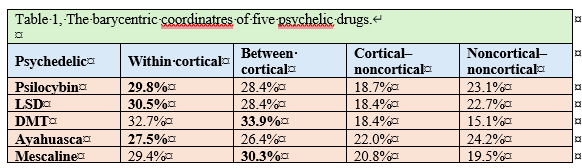
These percentages should not be interpreted as “30% of the brain is doing X.” They are normalized relational weights derived for this preliminary Dynamic-BCT analysis.
Their importance lies in the pattern among them.
And an interesting pattern immediately emerged.
4. Psilocybin and LSD Nearly Coincide
The barycentric positions of psilocybin and LSD are remarkably similar.
For psilocybin: (0.298,0.284,0.187,0.231)
and for LSD:(0.305,0.284,0.184,0.227).
Their separation in this normalized four-coordinate space is only about
In other words, after a large brain-connectivity matrix has been compressed into just four relational coordinates, psilocybin and LSD still land almost on top of one another.
This is important because the original neuroimaging study independently reported strong similarity between the connectivity effects of psilocybin and LSD.
The Dynamic BCT did not erase that biological relationship.
It preserved it.
That is an encouraging result for such a drastic dimensional reduction.
5. DMT Moves Somewhere Else
DMT occupies a substantially different region of the tetrahedron.
Its strongest relative component is
between-network cortical reorganization,
at approximately 33.9%.
At the same time, its noncortical–noncortical component falls to approximately 15.1%.
Geometrically, we can imagine the mobile fifth point moving toward the between-network cortical vertex and away from the noncortical–noncortical vertex.
This is a very different way of looking at a psychedelic state.
Instead of saying merely,
“DMT changes brain connectivity,”
we can say:
DMT moves the brain toward a particular region of relational organizational space.
The published study likewise found especially pronounced DMT-related changes involving coupling among large-scale networks, although the smaller DMT dataset means that such comparisons require caution.
6. And Then There Is Ayahuasca
Ayahuasca is particularly intriguing.
Chemically, ayahuasca produces psychedelic effects partly through DMT. One might therefore expect its brain-connectivity signature simply to resemble DMT.
It does not.
In our barycentric representation, ayahuasca shifts relatively toward the cortical–noncortical and noncortical–noncortical components:
Its position is clearly different from that of DMT:
The original investigators similarly described the ayahuasca connectivity pattern as relatively idiosyncratic compared with the other psychedelics. Again, caution is especially important because the ayahuasca sample was small.
Nevertheless, the result illustrates why relational geometry could be useful.
DMT and ayahuasca need not simply be labeled “similar” or “different.”
Their differences become geometric displacement within an organizational space.
7. From a Brain Matrix to a Moving Point
This is perhaps the simplest way to understand what the Dynamic BCT accomplishes.
A conventional connectivity analysis gives us a large matrix containing many pairwise relationships among brain regions or networks.
The Dynamic BCT asks whether some of that complexity can be represented by a much smaller relational vector:
That vector determines the position of the mobile point.
Consequently:
Each psychedelic state becomes a geometrical location.
Psilocybin occupies one location.
LSD occupies an almost identical location.
DMT occupies another.
Ayahuasca another.
Mescaline another.
The geometry therefore becomes a compact map of brain organization.
8. But the Real Goal Is Movement
The present analysis uses drug-averaged connectivity matrices, so each psychedelic is represented essentially as a static point.
The deeper promise of the Dynamic BCT lies in the word Dynamic.
Imagine measuring the brain repeatedly as a psychedelic experience unfolds.
Then we would have
The fifth point would literally travel through the tetrahedron.
At baseline it might occupy position .
As the psychedelic takes effect, it might move through
As ordinary consciousness returns, it might follow another trajectory.
The result would be something rather different from an ordinary brain scan:
a geometrical trajectory of changing brain organization.
9. This Is Not Yet Gnergonic Space
An important distinction must be made.
The four coordinates in this first experiment all come from functional-connectivity data.
They therefore constitute a Connectomic Dynamic BCT.
My broader hypothesis proposes something more ambitious.
I have suggested that the four vertices of a Gnergonic Dynamic BCT [5] might represent:
Those four dimensions would require independent operational measurements.
For example, Energy might be estimated from metabolic or physiological variables; Matter from pharmacological variables such as drug concentration or receptor occupancy; Information from connectivity and information-theoretic measurements; and Consciousness from carefully structured first-person reports.
After appropriate normalization, an individual’s state could again be represented by barycentric coordinates:
with
That would constitute a genuine quantitative Gnergonic Space.
10. Where First-Person Experience Enters Science
This fourth coordinate—Consciousness—is especially important.
A brain scanner cannot tell us completely what an individual experiences.
Consider two people whose brain images look similar.
One reports:
“I saw rapidly changing geometric patterns.”
Another reports:
“I felt that my individual self disappeared and I became part of a larger reality.”
Those experiences matter scientifically if our object of study is consciousness.
Therefore the proposed Gnergonic experiment would combine two kinds of evidence:
third-person measurements from neurobiology
and
first-person measurements from phenomenology.
Neither replaces the other.
Their relationship becomes part of the geometry.
11. A Much Stronger Experiment
This leads to what I think is the most important test of the entire proposal.
Suppose people enter profound altered states through very different routes:
psilocybin,
DMT,
meditation,
music,
religious experience,
or spontaneous mystical experience.
Their pharmacology and physiology may differ substantially.
But suppose individuals reporting similar experiences repeatedly travel through similar regions of Gnergonic Space.
Even more interestingly, suppose their trajectories converge:
If independent laboratories reproduced such a trajectory, we would have discovered something remarkable:
an organizational invariant of conscious experience.
That would be much stronger than showing that one drug activates one brain network.
It would suggest that physically different pathways can converge upon a common organizational state.
12. What About Spirit?
Here scientific caution becomes especially important.
I have proposed the possibility that Gnergonic Space itself may be a lower-dimensional manifestation of a deeper Gnergitonic Space, associated in my terminology with Spirit.
The analogy is geometrical.
A four-dimensional 5-cell cannot be completely seen in three dimensions. We can study only representations or projections of it.
Likewise, if a deeper organizational domain exists, perhaps it cannot be measured directly.
Its consequences might nevertheless appear as reproducible organization within observable psychophysical states.
Thus:
But the arrows represent a hypothesis, not an experimental result.
The present psychedelic analysis does not demonstrate Spirit, Gnergitons, or a higher-dimensional reality.
What it demonstrates is something much more modest—and scientifically more important at this stage:
The Dynamic BCT can be given quantitative coordinates and applied to real neuroimaging data.
13. From Metaphor to Model
This distinction matters greatly to me.
When I first conceived of the Dynamic BCT, it functioned primarily as a geometric metaphor.
Four vertices remained fixed.
A fifth vertex moved.
That seemed capable of representing relational organization.
But a scientific model must eventually confront numbers.
With the psychedelic connectivity data, we have taken a first small step across that boundary.
We began with experimentally measured brain relationships.
We reduced them to four defined quantities.
We normalized those quantities into barycentric coordinates.
And the resulting positions preserved meaningful features of the original neuroscience—most strikingly, the very close relationship between psilocybin and LSD and the distinctive positions of DMT and ayahuasca.
That does not validate the entire theory.
But it demonstrates that the geometry is computable.
And computability is where metaphor can begin becoming science.
14. A New Kind of Brain Map?
Conventional neuroscience maps activity onto anatomical space.
Perhaps a complementary neuroscience could map organization onto relational space.
The first tells us:
Where is something happening?
The second asks:
What organizational state is the brain entering?
These questions need not compete.
A future experiment could potentially assign every conscious event two descriptions:
The external description belongs to conventional spacetime-based neuroscience.
The internal description could potentially be represented through simplicial barycentric geometry.
One gives us a map of the brain.
The other may eventually give us a map of the brain’s changing organization.
15. The Fifth Point Has Begun to Move
There is a long distance between this preliminary calculation and a validated theory of consciousness.
The analysis must be independently checked. Alternative definitions of the four vertices should be tested. Individual-level and time-resolved data are needed. Statistical uncertainty must be incorporated. And, most importantly, the resulting geometry must predict something that conventional analyses do not already predict.
But something significant has nevertheless happened.
The Dynamic BCT no longer has to remain only a drawing.
Its moving fifth point can be assigned numbers derived from experimental brain data.
Five psychedelic states can already be placed at five different locations in the tetrahedron.
And those locations retain recognizable relationships present in the original neuroscience.
The next experiment is therefore clear.
We need to measure Energy, Matter, Information, and Consciousness simultaneously in the same individuals, follow their changing barycentric coordinates through time, and ask whether particular forms of conscious experience correspond to reproducible trajectories through Gnergonic Space.
If they do, the question will no longer be merely:
What does the psychedelic brain look like?
A deeper question becomes experimentally approachable:
Is there a geometry of conscious organization—and can we measure its transformations?
That is a question on which geometry, neuroscience, and first-person human experience may finally be able to meet.
References:
[1] Ji, S. (2026). A Geometric Worldview Integrating Modern Physics, Biology, and Jungian Synchronicity https://622622.substack.com/p/a-geometric-worldview-integrating
[2] Ji, S. (2026). Beyond Geometry: Could Dynamic Body-Centered Tetrahedron Model Relationships Rather Than Objects? https:/622622.substack.com/p/beyond-geometry-could-the-dynamic
[3] Manesh Girn, Manoj K. Doss, Leor Roseman, et al. (2026).An international mega-analysis of psychedelic drug effects on brain circuit function. Nature Medicinevolume 32, pages1543–1554
[4] Barycentric coordinatesystem. https://en.wikipedia.org/wiki/Barycentric_coordinate_system
[5] Ji, S. (2026). From Gnergons to Gnergitons: A Metaphorical S4 to S5 ransition
https://622622substack.com
No posts
Comments
Nothing yet. Say the first thing.
Sign in to join the conversation.